Welcome to the Mindfulness Meditation podcast.
I'm your host,
Dawn Eshelman.
Every Wednesday at the Rubin Museum of Art in Chelsea,
We present a meditation session led by a prominent meditation teacher from the New York area.
This podcast is a recording of our weekly practice.
If you would like to join us in person,
Please visit our website at rubinmuseum.
Org slash meditation.
We are proud to be partnering with Sharon Salzberg and teachers from the New York Insight Meditation Center.
In the description for each episode,
You will find information about the theme for that week's session,
Including an image of a related artwork chosen from the Rubin Museum's permanent collection.
And now,
Please enjoy your practice.
Good afternoon.
How are you all doing today?
Good.
Great to have you here.
Welcome to our weekly meditation practice together.
My name is Dawn Eshelman.
Great to have all of you here on a beautiful day.
And if you've been coming for a while here,
You know that we're having a year-long conversation all about power.
The power within us,
The power between us,
The nature of power,
Power with as opposed to power over.
And this month in our mindfulness meditation series,
We're talking about empowerment.
We've been talking about it mostly from a perspective of kind of a general or more secular concept and how that translates into a feeling of empowerment when we meditate.
But all along,
I've kind of been seeding you with this idea that,
Of course,
This concept of empowerment and the term empowerment has a very specific meaning and role in Tibetan Buddhism.
And so today,
We get to learn a little bit more about that with Lama Arya Dronma.
I will just repeat that an empowerment is a way to progress through your spiritual practice if you are a Buddhist.
And that is through a relationship with your teacher.
And so today,
We're looking at this beautiful image of a teacher,
Not just any teacher,
A very special teacher.
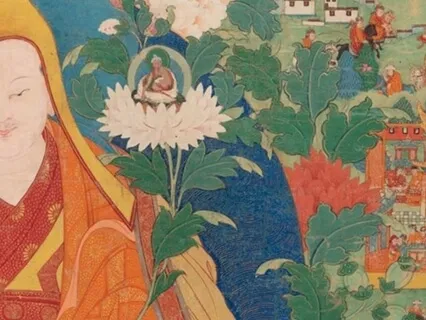
This is the fifth Dalai Lama.
And the Sangha is called scenes from the life of the fifth Dalai Lama.
It is from Tibet,
18th century.
And there's so much going on in this.
I'm going to just talk mostly about the main figure.
But as you can see,
It is a narrative painting.
So there are scenes from the Dalai Lama's life that are kind of illustrated all around him here,
Sort of like a photo album or a storyboard if we were to make a film of his life,
Right?
So you can take a walk up to,
Or an elevator if you prefer,
Up to the sixth floor with Jeremy afterwards.
And he'll tell you a little bit more of the detail of what is conveyed in this painting.
But we'll focus on the main figure,
The Dalai Lama,
This very important teacher,
Often known simply as the great fifth,
Really because he was just very,
Very political,
Had a lot of political prowess and religious importance,
And was renowned for unifying Tibet in 1642,
And was really integral to the creation of that Tibetan kind of national identity that really had a strong relationship to this model of the Lama and the Dalai Lama.
So the metaphor here for us today is not only that he was a great teacher,
And we can all think of some meaningful teachers in our own lives,
Religious or otherwise,
And perhaps empowerments that they gave to us,
Intentionally or not.
And again,
That concept of empowerment is integral to the relational aspect of the teacher and student,
But really that teacher is taking the point of view of reminding us of the knowledge that we already have within.
So again,
Lama Arya Dronma is back with us today.
It's so great to have you here.
She's studied and practiced Tibetan Buddhism for over 10 years.
She's trained in the Dharma Path program,
A progressive stages of meditation and contemplation for serious practitioners offered by Kagyu Thubten Choling Monastery.
And she's a graduate of the traditional Buddhist retreat of three years and three months.
She's a graduate of Mumbai University with a BA in sociology and is trained in computer programming from NIIT India.
And she actively volunteers as a fundraiser for breast cancer research and supports several nonprofit organizations.
Please welcome her back,
Lama Arya Dronma.
Hello and welcome everyone.
Thank you all for coming in today.
I'm so happy to be here with you all.
And thank you Dawn for the lovely introduction.
I see a few newcomers here.
Wonderful to have you all here.
Welcome.
I'm going to show you the session is going to be mindfulness meditation session is going to be very easy to follow.
And then we have Q&A.
And so feel free if you have any questions or any thoughts to share during the Q&A.
And so today's artwork is the image with scenes from the life of the fifth Dalai Lama.
So we all know the current Dalai Lama.
He is he's got millions of followers all around the world.
And he's also a Nobel Peace Prize winner of in 1989.
And I don't know if all if any of you know that he's the 14th Dalai Lama.
And there has been 13 previous incarnations before him.
And the first Dalai Lama was born in 1391.
And they're all believed to be the incarnations of Avalotkiteshwara,
Chenrezig,
The Bodhisattva of compassion.
And the Dalai Lama comes from the unbroken lineage tradition.
Like in ancient Tibet,
There were several hundred kingdoms and tribes which had its own kings and chieftains.
And basically,
Dalai Lama was a person entrusted as a spiritual leader of the country,
Kind of a national protector,
Who was like a peacemaker between hundreds of kingdom and tribes in Tibet.
So the Dalai Lamas were very important spiritual figures for many reasons,
For many,
Many reasons,
And especially the fifth Dalai Lama.
His name was Ngawang Lobtsang Jatso in the 17th century,
And was symbolic for the unification of the state of Tibet.
And he was also a national protector for holding the highest Buddhist value and traditions.
Likewise,
Today,
We have a very special day in the Tibetan tradition.
It is also the birthday of Jarlvang Karmapa the 17th,
Also from unbroken lineage tradition.
There have been 16 Karmapas before that.
And so today is his birthday,
And we're having special celebrations in the monastery.
And again,
This is in reference to Dalai Lamas being the incarnations,
Having 13 incarnations,
And Karmapa,
Who's very,
Very well known,
He's also got millions of followers,
He turns 34 today.
So I want to say Karmapa Chenno means acknowledging Karmapa.
So there are many master teachers who are incarnations,
Meaning that when one passes away,
There will be another person who is kind of like chosen,
Like a reincarnation.
But when I did ask my teacher exactly,
Am I going to be dead,
And then I'll come back as somebody,
And my teacher said,
No,
It's not as simple as that.
Apparently,
There was another great master,
And when he passed away,
There were five emanations born out of his death,
Which meant one had the mental activities,
One had the speech activities,
One had the intellect activity.
So there were many emanations,
Like five apparently,
But all his emanation in the next rebirth.
So it's not as simple as it sounds,
You die and then you're born with these highly realized teachers,
But when it comes to Dalai Lama,
To simplify,
There were 13 incarnations.
With Karmapa,
There were 16 incarnations before the current one.
And then we come back to the image,
Where in this image to the right of the Dalai Lama,
There's a scene of ritual empowerment.
And even when you see his hand,
There's a bell and a doje.
It's these ritual implements when they give empowerment,
They hold that being,
It's something solid,
A bell and a vajra,
And it holds the truth,
The wisdom,
And that's what it's symbolic.
And there are many others,
It signifies other symbolic esoteric ways too.
And the theme of the month is empowerment,
But what does empowerment mean in the Buddhist tradition?
Empowerment is a grand ceremony conducted by a master teacher from an unbroken lineage.
So Dalai Lama's lineage tradition would be something unbroken in the sense they can trace it back all the way to the Buddhas.
And that is why they also,
It's very important for the incarnations,
The previous incarnations.
So it's a grand ceremony from an unbroken lineage.
And in the Buddhist tradition,
It means a practitioner,
All of you all would be a practitioner,
Is allowed permission to learn specific meditation practice from a qualified authentic teacher,
A realized teacher.
So during this grand ceremony,
The master teacher recites the specific sacred text accompanied with all the ritual instrument.
He also uses certain symbolic objects to touch the practitioner's head,
To show the individual that they have received the transmissions.
And only then a practitioner can specifically practice certain meditation practice.
For example,
You or I may read a book and say,
Oh my God,
I have all this written in this text.
And I'm interested in doing this high practice.
And I can do so.
It's all in the text.
But the answer is no.
You need an initiation from a highly realized master,
From a master which has an unbroken lineage.
And I wondered why is it so,
Why the monopoly?
But I think it was because they wanted the teachings to be authentic,
Passed on,
Authentic teachings.
They wanted to keep it as they have received it.
So when you go to most of these traditional Tibetan teachings,
The master often reads from the text.
And one of my teachers would also say,
If he added something from his own thoughts,
He would say so.
You know,
These are what I'm sharing from my own thoughts,
But they always read from the text.
So the student will get the authentic teachings.
And that's why I'm very grateful to have these authentic teachings.
And I love sharing it with you all as well.
So having received such an empowerment,
It is essential to maintain the commitments.
And so even as a student,
I have a commitment.
You know,
When the teacher gives you these authentic teachings,
There are certain practices one should continue doing.
And it's very,
Very disciplined.
So that is called Samaya,
Meaning that we don't break that commitment that we have both had during the empowerment,
You know,
The commitment of doing the practice.
So when I went to do my three and a half year retreat program in the monastery,
I and there were many other students as well,
Our teacher,
Our master teacher took us all the way to India,
So we could get all the empowerment from his eminence Thay Sitarampuche who lives in Bheer in Himachal Pradesh.
And he's got this most beautiful monastery.
It's in Bheer and I think there are about 500,
600 monks who live there,
You know,
Students from little monks,
All of them studying many things,
Math and astrology and traditional text.
And so we went there especially to get empowerment for all the practices that we do in the three and a half year retreat.
So we stayed there for like three weeks.
And the practice was every day,
We would go into the temple,
The monastery,
And they would be all the monks,
About 500,
600 monks and all the lay people.
And first they would have oral,
Thay Sitarampuche,
The master teacher would do an oral reading of the whole text which are sometimes really,
Really thick.
And then there would be a lot of rituals.
And we would offer something called thormas,
Means offering to all the deities.
So we will not have any obstacles during that path.
The obstacles are our own mental afflictions,
Laziness,
You know,
Somehow not able to do these high practices even though we got.
So this is very,
Very methodical.
And for three weeks,
We are in reverence,
Sometimes we fast and there's a lot of praying.
So all the teachings,
Authentic teachings are passed on to us from master to student.
And why is the master so important?
The master teacher is very,
Very important.
It's almost like,
It's like in reference to a boat that takes you across the river,
You know,
You need a boat.
So you need a master of unbroken lineage.
So that's why the master teachers are very,
Very important.
So like I mentioned,
We spent three weeks there receiving all the teachings.
And then when we came back here to New York,
That's where the monastery is,
We had our own master teacher,
Who then having those oral instructions will also give us commentaries about the practice and how to do the practice.
So each practice is one month and then on top of that,
There's another higher practice and it goes on.
And eventually,
All these practices lead to one thing,
It is to understand the nature of your mind.
Right now,
It's your mind that leads to all the pain,
The anxiety,
The fear,
And the hatred,
And the jealousy.
Everything comes from your own mind.
And it is to know this nature,
This magnificent mind we have,
Which we know very little of.
And what we call it is,
We literally calling transforming our mind.
This is what it is.
We know very well to do so many exercises for our bodies,
But we do very,
Very little with our mind.
And a mind just takes you everywhere.
And the mind is the most important thing in the tradition to know its nature,
To know how it acts,
And to finally attain enlightenment through these practices.
So that's the goal.
And so today,
Coming back to the mindfulness practice,
I would like to do a formal mindfulness meditation practice we do in the monastery because today is a very,
Very auspicious day.
And this is very beneficial.
My teacher would say,
What good is any spiritual practice if it is not able to give immediate benefit when you want instant relief,
When you're stressed,
Upset,
Or you have anxiety or depression.
And I find this following meditation technique very,
Very helpful.
And I will explain soon.
And Buddha was once asked,
What have you gained from mindfulness meditation?
And he replied,
Nothing.
And everybody was like,
Oh,
Why am I here?
However,
Buddha said,
Let me tell you what I lost.
I lost anger,
Anxiety,
Depression,
Fear of old age,
And death.
These are all our fears.
And I think this is very,
Very well said.
So lately,
I've been speaking to a lot of students,
And most of them have been saying that they are really having a lot of anxiety,
The situation with the present situation,
Probably with the government,
With all these things that's happening,
And everybody feels a lot of anxiety,
And the mind is constantly thinking.
And I've had a lot of thought.
And I said,
I always want to come here and simplify meditation.
And I said,
When somebody is having these anxiety and constant thoughts,
I want to give you all mindfulness meditation.
That's something that you can do anywhere.
And one other thing I want to introduce,
I have done this before in a different class,
But I want to introduce a mantra.
So when you're having these constant chatter,
Constant thoughts,
Which makes you very anxious and which gets you thinking,
This mantra,
You can immediately say that to calm yourself.
So it goes with your breath,
And I will teach you how the technique is.
So when we start the mindfulness practice,
There are two essential points,
Which is in this tradition,
Which is in the Tibetan tradition.
I'm teaching you what I have learned from the tradition.
There are different meditation techniques,
And all these techniques help,
But the technique I'm teaching you is what I learned.
So there are two essential points when you do the mindfulness.
The first is your body posture.
So when we do this,
There are seven points of body posture,
Which is very,
Very important in our tradition.
And you can write volumes of books on this posture itself.
And the posture was given to us by this Buddha called Vairocana,
And Vairocana means illuminating.
So you can see by the word itself how important the posture is.
And I will go over the seven traditional postures,
But it's also important for you to be comfortable.
Each body is different,
So you can adjust to what feels comfortable to you.
You know the body posture,
It has to be comfortable if you have back aches or if you have any other aches,
Just adjust your body to it.
But slowly,
Slowly you can learn how to have your back straight.
So if all of you are sitting on the chair,
Fantastic.
Just keep your back straight.
And if anyone wants to move a little forward,
Not resting on your back seat,
That will be fine as well.
Keep your feet parallel on the ground.
It's best not to keep it crossed.
Keep your legs parallel because it stabilizes you.
And eventually it will be so easy to do this for an hour or so.
However,
Not recommended,
Short meditations are even much better.
So back straight and your legs are parallel on the ground.
And then we come to our shoulders.
We all love to slouch a little bit,
But we'll square our shoulders if we can.
And this wakes you up.
And also it grounds you.
You're sitting,
You're seated properly,
And the shoulders are square.
So it just grounds you.
And what we do with our hands,
We put our hands out there and we can put it on our knees wherever it falls.
Or take your hands,
Right hand or your left,
And touching the thumb.
You'll see this posture in a lot of Buddhist pictures.
So you can just.
.
.
Buddha's hands are like this.
It's called equipoise.
And you can put it on your lap.
Whatever feels right to you.
And now your head,
Your neck is slightly tilted and your gaze is somewhere.
.
.
Just look from the tip of your nose wherever it falls on the floor.
Just leave it gently there.
You're not studying anything.
And it has to also be peripheral,
Meaning as you gaze there,
You can see all this around you.
So it's gentle gaze.
And your lips are resting naturally.
Your tongue should be touching your upper palate.
And your eyes are slightly open.
So for those of you all who want to keep your eyes closed,
It's perfectly fine.
But learn to keep your eyes slightly open because all your senses are open.
And they're.
.
.
But they're unengaged.
So now the essential point of your mind.
We now turn our attention from our body to our mind because it's the mind that actually does the meditation.
Your mind should be relaxed.
And in the present moment of awareness,
Meaning you may be sitting here,
But you probably are thinking what's happening at home or your office or your list to do.
So bring your mind's attention to your body.
Your mind needs an anchor,
Otherwise it's jumping all over the place.
So today we're going to give the mind an anchor,
Which is your breath,
Following your breath,
Gently breathing,
Breathing normally.
So your mind's attention will be following your breath.
The reason the mind needs a focus or an anchor is so the mind does not keep wandering away,
Jumping from one thought to another.
So when the mind has something to focus,
The mind can gradually become still.
So for today's meditation,
Mindfulness meditation session,
We will focus our mind's attention on a breath combined with the mantra OM AH HUM,
Which is O-M-O-M-A-H-A-H-U-M.
What is a mantra?
It has different meanings,
But to simplify,
It's just a word or sound repeated to aid concentration in meditation.
So I will explain how it's done.
To start,
Let's all sit up straight and put your mind's attention on your breath,
Letting the breath be just as it is without trying to change or regulate it in any way,
Allowing it to flow easily and naturally with its own rhythm and pace.
So let's do that.
Let's just take a couple of breaths.
There was a class when they said,
We don't know how to feel our breath.
So just feel the breath.
You can do that a little bit where you can feel your breath.
Breathe in and breathe out.
So sit still,
Feel how it feels to sit still.
And then you can also breathe,
Inhale and exhale.
Breathe naturally,
Breathe normally.
And now we can combine the mantra,
Om Ah Hong,
With your breath like so.
When we breathe in,
Mentally recite,
Om in silence,
Mentally recite.
When we breathe in,
Mentally recite Om.
When your breath is inside the body,
Mentally recite Ah,
Which is A-H.
And as you breathe out,
Just recite,
Om,
H-U-M.
And all this is mentally recited.
And also note,
As you breathe out,
Let your breath pervade the entire space in front of you.
And then just rest in that present moment of awareness.
So we'll have short sessions.
And I'll guide you through this.
Relax.
As you breathe in,
Mentally recite,
Om.
And when the air is inside the body,
There's a gap.
Mentally recite Ah.
And as you breathe out,
Mentally recite,
Om.
And this is all done effortlessly.
It'll be something like breathing in,
Om,
There's a slight gap,
Ah.
And then when you breathe out,
Om.
Om Ah Hong.
And however your breath is,
Just integrate this.
Om Ah Hong.
And as you breathe out,
Let your breath fill the entire space in front of you.
Just rest in that present moment of awareness,
Putting all your attention on your breath and the mantra,
Om Ah Hong.
Anytime you start thinking,
Any thoughts,
Just say thinking,
Then drop it,
Let it go.
Don't engage in it.
And bring your mind's attention back to your breath and make it one pointedly,
All your concentration gently on your breath.
Inhale with Om Ah Hong as you breathe out,
According to your own rhythm.
It doesn't matter how many times your mind goes away to your thoughts.
As soon as you catch yourself thinking,
Just say thinking,
Acknowledge it,
Don't push your thoughts and then bring your mind's attention back to your breath.
Each time try to give more concentration on your breath,
Your full undivided attention to your breath.
Om Ah Hong.
Do not follow the past,
The past is finished.
Do not follow the future,
The future is not here.
So come back to the present moment,
Putting your attention on your breath with Om Ah Hong.
Relax a little bit now.
So you can stretch a little bit like this.
Feel free to move a little bit if you feel like coughing or clearing your throat,
It's totally alright during meditation.
And then for those of us who are just listening to someone,
Just think of all the sound as mantras as well.
So the reason I'm introducing you to this Om Ah Hong is when you have these constant thoughts,
So when I am in the monastery and there's a little stupa,
Like a temple,
I go around and I do this mantra with my beat.
I say Om Ah Hong,
That's one,
Om Ah Hong.
So when I have constant thoughts or something is happening,
Something is bothering me and I can't just sit and meditate because then the thoughts are coming to me.
So this is what you do.
You just say Om Ah Hong.
So Om is when you inhale and there's a little gap between your inhalation and your exhalation.
So that's when you do Ah and do your own rhythm and then Hum,
Which is H-O-M.
So all of you all can do Om Ah Hum loudly,
Verbally.
Om Ah Hum,
Om Ah Hum,
Om Ah Hum.
So now when you inhale,
You do Om,
Between the inhalation and exhalation there's a gap.
That's when you do Ah and then Hum and you're doing it absolutely right.
There's another gap when you inhale.
So that's very,
Very subtle.
So just giving you these thoughts for some of these thoughts I'm sharing with you all.
So why did I introduce you to Om Ah Hum again?
When you have a lot of things going on mentally,
You know,
You don't have to keep a long bead like this.
You can have a bracelet,
You know,
Where you have these little beads and then you can use that as well.
So you're using your breath,
You're using the mantra and you're using a touch.
So putting all that will immediately calm you.
And Om Ah Hum is very,
Very significant.
There's no translation at all.
But what it means is Om is body,
Mind,
Body,
Speech.
Om is body,
It's considered body here,
Speech and mind.
And when we are practicing,
As we get higher in our practices,
We even visualize Om Ah Hum,
The Tibetan,
Of course in the Tibetan letter,
We visualize that because it takes away all your obstacles of your mind,
Speech,
Body,
Mind and speech.
It takes out.
So these are also very powerful.
But for to just keep it simple,
Just,
You know,
It's good to concentrate on these three letters,
Om Ah Hum,
And it'll calm you.
And this is a practice,
You know,
You just can't do it one time and say get results.
It's something you do all the time.
It's training your mind.
That's what we do.
Thank you.
That concludes this week's practice.
If you'd like to attend in person,
Please check out our website,
Rubinmuseum.
Org slash meditation to learn more sessions are free to Reuben museum members,
Just one of the many benefits of membership.
Thank you for listening.
Have a mindful day.