Welcome to the mindfulness meditation podcast.
I'm your host,
Dawn Eshelman.
Every Wednesday at the Rubin Museum of Art in Chelsea,
We present a meditation session led by a prominent meditation teacher from the New York area.
This podcast is a recording of our weekly practice.
If you would like to join us in person,
Please visit our website at rubinmuseum.
Org slash meditation.
We are proud to be partnering with Sharon Salzberg and the teachers from the New York Insight Meditation Center.
In the description for each episode,
You will find information about the theme for that week's session,
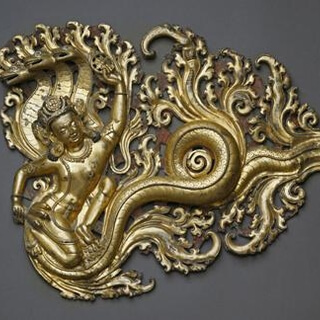
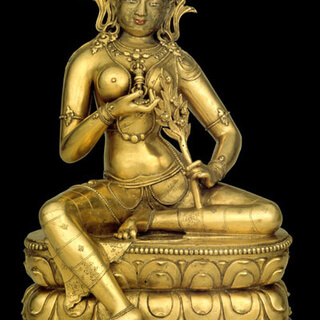
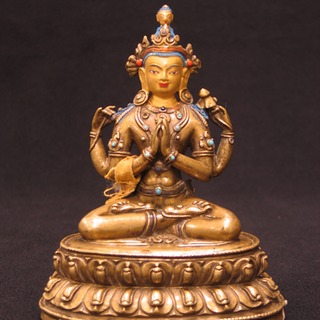
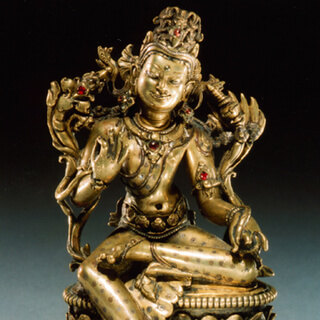
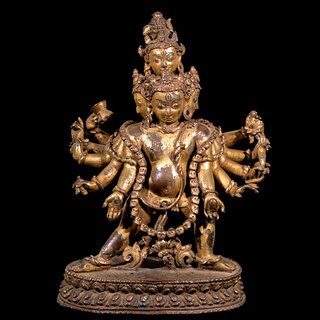
Including an image of a related artwork chosen from the Rubin Museum's permanent collection.
And now please enjoy your practice.
Hello.
Welcome to a month of mantra.
We're talking about mantra all month in our mindfulness meditation practice here.
And we're kicking off with the essential mantra,
OM.
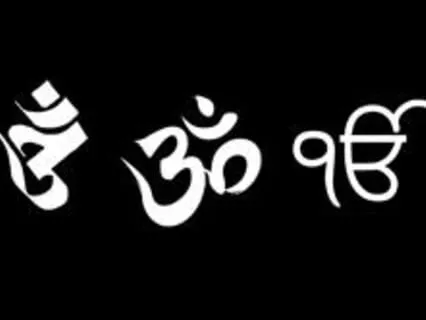
And you see OM depicted here behind me in a few different languages.
The first on the left is Jain,
And then we have Japanese,
Sanskrit,
Sikh,
And Tibetan.
And OM is the essential mantra,
As I mentioned.
It's also known as a seed syllable.
And it is often used on its own as a mantra or to kick off other mantras.
And the reason for that is that OM is considered to be the most powerful and potent.
And all mantras develop from OM within these traditions here.
OM is a little bit hard to talk about because the power of OM is really in experiencing the sound of OM and in making the sound.
So definitions vary from tradition to tradition.
But in the ancient Indian Vedic tradition,
OM is thought to be the sound of the creation of the universe.
It is thought to encompass the totality of everything in existence.
And it is thought to represent what is thought of as the unstruck sound.
So if you clap your hands,
That sound is a struck sound.
It sort of takes the sound that is primordial and existing already and brings it into being.
And OM is the sound of the sound that is already existing within the cosmos,
Within each of us.
So we'll back up just a little bit and talk about this concept of mantra.
And mantra,
As we'll be exploring throughout the month,
Is the sound of a potent syllable or phrase that is spoken and that is meant to be repeated in order to bring the speaker into a focus and into a higher realm of awareness for spiritual practice and sometimes for meditation.
And we can also think about mantra as kind of a more conceptual.
I think there is a more conceptual way into thinking about it.
So you can think about what are the conscious and unconscious mantras that you have in your secular lives as well?
And what are the mantras that you want to really put out there into your daily life?
And what are maybe some of the more subconscious kind of mantras that are being repeated that actually you want to become aware of and let go of?
So I think that this concept of mantra we can think of really as kind of a playful exploration of how it is that we talk to ourselves and what it is we want to be saying.
So Tracy Cochran is back with us and I'm so glad she's here to kick off this month of mantra and then also she'll be here at the end of the month to wrap it up with us.
She is a writer and editorial director of the quarterly magazine Parabola,
Which can be found online at parabola.
Org and also up in the shop.
And it's a beautiful poetic soulful publication.
If you haven't had a chance to take a look,
Please do.
She has been a student of meditation and other spiritual practices for decades.
In addition to teaching at the Rubin,
She teaches at the New York Insight Meditation Center and every Thursday and Sunday at Tarrytown Insight.
Her writings and teachings can be found online and along with her teaching schedule via Parabola on Facebook and Twitter and TracyCochran.
Org.
Please welcome her back,
Tracy Cochran.
Well,
I'm delighted to be back here.
I was daunted at first when I got to kick off mantra because I have a voice that reminds me of a story a monk told me where a famous teacher Ajahn Chah told him that there was a donkey that always tried to sing like a cricket.
So he would drink this nectar because that's what he thought the trick was and then open his mouth.
But of course,
It doesn't matter how we sound.
We all have our own sound outwardly and also inwardly.
And this is a very special place where we get to sit down and open to unknown things,
All of us,
To explore them ourselves.
So I thought of two little examples.
One happened to me last night.
I woke up at two in the morning.
I don't know if this has ever happened to you.
I had insomnia and I found my thoughts circling and circling.
Have you ever had that?
Again,
You don't really know what you're worried about,
But there must be something.
So you search for something because there's this edge of anxiety.
And then it occurred to me to repeat the phrases of metta,
Which is a practice in this tradition.
May I be safe?
May I be well?
May I be happy?
So this is a mantra in English.
And the meaning of mantra,
One of the definitions from its root is mind protection.
Mind protection.
And it means it lifts us out of that self-enclosed little loop of thought and reminds us that we're in a bigger world.
So I was soothed and I went back to sleep.
And I thought it was a story that was once shared in parabola,
In fact,
About great mantras.
How do we approach them if we didn't grow up with them like Aum?
Think of a time when you were lost,
A little kid lost in the woods.
Or just imagine it.
And you begin to feel anxious.
Will I ever,
Ever find my way home?
And you hear a sound.
And it's familiar to you.
You might not have heard it before,
But it feels familiar.
And you have images of what it's like inside your home.
Let's say there are fairy tale images with fire crackling away and loved ones smiling at you.
So you go towards the sound.
This is mantra.
This is Aum.
Aum is the symbol Aum was found in a book that is arguably the oldest book in the world,
The Rig Veda.
Veda means sacred knowledge.
But according to one of my teachers,
Bikkhu Bodhi,
It also means knowledge that you feel.
You don't just think.
Veda.
So that Aum is something you feel inside.
And I gave myself and I give you complete permission to think of it as Aum.
Aum.
Aum.
So it was written as a symbol,
A sacred syllable,
3,
000 years ago.
But it existed before that.
People have been wanting to come home.
You walk into this room.
If you're anything like me,
A lot of times you feel like a brain on a stick.
Am I right?
Just this frantic brain on a stick.
Really.
And you sit down and you might not even know why you come exactly.
And you might have misgivings.
You can barely squeeze it in.
But as you sit down,
You begin to remember you're more than a brain on a stick.
There's an awareness in you that's not thinking.
And there's also a vibration,
A sound.
And it doesn't have to be a sound that you make,
Although I encourage you to try in a few minutes,
Because if I can do it,
You can also do it.
It's a shift from feeling alone in the universe to living,
Taking your part in a greater wholeness,
In a world full of vibrations,
Opening to vibrations.
Just like I did last night in the midst of my insomnia,
When remember mantras,
Sanskrit has a special quality of being created to represent sounds.
But mantras exist in every single language,
Including your own.
There are Christian monks who repeat the mantra,
Lord have mercy,
Until it's just a vibration.
They go about their work.
They cut wood.
They carry water.
Chanting,
Lord have mercy,
Or just mercy.
Or sometimes you find yourself just saying,
Help.
It's the same impulse to attune yourself to another vibration,
To emerge into a greater wholeness.
So Aum,
Aum is special.
And in a way,
All of the Upanishads,
All of the ancient texts are hymns to Aum,
Because it's an expression of creation and the creator,
But also Aum,
Also our innermost connection to this creation.
That we have a home here.
We're meant to be here.
We're welcome here.
So as Don said,
It's very difficult to talk about.
So I thought that,
And Don thought,
That it would be nice if we try something together that's called a rolling Aum.
I really kind of love that sound.
I'm going to put my mic down in a minute,
And we will all say Aum in our own way,
With our own breath,
In our own pitch.
And we're going to do that for a few minutes,
And then we will go into stillness,
Straight into the meditation.
Okay.
So let's have an experience together,
Because that's the way we're going to know.
And I'll ring the bell very gently after a little while.
And then that will be our signal together to go into stillness and to let that vibration sound in our sitting.
Okay.
So,
Aum.
Om.
Om.
Om.
Om.
Om.
Om.
Om.
Om.
Om.
Om.
Om.
Om.
Om.
Om.
Om.
Om.
Om.
Om.
Noticing that stillness is also vibration.
That the sensation inside the body is also vibration.
And that breathing in and breathing out,
We are in a sea of vibration.
Noticing that when we get taken,
We come home to the breathing,
To the body,
And take our seat in the world.
Noticing as we breathe in and breathe out,
We are in a state of exchange with life.
We are part of it,
Giving and receiving.
We are in a state of exchange with life.
We are in a state of exchange with life.
We are in a state of exchange with life.
We are in a state of exchange with life.
We are in a state of exchange with life.
We are in a state of exchange with life.
When we fall asleep or get carried away in thinking we come home without judgment,
Knowing we'll be welcome every time,
No judgment,
Back to the breath and the body and being here.
We are in a state of exchange with life.
We are in a state of exchange with life.
We are in a state of exchange with life.
We are in a state of exchange with life.
We are in a state of exchange with life.
We are in a state of exchange with life.
We are in a state of exchange with life.
Noticing that as we relax,
As we soften through this return,
We also open,
We expand,
We feel more part of life.
We are in a state of exchange with life.
We are in a state of exchange with life.
We are in a state of exchange with life.
We are in a state of exchange with life.
We are in a state of exchange with life.
We are in a state of exchange with life.
We are in a state of exchange with life.
We are in a state of exchange with life.
We are in a state of exchange with life.
We are in a state of exchange with life.
We are in a state of exchange with life.
Sati,
The Pali word for mindfulness,
Means to remember.
In stillness with others and chanting,
We begin to remember who we are,
That we're so much more than we think.
We are in a state of exchange with life.
We are in a state of exchange with life.
We are in a state of exchange with life.
We are in a state of exchange with life.