Welcome to the mindfulness meditation podcast.
I'm your host,
Dawn Eshelman.
Every Wednesday at the Rubin Museum of Art in Chelsea,
We present a meditation session led by a prominent meditation teacher from the New York area.
This podcast is a recording of our weekly practice.
If you would like to join us in person,
Please visit our website at rubinmuseum.
Org slash meditation.
We are proud to be partnering with Sharon Salzberg and the teachers from the interdependence project and the New York insight meditation center.
In the description for each episode,
You will find information about the theme for that week's session,
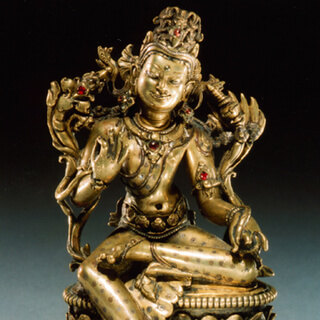
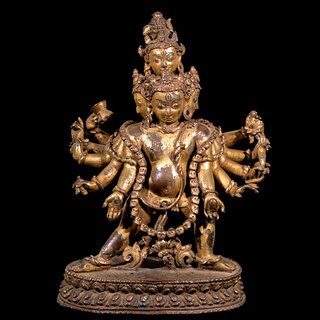
Including an image of a related artwork chosen from the Rubin Museum's permanent collection.
And now,
Please enjoy your practice.
Hi everyone.
Happy spring.
We made it,
Kind of.
We will,
We will.
Yes,
It is spring out there and it is,
There is something reassuring,
Certainly,
Of making it through a long winter and recognizing the pattern of the natural world around us and connecting with that.
We are talking about being whole this month and in doing that,
We are reflecting on another pattern in nature and this is the pattern of fractals.
So fractals are,
How many of you have been here for another session this month?
Many of you,
Great.
And how many of you have not?
Either are brand new or have just come after a little break.
So we are talking about fractals,
This pattern in nature that occurs in things like a snowflake or a fern or a flower that has multiple petals.
And a fractal is a never-ending pattern.
It is a geometric form that is self-similar across different scales,
So we are seeing this one element sort of repeat itself over and over in order to create the whole and is really infinitely complex.
And for our purposes,
We are looking at this as a kind of reminder of the interconnectedness between matter and of the part and the whole and the relationship,
The synergistic relationship between those two things.
And so today,
We are looking at a really interesting artwork from the fifth floor,
Nepalese Seasons,
Which is just about to close.
So if you have not seen it or you want to take one last look,
Please do so after the program today.
Jeremy will be right outside.
He can take you up to this object in particular so that you can learn a little bit more about it,
But also just so you can take the exhibition in one last time before it closes within the next week.
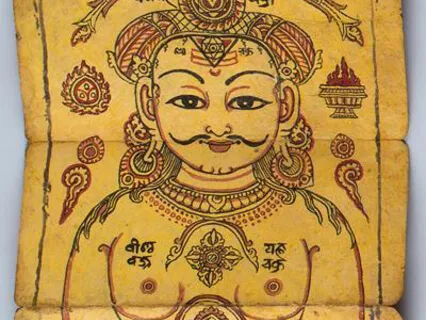
This is an 18th century Nepalese manuscript,
But the concept depicted here is ancient.
This is Purusha,
And according to the Vedas,
The gods sacrificed Purusha in order to create life throughout the universe.
And later,
This myth was reinterpreted by tantric traditions to relate the microcosm of the body to the macrocosm of the cosmos.
So that relationship even between the cellular and the galactic,
And here this representation of the interconnectedness between all things.
And on his torso,
Purusha's torso here,
Are various symbols marking the chakras of his body or the wheels of energy.
So we will get into this concept of being whole a little bit further with our wonderful teacher Sharon Salzberg,
Who's been with us throughout the month,
This month,
And it's been great to have her here for such a good concentrated period of time.
Sharon is the co-founder of the Insight Meditation Society of Barre,
Massachusetts,
And she is the author of many wonderful books,
Including Real Happiness at Work,
And I know she's just on the brink of her new book as well.
Maybe she'll tell us a little bit about it.
So please welcome back Sharon Salzberg.
Hi there.
I think he's so cute.
I don't know if you're allowed to say that.
I think he was just really disrespectful.
He's just really cute.
So going from the cellular to the galactic.
As many of you know,
When I teach meditation,
I'm really intrigued by that moment when we've already been distracted.
We've been lost,
We've floated away in a sea of thought,
Or we've fallen asleep,
And then we kind of come to,
We emerge,
And in that moment we realize,
Oh,
It's been quite some time since I last felt a breath or said the mantra or whatever it is,
Whatever method we may be using,
And that I really consider an extraordinary moment in just that way.
It seems so small.
It's really granular.
To say to somebody,
Maybe you leave a meditation session,
And to say,
Well,
I felt a few breaths,
My mind wandered and I brought it back,
Would not be a lot of social credit.
Like wow,
Really.
But I find that a really big wow moment because there's a tremendous amount that goes into letting go and starting over.
And most especially,
Maybe,
I think the secret ingredient is what these days is mostly called self-compassion.
It is so much more likely,
In terms of our conditioning,
To feel a few breaths,
As one example and the example of what we'll do together,
To feel a few breaths,
Kind of wake up somewhere else.
India,
That was a nice trip.
And then to berate yourself and blame yourself and kind of reify the self that has blown it.
I am the worst meditator that ever lived.
I'm the only one in this room who's thinking.
No one else in the room is thinking.
They're all sitting here bathed in brilliant white light.
Or I forget the color of the light.
It's some light that people get.
Blue light or golden light or maybe white light.
Anyway,
They have light.
I have no light.
They're not thinking.
I'm thinking.
Or maybe they are thinking.
But they're thinking beautiful thoughts.
They're thinking spiritual thoughts.
I'm the only person who's thinking about snow removal in New York City.
Probably not.
But why am I thinking about that?
I already wrote the mayor like 15 times last week.
And here I am.
I'm so bad.
I'm so awful.
I can't do this.
That's more likely than letting go and beginning again.
We're just so conditioned toward that kind of judgment and harshness and putting ourselves down and feeling like a failure.
But what's the consequence of that in real terms?
We have added to the period of distraction,
Maybe considerably.
And it's so demoralizing.
It's so exhausting to just be that down on ourselves.
In contrast to recognizing like,
Yes,
I made a mistake,
Or I kind of blew it,
Or I took a trip to India instead of being aware of my breath.
And let me let go.
Let me,
In effect,
Forgive myself in order to start over,
In order to make progress,
In order to be able to begin again.
That quality of self-compassion is so commonly mistaken for laziness and having no standards of excellence and losing a sense of being rigorous in what we do or wanting to get ahead in what we do.
But really,
It's the opposite.
I think it's the most effective means to actually be resilient,
To make progress,
To make a change,
To get ahead in a task,
To learn something.
Because we're always,
In effect,
Beginning again,
Right?
So to be kind to ourselves in these little ways,
You know,
One moment our minds wander and we come back without a lot of duress,
Without a lot of drama.
And then the next time,
Which could be ten seconds later,
It happens again and we come back.
It's very hard to measure,
But that's actually what progress is.
It's much easier and we tend to,
You know,
We have the metric of the numbers,
Like,
Well,
Yesterday I was with three breaths before my mind wandered.
Today I should be with eight.
Tomorrow I should be with 18.
That's progress.
It's confounding to us to be in a system where that's not progress.
Where progress is letting go more gracefully.
Progress is being kinder to ourselves.
Progress is being able to begin again sooner and sooner.
That's progress,
But it's kind of immeasurable.
And yet that's the,
That's like the engine of transformation because it's cellular to galactic,
Right?
You don't have to give yourself a lecture,
You know,
It's not like you're in some situation where you have to like insist,
You know,
I spend all that time meditating on compassion.
Here I am and I couldn't care less about this person,
But I better pretend,
You know,
That something's going on.
It's not like that.
It's not studied.
It's not labored.
It's like we've exercised that muscle,
Right?
The compassion muscle beginning with ourselves in these tiny little increments.
And the more we strengthen that,
The more it begins to manifest in bigger and bigger and bigger and more challenging and kind of more intriguing dimensions as well.
Just naturally.
Because we have strengthened it in all of those ways.
This is why we say in terms of practice that it's the ordinary,
It's the everyday,
It's the kind of effort we make,
You know,
Which could seem on the surface a little tedious or certainly not that exciting.
Oh,
My mind wandered,
I brought it back.
That's what counts because that's what creates the conditions for that muscle to have been strengthened for the self compassion leading to compassion for others to be put into place when we really need it.
I was once interviewed for,
It was actually good housekeeping,
Which is,
If you've ever seen my house,
Is really embarrassing to say.
Either my house is New York or Massachusetts.
In fact,
My part of the interview never made an end.
Not because they noticed my house,
But they just didn't seem to use it.
But anyway,
The topic was something like,
The question the interviewer asked me was something like,
How would you see using mindfulness in a time of like complete crisis?
Like when the bottom has just fallen out of your life.
And once more,
I had that kind of experience where you just see these words come out of your mouth.
So what I heard come out of my mouth was,
I wouldn't wait.
Like,
Don't wait.
Some people do wait and it's only then when,
You know,
There's this tremendous challenge that they reach out for some method or some way to find more centeredness or more grounding or have a different perspective.
And it might be useful even then.
But why wait?
You know,
Why not have that kind of sense of resource and confidence and,
You know,
Even if it's intermittent confidence,
You know,
Some sense that you have something accompanying you that's going to help support you and help broaden your perspective and remind you of what you really care about most in this time of greater crisis or challenge.
So don't wait.
You know,
It's the ordinary,
The everyday.
It's like,
Oh yeah,
Right,
It's time to sit.
That's really when it,
That's like the strength training.
And it will be there for us when we need it the most.
And a key,
Key ingredient in that is self-compassion.
It is so much harder to make progress if,
Say,
Every time our minds wander,
We then launch into that kind of,
You know,
If every time our minds wander,
That's the beginning of like this long,
Long,
Long train of judgment,
You know,
Like,
When will we begin again?
And how will we strengthen that kind of resilience?
So as we sit together and we guide you through it,
I would urge you to pay particular attention to that moment,
Like when you emerge,
When you have been to India or Scotland or,
You know,
Alaska,
Wherever.
I don't mean to prime that,
But,
You know,
Should it happen?
How do you speak to yourself?
And if it's in kind of a harsh or punitive way,
See if you can sort of gentle that voice,
Not dismiss it or struggle with that voice too,
But just see if you can kind of gentle it,
Or soothe it,
And begin again more and more quickly.
And then in your life,
Take a look now and then at the moments when compassion for somebody will just start to emerge,
You know,
It will just start to manifest without that sort of deliberation and like,
I better be better,
Because that will happen too.
Okay,
So let's sit together.
You can sit comfortably.
Close your eyes or not.
See if your back can be straight without being strained or over-arched.
You want like some energy in your body,
But you also want to be relaxed and at ease.
You can start by listening to sound,
Whether it's the sound of my voice or our baby or any other sounds.
See if you can just relax deep inside.
Allow the sounds to come and go.
It's almost like the sounds wash through you.
Bring your attention to the feeling of your body sitting,
Whatever sensations you discover.
Bring your attention to your hands and just see if you can make the shift from the more conceptual level to the world of direct sensation.
Picking up warmth,
Coolness,
Throbbing,
Pressure.
You don't have to name these things,
But feel them.
Bring your attention to the feeling of your breath,
Just the normal,
Natural breath,
And just that same level,
Feeling the sensations.
Can find a place where the breath is strongest for you or clearest for you.
Maybe it's the nostrils or the chest or the abdomen.
Can bring your attention there and just rest.
See if you can feel one breath.
Boys and girls keep saying these words and for you to feel that is a big Recipe!
If you like,
You can use a quiet mental notation like in,
Out,
Or rising,
Falling to help support the awareness of the breath,
But very quiet.
So your attention is really going to feeling the breath,
One breath at a time.
Images or sounds or sensations or emotions should arise,
But they're not very strong.
Just let them flow on by.
You're still connected to the feeling of the breath.
They can come and go.
It's okay.
But if something really picks you up and pulls you away,
You get lost in thought,
Spun out in a fantasy,
Or you fall asleep,
Truly don't worry about it.
Let's pay attention to the moment that we emerge,
Because that's the moment we have the chance to be really different.
So instead of blaming yourself and judging yourself,
See if you can be gentle,
Let go,
And with kindness towards yourself,
Begin again.
Omega.
.
.
.
.
.
.
.
.
.
.
.
.