Welcome to the Mindfulness Meditation Podcast presented by the Rubin Museum of Art.
We are a museum in Chelsea,
New York City that connects visitors to the art and ideas of the Himalayas and serves as a space for reflection and personal transformation.
I'm your host,
Dawn Eshelman.
Every Monday we present a meditation session inspired by a different artwork from the Rubin Museum's collection and led by a prominent meditation teacher from the New York area.
This podcast is a recording of our weekly practice currently held virtually.
In the description for each episode,
You will find information about the theme for that week's session,
Including an image of the related artwork.
Our Mindfulness Meditation Podcast is presented in partnership with Sharon Salzberg and teachers from the New York Insight Meditation Center,
The Interdependence Project and Parabola Magazine.
And now,
Please enjoy your practice.
Welcome to Mindfulness Meditation Online with the Rubin Museum of Art.
My name is Dawn Eshelman.
Great to join you here for our weekly program where we combine art and meditation online.
And for those of you who are new to the Rubin,
We're a museum of Himalayan art and ideas in New York City.
So great to have you all joining us and happy Losar to you.
It's the fourth day of Losar today,
A year of the water tiger.
And I hope you're having a wonderful celebration.
If you are celebrating Losar,
We were talking in our staff meeting earlier about celebrating by eating lots of momos.
So hope that it's been a good New Year celebration for you.
And of course,
Together here,
We will take a look at an artwork from our collection.
We will hear a brief talk from our teacher.
Today we have a wonderful teacher who is new to us here in the community,
Kyra Jewell-Lingo.
And so delighted to have her joining us and joining our community here.
Kyra will give us a brief talk and then we'll sit together 15 to 20 minutes for a meditation guided by her.
So this month,
We are excited to really have a lot of life returned to the museum.
In many ways,
We are offering the opening of a brand new exhibition called Healing Practices,
Stories from Himalayan Americans,
Which is really about practices for healing from and through the eyes of many people in the local Himalayan American communities who have some kind of role in giving care,
Whether that is through the lens of social justice and activism work or being a nurse in the ER and so many other roles that this group of people play.
They've really helped to shape this exhibition and make it not only an exhibition of our collection,
But their own personal objects and stories.
And we hope that you will come and enjoy this really special exhibition.
It is slated to open March 18th,
Which is a Friday,
Big fun public opening with the vocalist Yesh and her collaborators.
And we really want to invite you.
It's a free opening.
You do need a ticket,
However,
And you should reserve that in advance.
But we hope you can come.
So this exhibition has really inspired our topic for the month,
Which is care.
Care,
Taking care,
Offering care,
Receiving care.
What does that look like in our lives?
What does that look like in our practices?
What does that feel like?
And so we'll be hearing a little bit more about that from our teacher today.
But first,
We'll take a quick look back at the artwork we've been looking at here.
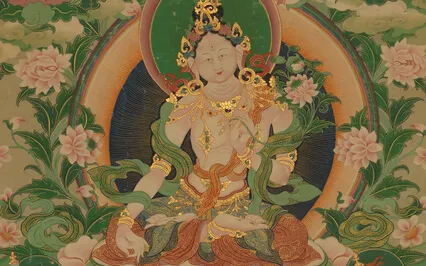
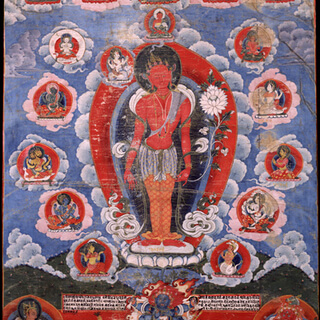
And this is Tara,
White Tara with long life deities.
This is from 19th century Tibet,
Pigments on cloth.
And Tara is,
Of course,
Known for her care of all sentient beings.
And so that's what's brought us to this tanka today.
We'll look at it together here and see what a lush and colorful tanka painting this is.
There are rich blues that define the sky above and water below.
And then greenery included in here,
Some leafy greens and some greens kind of surrounding these lotus blossoms as well.
And even a light colored of green in the background here.
And of course,
Our central figure is white Tara,
The female Buddha who works for the benefit of all beings and has many manifestations.
In this manifestation,
White Tara bestows longevity,
Long life,
And the care that goes along with offering that.
Her right hand rests on her knee displaying this gesture of infinite generosity.
So echoing that offering of care,
While the left hand holds a stem of a pure white lotus blossom above her shoulder.
And she has incredible eyes,
A pristine awareness.
But now I'm so excited to bring on our teacher today,
Kaira Julingo.
Kaira Julingo is a Dharma teacher with a lifelong interest in blending spirituality with social justice.
She received LAMP transmission from Thich Nhat Hanh and became a Zen teacher in 2007 and is a teacher in the Vipassana Insight Lineage through Spirit Rock Meditation Center.
Her work continues the engaged Buddhist movement developed by Thich Nhat Hanh and she draws inspiration from her parents' stories and her dad's work with Martin Luther King Jr.
Based in New York,
She leads retreats internationally,
Provides spiritual mentoring and interweaves art,
Play,
Nature,
Racial justice,
And embodied mindfulness practice in her teaching.
Kaira's book,
We Were Made for These Times,
Skillfully Moving Through Change,
Loss,
And Disruption is now available for purchase.
For more information about Kaira's practice and meditation session,
You can visit kairajul.
Com and her book is available.
If it isn't available in our shop today,
It will be very,
Very soon.
Kaira,
Thank you so much for being here.
Thank you so much,
Dawn,
And a warm welcome to you all.
I'm glad to be with you and really appreciating this theme of care that we're exploring this month.
I was thinking about how care is often expressed in the face of suffering.
And I was thinking it's also,
Care is also something we can bring to what is going well.
And so this,
What I'd like to share about today and also guide in a meditation is about bringing our awareness to other people's good deeds,
Other people's kindness and compassion.
And when I saw this beautiful painting,
This thangka,
The white Tara surrounded by the divinities of longevity,
I thought that's a form of care for what's here.
We want what's here to last and be strong and to grow and to endure.
So when we bring our awareness to those in the world that are creating more beauty,
Creating more unity,
More harmony,
More truth,
More justice,
More wisdom,
That's a white Tara practice of care,
Of wishing those people well,
Of taking delight in those actions that are transformative for everyone.
And so when we rejoice in these beautiful acts,
We bring attention to them,
We support them,
We increase them in the field of collective consciousness.
And so this is a practice in the Vajrayana,
Tibetan and Tantric traditions of Buddhism of celebrating,
Rejoicing both in our own and in others' good deeds.
The term is yirangwa,
I may or may not have pronounced that properly,
Yirangwa,
Rejoicing in others' noble actions.
So once I was sitting on a meditation retreat and a teacher said,
If you don't do anything else,
But just at the end of the day,
If you can rejoice in the good actions of others,
The great beings,
Spiritual teachers,
Any beings,
That's enough,
That's all you need to do.
If nothing else,
You can always rejoice in good actions that have been done that day.
Karma Phuntsho,
The author of the History of Bhutan,
Says of this rejoicing practice,
It is a way of experiencing joy without effort or cost,
And is an easy method of accumulating merit.
So this understanding that if we join our mind with someone else's good actions,
We get to be part of them somehow.
They become part of our wholesome actions as well.
And so,
This is from Venerable Khenpo Tsewang Rinpoche,
In the Buddha's teachings it says that even if you can't do an activity that benefits others,
By simply rejoicing when other people do good things,
You'll get the same merit as them.
It's like when someone changes a lightbulb.
Even though only one person actually replaces the bulb,
Everyone else gets to experience the benefit just as if they all changed the bulb.
Similarly,
Rejoicing in others' good activities is a very skillful means,
And you don't have to do anything.
Just sit back and think,
Wow,
This is so great.
Buddha Shakyamuni and Guru Padmasambhava both said that by rejoicing,
You receive the same benefit as the person who actually performs the activity.
So let them do the job.
We can just feel happy with that.
In one way,
This is very simple,
But it's also very special.
That's from his book,
The Essential Journey of Life and Death.
So we can do this in different ways,
This rejoicing.
I love this very receptive practice,
Just letting it happen and being happy for it.
Maybe there's also practices like writing to someone to share what you appreciate in them.
We call this love letter practice.
We can write down the things we appreciate about someone,
The things that they've done well that we celebrate,
That we rejoice in,
As a way to make that stronger in them and stronger in the collective consciousness.
It makes it stronger in us when we express our appreciation.
So there are many stories of the benefits that come from rejoicing in the good of others.
This is from the Buddha's time.
The king of Srivasti was named King Pasenadi,
Pasenajit,
Also in another of the versions of the language.
So he was very devoted to Buddha,
Shakyamuni.
He often invited him to his royal palace for lunch and along with his monks and nuns.
There would be beggars around the palace and there was an older beggar in particular who thought how wonderful and beautiful that King Pasenajit has so much merit to become such a great king and still he's continuing to do such big meritorious activities.
If I ever have the capability,
I will also do the same thing for the Buddha and all these wonderful practitioners,
Bodhisattvas.
So this is what she thought very sincerely from her heart.
And in the teachings it says that she accumulated the same merit as the king because her intention joined with his activities.
So we can both rejoice in our own goodness,
Even the very small things we've done we can treasure them.
A time when we restrained ourselves and didn't tell that white lie,
A time when we were able to avoid making a harsh retort when irritated,
When we reached out to someone in need,
When we made a joke and brought humor to a difficult situation.
This is Venerable Khenpo Tsewang Rinpoche again.
He says,
Rejoicing in your own deeds is also very important.
The teachings always say that we should inspire ourselves.
If you do something good in the eyes of the Buddha,
Dharma,
And Sangha,
Or in the presence of your friends,
It's very good.
Even if your friends and family don't see what you did,
It benefits others,
Yourself,
Or your meditation.
So we should be happy and even if we have a single good thought,
We should be happy and dedicate that merit of our practice.
So whether it's visible or invisible,
We know our own mind.
Every time we do this,
We're progressing and moving forward,
Rather than walking backward or staying stuck in the same place.
So this is the importance of rejoicing in our own good deeds,
In our own goodness,
As well as that of others.
So I will invite us to practice this now in a meditation and see how this feels to extend our mind to celebrate the good that's happening,
Both generated from us as well as from others.
So let yourself settle into whatever position is good for you for this 20-minute practice.
Feeling your body and the space around your body,
And letting your body release itself into this space,
Into the support of what's holding you.
Noticing your breath,
Knowing that breathing is happening,
And noticing how your breathing connects you with everything around you,
The atmosphere,
And allowing yourself to feel supported by the air that you're breathing.
And now bring to mind those people,
A little bit everywhere in the world,
Who are doing things you would want to celebrate and rejoice in.
Those that are caring for others in this moment,
Those who are caring for people,
The elderly and children,
The sick,
The dying,
Those being born,
Those who are feeding others and teaching others and holding others in their suffering,
Those who are bringing others joy,
Making others laugh,
Those who are removing fear from others' minds,
Those who are offering spiritual support and comfort,
Making sacrifices to offer care and help,
Those who are bringing attention to the plight of those who are being oppressed,
Those truth-tellers,
Journalists,
Activists,
Those who are practicing generosity,
Making donations,
Offering food,
Equipment,
Trainings.
Let yourself feel the goodness of all of this care that's happening right now,
Everywhere on the planet,
And celebrate it,
Honor it,
Rejoice in it,
The acts of courage of Russian people demonstrating in the streets to protest the war their country has initiated in Ukraine,
The acts of care among people in Ukraine for each other and other countries caring about those fleeing Ukraine,
The acts of kindness and courage in places of war in Myanmar,
In Eritrea,
In Sudan,
Syria,
People doing their best in really difficult situations to keep others from falling into despair,
To let them know they are cared for and not forgotten.
We can rejoice in those countries and places standing up to injustice,
To oppression,
On a global scale,
Those that are looking at the systemic nature of these problems and how to solve them at their roots.
If all of these people weren't doing these acts,
Our world would be a much less beautiful place,
Honoring all the farmers,
The laborers who harvest food and transport it,
Those responding to humanitarian crises,
Those who are answering hotlines for domestic violence,
For suicide,
Those who are raising money in their communities to support those in need,
Those working to change unjust laws so that people can receive the care they need,
The support,
The opportunities,
Neighbors being there for each other,
People being kind to one another,
Community organizations coming together to support those who are more vulnerable,
Children taking care of their pets,
People caring for their gardens and beautifying public spaces,
All the people caring for other animals,
Caring for forests and rivers,
Oceans,
Ecosystems,
Soil,
Air quality,
Letting yourself feel grateful for all the people doing kind and thoughtful actions as we speak,
As we meditate in this moment,
Letting that come into our consciousness so that we are taking part in it and celebrating it,
Even anyone,
Anywhere,
Thinking a beautiful thought or using kind,
Loving,
Truthful words,
We can rejoice in that,
Offering a smile to another.
Maybe situations arise in your mind when someone or some being was kind to you personally.
Allow that to sink in,
To really nourish you,
The goodness of their action,
How good it felt to receive it.
Every time we bring up a memory like that,
We get to have it all over again.
Our bodies and brains,
They respond the same way in this moment as they did in the actual moment when that act of kindness happened.
So let yourself have that right now,
That memory of kind action toward yourself.
And now bring to mind any beneficial or wholesome deed you yourself have done in recent time,
Or less recent.
Maybe it was a thought,
Or a word,
Or a physical action,
Compassion that arose in response to another's suffering,
Empathy for someone else in difficulty,
A time when you were kind,
Or a time when you refrained from doing something unbeneficial.
You can rejoice in those actions too,
Or perhaps ways that you have taken care of yourself,
Letting yourself get enough sleep,
Or exercise,
Or practicing good mental hygiene,
Like meditating,
Going for walks.
You're showing up today,
Right now,
To practice.
We can really rejoice in this goodness,
Your own desire to cultivate your mind.
Celebrate that.
So we close the meditation now,
Dedicating the wholesome merit of our meditation to all beings everywhere.
May all beings be safe,
Be healed,
Be protected.
May all beings be able to rejoice in the joy,
In the goodness,
In the wholesome actions of others and themselves.
So this sound of the bell will carry our rejoicing out into the cosmos.
Thank you,
Kyra.
That concludes this week's practice.
If you'd like to support the Rubin and this meditation series,
We invite you to become a member.
If you're looking for more inspiring content,
Please check out our new podcast,
Awaken,
Hosted by Laurie Anderson.
The 10-part series features personal stories that explore the dynamic path to enlightenment and what it means to wake up.
Now available wherever you listen to podcasts.
Thank you for listening,
And thank you for practicing with us.