This episode is brought to you by the Tricycle Talks podcast,
An interview show featuring discussions with Buddhist teachers,
Writers,
And thinkers about navigating life's hurdles and how we can be better in touch with ourselves.
Tricycle Talks is created by Tricycle,
The Buddhist review which has been the leading Buddhist magazine in the West for over 30 years,
With award-winning editorial,
Online courses,
Events,
And podcasts.
Whether you are a beginner or a long-time practitioner,
You will find valuable takeaways and tools to apply in your daily life.
I really enjoyed the episode with novelist Ben Okri,
Who spoke about how writing can be a spiritual practice and why he believes that art is most powerful when it brings us to a point of crisis.
Please go to tricycle.
Org slash podcast to learn more.
That's tricycle.
Org slash podcast,
Or follow Tricycle Talks on Apple Podcasts,
Spotify,
Or wherever you listen to your podcasts so you will never miss an episode.
Welcome to the Mindfulness Meditation Podcast,
Presented by the River Museum of Art.
We are a museum in Chelsea,
New York City that connects visitors to the art and ideas of the Himalayas and serves as a space for reflection and personal transformation.
I'm your host,
Tashi Chodron.
Every Monday,
We present a meditation session inspired by a different artwork from the River Museum's collection and led by a prominent meditation teacher from the New York area.
This podcast is a recording of our weekly practice currently held virtually.
In the description for each episode,
You will find information about the theme for that week's session,
Including an image of the related artwork.
Our Mindfulness Meditation Podcast is presented in partnership with Sharon Salzberg and teachers from the New York Insight Meditation Center,
The Interdependence Project,
And Parabola Magazine,
And supported by the Frederick Lentz Foundation for American Buddhism.
And now,
Please enjoy your practice.
Tashi Delek Hello,
Everybody.
Tashi Delek.
Welcome.
Welcome to Mindfulness Meditation Online with the Rubin Museum of Art.
I'm Tashi Chodron,
And I'm so happy to be your host today.
It is so wonderful to see so many familiar names on the chat here.
I see you joining from Lower Manhattan,
Brooklyn,
Upper Manhattan,
Jackson Heights,
Queens,
Lancaster,
Pennsylvania,
Flushing,
Queens,
Seattle,
San Francisco,
And oh my,
Someone as far as France.
Wow,
Thank you all so much for joining.
And those of you who are first time,
We are a museum of Himalayan art and ideas in New York City,
And we are so glad to have all of you join us for our weekly program where we combine art and meditation online.
Inspired from our collection,
We will take a look at work of art from our collection.
We will hear a brief talk from our teacher,
And then we will have a short set,
15 to 20 minutes for the meditation guided by our teacher.
Today's theme and artwork,
We are still exploring on the theme of gratitude,
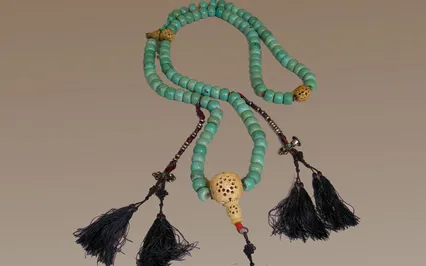
And the art connection for today's session is this beautiful prayer beads mala called chenwa in Tibetan word,
Origin from Tibet.
This strand has a standard 108 beads,
An auspicious number rooted in early Buddhist literature on prayer beads and pre-Buddhist Indian beliefs,
But also symbolic of purifying the 108 causes of negative karma.
In Tibetan Buddhism,
Prayer beads are used to count the recitation of prayers or mantras.
Some practitioners recite one round daily of certain mantras.
One of the most common mantra is om mani padme hum.
Even a child from a Tibetan Buddhist family in Tibet or in exile in India would know to recite.
Some practitioners accumulate certain mantras 100 million times.
When accumulating 100,
000 or more,
Then the counters on the mala plays a very important role.
As you see here in the image,
Those two strands,
Each with 10 beads are used as counter.
After each round of 108,
Then one can pass one bead until all 10 beads are moved to the other side.
Then you use the other counter for 1,
000 counts.
That's how a practitioner keeps track of 100,
000 or more accumulation to remove obstacles,
To bring forth blessings and things like that.
So most important is to dedicate the merit to all sentient beings' benefit.
In fact,
I remember there is a saying in Tibetan called ngak khen nupar thang la yu,
Which means the power of mantra is in the number of accumulations.
Isn't that amazing?
So certain materials are thought to impact the merit accrued,
Particularly when associated with a specific type of deity mantra practice.
For instance,
Bone beads are for wrathful deity practice.
Crystals are often associated with Avalokiteshvara mantra accumulation.
Likewise,
Redstone for magnetizing,
For power and love,
And then turquoise precious stones are to open all chakras and also for healing.
And prayer beads are religious objects of a particularly personal nature,
And so the materials often reflect both the status and taste of the beads' owner.
This set with its precious stones and metal and intricately carved bone once belonged to a princess of Derge in eastern Tibet,
And this is a prayer bead from 19th century,
And the set is among those given to the museum by Anne Dorsey.
Now let's bring on our teacher for today,
Kaira Jewellingo.
Kaira Jewel is a dharma teacher with a lifelong interest in blending spirituality with social justice.
Her work continues the engaged Buddhist movement developed by Thich Nhat Hanh,
And she draws inspirations from her parents' stories and her dad's work with Martin Luther King Jr.
After living as an ordained nun for 15 years in Thich Nhat Hanh's monastic community,
Kaira Jewel now teaches internationally in the Zen lineage and the Vipassana tradition,
As well as in secular mindfulness at the intersection of racial,
Climate,
And social justice with a focus on activists,
Black,
Indigenous,
People of color,
Artists,
Educators,
Families,
And youth.
Based in New York,
She offers spiritual mentoring to groups and is the author of We Were Made for These Times,
Ten Lessons in Moving Through Change,
Loss,
And Disruption from Parallax Press.
Her teachings and writings can be found at kairajewel.
Com.
Kaira Jewel,
Thanks so much for being here.
Thank you so much,
Dear Tashi,
For the introduction and for everyone at the Rubin Museum for having this gathering.
My pleasure.
It's good to be here with you all.
Yes,
I'll just say a few more words about this event on January 1st in case you'd like to join us.
I'm so happy that we're connecting with these prayer beads today because my husband is an Episcopal priest who grew up Catholic and there are prayer beads all over our home,
Both Buddhist and Christian,
And they have a lot of significance for me,
For us.
He and I,
We offer a monthly Buddhist-Christian community of meditation and action.
But separate from that,
On January 1st,
We'll be offering a 90-minute session to reflect on the past year and prepare for welcoming in the new year in loving and aware community.
And so we'll gather on Zoom and we'll offer the ancient prayer practice inspired by Saint Ignatius of Loyola called Examine.
And so it's four questions that help us to reflect on the past year and what is it that we really wish to bring about or stay connected to in the year to come.
So it is free of charge by donation,
And I'll put the link in the chat if you're interested.
So we're exploring the theme of gratitude.
And what's coming up for me today is the importance of gratitude,
Especially when things don't feel like we need to be grateful for them,
Right?
When things are difficult and challenging and hard.
I have had some difficulties recently,
And so it's not the most natural thing to gravitate towards gratitude.
But gratitude can also really be a kind of boat on rough waters.
Like if the difficulties in our life are stones,
If you drop a stone in the water,
It'll just sink to the bottom.
But a boat can carry many stones and not sink.
And gratitude is like a boat that can help us hold the difficulties of our life and not sink with them.
So I'll tell you a story.
I actually just went to pick up my dad at the airport today.
While I was in traffic,
I saw the car ahead of me had a bumper sticker that said,
Student Driver,
Please Be Patient.
And I felt so touched by this bumper sticker because I thought every one of us needs that bumper sticker.
We all have ways in which we're learning and growing and making mistakes.
And we all deserve that graciousness of others being patient with us,
Still being a student of life.
And this sense of generosity to give people the benefit of the doubt to not be so quick to judge,
It was very touching for me.
And so I named that because the story that I want to tell you is about my dad.
So this happened today as I was going to pick him up.
It felt like an important teaching.
So my dad and I,
So this happened when I was a nun.
I was traveling with Thich Nhat Hanh and the larger Sangha of lay and monastic students.
We were in India for about a month leading retreats and visiting schools,
Bringing mindfulness into schools and offering retreats for teachers.
We had retreats for the Dalit community.
So we had just completed a retreat for teachers.
My dad accompanied us on this journey.
So this happened to him.
He was helping me.
I wanted to offer fruit to people who were begging at the train station.
So I put bags down.
He put bags down so we could get to the fruit and offer it.
And then we got all our bags and went onto our train.
Well,
He realized when he got to his seat that he had left his laptop bag,
Which had his phone and it had his keys and it had his laptop.
So he went back out.
The train was about to go.
He rushed back out.
Of course,
The bag was nowhere to be found.
And so he was in great distress.
And he happened to be sitting next to a Muslim family,
A woman and two younger daughters.
One was 11,
One was six.
So the 11-year-old was named Hannah.
They got to know each other,
Introduced themselves.
And he was drinking chai that was being brought down the aisle.
And he tried to offer chai to the family.
And the 11-year-old girl said,
Well,
We're fasting because it's Ramadan.
So I wouldn't eat or drink that whole day.
So they started talking.
She was very curious and a good conversationalist,
This young woman.
And so my dad asked her,
Have you ever lost anything,
Hannah?
Because he was really perplexed about this loss.
And Hannah said,
I've lost things like books and journal.
And the worst thing I lost was a friendship because we got angry at each other and we said terrible things to each other.
And then he said,
Well,
I lost a big book,
A computer book and all these other things,
House keys,
Everything was in that laptop bag.
And he told her how upset he was about that.
And she looked right into his eyes and she said,
Uncle,
You need to thank God for the good he has given you this day.
As an 11-year-old child,
She said that to him.
And he was so struck by that.
It was really like just the wisdom of the whole universe coming through her.
And he really took that in.
And they had this amazing conversation that we were going from Dehradun to Delhi.
And they ended up staying in touch.
The family moved to Dallas.
My dad has been there to visit them now.
Hannah's graduated from college.
They're still in touch with each other.
But he really reflected on that teaching.
What does it mean to be grateful,
Even when things are not at all what we wish them to be and when we are actually in real hardship.
And so that is a real spiritual practice of finding ways to be thankful,
Even in the midst of loss,
Even in the midst of grief.
Not as a way of suppressing,
Not in a superficial way,
But in a deep,
Receptive,
Humble way that life is still supporting us,
Life is still sustaining us,
And there's still much to be grateful for.
And so these prayer beads,
The teachers,
We get offered several different artworks to choose for our presentation.
And these prayer beads really grabbed me in my heart of everything that was offered as a possible artwork.
And I read the description and it said they were the actual prayer beads used by a Tibetan princess.
I love that.
I love that these prayer beads were made for a person,
A human,
And this human used them probably regularly,
Maybe daily.
And while all the art we get to connect with is very precious,
Very meaningful,
The fact that someone held these in their hands and practiced with them,
As they had a relationship with them,
Infused them with their energy of mindfulness,
Compassion,
I just felt an instant connection and this sense of intimacy that is a little different than a painting or something that you put on the wall.
So I'm grateful that this art piece is included in the museum's collection.
And Tashi mentioned already this connection to the rosary and to other traditions.
The Hindu tradition also uses lalas.
There are many different traditions that use beads as a way to anchor ourselves in the practice.
And so the bead can be a mantra practice,
As Tashi mentioned.
It can also be a breath practice where we follow our breathing.
We take an in-breath,
Take an out-breath,
And hold a bead.
Take another in-breath,
Another out-breath,
Hold the next bead.
It can be a prayer as in the rosary.
We can also hold the mala,
The prayer beads,
When we do walking practice.
And one bead can be one step,
One step or one movement in mindfulness.
So what I really appreciate about these prayer beads is the way that they help us honor the preciousness of each moment,
Whether it's our breath,
Whether it's our steps,
Whether it's the prayers,
The wishes we're making for ourselves and others.
It's this attention to detail and this commitment to not miss what's happening,
The way each moment is unfolding in our lives in a unique and deeply precious way.
And so the meditation I want to offer us around gratitude,
We can also think of holding a bead and being aware of one thing we're grateful for,
Calling to mind a person that's in our lives that we're grateful for,
An animal or a place we love to go to,
And the next bead another gratitude we can call to mind.
So we'll get to practice this now in our meditation and I invite you to visualize yourself holding prayer beads,
Maybe the same prayer beads we just saw in the image,
The turquoise prayer beads with the bone pieces that join them together.
So taking a position that supports you to be present and also at ease,
Feeling your feet on the ground,
Feeling your seat in the chair or on your cushion,
Wherever you're seated,
Feeling your hands,
Noticing whatever sensations are there in your hands and bringing awareness to the face,
Allowing the muscles of the face to rest over the skull to soften,
Letting the eyes rest in the sockets,
Allowing the shoulders to release down away from the head and neck and visualizing now.
If this is helpful,
You can always just connect with the physical sensations of my guidance if visualization isn't so helpful for you,
But seeing yourself holding prayer beads,
Maybe the turquoise ones we saw,
Maybe other beads and feeling one bead between your fingers,
Taking a breath,
In and out,
Moving to the next bead,
In and out.
Let yourself count eight more beads like that,
So we take 10 breaths in awareness.
Each time you breathe a new breath,
You move to the next bead.
That was 10 for me.
You can release that attention to the breath,
Just let yourself connect to the feeling of your body.
Notice what's here,
Resting back,
Letting go of needing to do anything or make anything happen,
Just being,
Especially allowing the space in the center of your forehead and between your eyebrows to spread out and soften.
Sometimes with counting,
We can get a little bit focused in that part of the face,
Or just releasing,
Softening the space between eyebrows.
Now again,
Only if it's helpful,
Visualize the prayer beads.
Now you're holding a bead that represents something you're grateful for.
It's a call to mind,
Maybe something in your physical environment that is supportive of you.
Maybe it's a plant or something that you find beautiful or comforting in your home.
So hold that bead,
Connect with your gratitude for this thing in your physical environment.
Now moving to the next bead,
Let yourself feel gratitude for something in your body,
Something in your own physical body that's working well,
That is supportive of you in some way.
So we have people doing lawn work nearby,
So I'm moving to the next bead and grateful that they are taking care of the lawn.
So let's all reflect on something that's happening in our external environment that we are grateful for.
Same thing in our,
Beyond our home that we are grateful for.
Now bringing to mind as we move to the next bead,
In our prayer beads,
Someone,
A person that we feel grateful for from our past or from our present,
Someone who has been kind to us or encouraging of us,
Just letting that person come to mind,
Connecting to the feeling of gratitude for that person.
And for the last bead,
We can bring to mind a species beyond the human.
In the more than human world that we are grateful for,
It could be a plant species,
It could be an animal species.
Reflecting on,
You know,
That bone is part of this prayer bead.
That bone came from an animal,
I imagine.
So we are constantly in dependence on other species.
And so what species do you feel grateful for?
Do you want to take this time to honor and remember and express gratitude for?
For me,
I'm so grateful that dogs exist,
That we have this canine species that evolved,
That early humans and early dog ancestors evolved to be able to live together and support each other.
What species are you grateful for?
I know I said that was the last bead,
But one last bead is just gratitude for the Earth,
Our whole solar system,
Our whole cosmos.
Just the fact that we have a place that we can call home,
This blue planet floating in space,
Very quickly actually,
Rotating around the sun,
And our whole solar system is moving very quickly through the galaxy.
Just grateful that we have our place within the other celestial bodies,
That this whole universe is our home and sustains us in all of our needs every single day.
And we'll close with the sound of the bell,
Holding our bead of gratitude for the whole universe.
Thank you.
Thank you,
Kajal,
For that beautiful session.
That concludes this week's practice.
If you would like to support the Rubin and this meditation series,
We invite you to become a member of the Rubin.
If you're looking for more inspiring content,
Please check out our other podcast,
Awaken,
Which uses art to explore the dynamic paths to enlightenment and what it means to wake up.
Season two,
Hosted by Ravina Arora,
Is out now and explores the transformative power of emotions using a mandala as a guide.
Available wherever you listen to podcasts.
Thank you for listening.
Have a mindful day.