Welcome to the Mindfulness Meditation Podcast presented by the Rubin Museum of Art.
We are a museum in Chelsea,
New York City that connects visitors to the art and ideas of the Himalayas and serves as a space for reflection and personal transformation.
I'm your host,
Tashi Chodron.
Every Thursday,
We present a meditation session inspired by a different artwork from the Rubin Museum's collection and led by a prominent meditation teacher from the New York area.
This podcast is a recording of our weekly in-person practice.
In the description for each episode,
You will find information about the theme for that week's session,
Including an image of the related artwork.
Our Mindfulness Meditation Podcast is presented in partnership with Sharon Salzberg and teachers from the New York Inside Meditation Center,
The Interdependence Project and Parabola magazine and supported by the Frederick P.
Lenz Foundation for American Buddhism.
And now,
Please enjoy your practice.
Good afternoon and Tashi Delek.
Welcome.
Welcome to Mindfulness Meditation at the Rubin Museum of Art.
I am Tashi Chodron,
Himalayan Programs and Communities Ambassador,
And I'm so happy to be your host today.
We are a global hub for Himalayan art with a home base in Chelsea,
New York City,
And we're so glad to have all of you join us for our weekly program where we combine art and meditation.
Inspired by a collection,
We will first take a look at work of art from a collection.
We will then hear a brief talk from our teacher,
Elaine Rethals,
And then we will have a short sit,
15 to 20 minutes,
For the meditation guided by her.
Now,
Let's take a look at today's theme and artwork.
The theme this month,
We are exploring on the theme of compassion,
Which is Bodhicitta in the Vajrayana Tibetan Buddhism.
Compassion is the key to awakening.
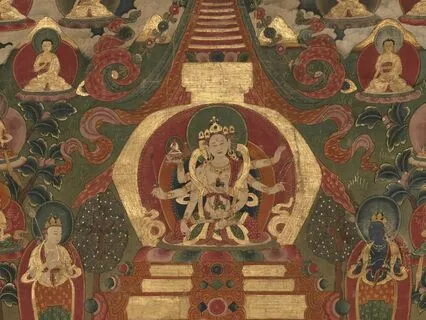
The connection to the theme is this beautiful Thangka painting of Ushnisha Vijaya.
Ushnisha is associated with overcoming obstacles,
Particularly those related to sickness,
Disease,
And untimely death.
Her compassionate activity extends to protecting beings from various forms of physical and mental afflictions.
Now,
This Thangka painting,
The art connection for today's session,
Is this beautiful painting of Ushnisha Vijaya,
Meaning victorious crown ornament.
In Tibetan,
She is known as Tsukto Namgyal Ma Tsela.
She is one of the three long life deity.
She also removes obstacles,
Promotes well-being,
And ensures environmental stability,
Something she needs to work on harder every day now.
This painting is origin from Tibet,
Dated 18th century,
Mineral pigments on cloth,
And it's about 50 x 38 x 2 1⁄2 inches,
Roughly.
Ushnisha Vijaya is the central focus of the painting.
She's seated with a stupa.
She bears a variety of auspicious objects in her eight hands,
Including white lotus,
A vajra,
Lasso,
A bow,
An arrow,
And a vase filled with the nectar of immortality.
Her hand gestures convey supreme generosity,
Protection,
And meditative balance.
This painting was commissioned by a family to commemorate the death of a relative.
At the bottom center of the painting is the depiction of the deceased individual.
The small figure,
Wearing white,
Is shown seated on a lotus,
Indicating that his relatives hope that the merit generated by the painting will help him to be reborn into the pure realm of a Buddha.
Now let's bring on our teacher for today.
Our teacher is Elaine Rethels.
Elaine has been studying and practicing the Dharma since 1988.
In addition to teaching Dharma at New York Insight,
She is a certified mindfulness-based stress-reduction teacher,
That is MBSR,
And certified MBSR teacher-trainer.
She's deeply interested in helping students integrate mindfulness into daily life and has been involved in the New York Insight's diversity efforts for many years.
Elaine,
Thank you so much for being here.
Please help me in welcoming Elaine Rethels.
Hello.
Yeah,
So I've been thinking about Ushnishavaya,
Vijaya,
And what it means to perhaps receive this kind of blessing.
We were talking before you all arrived about how none of us actually knows the length of our lives.
And there are some things we can control in terms of the obstacles of our lives,
But ultimately we actually don't know.
And you know,
I'm wondering,
That doesn't actually mean we're not protected.
You know,
What is our practice and how does our practice protect us?
And how does compassion itself protect us?
And I am reminded of a story about how a friend of the Dalai Lama's was imprisoned for over a decade,
I think,
By the Chinese.
And either he was released or escaped and traveled arduously back to be reunited with the Dalai Lama.
And after he received medical care and recovered somewhat,
They were reunited,
They were having tea,
And the Dalai Lama said,
Tell me friend,
Were you ever in danger?
So years in prison,
Right?
This treacherous journey from the prison back to Dharamsala.
And he paused and he thought,
And he said,
Yes,
There were moments when I almost lost compassion for my jailers.
And so what is the protection that we receive in the context of our lived lives?
And what is the protection that our practice,
What we're trying to cultivate in this moment every day,
Since we don't know how long we have in this life,
That how do we bring that gift of life and the removal of obstacles into every moment?
What's practice here?
What are the dangers,
The internal dangers that my mind and heart might face?
How do I free my mind and heart from the internal dangers that I do have control over?
So this is something that I've been thinking about in my life and in the shared lives we have in the world today,
Where there are certainly many environmental and other threats,
Where there's war and poverty and increasing disparities in wealth and difficulty talking to each other more and more.
What is the protection that perhaps we're blessed with?
And how does that help us be responsive?
And so I want to tell you a little bit that I've learned about compassion,
And it might be a different tradition,
Well,
I know it's a different tradition,
But I don't know if it is present in the Tibetan tradition as well,
That compassion actually has two pieces.
We often hear the word karuna about compassion,
But there's another word,
Anukampa.
It's anukampa karuna.
And the anukampa part is the heart that vibrates in the presence of suffering.
It's the heart that vibrates.
May it also vibrate in the presence of joy,
Right?
But here it's almost like the empathy that we feel when we're in the presence of suffering.
And for many of us,
That's a very difficult thing to actually stay present in the presence of our own or others' suffering.
It's so easy to move to wanting to turn away or to fix without actually knowing what's needed to rush in and fix,
Or to blame.
I don't know if you know this from your own life.
I certainly know it in my own experience and in observing what happens in natural disasters or in acts of war where there's this outpouring of compassion and,
Oh my goodness,
And then there's like,
Who should we blame for this?
We can't stay in this space.
So there's the anukampa piece.
And the karuna piece is once we've allowed our hearts to vibrate and perhaps settle so that we can see more clearly,
This question of how can I help,
What's practice right here in this moment,
Right?
So it's both.
For those of us who might be not just in families where we have friends and relatives who are suffering and we want to necessarily go in and fix or come to a cause about why that is,
But for those of us who are working in social justice,
How important this is to be able to move from a place of compassion rather than a place of aversion,
Rather than a place of ill will,
Rather than a place of imposing my or our views of what our view says is right,
But to really engage in this out of compassion,
Recognizing that the danger to our hearts is to lose access to that,
Right?
So I thought I'd guide some compassion practice today.
And so pausing,
Feeling your posture,
Feeling your seat,
Perhaps placing your arms on your lap or on the arms of the chair,
And coming home to the body,
The truth of the body sitting here,
Not just alone,
Sitting here in community,
Feeling the breath as it moves past your heart,
The lungs massaging the heart perhaps,
Perhaps recalling an area in your own life where there's challenge,
Whether it's physical,
Some sickness or physical challenge or a challenge of the mind and heart,
A struggle,
Something that you're willing to be with and without rushing in,
Just taking a moment to pause and to receive the responsiveness of the heart to your own suffering,
To your own confusion,
And perhaps offering yourself,
And if you like you can put a hand on your heart or touch your cheek,
Really feeling your own presence.
I care about this,
This pain or this sorrow,
This feelingness.
Can you connect to your own care for your own well-being?
In whatever the situation is,
May I find peace.
In the midst of this,
Perhaps the traditional phrase of may I be safe and protected from harm,
And of course there's the external harm,
But here cultivating this wish to be moving out of kindness and compassion and generosity rather than aversion and ill will,
And it may be that you notice the habit of thinking and planning and the to-do list and what I need to do and who I should talk to about this or if only,
And just noticing the habit of the mind and they may be very skillful actions,
And yet can we just stay for now in the midst of the uncertainty,
Perhaps pain,
Sorrow,
Grief,
May I find my way to peace,
I care about this,
And softening now and releasing this particular situation in your current life experience,
Grounding once again in the body,
In this community of people breathing and practicing here,
And perhaps bringing to mind a loved one or somebody you care about,
A friend or a family member or neighbor who might be going through some difficulty right now,
Could be any kind of difficulty,
It's not a competition,
It's not about measuring who deserves,
We all deserve to be met with empathy and compassion,
Just taking a moment to see what arises in the mind and heart,
Sometimes to be honest when it's somebody you care about or for sure with oneself there might be a sense of impatience,
Just figure it out already or perhaps there might be a sense of pity and looking down upon,
But compassion is neither of those,
Just like me,
So as you visualize this person,
Hold them near or in your heart,
Touching into your care for them and perhaps wishing them ease,
May this situation be resolved,
May you move through this with grace,
May you find ease in the midst of this situation,
Right here,
Right now,
And if it feels right for you today in this moment,
Broadening the scope of care to include all beings on this planet who are experiencing the effects of climate change and environmental degradation,
Some of us certainly more privileged than others as we sit here in this beautiful air-conditioned space,
But sensing our own struggles and confusion and fear and grief and hearing the cries of this world,
This planet,
The trees,
The animals,
Fish,
The oceans,
All beings,
So certainly there's this wish for ease in the midst of this turmoil,
May all beings be as safe as is possible from the external environmental factors and may all beings be at ease internally,
Free from reacting with the poisons of aversion and hatred and blame,
So there's a way that engaging in compassion practice is acknowledging things as they are,
But because we acknowledge that it doesn't mean it gives us a pass to move to the sidelines and not do anything,
And it certainly doesn't mean that we approve or resign to the situation,
So in all of these dimensions,
Ourselves,
Those in our immediate circle,
And more globally,
Whether it's about the climate or other factors,
There is this question we live into of,
How can I help?
It might be something small,
But it's not just about the vibration,
Right?
It's not just about the empathy.
The invitation is what's practiced here,
What's needed here.
We don't know the answers,
But we listen.
We ask and we listen.
And of course,
Compassion practice is made possible by the cultivation of equanimity,
This recognition that I care about this,
And things are the way they are,
That our experience from moment to moment arises as a result of conditions that are so vast and intertwined,
And we are ultimately,
You know,
Not in control of anything but our response,
Certainly not the outcome.
So may we have compassion,
May we care,
May we act and let go of being attached to outcome,
May we be at ease.
And this is the dance to live in this world,
To be engaged,
To be involved,
And to know things are the way they are,
And to not know the outcome,
To not be attached to the outcome.
May all beings live in the heart of compassion.
May all beings respond with kindness and generosity and care,
And may there be peace.
Thank you so much for that,
Elaine.
That concludes this week's practice.
To support the Rubin and this meditation series,
We invite you to become a member at rubinmuseum.
Org membership.
If you are looking for more inspiring content,
Please check out our other podcast,
Awaken,
Which uses art to explore the dynamic paths to enlightenment and what it means to wake up.
Season two,
Hosted by Raveena Arora,
Is out now and explores the transformative power of emotions using a mandala as a guide,
Available wherever you listen to podcasts.
And to stay up to date with the Rubin Museum's virtual and in-person offerings,
Sign up for a monthly newsletter at rubinmuseum.
Org slash enews.
I am Tashi Chodron.
Thank you so much for listening.
Have a mindful day.