Welcome to the mindfulness meditation podcast presented by the Rubin Museum of Art.
We are a museum in Chelsea,
New York City that connects visitors to the art and ideas of the Himalayas and serves as a space for reflection and personal transformation.
I'm your host,
Dawn Eshelman.
Every Monday we present a meditation session inspired by a different artwork from the Rubin Museum's collection and led by a prominent meditation teacher from the New York area.
This podcast is a recording of our weekly practice currently held virtually.
In the description for each episode,
You will find information about the theme for that week's session,
Including an image of the related artwork.
Our mindfulness meditation podcast is presented in partnership with Sharon Salzberg and teachers from the New York Insight Meditation Center,
The Interdependence Project,
And Parabola Magazine.
And now,
Please enjoy your practice.
Hi,
Everybody.
Welcome to the Rubin Museum of Art's weekly mindfulness meditation online.
My name is Dawn Eshelman,
And it's great to be here with you for our weekly practice,
Where we bring you a work of art to frame a conversation and then a practice,
A meditation practice.
And I hope you all are very well in this holiday season and maybe enjoying a little extra bit of rest and lovely food and all of those good things,
Connecting with people as you are able.
The Rubin Museum is a museum of Himalayan art and ideas from that art.
And each week here in our practice,
We look at a different work from our collection,
As we'll do today.
We hear from our wonderful teacher today is Sharon Salzberg,
Who we get lucky as we get to have three weeks in a row.
And then we'll sit together for 15,
20 minutes.
So thanks for joining us from all over the place.
It's really a beautiful benefit of practicing online is coming together with people who are joining us just really literally from all over the globe.
So let's look at the artwork that we are sharing today.
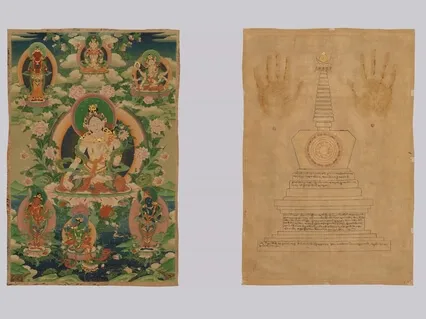
We're looking at this beautiful painting,
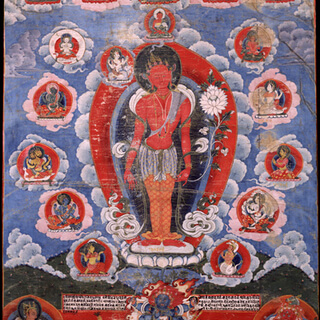
Which is White Tara with long life deities.
And we're bringing this to you today within the context of our theme for the month,
Which is generosity.
And as a female Buddha,
Tara works for the benefit of all beings.
So kind of embodies this idea of generosity or compassion,
As we might more commonly say when thinking about Tara.
And this form known as White Tara bestows longevity,
So long life.
And her right hand rests on her knee,
In fact,
Displaying the gesture of infinite generosity.
And the left hand holds a stem of a lotus blossom that then kind of sneaks around and blooms over her shoulder there.
So the reverse of this painting is also really interesting.
So we've included it here.
Here you can see a depiction of a stupa with a mandala drawn in its dome and handprints.
And these are handprints of a Buddhist master.
And prayers and dedications written in gold on the stupa's body state that this painting was commissioned by Yeshe Lobsang Tenpa.
He dedicates the merit of the painting's creation to preventing untimely death for longevity and prevention of dangers for all sentient beings and asked to bestow the blessings of a long and auspicious life.
So we'll hear more about this idea of generosity from our speaker today,
Sharon Salzberg.
Before I bring her on,
I'll just let you know that,
As many of you know already,
That Sharon is the co-founder of the Insight Meditation Society in Barre,
Massachusetts.
And she's guided meditations worldwide for many years.
She's the author of some beautiful and practical and useful books,
Including her latest Real Change Mindfulness to Heal Ourselves and the World.
So if you're looking to brush up and kind of retune your meditation practice for the new year,
Check it out.
We're so delighted to have her be part of many of the Rubens programs.
So please welcome Sharon Salzberg.
You're there.
Okay.
Hey,
How are you?
I'm well,
How are you?
I'm good.
I'm well too.
Here in the clouds again.
Here I am floating Ruben style.
I'll hand it over to you.
Thank you.
Thank you so much.
And thank you all for joining us.
I've often said,
I've probably said here as well,
That I'm very fond of New Year's Eve.
I'm very tuned into it,
Even though I know it's just a construct that we've created.
It's always been a meaningful thing for me.
And I've said,
I'm very lucky as a Buddhist,
A Jew and a Westerner.
I get three a year.
So we're about to hit one.
And it's quite a moment of consideration of our values,
How we can be happy.
Maybe happy again,
Things that are really troubling and even uncommon paths or paths to happiness that aren't necessarily so conventional or ordinary.
And I actually think of generosity in that light.
When I look at that image of tar,
For example,
First of all,
We can recognize that generosity is not only material,
It can be material.
And it can also be generosity of the spirit.
It's thanking somebody or noticing that they seem uneasy or in some distress or paying attention to the people we normally look right through or discount.
It's having that moment of appreciation for those perhaps we've taken for granted and so on.
So there's a real energy that is generosity of the spirit.
And whether we are offering materially or we're offering in these other ways through love and kindness,
Through presence,
Whatever,
I think the common belief is that that's going to leave us at a loss.
We're going to have less than we had before.
We'll have expended something that is a finite resource.
It's a zero sum game.
And so it's not that enticing really to feel that generosity is a path toward happiness.
But when I look at that tar as just one example,
I don't see someone feeling depleted or overcome or like,
You know,
It's unfortunate that I gave that or something like that.
There's something about the act of generosity when it's pure,
When it's coming from a pure motivation that actually returns us to a place within that's whole,
That's complete,
That isn't in a state of lack or need or insufficiency.
Even if it's just for a moment,
We're back there.
We've returned to that space and somebody that genuinely exists and having been reunited with it,
We can go on in a different way,
At least for a while,
You know,
Not looking around so compelled by what we think external to us is going to make us whole.
It's like we just visited there and we have more confidence.
So there's actually a teaching in the Buddhist tradition about practicing generosity makes you fearless.
And they say you can go into any room,
You can go into any crowd.
And perhaps I think it's for this very reason that we're not,
You know,
So kind of almost desperate to find that which will perhaps make us feel better.
It's the very state of wholeness that is the best of feelings.
And that's what happiness can be actually defined as.
So giving is really,
It's like an experiment.
And I think it's always worth paying attention to how it makes you feel because there's some surprises there often.
So many times we think I could never give enough,
I don't have enough,
I can never be enough.
Anything I could try to do would be insufficient.
And yet the reality is that that hesitation is also just a construct.
It's just an idea.
And that I was just reading about some research by David Lim at Adelphi University about how people who have gone through a lot of adversity in their lives,
People who have gone through a lot of challenge in their lives are often very,
Very generous because they realize that even the small,
Seemingly small thing makes a difference because they have been on the other side of that.
They've experienced that it makes a difference when someone stops and thanks you or recognizes you in the dignity of your being or offers you something,
Whatever it might be,
Material that from the point of view of the giver,
The conditioning,
The habit is often that like couldn't really make a difference.
But from the point of view of the recipient who's struggling in some way,
It makes a difference.
And I just found that fascinating that this is being researched now.
So giving is a practice,
It's an experiment.
It's trying it,
Not to the point of folly.
And for those of you in New York,
I always say,
Never give away your rent controlled apartment.
If we even have rent controlled apartments anymore,
I don't know.
But it's not that you're trying to harm yourself or your family,
But often we can stretch and just see what it's like.
The other side of giving,
Interestingly enough,
Is in a way it's like giving to oneself.
It's being able to receive.
And even for people who are interested or willing to make the experiment in giving to others,
Whether material or generosity of the spirit,
They might have a harder time actually with the notion of giving to oneself,
Which is receiving.
Whether it's offering loving kindness to oneself,
Offering self-compassion and that,
You know,
Self-compassion particularly arises in times when we've made a mistake or we've lost sight of what we really care about or lost sight of our aspiration or it's exemplified,
It's embodied in the meditation practice that we're going to do soon with how do we speak to ourselves when we realize our attention has wandered?
You know,
We sit down with an intention perhaps as one method to settle our attention on something like the feeling of the breath.
And then lo and behold,
We're redecorating an apartment in New York City.
We actually don't have something like that.
And then there's a moment when we realize that.
So how do we relate to ourselves after having blown it?
That is really the critical moment we say.
And that has to do with the generosity of having some compassion for ourselves,
Giving ourselves a break.
And sometimes it is really a matter of receiving.
I've been speaking a lot lately about my friend Ram Dass who died just a little tiny bit over a year ago on December 22nd.
And he had a very significant stroke maybe 19 or 20 years before he actually died.
And subsequent to the stroke,
He only lived in a wheelchair and he had aphasia.
He had quite some difficulty in giving lectures and things like that in terms of very long pauses.
And yet he was teaching.
He went back to teaching when he'd recovered enough and he moved to Maui.
He lived in Maui for the rest of his life.
So in order to see him,
In order to be able to teach with him,
We used to go to Maui,
Which was not really a terrible hardship,
And teach with him.
And I remember sitting in the back of the room once one year.
So this is well into the time of his having had the stroke.
And Ram Dass was speaking and he said,
You know,
The hardest thing of all subsequent to my having a stroke was having to get help from other people.
He said it was harder than the physical pain,
Harder than living in a wheelchair,
Harder than the change in speech.
He said it was the hardest thing of all and it was the most liberating.
And then he went on to say,
You know,
One of my famous books is called How Can I Help?
And he said,
Now I feel like writing a book called How Can You Help Me?
Which I thought was pretty great.
And it's quite fascinating for me.
Like I'd known Ram Dass since January of 1971,
Which is when I did my first meditation retreat ever.
I was about to hit an anniversary.
And he was there as another student.
And you know,
Through many,
Many,
Many years,
We practiced together in Hawaii,
In Burma,
All over the place.
And I had tremendous admiration for him,
Especially as a pioneer.
He was the first person I knew who was working with homeless people.
He was the first person I knew who was working with people who were dying.
He was the first person I knew who was working with people in prison.
And so we had that kind of energy.
And then yet it was only toward the end of his life that you could feel that barrier toward receiving actually crumble.
And because it was like no internal barrier,
He was a helper,
But he could also take love in and care in.
It felt like he was made of love.
He was made of light.
It was an extraordinary difference.
And I think that a lot of that was at the root of that.
And so I often think about that balance giving,
Which can be a practice and needs to be an experiment I think,
And also receiving,
Which might make us feel kind of uncomfortable.
And I would say in a time like ours right now,
Where it's so hard for so many people,
Knowing that it's okay to receive,
It's okay to ask for help is actually a very crucial thing.
And so much is stigmatized in our society or society in general,
Being not totally in control,
Being afraid,
Having some suffering of some kind.
There's so many things that are so many things that are kind of stigmatized in a little bit of a different direction,
Like kindness.
That's stupid in the eyes of a lot of people and in a lot of our conditioning often.
And so it really takes a lot to challenge such broad-based conditioning.
And yet here we are with that opportunity because of a practice,
Precisely because of a practice that has us look really at whatever our experience is in a different way.
So let's practice a little together.
You can sit comfortably,
Close your eyes or not,
However you feel most at ease.
We'll start by listening to sound,
Whether the sound of my voice or other sounds.
It's a way of relaxing deep inside,
Allowing our experience to come and go.
It's like the sounds wash through you.
Unless you're responsible for responding to a particular sound,
Let them arise and pass away.
And bring your attention to the feeling of your body sitting.
Feel the earth supporting you.
Feel space touching you.
Bring your attention to your hands and see if you can move from the conceptual level like oh fingers to the world of direct sensation,
Picking up pulsing,
Throbbing,
Pressure,
Whatever it might be.
You don't have to name these things,
But feel them.
And bring your attention to the feeling of the breath.
Just the normal natural breath,
Wherever you feel it most distinctly,
Nostrils,
Chest or abdomen.
You can find that place.
Bring your attention there and just rest.
See if you can feel more in breath.
It's just one breath we're paying attention to.
You don't have to be concerned with what's already gone by or lean forward for even the very next breath.
Just the normal natural breath wherever it's strongest for you.
You aim your attention toward this very moment,
This very breath,
And simply feel.
And should you find your attention wandering,
You get lost in thought,
Spun out in a fantasy or you fall asleep that's the moment for a little generosity toward yourself and some kindness.
Instead of launching into a whole diatribe about how terrible you are,
See if you can let go gently and bring your attention back to the feeling of the breath.
Unpleasant.
You you you you you you you No matter how many times your attention may wander it's okay we're practicing letting go and practicing beginning again you you you you you you thoughts may come and go sensations may come and go images sounds you can let them arise and pass away we'll just rest our attention on the feeling of the breath you you you you you you you you you you you