Welcome to the mindfulness meditation podcast.
I'm your host,
Dawn Eshelman.
Every Wednesday at the Rubin Museum of Art in Chelsea,
We present a meditation session led by a prominent meditation teacher from the New York area.
This podcast is a recording of our weekly practice.
If you would like to join us in person,
Please visit our website at rubinmuseum.
Org slash meditation.
We are proud to be partnering with Sharon Salzberg and teachers from the New York Insight Meditation Center.
The series is supported in part by the Hamera Foundation.
In the description for each episode,
You will find information about the theme for that week's session,
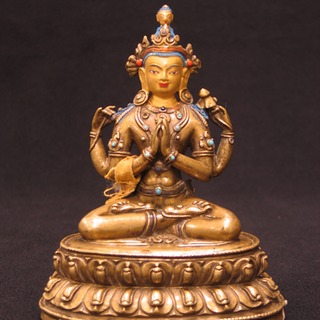
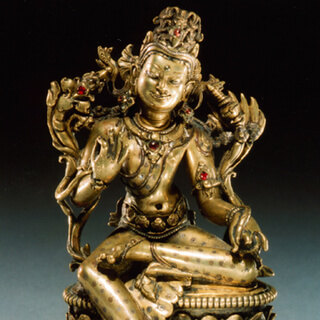
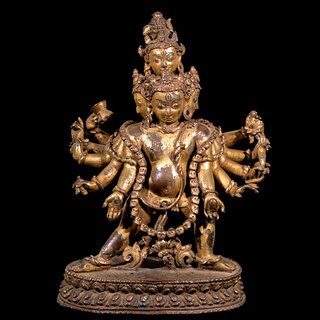
Including an image of a related artwork chosen from the Rubin Museum's permanent collection.
And now please enjoy your practice.
Good afternoon,
Everybody.
Happy spring.
I feel like we just keep saying that over and over until it's true.
And I think finally it's true.
So spring always feels like it makes everything new again.
And there's always such a sense of discovery that goes along with it.
You know,
Looking at the blossoming of the trees or the flowers as beautiful as they may be,
Even with the little allergies in there.
But such a special time of year for really remembering that idea of beginner's mind and seeing everything in new.
And we are talking this month about discovering,
Partially because of the season we're in,
But also as inspired by some of the artwork up on the sixth floor in the exhibition,
The Second Buddha.
There is a tradition there that is described in those artworks that is really quite beautiful and magical.
And that is that Padmasambhava,
The second Buddha,
Was known to plant treasures and teachings in the future for specific people to discover when they were needed most.
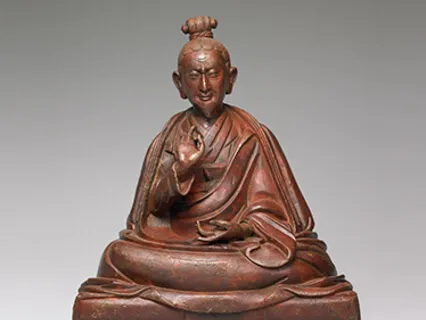
And today we are looking at one of those treasure discoverers,
Also known as treasure revealers.
And this is Jigme Lingpa.
He is a treasure revealer in the Terma tradition.
And this sculpture is from 18th century Tibet.
It's actually metal work.
It might look wood,
Right?
Wooden,
But it is metal.
And his life purposely in discovering the Terma teachings that Padmasambhava left,
And in fact that was his kind of greatest achievement and gift to his tradition.
So he discovered text through a vision during a meditation retreat.
He was visited by a Dakini who appeared to him and offered these texts to him and then ordered him to swallow them whole as a way of protecting them.
And so he did.
And he kept them secret for seven years.
And by discovering this text,
He actually combined two separate Dzogchen lineages into one practice and really changed the entire future of those traditions,
Vimalamitra and Trisong Detsen,
Into one practice.
So this idea of discovery is something that we can take into our practice,
Our own meditation practice as a metaphor for part of why we do what we do.
And the practice is not necessarily a goal oriented one,
Right?
There's no hunting down of discoveries,
But there are things that may be revealed to us as a part of our practice if we're open to them.
And we'll hear a little bit more about that from our teacher today,
Tracy Cochran.
It's wonderful to have you back Tracy,
As always.
So Tracy is a writer and editorial director of Parabola magazine,
Which I'm holding right here.
And it's available in our shop.
If you'd like to pick up a copy.
This issue is all about the miraculous.
So another kind of springtime feeling I think.
So Tracy has been a student of meditation and other spiritual practices for decades.
And in addition to teaching here at the Rubin,
She currently teaches at the New York Insight where she is just about to end her Monday night series of drop in mindful writing classes.
So you have one more chance this coming Monday.
If you'd like to experience that at New York Insight,
You are very welcome to drop in just for this last one,
Even if you've never been before.
And she also teaches every Sunday at Hudson River Sangha in Tarry Town,
New York and her writings and teaching schedule can be found online via parabola on Facebook and Twitter and Tracy Cochran.
Org.
Please welcome her back Tracy Cochran.
I'm very happy to be back.
And I'm happy to be sitting behind this particular figure,
Because they give teachers an opportunity to choose images.
And what really caught my attention about this one is that he was said to look very,
Very young from a distance.
And when you got close up,
You would see that he was actually very,
Very old.
And I really like this idea.
One of the things I love,
I love everything about being at the Rubin,
But one thing in particular I like is the distance and the lighting.
I do.
I once heard that joy is the best makeup,
But I think it's distance and lighting.
I do.
Beautiful lighting.
But something else,
I think that being in a state of discovery,
A state of realizing something is always young.
Think about that.
When you watch somebody's face light up with a sense of recognizing something,
They look young,
They glow.
And the word discover,
Of course,
In English means to uncover.
And so much of this practice is about seeing something that's always there.
We just didn't notice it before.
So what else is young?
It's spring,
Right?
It's dawn,
As I'm sure you noticed all by yourself,
Since it's 87 degrees out there,
According to one temperature I saw.
There can be a tinge of grief in spring.
We see all these budding flowers and trees and we remember,
Say,
A graduation that all of a sudden was quite some time ago.
Have you noticed?
There can be a tug,
A yearning.
You might,
For example,
Want all new clothes suddenly.
You feel this kind of pining inside.
And I related to the theme of a slow motion discovery or discovering something in the future.
I wanted to share a great American sutra about a young person,
A young man named James.
He was very,
Very poor and he was desperate to get out of North Dakota where he was from.
And one night,
He was driven anyway,
But one night during the war,
He was in a uniform and he looked up on a front porch in Louisville and beheld a young woman who in that moment encapsulated everything he desired.
She was beautiful.
She gleamed like silver.
She was like white gold.
And she seemed to him to be completely above the hot suffering of the poor,
Safe and protected.
And in that moment,
He dedicated his whole life to becoming the kind of man who could have that woman and be on that porch.
And her name was Daisy Buchanan.
And in that moment,
He became Jay,
Jay Gadsby.
And he dedicated himself by hook or by crook,
Mostly by crook as we know.
He's the great American,
What,
Success story,
Tragedy.
He was ravenously determined to be rich and powerful and to be dressed right and to have the right mansion and to throw the right parties.
Anything he could do to become a man who could have Daisy Buchanan.
And there comes a moment in this great sutra of desire where he gets to see Daisy again.
His mansion is right across the bay and night after night he looks out at that green light at the end of the dock pining for her.
And at last,
Conditions are just right so he gets to stand next to her.
But something extraordinary happens in that moment.
He realizes that she's changed,
But he can't let that in.
And he's changed,
But he can't let that in.
He can't quite accept that the object of his desire is already in the past.
And as we know it ends tragically.
But the reason it's worth recounting is because our desires are rooted in the past,
Ours too.
There are images,
There are tastes,
There are scents of what it is we pine for,
That were planted in us long ago.
And so in a sense,
Just like Jay Gatsby,
Where always there's that beautiful line at the very end of the book,
The great Gatsby,
About being boats against the current,
Born unceaselessly,
Again,
Towards the past.
How can that be?
This is the first great discovery.
When I first read the great Gatsby,
There was a middle-aged woman auditing the course in college who said,
You will not understand the great Gatsby until you get to be my age.
And I was incredibly offended because I thought I understood the romance of the story.
It's so beautiful.
And I did understand that.
But she understood that truth that was planted there,
That things change,
That things are impermanent,
That people are impermanent,
That we are impermanent.
Has anyone here ever had a kind of haunted feeling?
Have you ever pined for something you don't have or somebody?
I can see the smiles.
I can see far into the audience.
This kind of pining feeling.
Have you ever had an inner feeling of insecurity?
You feel a little bit insecure,
Like you're not quite where you want to be.
You're not quite together in the way you'd like to be together.
Just there's this little edge of feeling vulnerable and not quite right to step out on that porch.
And the first great discovery of this practice is that this is the way life is.
It's impermanent.
And there's always that edge,
That ache.
And it's made more painful by desire.
Another great discovery.
Have you ever noticed that the more you desire something,
The more you feel its absence?
The more you desire money,
The poorer you're going to feel.
Have you noticed?
It's like a backwards law.
Or the more you yearn to be attractive and desirable,
The more trouble you have with the image that confronts you in the mirror,
The more you're going to hate your clothes.
There's always that ache,
That rub.
So the imitation in this practice is,
If only Jay Gadsby had been here,
Which is highly unlikely,
But to realize in that moment of greatest suffering,
That moment of even having what you want and still feeling that lack of wholeness,
That slight unease,
That pining feeling,
That if you turn your attention to yourself in that moment,
In that moment with kindness,
There's a new life that appears.
This letting be.
It's like this now.
And there can be this opening,
This quality of discovering a new life,
Letting an old dream die,
An old dream of who you think you are,
Letting it be,
And finding what's right here right now.
And on a day like this,
Sitting together,
There can be such a feeling of discovery about that,
A feeling that I had no idea what I could be.
I've been so captive to this idea that I had to be this one thing,
But look at this,
Sense this,
Feel this.
Look at the size of this life right now,
Right here.
So let's sit.
We put feet firmly on the floor.
Let our backs be straight.
Let our eyes close.
And just notice what's here.
Just notice this body right now,
In this moment.
And notice how it feels to give yourself your full acceptance,
Expecting attention,
Noticing what's here with no judgments,
No striving.
And as the body begins to soften in the light of this kind attention,
Bring the attention to the breathing without seeking to change it in any way.
Just notice the in-breath and And immediately you notice thinking,
Sensing,
Images,
Opinions.
And we let everything be.
From everything.
Nothing is excluded.
And when you notice that you're thinking or dreaming,
You bring the attention back to the breath and the body in this moment.
Noticing the vibrancy inside you.
The light of a way of breathing.
The light of awareness without thinking.
Sati means remember.
Remember the present.
Hai.
Noticing that at any moment I can come back to the warmth and the light of an attention that doesn't judge,
That accepts with no exceptions.
As we continue making this movement of return,
We notice that we soften and open to life.
Everything that comes with kindness and letting go.
Letting everything be without striving to change it.
Noticing that it changes.
Letting everything be without striving to change it.
Letting everything be without striving to change it.
Noticing how it feels to come back with no judgements.
Noticing how it feels to come back with no judgment.
Just acceptance.
Letting everything be without striving to change it.
Letting everything be without striving to change it.
Letting everything be without striving to change it.
Letting everything be without striving to change it.
Letting everything be without striving to change it.
Letting everything be without striving to change it.
Letting everything be without striving to change it.
Noticing how fresh and warm it can feel to be here.
Letting everything be without striving to change it.
Letting everything be without striving to change it.
Letting everything be without striving to change it.
Letting everything be without striving to change it.
Letting everything be without striving to change it.
We begin to remember that we're meant to be here.
We begin to remember that we're meant to be here.
We begin to remember that we're meant to be here.
We begin to remember that we're meant to be here.
We begin to remember that we're meant to be here.
As we prepare to finish,
We notice how much more we are than we think.
We are alive.
Thank you so much for your practice.
I look forward to seeing you in June.
Bye-bye.
That concludes this week's practice.
If you'd like to attend in person,
Please check out our website,
Rubinmuseum.
Org slash meditation to learn more.
Sessions are free to Rubin Museum members,
Just one of the many benefits of membership.
Thank you for listening.
Have a mindful day.