Welcome to the mindfulness meditation podcast.
I'm your host,
Dawn Eshelman.
Every Wednesday at the Rubin Museum of Art in Chelsea,
We present a meditation session led by a prominent meditation teacher from the New York area.
This podcast is a recording of our weekly practice.
If you would like to join us in person,
Please visit our website at rubinmuseum.
Org slash meditation.
We are proud to be partnering with Sharon Salzberg,
The teachers from the New York Insight Meditation Center,
The Interdependence Project,
And the Shambhala Center.
The series is supported in part by the Hemera Foundation.
In the description for each episode,
You will find information about the theme for that week's session,
Including an image of a related artwork chosen from the Rubin Museum's permanent collection.
And now,
Please enjoy your practice.
Good afternoon,
Everybody.
Hi,
Welcome to the Rubin and to our weekly mindfulness meditation practice.
My name is Dawn Eshelman.
We are talking about community this month,
And that is certainly something that we experience here together in our weekly practice.
And thank you for that.
I experience it too with you,
And I appreciate it.
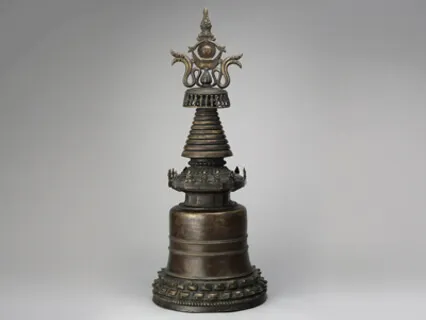
We are looking today at a stupa.
This is a relatively small stupa that is located in our galleries,
Just a couple of feet tall.
But of course,
Stupa can range in size from teeny tiny to really many stories high.
They can be a monument in a landmark and are often the focal point of a pilgrimage or destination,
Spiritual destination.
And often,
When people travel to a stupa,
They will circumambulate around it as a form of worship and a form of accumulating merit.
And that is,
For us,
A kind of symbol of community.
This is a kind of an anchor point that community can gather around.
And that action of circumambulating is also can be a kind of social activity as well.
So a stupa is originally even predating the Buddha,
A type of marker for a burial ground.
And then when the Buddha passed away,
According to legend,
Eight great princes divided his ashes with each creating a stupa in their own kingdom.
And then during the third century BCE,
The great Indian king Ashoka took the contents of those eight stupas and spread them across 80,
000 stupas.
And so this became a symbol for disseminating teaching of the Buddha,
But also kind of symbolizes this global community.
And I can't help but with that in mind,
Give a nod to climate week,
Which is this week.
And just in the same way that a community comes together to create and build a stupa or to take care of it,
We can think of the earth in that same way.
That's something that we're all working to take care of.
And finally,
With that in mind,
A note that climate change has caused severe seasonal droughts for the Ladakh community in the Himalayan region.
And so,
As we all know,
The Ladakh community is a very,
Very important part of the world.
And so,
We're all working together to create and build a stupa.
And so,
With that in mind,
Give a nod to climate week.
And then in the next century BCE,
A note that climate change has caused severe seasonal droughts for the Ladakh community in the Himalayan region.
And so,
With that in mind,
A note that climate change has caused severe seasonal droughts for the Ladakh community.
She has been studying and teaching for over 45 years.
And she's the author of many fabulous books,
Including her most recent,
Real Love.
Please welcome her back,
Sharon Salzberg.
Hello.
Community,
What a great topic.
And for this moment,
Being back here after a while away,
I was thinking when I walked into the cafe,
I came in through that door,
And I just saw these people there that I knew.
I thought,
Oh,
What a fabulous sense of community.
And I realized how much the sense of community is like a sense of home,
Right,
But not necessarily place-based,
But being is based.
I think that's very much the sense of like,
Oh,
I'm home.
So,
What does being home feel like to us?
It feels the place where we don't have to pretend or we don't have to put on an act.
We feel freer.
We feel more relaxed.
We feel at ease.
We have ease of heart.
We allow ourselves maybe to be vulnerable because we don't have to act out a role in some way,
In this ideal sense of home.
It's so comfortable to be home.
And here we are,
Looking at how to forge a home,
Certainly within ourselves,
Through various practices and with one another.
I'm sure since those of you who come very often to these sessions,
I would imagine someone else has quoted the Buddha in talking to Anandas,
A very often used quote,
Where Anandas,
This figure in Buddhist literature,
In the text,
He's sort of like the straight man.
And he doesn't seem that bright,
But of course he was massively enlightened.
That's why I thought,
Oh,
Maybe you shouldn't say that.
Anyway,
His role is to elicit things from the Buddha,
So it's always like,
Not so,
Ananda.
Don't put it that way.
It's not that way.
It's this way.
It's not really that.
It's this.
Ananda once went to the Buddha and said,
It seems to me that half of the holy life is having good friends.
And the Buddha said,
Not so,
Ananda.
Don't say that.
In fact,
The whole of the holy life is having good friends,
Which is a beautiful,
Beautiful comment.
In the Burmese tradition,
Which is where I did most of my,
Certainly my initial practice,
The word for teacher,
The term for teacher in Pali is kalyanamitta,
Which means spiritual friend.
The Buddha is often talked about as having been the best friend any of us could have because their motive in being with us and trying to help us is really our own liberation.
It's not ego gratification.
That's a really good friend.
And when I first practiced meditation,
I began in the context of an intensive ten-day retreat in India.
And in the beginning of those retreats is a kind of ritual saying,
Okay,
Now we're embarking on a journey.
We were asked to undertake three refuges in the Buddha,
The Dharma,
And the Sangha.
So taking refuge doesn't mean that now you're a Buddhist and you get a card or anything like that.
It's an invitation to really think deeply and hold in your heart what these three might symbolize.
So the first is the Buddha.
Now the Buddha is always talked about as having been a human being,
Not even like a divine being.
He was a human being.
When we look at a Buddha,
It's not a kind of alienated look.
It's really seeing something about human potential,
Which exists inside of us,
Potential for clarity,
For love,
For wisdom,
And so on.
So we take refuge in the sense of affirming a possibility.
If we're undertaking a meditation practice,
For example,
The possibility is to have an inspiration,
An aspiration that's pretty immense,
Not just to feel a little bit better on the weekends or something,
But wow,
Let's see what love I am capable of,
What wisdom I really might live with,
How those might be integrated fully into my life.
And we take refuge in Dharma.
Dharma is a Sanskrit word.
It particularly means the path or the way.
It's not like taking refuge in the sense of taking a vow of allegiance to a doctrine or something like that,
But it's really undertaking a journey.
It's not something that works if you sit back and think,
That was a great thing that other person did.
It's a journey.
It means putting yourself out there,
Experimenting,
Really taking a look to see what your own experience is and using the guidelines that do exist.
There is a path,
And you may say it's worthless after experiencing it.
That's fine.
That's up to you.
But you have to experience it first if you really want to honestly get some sense of it.
And I think I found it quite reassuring to think,
Oh,
These teachings have existed for a really long time.
This isn't just some casual recent,
Recent discovery.
And of course I hear it from the other side now,
Where sometimes,
Especially with loving kindness and meditation,
Which tends to be the one I'm most identified with in the eyes of the world,
Where I was teaching once,
For example,
In Connecticut,
Actually.
It was a weekend.
Somebody came up to me and said,
This stuff is incredible.
When did you make it up?
And I said,
Well,
You're really in luck.
I didn't make it up.
That would be a problem.
So it's some sense of like,
Wow,
Isn't that incredible?
It wasn't made up in a sort of New Age brochure,
Unlike a lot of things that are kind of made up.
I was just sort of talking the other day somehow.
I was saying to somebody,
This group of people that I began long ago with,
I don't know,
Many books ago,
I began seeing myself described in a lot of places as one of America's most beloved spiritual teachers or meditation teachers.
And I got really excited.
And I thought,
Did they do a survey?
I was like,
What a sweet thing.
And then I asked the person who was my publisher at the time,
I said,
How did they find out?
And he said,
I made it up.
I said,
Okay,
That's made up.
The practice is not made up.
So that should be reassuring.
And then the third refuge is Sangha,
S-A-N-G-H-A.
In Pali,
It means community.
So here we are.
It means community in a lot of different senses.
Community in the sense that there have been beings who have walked on this path or other paths,
Who have,
Through their own dedication and their courage,
Been willing to be unconventional and not just to take easy answers for where happiness is to be found.
And they have forged ahead,
And so can we.
It's almost like this sense of entering the stream of people who are explorers,
Who are that bold.
And they,
Too,
Are human beings like we are,
With strengths and weaknesses and all of that.
And so we have the opportunity to get a sense of fellowship,
Even in that more abstract way,
To understand that this is within human potential.
People have done this,
Not just the solitary figure of the Buddha or the singular figure of the Buddha,
But beings have done this and have lived very different kinds of lives as a result.
And let's check this out.
Let's see what that might mean for me.
And then it also means community in this sense.
We gather together.
We practice together.
We find we're not the only ones with certain kinds of challenges.
And that's also reassuring.
I remember that first retreat I did,
My own first retreat,
Was in India in this town,
Bodh Gaya,
Bless you,
Which is the town that's grown up around the descendant of the tree.
They say the Buddha was sitting under when he became enlightened.
And the place we were,
The place the retreat was held,
Was this kind of like Burmese temple,
Which was a little bit down the road outside of town.
And the men all slept on the roof under a tent.
The women all slept in the corridor surrounding the meditation hall.
There were different doors into the hall.
And so it was like a square.
And we all slept on the floor.
That's just how it was.
And so for some reason,
Goenka,
S.
N.
Goenka,
Who was the teacher of that retreat,
Decided one day after lunch he was going to go around to where everyone was staying and ask them how their meditation was going.
So I could hear him approaching and asking all these different people.
And I had just been through this bout of incredible sleepiness,
Just so much sleepiness.
And I was really embarrassed.
I didn't want to tell him.
But he was getting closer.
And then fortunately the person next to me,
Right next to me,
Who is still a very good friend of mine,
When he asked her,
She said,
I'm so sleepy.
And I thought,
Great.
Now I'm going to get the advice.
And I don't have to disclose it maybe.
So then I waited.
I thought,
Oh,
This is so exciting.
He's going to give her a special mantra or some extraordinary esoteric thing.
And then he said,
Perhaps you should go throw some cold water on your face.
And I thought,
Really?
But just to know that I'm not the only one,
This is something that happens.
Here we are,
Became the path for a lot of compassion.
In some ways we can be so much harsher with ourselves than with others.
But when you imagine,
Well,
It's not just me.
How would I speak to this friend who keeps falling asleep?
Or this other person who keeps falling asleep?
I would be a lot nicer to them.
And then we can start there and then bring it inside.
To know we all have these challenges that we're all trying.
And that it's not easy to step away from conventional values,
For example.
And to think I want to explore different kinds of happiness and what joy to find out we're not the only one.
Here we are,
And we can really,
Even in silence,
Support one another tremendously.
So why don't we sit together?
Just sit comfortably.
Close your eyes or not.
However you feel most at ease.
You can find the place where your breath is strongest for you,
Clearest for you.
Bring your attention to that place and just rest.
Let's see if you can feel one breath.
When you find your attention has wandered,
You've gotten lost in thought,
Or spun out in a fantasy,
Or you fall asleep,
Just take a moment and look at how you speak to yourself in that moment.
And if you find that voice is pretty punitive,
You've failed,
You're terrible.
Everyone else is doing better than you,
Or something like that.
See if you can just recognize that.
Let go of it gently.
And with some kindness towards yourself,
Return your attention to the feeling of the breath.
Let's see if you can feel it.
Let's see if you can feel it.
Let's see if you can feel it.
See if you can feel just one breath.
Without concern for what's already gone by.
Without leaning forward for even the very next breath,
Just this one.
And if your attention wanders truly,
It's okay.
That's just the conditioned nature of our minds.
The most important moment is after your attention has wandered.
Practicing letting go.
Let's see if you can feel it.
Let's see if you can feel it.
Let's see if you can feel it.
Let's see if you can feel it.
Let's see if you can feel it.
Let's see if you can feel it.
Let's see if you can feel it.
Let's see if you can feel it.
Let's see if you can feel it.
Let's see if you can feel it.
Let's see if you can feel it.
Let's see if you can feel it.
Let's see if you can feel it.
Let's see if you can feel it.
Let's see if you can feel it.
Let's see if you can feel it.
Thank you.
That concludes this week's practice.
We hope you enjoyed this video.