Welcome to the mindfulness meditation podcast.
I'm your host Dawn Eshleman.
Every Wednesday at the Rubin Museum of Art in Chelsea,
We present a meditation session led by a prominent meditation teacher from the New York area.
This podcast is a recording of our weekly practice.
If you would like to join us in person,
Please visit our website at rubinmuseum.
Org slash meditation.
We are proud to be partnering with Sharon Salzberg and teachers from the Shambhala Center.
The series is supported in part by the Hemera Foundation.
In the description for each episode,
You will find information about the theme for that week's session,
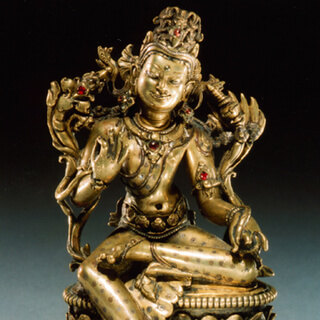
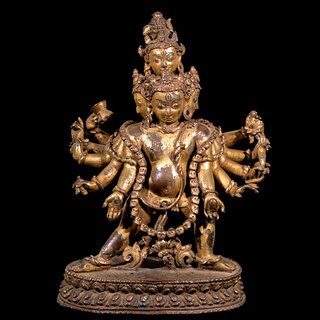
Including an image of a related artwork chosen from the Rubin Museum's permanent collection.
And now,
Please enjoy your practice.
Good afternoon,
Everybody.
Welcome to the Rubin and to our weekly mindfulness meditation practice.
My name is Dawn Eshleman.
For anybody who's here for the first time,
Anybody?
A few,
Welcome.
Great to have you.
We have been talking this month about focus,
The element of focus,
And what that has to do with our meditation practice.
And we started off from the scientific point of view,
Understanding that what we focus on actually can shape physically our brains.
And last week,
We had a really different lens to look through,
Which was through a kind of fairy tale and understanding of kind of our life's focus,
Peeling back the layers until we get to the core.
And today,
We're kind of going back to our wheelhouse here.
We are looking at a really beautiful object from our collection.
It is this kind of gorgeous and fierce dagger or purbha.
And it is a ritual dagger.
So it's a very important ritual tool in Tibetan Buddhism,
Specifically Tantric Buddhism.
This was created in the 17th century.
It is iron and gilt brass.
And it is actually,
It's hard to see in this image,
But it's actually a three-sided blade.
So there are three kind of blades coming to a point there.
Up at the top of the blade,
Encircling it,
Is a really interesting kind of hybrid animal that is in the kind of wrathful canon.
And then up the blade at the very top,
You can see some wrathful faces.
And this,
Of course,
All tells us that this instrument is utilized to ward off negative demons.
So we employ these kind of wrathful elements ourselves to help us with that in this practice.
The dagger itself is used in many different occasions to ward off negativity and to really kind of ground and focus a project.
For example,
When a monastery is built,
The first thing that occurs,
A sort of a groundbreaking ceremony,
Is to take this ritual dagger,
Which is a would use it in that ceremony,
And pierce the ground with it,
To be kind of the very first and grounding element to that new creation.
And so we can take that symbolism into other acts as well and understand that the dagger is really symbolizing this sort of piercing of negative demons,
Really kind of in a way focusing on them in order to pierce them,
And therefore dispelling them and warding them off,
Clearing the ground,
So that something new can begin.
So we are welcoming a new teacher here today,
And I'm delighted that she can join us for our series.
Dr.
Shante Paradigm Smalls is here with us today.
She is a teacher and meditation instructor in the Shambhala lineage of Tibetan Buddhism.
And so in addition to welcoming Shante today,
We are welcoming the Shambhala Center as a partner in this program.
She's a student of Sakyong Rinpoche and has been a member of Shambhala and the New York City Shambhala Sangha since 2006.
And Shante is an assistant professor of English at the St.
John's University in Queens,
New York.
Please give a warm welcome to Dr.
Shante Paradigm Smalls.
Good afternoon,
Everyone.
Can you hear me?
Thank you.
So thank you so much,
Don and the Rubin,
Sharon Salzberg and the New York Insight Center for welcoming me and Shambhala back to the Rubin.
I think Ethan Nicktern used to teach here,
Who is also a member of Shambhala,
My meditation instructor.
And I'm really excited.
Thank you all for coming out in your lunch hour or this time.
It's really lovely to see all your faces.
And this is really on the spot.
So that's great.
Talking about focus.
It's a real sense of being on the spot with you all.
And I hope we can have a nice give a little pithy talk of relating the perba to meditation practice.
Then we'll practice for about 20 minutes of guided meditation with enough space for you to kind of sit.
We'll walk through that and then we'll have some Q&A.
OK,
So I'm going to my notes here.
So as Don so eloquently said,
This is a perba or a ritual dagger,
Tibetan ritual dagger.
And you can learn more about this particular dagger,
I think,
After during the tour.
But I'm going to talk about the principle that this perba or the principles that it represents.
So one of the elements is this three sided aspect of three sided blade.
And it has to do with the three Buddhist realms.
Heaven,
Earth and humanity or heaven,
Earth and environment,
Depending on translation.
And not heaven,
Maybe as we might typically understand it,
But the qualities of view,
Earth and kind of practicality and putting those things together.
So this perba represents enlightened action.
And so it's associated with yidams or meditation deities,
But particularly Vajrakalaya,
Who is the Buddha of action,
Of enlightened action.
And that deity is from the enigma lineage.
I don't know how much you all know about the different schools of Tibetan Buddhism,
But the enigma school is the oldest school.
And so in Shambhala,
The Vajrakalaya practices were introduced actually not that long ago,
But about a decade ago.
The practices themselves are,
Of course,
Very,
Very old,
As old as the enigma lineage.
But in our tradition,
They had only been practiced by our lineage holders.
And then they were introduced to senior students.
And so in the last decade,
They've rolled out as practices.
Actually,
As I was preparing today,
I said,
Oh,
Like,
Maybe I could find something.
And I found in one of my chant books,
Actually,
A daily practice for Vajrakalaya.
I just sort of thought,
Oh,
That's really auspicious.
So the perba or the practice associated with Vajrakalaya is focused on removing obstacles.
So physical obstacles,
But also working with obstacles of mind,
Obstacles in our lives,
And protecting the environment of truth and kind of kindness.
And those things flourish as a result of kind of that genuine action.
And so in relationship to focus,
I want to soften the word focus a little bit.
I don't know for you all,
But for me,
When I hear focus or when I think of focus,
It's very intense.
It's a little bit sharp.
And that's OK.
It can be one-pointed.
But there's also an aspect of gentleness in relationship to focus in meditation.
And so one way to think about focus in relationship to meditation,
And this perba actually can be an object of meditation,
For instance,
If you're doing some kind of visualization practice.
But one way to think about focus is to think about an object of meditation.
So for many traditions,
The basic object of meditation is some relationship to the breath.
And sometimes when I'm working with new meditation students or talking to newer practitioners,
They'll get very athletic about meditation.
And it is a body practice because obviously we use our body.
But there's a kind of tensing.
And the practice is really meant to help us relax,
Not relax in the sense of fall asleep,
Although I fall asleep many times on the cushion,
Not to be too loose,
But to help us to step away from our habitual everyday patterns and really feel what it's like to feel the breath as it enters and leaves and moves the body.
So we think we talk about a lot of times across many meditation traditions the object of meditation.
And in my tradition,
We talk about the relationship between mindfulness and awareness or shamatha vipassana,
Which basically means peaceful abiding or can be translated into mindfulness and vipassana,
Which means awareness basically.
And that the practice of shamatha,
Of sitting practice,
Where you work with your breath in a sitting posture,
Whether it's in a chair,
Which we all are,
Or on a cushion,
That working with the breath and working with the thoughts that come up as one is sitting in a chair and breathing helps us to work with our mindfulness,
Placing our mind on an object.
And that work of placing your mind on an object,
Continual placement of your mind on an object,
As the mind wanders or gets taken away by thoughts,
Naturally causes us to get in touch with our awareness.
So we can think of mindfulness as you're listening to me speak or you're looking at me,
But if the door opens,
You might be aware of that,
Your environment.
So there's a way that we can pay attention to what's happening to a thing,
But we're also aware of our environment.
And so that's the relationship between mindfulness and awareness.
And so that's a kind of a gentle expansion or a gentle unfolding of this idea of focus,
That we gently place our attention on our object of meditation,
And that helps us to become aware of our environment,
External environment and internal environment.
Does that make sense?
And then I just want to say one last thing about this in relation to the connection between meditation,
The ritual or the idea,
Concept of the perba,
And how that's sort of enacted or thought about in certain tantric traditions.
So one of the concepts that this perba is related to is something called the four karmas.
Has anyone ever heard of the four karmas?
So this has to do with skillful action.
And it sounds actually really,
Really cool,
And it is really,
Really cool,
But it's much less kind of violent than it sounds.
So they're related to these four concepts of pacifying,
Enriching,
Magnetizing,
And the perba would also be associated with the last one,
Which is destroying.
So we always start with the ground of pacifying,
Pacifying our own minds,
Pacifying situations.
If you're trying to be helpful,
If you work with people,
Or if you're working with yourself on the subway or on the street or something,
The ground is always pacifying,
Right?
De-escalation in other kinds of language.
And enriching has to do with what can I bring to the situation?
How can I work with the situation?
And then there's magnetizing,
Which has to do with how we bring people together,
And how we sort of bring harmony and community,
How we work with our situation,
What kind of skills can we bring to a situation to make it as robust as possible?
So those three things maybe seem different than the last one or contradictory to the last one.
And destroying is not necessarily breaking things apart,
But it's a skillful way of cutting harmful action.
A lot of people hear that and they want to go right to the cutting.
But maybe they have someone in mind like,
Yeah,
I want to cut that person or cut that situation.
But it's more like a ladder.
You can't get to the top of the ladder by necessarily,
Well,
You could,
I guess,
Jump,
But you'd probably hurt yourself.
You have to take the rungs.
So these are relational.
So I think maybe that's all I'll say about that.
And maybe I'll ask you to take a comfortable seat.
And so I assume,
How many of you meditate?
Wow,
That's great.
So and do you meditate regularly?
Is that a great?
Excellent.
How many people do not meditate?
OK,
Thank you.
One out of two.
OK,
That's OK as well.
So I'm assuming many people have different practices.
Perhaps you belong to a particular tradition or you have a particular way of meditating.
And that's excellent.
This is not a conversion session.
But I'm going to teach what I know,
Which is the technique,
The basic sitting technique that I was introduced to when I first came to Shambhala in 2006,
And the basic technique we teach and that I teach to students.
So we're all sitting.
That's great.
And if you can,
The most important thing is to be comfortable and to try to have a sense of relaxation and a sense of feeling your own inherent intelligence and your own inherent beauty and humanity,
Which is such a gift.
The gift of being alive and being with each other.
In terms of the physical technique,
We,
As you all are,
We sit upright with our feet planted firmly on the ground.
So the bottom half of the body,
There's a sense of groundedness in the earth.
I may just stand up for a second if hopefully that's not too.
There's a sense of groundedness in the earth,
Almost like mountain pose.
If you know that from yoga.
And there's a sense that through our body,
We're connected to this terrestrial plane that we're on.
So just feel your body,
Your feet,
Your sits bones sinking into the earth,
The chair as representative of the earth.
Just feel that sensation.
If you like,
You can place your hands on your knees or your thighs or if it feels more comfortable on the arms of the chair,
Just a relaxed sense of being here.
I'll just model that.
The upper part of your body is upright.
It's as if your torso and up is like the stalk of a beautiful blooming sunflower.
There's dignity as your body reaches for the sky or the heaven concept.
And the front of your body is soft and relaxed.
It's open.
The heart center,
Which is not quite the heart,
But it's the center of your being in your chest area.
The heart is also in Tibetan Buddhism.
The heart and the mind are one.
So the heart is actually located.
As they say,
The heart is the seat of the mind.
The back of your body is firm.
Not tight,
Not rigid,
But just upright,
Supporting you.
So you work with the balance of soft front,
Firm back.
Okay,
Great.
Now,
Here's where it may be a little bit different for some of you.
And if this doesn't feel comfortable,
Feel free to disregard this instruction.
The gaze is actually open.
And your gaze is downward about.
You sort of look through the person in front of you,
About six to eight feet in front of you,
Where your eye is just taking in the whole environment.
It's a soft focus.
You're seeing with your whole eye.
If that feels uncomfortable,
You don't like it,
Feel free to disregard it.
And finally,
The object of your meditation is actually to feel the sensation of your body as it breathes.
Feel the sensation of breath coming in and as it goes out.
And just place your attention on that sensation of the body breathing.
And when thoughts arise as they do,
That is the nature of mind,
If they take you away from your object of meditation,
Which is the sensation of the body breathing,
Just lightly,
Gently,
Like a feather touching a bubble,
Say thinking,
And we turn your attention to the sensation of your body breathing.
So we'll sit,
I'll ring the gong here,
Or the rin.
And then I'll ring us out when we're done.
GONG GONG GONG GONG GONG GONG Thank you,
And have an amazing day.
Enjoy this beautiful day in this beautiful museum.
APPLAUSE That concludes this week's practice.
If you'd like to attend in person,
Please check out our website,
Rubinmuseum.
Org slash meditation to learn more.
Sessions are free to Rubin Museum members,
Just one of the many benefits of membership.
Thank you for listening.
Have a mindful day.