Welcome to the mindfulness meditation podcast.
I'm your host,
Dawn Eshelman.
Every Wednesday at the Rubin Museum of Art in Chelsea,
We present a meditation session led by a prominent meditation teacher from the New York area.
This podcast is a recording of our weekly practice.
If you would like to join us in person,
Please visit our website at rubinmuseum.
Org slash meditation.
We are proud to be partnering with Sharon Salzberg and teachers from the New York Insight Meditation Center.
The series is supported in part by the Hemera Foundation.
In the description for each episode,
You will find information about the theme for that week's session,
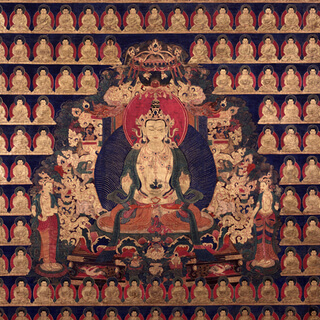
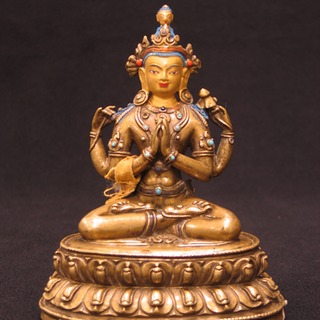
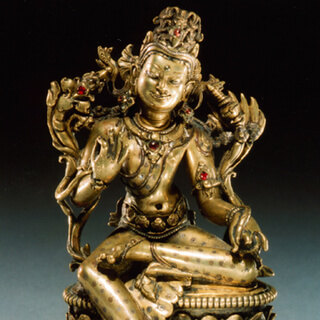
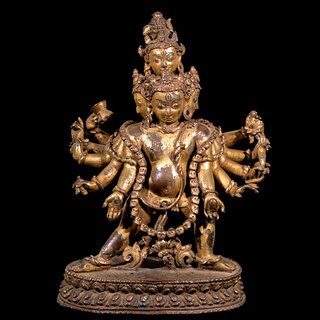
Including an image of a related artwork chosen from the Rubin Museum's permanent collection.
And now,
Please enjoy your practice.
It's wonderful to see you all and thanks for being here for our weekly mindfulness meditation practice.
My name is Dawn Eshelman.
There's one new face in the room today that I know of and that is our teacher,
Rebecca Lee.
And I'm so excited that she's here with us.
I will introduce her to you in just a moment and bring her up on stage.
Well,
As is our practice,
We have selected with Rebecca a work of art that kind of frames the discussion we're going to have today,
Which is all about transforming obstacles.
And this theme,
Transforming obstacles,
Is something we've been talking about throughout the month about how it appears in the art in our collection,
But also how we can use that as a metaphor for our own practice,
Which is all about transforming obstacles in the moment.
So today,
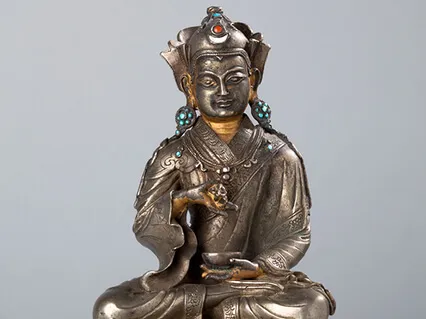
We're looking at a beautiful sculpture.
This lives up on the sixth floor.
And so if you want to learn a little bit more about it than what I'm going to tell you today,
You can meet Jeremy right outside,
Right after the program,
And he'll take you upstairs to the sixth floor.
And you can look at this object in person and learn a little bit more.
So this is from 15th century Tibet.
And this is Padmasambhava.
Padmasambhava is kind of known as the second Buddha,
Master of time.
He's kind of a sorcerer of time,
Able to read the past,
Present,
And future and experience them all together at once.
And with that,
He has the ability to project his teachings into the future so that they can be discovered when they're needed.
Kind of cool,
Right?
A time traveler,
Really.
And he also is known first and foremost for bringing Buddhism to Tibet.
And he's kind of this magical,
Kind of a little bit of a rock star in his own time,
Right?
He's been known to transform deities into flying dragons and fly across countries and do all of his time travel and his teachings,
Of course,
Are the most interesting and exciting element of all.
And even he faced some obstacles along the way,
Including when he was bringing Buddhism to Tibet,
A lot of resistance from these demons that he actually had to transform.
Not only did he,
He didn't just,
I should say,
Annihilate them or send them out of the way,
He transformed them into supporters and they became supporters of Buddhism in Tibet.
So also just wanted to look at this a little bit with you.
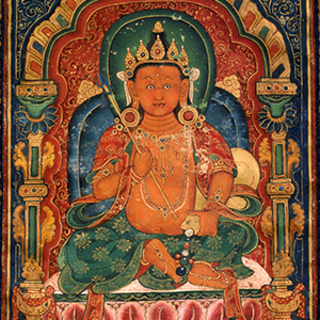
We see that Padmasambhava is sitting on a lotus throne.
He's seated in a lotus or a meditation kind of position.
And he has two esoteric ritual objects in his hands.
In his bottom hand is a skull cap,
A skull bowl,
Made a bowl made out of a skull.
And in his top hand he has a vajra.
And these are both common symbols that you will see throughout this tradition of art.
And some pretty great earrings,
If I do say so myself.
And lots more to look at there as well.
What obstacles do I need to transform to get those earrings?
So Rebecca Lee is with us today and she is,
She practices and teaches in the Chan tradition.
And if you haven't heard of that,
It is,
And you may have heard of the Zen or Zen Buddhist tradition and Chan is the Chinese pronunciation of Zen.
Hopefully she'll tell us a little bit about it.
Rebecca Lee is a Dharma heir in the lineage of Chan master Sheng Yin and started practicing meditation in 1995.
She began her teacher's training with Master Sheng Yin in 1999 to become a Dharma and meditation instructor.
She's trained with Simon Child to lead intensive retreats and received a full Dharma transmission in 2016.
She currently teaches meditation and Dharma classes,
Gives public lectures and leads retreats in North America and the UK.
She's the founder and guiding teacher of Chan Dharma community and a sociology professor at the College of New Jersey where she also serves as faculty director of the Alan Dolly Center for the Study of Social Justice.
Her talks and writings can be found online at rebeccalee.
Org.
Please give her a warm welcome.
Thank you so much,
Dawn,
For your lovely introduction.
And I learned so much about Padma Tambava.
When I was given the option to choose one of the artworks,
Padma Tambava was a no-brainer for me.
Dawn talked about my connection with Chan master Sheng Yin who is my root teacher,
My master,
And also my current teacher,
Simon Child,
Whom I have trained with.
I want to also talk about Dr.
John Crook who was Master Sheng Yin's first lay Dharma heir and also Simon Child's teacher as well.
And the reason why I want to talk about John Crook was that he's the person who got me thinking about Padma Tambava.
Not only was he a Chan Buddhist master himself,
He started practicing Chan in Hong Kong in the 1950s,
But he was also trained to teach Tibetan Buddhism.
And so Padma Tambava was one of his masters in his mind.
Coming back to the Reuben is very special for me because this is his favorite space in New York City.
When we used to host him in our home,
When he came to lead retreats at our retreat center,
He always would like to come visit the Reuben and we often would visit Padma Tambava.
So I look forward to being able to visit this statue again.
John Crook passed away in 2011 and so it's a very special day for me to be remembering him here with you.
So Dawn talked about my training with Master Sheng Yin who passed away in 2009 and I have practiced with Master Sheng Yin for a long time,
Not just as his teacher,
Not just as a student,
But also I served as his interpreter traveling with him to lead retreats and attend international religious leaders meetings.
I worked on two books with him,
One of which his autobiography.
I also worked with him to run the retreat center in Upstate New York as well as being in the teacher training program with him.
So because of that,
I consider him my master,
My root teacher and what I present in retreats and Dharma teaching mostly came from what I've learned from him and also through John Crook and Simon Chow who studied with Master Sheng Yin in the Chinese Chan tradition.
And Dawn mentioned Chan tradition is,
Chan is the Chinese pronunciation of the word Zen that's more well known here in America and also Zen went to Japan from China.
So the Zen tradition used a lot of the teachings and Chan master's writings from China.
Some of you might have heard of Dogen who went to China and studied at this monastery that I visited with John Crook in 2008 where Dogen encountered the practice of silent illumination.
Some of you might have heard.
So that's a very brief history or connection to what you might know.
And I'm part of this lineage that had both the Soto,
What you're more familiar Soto Zen in Chinese,
Chaodong lineage,
As well as what you'd be more familiar with Rinzai Zen,
Which is Linji in Chinese Chan tradition.
The Master Shanek got transmission from both of the lineages in China.
And today's topic,
Transforming obstacles,
Is really lovely to hear that even Padmas and Vavas encountered obstacles.
And when we are here engaging in the practice,
It's helpful to remember what would we do.
What are we doing here in the practice of Buddhism?
Buddhism 101,
Suffering.
We want to be free from suffering.
And remembering what is suffering all about.
Suffering or Dukkha is really this sense of,
This experience of unsatisfactoriness.
Whatever that is going on right now is not good enough.
Whatever that's going on right now,
Something's wrong,
Something's missing.
It's not good enough.
And because of this way of being,
We feel that our life is filled with obstacles.
It may have something to do with what's going on in our lives.
We have children,
Maybe the kids,
Something's wrong with their grade.
I heard from Chinese parents,
99?
Why did you miss that one question?
And just failing to acknowledge that,
Wow,
You got 99 questions right.
What's wrong with that one question?
Don't we do that?
Or when we're at work and we are getting all upset that our coworkers just wouldn't do this thing right,
Or wouldn't do what we would like them to do,
To maybe solve a problem together.
And we're just all forgetting that they're here,
They're doing all the other things that they've been doing to make things work.
Or maybe it has something to do with what's at home.
We get annoyed with what our spouse wouldn't do,
That they're not meeting our expectation.
They're not cooperating with us,
Maybe in figuring out where to move to.
I heard someone telling me about this problem recently.
And so we focus on that,
That's my obstacle,
That's my obstacle,
That's my struggling,
Struggling,
So much suffering.
And of course,
When we focus on what is not working,
We completely forget to also notice everything else,
Everything else in our lives.
And you might experience that in your own meditation.
I don't know if you have experienced that when we're sitting here,
Some part of the body's not comfortable,
Discomfort,
And then we focus on that.
I wish that pain would go away and just we engage in this battle with it.
And this creates a distorted view of reality.
Well,
The body's not just that pain,
Right?
There's actually the rest of the body that is working.
The heart is beating,
The lung is working so that we're still breathing.
But we have this habit of allowing what we perceive as obstacle to take over and allow it to define our entire reality and forgetting everything else,
That is actually still there.
And we develop this habit of taking that all for granted.
The kid gets 99% of the question right,
But that's what you're supposed to do,
To get for granted what they work hard for that too.
Same thing with the body.
Or we might nitpick ourselves.
For example,
We sit here,
The body's just minding itself,
Breathing.
You're doing a breathing meditation.
Then you begin to nitpick our breath.
My meditation's not good enough,
Like I'm not relaxed enough.
My breathing is not whatever it is supposed to be enough.
And so we nitpick the part we think is not perfect,
It's not how it's supposed to be.
Well,
The body's breathing.
Isn't it something?
I think so.
I'm quite happy that it is breathing and remembering that.
But we do have this habit of forgetting to acknowledge that,
Taking that all for granted,
And allowing what we see as the obstacle to take over our whole existence,
And then making our life more difficult than it really needs to be very often.
So in the practice here,
What we can do is to practice allowing everything to be there.
Whatever it is,
If it's a busy mind,
Allow it there.
Allowing it to be there.
And to fully experience it with this relaxed body and mind.
And allow ourselves to be here with whatever is here in this present moment.
And we allow ourselves to do that,
We'll notice what seems to be some insurmountable obstacle.
Maybe some physical discomfort in our meditation.
Maybe the idea that the breath is not perfect,
My meditation is not going perfectly.
We observe that thought,
And then we see that it will on its own fade away from our mind.
And then we're here.
So let's try that together with our meditation.
What I'd like to invite you to do is to sit in a comfortable position.
If you're in a chair,
You might find it helpful to sit in the front half of the chair.
That will allow your upper body,
Your back,
To be relaxed and erect,
Facilitating this wakefulness.
And I take you through a guided meditation.
And if you wear glasses,
You might find it helpful to take off your glasses to reduce the pressure stimulating your facial muscles.
And we begin.
Feel the relaxation of the top of the head like melting butter.
And feel the relaxation spread to the forehead.
Back to see if we are holding tension in these muscles,
Maybe between the eyebrows,
By habit.
Maybe because of worries.
We can give these muscles a vacation and allow the tension to melt away.
And feel the relaxation spread to the eyeballs and eye muscles that get tensed up from all the analyzing,
Judging,
Comparing,
Planning in our daily life.
And right here,
Right now,
We can give these muscles a vacation and allow the tension to melt away.
And feel the relaxation spread to the facial muscles.
Back to see if we are holding tension in our facial muscles by habit.
Maybe from the need of needing to hold up a facial expression for the world to see.
Right here,
Right now,
You can give these muscles a vacation.
There's no need to hold the facial expression for others.
Allow the tension to melt away.
Check to see if you are holding tension around the ears,
In your jaw.
And feel the relaxation spread to the entire head.
Feel the relaxation spread down the neck muscles like melting butter,
Directly experiencing these muscles softening,
Allowing the tension to melt away.
And feel the relaxation spread down the shoulder muscles,
Feeling these muscles softening.
And feel the relaxation spread down the arms,
The forearms,
All the way down to the fingertips.
And feel the relaxation spread to the chest area.
Check to see if we are holding tension in this area by habit,
Maybe from anxiety,
Worry.
Right now,
We can give this anxiety,
Fear a rest and allow the tension to melt away.
And feel the relaxation spread down to the lower abdomen.
We hold a lot of tension in these lower abdominal muscles by habit in our daily life.
Right now,
We can trust that the skeletal structure can hold up the body and give these muscles a vacation,
Allowing the tension to melt away.
And feel the relaxation spread to the upper back,
Feeling the tension we often hold in the muscles between the shoulder blades melting away.
And feel the relaxation spread down to the lower back,
Down to the buttocks where we can feel the sensations of the bottom sitting on the chair.
And feel the relaxation spreading down to the thigh muscles.
Check to see if we are holding tension in these muscles,
Allowing the tension to melt away.
And feel the relaxation spread down the legs all the way down to the toes.
And feel the relaxation of the entire body sitting right here,
Right now.
Allowing,
Allowing the body and mind to be as it is in this unfolding present moment.
Moment after moment.
All we need to do is to be here.
And we may notice the subtle movements of the body breathing.
Allow ourselves to experience the breathing body.
What we often take for granted.
And you may notice thoughts,
Images,
Memories coming through the mind.
No problem.
That too is part of the present moment.
Allow it,
Allow them to be here.
And when it's time,
They will go away on their own.
We practice cultivating this weak form.
Their awareness.
Just being here with ourselves.
Being gentle with whatever arises in the mind.
As an antidote to the habitual harshness that our culture has conditioned in us.
Maybe we Christians can look forward to it.
.
.
.
.
.
Many blessings to you.
.
.
.
.
That concludes this week's practice.
If you'd like to attend in person,
Please check out our website,
Rubinmuseum.
Org slash meditation to learn more.
Sessions are free to Rubin Museum members,
Just one of the many benefits of membership.
Thank you for listening.
Have a mindful day.