Welcome to the Mindfulness Meditation podcast.
I'm your host,
Dawn Eshelman.
Every Wednesday at the Rubin Museum of Art in Chelsea,
We present a meditation session led by a prominent meditation teacher from the New York area.
This podcast is a recording of our weekly practice.
If you would like to join us in person,
Please visit our website at rubinmuseum.
Org slash meditation.
We are proud to be partnering with Sharon Salzberg and teachers from the New York Insight Meditation Center.
In the description for each episode,
You will find information about the theme for that week's session,
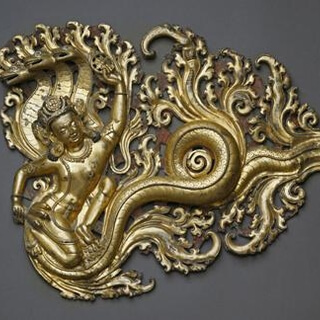
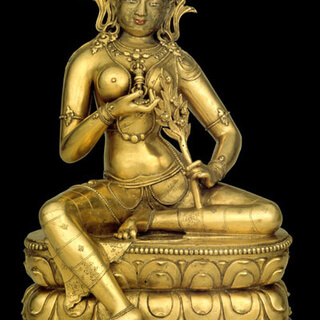
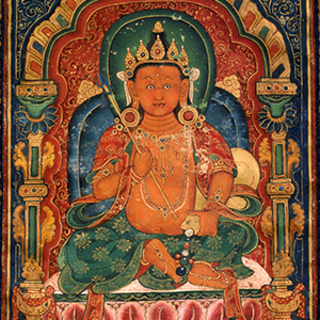
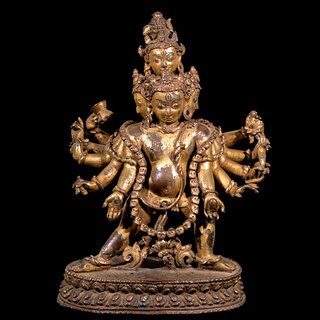
Including an image of a related artwork chosen from the Rubin Museum's permanent collection.
And now,
Please enjoy your practice.
Hi,
Everyone.
Welcome to the Rubin Museum of Art and to our weekly mindfulness meditation practice.
I hope you're feeling extra wise.
We've been talking about wisdom all month and its connection to this larger concept of power that's been in our little zeitgeist here.
And within the Tibetan Buddhist context,
Of course,
There is a deep relationship between wisdom and compassion and those two elements being the way to enlightenment for Buddhist practitioners.
And today,
We're looking at a figure that I don't think we've ever looked at here together before.
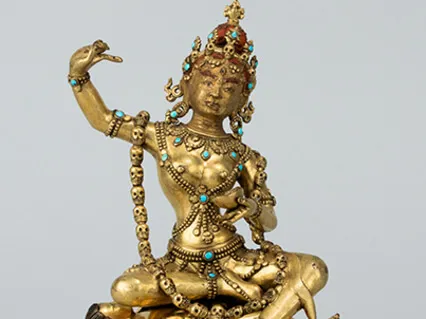
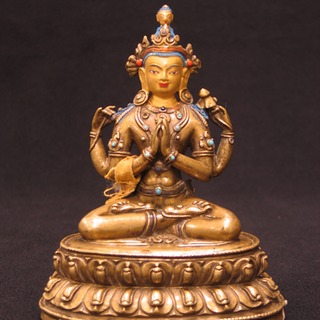
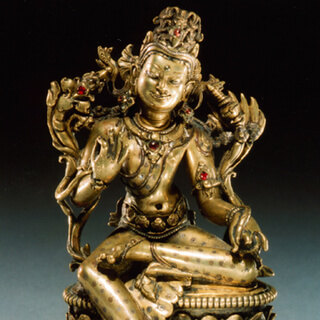
This is Yogini Nairatmya.
And this sculpture is 17th century Tibet.
This is in our collection,
Masterworks,
On the third floor.
And this Nairatmya Yogini is a female tantric deity and yogini.
And she's also known as goddess without self.
Or another way of saying that is without ego.
And she's considered the embodiment of the profound understanding of the nature of reality,
Wisdom that the self or ego is empty of inherent existence.
So through this lens of Tibetan Buddhism,
We can see that this concept of wisdom actually has a lot to do with emptiness or impermanence.
And in fact,
That's what the sculpture is telling us.
So we see that this deity is seated on her lotus throne.
And as we move up,
We can see that there are actually a lot of familiar elements here for those of you who have been with us for a little while.
Even though this is a completely new figure that we're looking at,
I bet you can decode some of the symbolism here.
So she's seated on a person,
Which we often see from time to time,
Right?
But it's just very naturalistically depicted here.
And so the symbolism here,
This person that she's sitting on,
This is a corpse.
And this is symbolizing the ego being kind of overcome,
Right?
And she's seated in kind of a half lotus position with one foot out,
So she can kind of take a step out to help.
She is bejeweled and kind of has the look of a bodhisattva,
Though that's not necessarily what she is here.
She has a garland of skulls,
Right?
Also this nod to impermanence.
And this sort of through Westernized what might be considered more optimistic side of impermanence,
This sense of possibility and interconnectedness that we all have.
And then her gestures are really interesting here,
And there's a reason for that.
So in her left hand she holds a skull bowl.
This is a bowl made out of a human skull.
Also this nod to impermanence and wisdom being all about emptiness.
And in her right hand,
It's a gesture we don't usually see,
Right?
And that's because she used to actually be holding a curved knife.
So it's missing,
Right?
And that knife is often held above the shoulder like that and used to symbolize a kind of cutting through of ignorance,
Which we see here.
And then of course her beautiful crown,
Also with skulls surrounding it.
So Buddhist tradition always describes wisdom as this understanding of not just knowledge,
But of the true nature of reality.
And this yogini is a helpful representation of this definition of wisdom,
But in a physical form.
Kimberly Brown is here with us today,
And she's here this week and also next week.
So it'll be really nice to have you two weeks in a row,
Kimberly.
She's the executive director of the Interdependence Project and a graduate of its meditation teacher training program.
And she leads mindfulness and compassion classes,
Workshops,
And retreats for groups and individuals in New York City.
She studies American and Tibetan Buddhism and practices loving kindness meditation.
And her teaching methods integrate depth psychology,
Compassion training,
And traditional Buddhist techniques as a means to help everyone reconnect to their inherent clarity and openness.
Please welcome her back,
Kimberly Brown.
Hi,
Everyone.
I'm your vain meditation teacher.
I do not like to wear these glasses,
But I can't see you otherwise.
So thank you,
John.
Wisdom.
I know you've been talking about it all month.
And this beautiful metaphor here,
This yogini,
Reminds us of what wisdom is.
In the Buddhist tradition,
Wisdom is seeing reality clearly.
That's all.
It's not really a mystical thing.
It's seeing the nature of our hearts,
The nature of our minds.
And these marks of reality are everything's impermanent,
Ever-changing.
And also,
Everyone here,
Every human you meet has suffering.
And that suffering is caused by our deep delusions.
You can see this yogini squashing a delusion here.
And the third mark of wisdom is this non-self or emptiness.
Now what those terms really point to are that we are deeply interconnected,
Interrelated.
Thich Nhat Hanh calls our lives interbeing or interdependence.
What this means is simply that none of us exist independently.
However much we might think this,
It's one of our greatest delusions.
Everyone here right now,
You are breathing the same air.
It is not possible to move somewhere where you are not breathing the air.
That's just a simple,
Easy way to look at interdependence.
And just so all the objects here,
They didn't just burst into the air.
This beautiful bell,
Someone found the metal,
Shaped it,
It came out of the earth.
It's made up of many,
Many elements,
Interbeing,
Interrelatedness,
Emptiness.
So in one way,
It all seems pretty obvious.
And I remember years ago when I was a Buddhist student just learning,
I remember saying to friends and teachers,
Like,
Well,
Yeah,
OK,
That's true.
I see it.
I see it.
Everything's impermanent.
I know that I'm not independent and that I have suffering,
Right?
But that was just an intellectual knowing.
That was not the same as wisdom.
Wisdom in this tradition means directly experiencing these realities of our existence,
These truths.
The word prajna,
The Sanskrit word for wisdom in this tradition is deeper knowing,
Deeper knowing.
And one way to think of that is moving this knowing from your brain to your heart.
OK?
This is the deeper sense.
This is cultivated through meditative techniques.
It's how we can have a direct experience of impermanence,
Of interdependence,
Of suffering.
And through ethical actions,
When we start to see that everything we do and say impacts ourselves and others,
That's another way to start to recognize interbeing.
So when I mentioned that you can consider this deeper knowing moving from the head to the heart,
In this tradition,
If you sit with Asian teachers,
They will often refer to the mind by pointing to their heart center.
All right?
Guard your mind.
Be careful of your mind.
OK?
And they're pointing to this deeper knowledge because in this tradition,
It's not the brain that holds the wisdom.
It's the mind,
Chitta,
C-I-T-T-A,
Heart-mind.
OK?
So it matters to have this direct experience because we can all agree that these things are true.
But if you're not living through them,
Then your actions aren't likely reflecting this wisdom.
Right?
You know,
Just to kind of do a thought experiment,
If all the humans on the planet had a deep recognition of impermanence,
OK?
Well,
Then each one of us would be able to not cling to the things that we want.
Right?
We'd be able to let go because we'd understand the nature of life.
We'd be able to lose someone we love and feel that terrible pain and allow it because that's the nature of life.
We'd also be able to have our happy moments and our joy without struggling for it to always stay.
Right?
That's like a neediness.
And you know,
If we all had a sense of interbeing,
Well,
That's kind of obvious.
You know,
I just made the reference to air.
I mean,
If I were a manufacturer and I built a factory here in the city and it was polluting,
I would understand that that would affect everybody.
And everybody includes me and my family too.
Right?
So you'd start to see how your actions affect each other.
And finally,
If you are able to touch into suffering your own and others,
Naturally then compassion arises,
The compassion that can be with suffering and also has a movement toward alleviating it.
OK?
So when we see this powerful figure,
This wisdom arising,
Compassion necessarily arises with it.
They are inseparable,
Wisdom and compassion.
When wisdom arises,
So does compassion.
When compassion arises,
So does wisdom.
They're different sides of the same coin.
So this yogini is powerful.
And you can see that right away.
I mean,
She's sitting on a corpse.
But what we don't maybe apprehend so quickly is she's compassionate too.
We know this because for one,
She has this seat in which her right leg is ready to spring.
OK?
That is the deep compassion she feels for all living beings.
And she's ready to alleviate it in any way that she can.
OK?
Now we don't always see this.
And I certainly have grown up with ideas that compassion,
That lovingness,
That kindness are not at all powerful.
In fact,
They're kind of maybe weak and that maybe they're not worth so much.
Now I know from practicing and from teaching,
Compassion is incredibly powerful.
And yet,
I guess it was about a month ago,
I was teaching at Socrates Sculpture Park.
It's a beautiful park on the river.
And I was teaching of in kindness meditation in the evening.
There are many people there.
It was a beautiful night.
And my husband took a picture of me that I saw the next day.
And you know,
I'm sitting in the grass.
I don't have shoes on,
Wearing a flowery dress.
My hair is kind of messy.
And the immediate thought that went through my mind was,
Oh my god,
I look so soft.
Right?
And the next thing that came through my mind was an image of the actress Linda Hamilton in the Terminator movies.
OK?
If you haven't seen that movie,
It's a very fierce woman.
You know,
She's a soldier.
And I had to laugh because I still have the idea that if I really want to be powerful,
I have to have force and physical strength.
OK?
Now,
Clearly,
That's not true.
OK?
Because real power is the power to cut through our delusions.
Our delusions that we're separate,
Our delusions that nothing's going to change and we're going to live forever somehow,
And our delusions that we aren't deluded.
OK?
That's real power.
And that's the power to change each other,
To change ourselves,
And actually to change the entire world.
So today we're going to practice some loving kindness meditation for ourselves and each other.
And we're going to do it for three beings today,
Three groups.
First,
We will choose a dear one,
Like a benefactor,
Someone that we have felt so much love from in a very easy way.
Then we'll move to ourself,
Do it for ourselves.
And then we're going to do it for each other,
For everybody in this room.
So take a moment to look around this room.
Make eye contact with each other.
We have so many different people,
Different ethnicities and ages,
Different colors,
Genders.
All right.
So just find a seat that's comfortable to you.
It's been so warm that many of us are feeling very sleepy.
OK?
So try to find a way that you feel alert as well,
As relaxed.
OK?
You can go ahead if you'd like and close your eyes.
If you're very tired,
Keep your eyes open and just let them gently gaze at the floor.
And go ahead and take a few breaths,
Consciously taking some breaths.
They might be a little deeper than you have been experiencing today.
Noticing your feet and your seat and your belly,
Relaxing your shoulder blades,
Relaxing the back of your head,
Allowing sound to enter your ears,
Noticing your feet,
Your seat,
Your belly,
Relaxing your shoulder blades,
Relaxing the back of your head,
Relaxing your forehead and your cheeks and your jaw.
Bringing your attention to the center of your chest,
Your heart center.
You might notice the rise and fall of your body as you breathe.
Taking a moment to recognize and honor your intention to be here today.
OK?
So that intention is simply what brought you here on a beautiful summer afternoon to sit in this indoor space,
To practice learning how to open your heart,
Working with your mind,
And also to be in this group and support each other with such patience and kindness.
So whatever brought you here,
Really appreciate it.
You might even say thank you silently to yourself.
You could say it audibly,
Thank you.
A great teacher,
Shanti Davis,
Says that this intention is like finding a rare gem just lying by the side of the road.
It's so rare.
Really take that in.
Bringing your attention to your feet,
Your seat,
Your belly.
Noticing your shoulder blades,
The back of your head.
Feeling your forehead and your cheeks and your jaw.
Allowing sound to enter your ears.
Taking your attention on your heart center.
Taking a moment to allow the presence of this loved one,
Someone with whom you have a pretty easy relationship,
Someone who has really felt that you're very special and encouraged you.
This could be a human.
This could be a pet.
And allowing yourself to connect with them.
You could visualize them.
You could just have a sense of their presence here or their smell.
And offering these phrases,
May you be filled with loving kindness.
May you be free from fear.
May you be safe.
May you be healthy.
May you be filled with loving kindness.
May you be free from fear.
May you be safe.
May you be healthy.
May you be filled with loving kindness.
May you be free from fear.
May you be safe.
May you be healthy.
Continuing on your own,
Silently.
So you're giving a gift to this dear one.
So you're giving a gift to this dear one.
So you're giving a gift to this dear one.
So you're giving a gift to this dear one.
Noticing where your mind is,
If you've strayed from the phrases,
Gently coming back,
Reconnecting with this loved one.
May you be filled with love and kindness,
May you be free from fear,
May you be safe,
May you be healthy.
May you be free from fear.
May you be free from fear.
May you be free from fear.
May you be free from fear.
May you be free from fear.
May you be free from fear.
May you be free from fear.
May you be safe.
May you be healthy.
Moving your attention away from this sense of this loved one,
Noticing your feet,
Noticing your seat and your belly,
Relaxing your shoulder blades,
Gently feeling your forehead and your cheeks and your jaw,
Allowing sound to enter your ears,
Bringing your attention to your heart center,
And now allowing your presence to arise in your heart.
A sense of yourself.
You could imagine yourself maybe as a child or in a time of difficulty.
You could just have a sense of you here,
Making this connection and offering these phrases of love and kindness to yourself.
May I be filled with loving kindness.
May I be free from fear.
May I be safe.
May I be healthy.
May I be filled with loving kindness.
May I be free from fear.
May I be safe.
May I be healthy.
May I be filled with loving kindness.
May I be free from fear.
May I be safe.
May I be healthy.
Continuing on your own so you're giving yourself a gift.
Noticing where you are if your mind has strayed from the phrases.
Gently coming back,
Reconnecting.
May I be filled with loving kindness.
May I be free from fear.
May I be safe.
May I be healthy.
Gently coming back.
May I be filled with loving kindness.
May I be free from fear.
May I be free from fear.
Gently coming back.
May I be filled with loving kindness.
May I be filled with loving kindness.
Gently coming back.
May I be filled with loving kindness.
May I be filled with loving kindness.
Gently coming back.
May I be filled with loving kindness.
May I be filled with loving kindness.
Gently coming back.
May I be filled with loving kindness.
May I be free from fear.
May I be safe.
May I be healthy.
Let go of the sense of yourself and bring your attention to your feet.
Noticing your seat,
Your belly,
Relaxing your shoulder blades,
Relaxing the back of your head.
Gently feeling your forehead and your cheeks and your jaw.
Allowing sound to enter your ears.
If you're feeling very tired,
You can open your eyes and just gently gaze at the chair in front of you.
Now just taking a moment to arise in your heart a sense of everyone in here.
You might imagine everybody you just saw a few minutes ago or you can just really kind of feel the presence of all these people.
And offering these phrases,
May we be filled with loving kindness.
May we be free from fear.
May we be safe.
May we be healthy.
May we be filled with loving kindness.
May we be free from fear.
May we be safe.
May we be healthy.
Just taking a few minutes to silently make these offerings,
These wishes to each other.
.
.
.
.
Gently feeling your forehead and your cheeks and your jaw.
Allowing sound to enter your ears.
Taking a moment just to rest.
You don't have to fix anything or change anything right now.
Just letting yourself rest in this moment.
.
.
.
.
Thank you everyone.
.
.