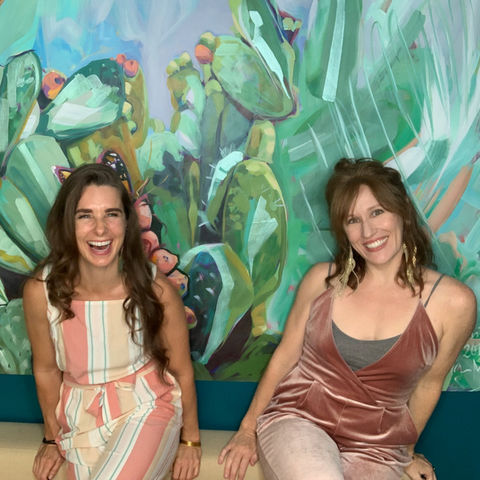
Thanks for joining us here on Pretty Spiritual where we're attempting the unthinkable about how to navigate this messy,
Beautiful,
Imperfect life with spiritual tools,
Principles,
And our own personal stories.
So we're not experts,
We're not religious,
We're definitely silly.
We're honest,
Real,
And willing to share.
So join us as we connect,
Bond,
And grow together.
Welcome back to Pretty Spiritual.
We're back.
Hey.
So glad.
I mean,
So sad.
Because today,
Thank you,
That was a nice lead in.
Today we're talking about depression.
So go ahead and get your Elliott Smith complete discographies on hand.
Or whatever else is sad in case you don't know who that is.
I'm assuming that's very sad music.
We've each had personal experiences and struggles with depression.
And I believe it's something that a lot of people struggle with.
Actually,
I know that because I did a little bit of research and preparation for this topic.
Psychiatry.
Com defines depression as a common and serious medical illness that negatively affects how you feel,
The way you think,
And how you act.
So if you're wondering if you're depressed,
You ought to talk to a medical professional.
But some of the common symptoms of depression are feeling sad,
Loss of interest or pleasure and activities that you once enjoyed changes in appetite changes in sleep,
Loss of energy or fatigue,
Feeling worthless,
Guilty,
Having a hard time focusing,
Concentrating or making decisions and thoughts of death or suicide.
I also wanted to share some quick stats about the prevalence of depression these days in America.
So about 7% of the population has experienced a major depressive disorder in the past year.
If you're one of those people,
Hopefully that makes you feel not so alone because there are 10.
3 million people having that experience alongside you.
And the World Health Organization says that about 300 million people worldwide struggle with depression.
So if you're experiencing depression or something that feels like that,
I really want to emphasize that you're not alone.
Also,
Some of those numbers could actually be conservative,
Perhaps.
And maybe if you're listening and you don't have a personal experience with depression,
You're listening because you want to know how to support someone in your life who's struggling with it.
We hope that the ways we talk about our own experiences can offer some greater understanding and hopefully be useful to someone out there.
Our goal,
Our aim,
Our main purpose and aim.
The last thing I want to say before we get into it is to emphasize that we are not medical professionals.
That depression,
Especially combined with other physical or psychological issues is a complicated issue.
And we don't know what is best for you.
We will encourage you to work with your doctor and support system,
Whatever that looks like,
To come up with a plan for how to treat whatever is going on and get well.
And we can't know what your experience is like,
But if you want to share it with us,
We'd be really happy to hear about it.
We'd love to hear from you.
So please let us know how you're feeling,
Especially if you're feeling alone or stuck with something like depression and you just need to reach out and talk about it or it feels like that might help.
Please get in touch with us.
You can reach us by email at prettyspiritualpodcast.
Gmail.
Com.
Also check us out on Instagram.
That is such a fun way to communicate at Pretty Spiritual Podcast on Insta.
Slide into the DM.
Is that what the young folks are saying?
That's what they say,
But I feel like I've been overdoing it.
So however you want to.
Get in touch.
We're here to listen.
Yeah,
That would be great.
We also have a website and that's about to have more and more resources on there just as soon as we are able with our human aid to do such things.
Thank you for that reminder.
So look for that at prettyspiritualpodcast.
Com.
Okay,
We're going to dive right in,
Talk about depression,
What it feels like,
What our personal histories are,
Have been with it.
Annie,
Take it away.
Hi.
Hi.
Thanks for the topic and the intro,
Ella.
This was hard for me.
This is a hard one for me to talk about because I'm still working on the core of my experience with depression.
I've always thought of myself as a happy person and my exterior is very smiley and playful.
And that's also how I feel inside.
But at the same time,
As an adult,
I've always had this space of this deep sadness inside of me.
And so as an adult,
And this never happened as a child,
But in my grown years,
Especially during winter or rainy periods,
My body and mind can slip into this low functioning mode.
I was almost like I'd make fun of myself and I would just be angry at myself for being low functioning or be like,
Oh,
I'm not a functional adult.
What I just said,
That's a theme that you'll hear in a lot of our episodes where I'm learning how much I didn't give credence to my experience and identify it as a true experience and instead would just have this anger or disdain in myself for not being to snuff or clicking at whatever level I thought I was supposed to.
And I'm just starting to get some new awareness around stuff and I can look back and be like,
Oh,
That's depression.
Oh,
That makes a lot of sense.
So if you're in the middle of something and you don't know what it is,
It's okay to not know maybe just be really nice to yourself.
Pro tip.
Bro,
At all times.
The brutal self-flagellation isn't helpful.
Especially if that suggestion makes you angry,
Then it applies to you.
Apply it now and often.
A couple of years ago,
I went to the Broad Museum in Los Angeles and there's this mural there by the artist,
Laurie Pittman,
And it's about 26 feet long and it's super colorful.
It has all these bright figures and it almost has a cartoonish feel.
So it's really playful and colorful,
But written on each of the panels is this line and it said,
Like you,
I despair,
Sometimes an overwhelming sadness,
A deep funky funk.
And I took a picture of this mural and I kept it on my desk and I didn't even know why,
But I just was like,
Oh,
Yes.
It kind of explained this deep sorrow inside of me.
I love art for that.
Sometimes it can put things into words that I don't even know about myself yet,
But it just made sense to me and I didn't question,
Of course,
But everybody has this deep pool of sorrow inside of them.
So when this deep funky funk would hit me or this low functioning swamp would consume me,
It usually meant I'd been going too hard,
I'd been overdoing myself,
I'd been churning out energy that I didn't have enough of,
And then it would,
Or maybe it'd rain for three weeks straight and then maybe I wouldn't really want to shower.
One of my indicators is I will wear the same clothes to bed and then I'll wear them out to life and then I'll wear them to bed.
I'll wear them to life.
It's just practical.
It's just practical.
And so those are indicators,
But accompanying it would have this really gentle thought,
Wouldn't it be so much easier if I was just gone?
It was always a very passive kind of gone,
Just kind of a poof or some kind of very passive way for me to disappear from the planet,
But it essentially was like an escape death fantasy.
I just kind of thought that's how I was wired.
In February of 2018,
I started doing this acupuncture and craniosacral work and already for years I've been doing this meditation and having the kind of space inside of me.
I thought that I was treating this really bad TMJ persistent intense jaw clenching and instead what came out was PTSD from an assault that took place 20 years ago and then an abusive relationship in my twenties.
So as I do the healing work around these buried by unprocessed experiences and emotions,
I am hopeful and amazed to feel that this deep pool of sadness is starting to recede and it's like I'm putting some light on it.
It feels like it might not always be there.
So this is a slow process and obviously it's a little bit tender for me.
It's been a year so far that I've been working on this and understood that what happened in the past really has had an impact on my mental health and I'm working with professionals to grow and heal.
But of course I want it to be fixed yesterday,
Like done with months ago.
A lot of it's just patients,
But the work and the tools is what this is all about.
So I'll share more on what's working for me when we share about our tools.
Thank you,
Sweet Annie.
We love your sweet vulnerable tender heart.
Thank you.
It's real.
Lindsay,
Do you want to let us know what it's been like for you?
Annie,
Thank you so much for really opening up and talking to us.
Without doing that,
It's hard to make movements towards healing.
So it's really brave and courageous any steps that we can do whatever that looks like.
In dealing with depression,
It's really tricky because the things that we need to do to get into action are difficult.
It's important to remember that there's a difference between difficult and impossible.
Thinking back on this,
I'm reminded of my mother.
It's appropriate to talk about that and difficult.
So I'm going to do it.
My first experiences with that,
Pretty confusing being a child.
My mother,
She's manic depressive,
Which is another term for bipolar,
Which is characterized by moments of elation and depression and like really up or really down.
They last a really long time.
I've had bouts with what is described as depression,
But it was nothing like my mother's clinical depression.
I believe that my depression was due to outside issues.
The main issues being my inability to cope with the past and what it was like during that childhood.
I was bringing the pain and the grief of the past into my everyday life.
It was making it impossible for me to be present in the moment and to experience the pleasure or irregularity of this moment.
It's difficult to do when I haven't been able to process the grief and trauma of the past.
I didn't realize I was reliving like the past hurts and traumas and shortcomings.
I was in a loop of reliving the pain every day and days on top of days and sadness on top of sadness.
The inability to cope fueled my experience of depression.
The times that I had depression,
It was due to my lack of coping skills,
My lack of resources.
Honestly,
I was raised by someone who was in a constant state of some level of depression.
It makes sense that I thought I wouldn't be able to escape depression.
I really did think that I was doomed to a life of depression or becoming manic depressive myself.
That's probably been my biggest fear most of my life.
But I have a therapist and I know it's so required.
I've been with him for almost three years.
This my dude.
We in there.
I'm really talking to this guy.
Mental illness.
It's very confusing and scary and especially with child logic and just not having tools or resources or examples of adults that were well until I got a therapist and started this work recognized and dealt with past trauma.
I was currently bringing into my present life years and years of therapy.
My belief of being bound to a life of depression and insanity seemed the only way.
The description of depression at the beginning that Ella was sharing about was really just a walk down memory lane for what it was like living with my mother as a child.
I really share all of this just to be useful and to get down to tools.
I wanted to give a tool right away because that was just so much to deal with.
It's like,
Oh my God,
Put the tool on right now.
But I'm going to go ahead and wait until it's time.
I would like to hear about Ella.
What you want to share about.
Thank you both so much for sharing so honestly and really touching into what it feels like.
So much tenderness.
So much.
Yeah,
I first started getting depressed when I was around 13 or 14.
I remember starting to feel kind of acutely like I didn't belong.
And then by the time I was like 15,
I was on antidepressants and I continue to take antidepressants and they help a lot.
There's also depression in my family history and I grew up with a fear of the dark thing that was inside me.
Like I didn't know what it was,
But it did not feel safe to be around it.
And my biggest fear was that I was going to have a psychotic break.
Whatever that dark thing inside me was,
Was going to break me and I wouldn't be able to come back from it.
That's not a fun way to be alive.
So my depression continued to escalate and from about the age of 17 until I was 26 or 27,
I got really caught in depression to the point where it was catatonic.
My mom wanted to have me forcibly committed to a psych hospital.
I just couldn't function.
I couldn't get out of bed.
I couldn't shower.
It was really hard for me to do the kind of like basic things that are required for a human being to take care of herself.
And I couldn't interact with people.
I couldn't be in relationship.
I cried constantly.
Like what Lindsay was saying about just not being able to cope.
I was having that same experience and the more I kept doing the same stuff,
The more mired in that cycle I got.
I just couldn't function and I wanted to die pretty much all the time for years.
And sometimes it was that kind of passive suicidal ideation that Annie was describing and other times it was more substantive.
For me what happened is that I was like reaching a breaking point.
All of a sudden I was in rehab and I wasn't drinking or doing drugs and I had this idea that the depression was going to go away when I stopped doing that.
There's a metaphor that I like for sobering up,
Which is driving around in an old car full of stuff and then you hit the brakes and everything that's in the back of the car comes flying forward and that was very much my experience with depression.
It was like,
Oh,
I thought it was bad before,
But this is,
I just couldn't,
I couldn't do anything.
I just felt like I was being eaten alive by it and what I did,
I wouldn't necessarily suggest to another person,
But it's my story and it worked for me.
I ran away to a Zen monastery and depression came with me.
Like it does.
That classic tale.
Yeah.
I think we're all excited to start talking about the tools here.
I'm feeling uplifted.
It desperately needs them,
I could say.
We've talked about what our experience with depression has felt like and looked like.
If you have an experience with depression that's different from what you hear us describing,
It's so important that we all have these different experiences.
The fact that we all have different experiences and ways of talking about it means that there's help available to you,
Period.
Everyone else has been through what you've been through,
Even if you're not hearing your story and what we're saying right now.
Our only aim to be helpful,
To be of service.
That's right.
How can we meet the experience of depression with tools?
Like what helps you when you're feeling depressed or falling into a chronic depression?
Oh,
I've got some tools.
Let's hear it,
Manny.
Good.
I have three tools I want to share.
My first spiritual tool is professional help.
Let's get some more plugs in for that.
Oh my gosh,
Big fan.
Go right away.
My mind and thoughts can be very misleading when my emotional state is unwell.
So asking for a professional to guide me through the mud is a powerful spiritual surrender.
I don't need to figure it out by myself.
So that's my first tool.
My next spiritual tool is very similar to the tool that I shared in the anxiety episode and it's to avoid isolation,
Which is very hard.
So I avoid isolation by taking action based on my commitments rather than my feelings.
When I'm in a swampy state,
My feelings have these resounding proclamations that sound like this.
Life is too hard.
You better not bother.
Stay in your bed sweater and turn off your phone.
And that's what seems real and true.
And if I follow that,
I sink deeper into my swampy state.
But if I take action based on my commitments,
Which include things like walking my dog,
Showing up to my meetings and work plans,
Eating dinner with my wife,
Et cetera,
The better that I can kind of manage to be in the world.
So the less I show up to my commitments,
The more slippery my emotional state becomes.
So taking action and just doing my commitments,
Regardless of how I feel or what I'm thinking is really a powerful spiritual tool for me.
And when I'm doing that,
Then I can do this third tool,
Which is being of service to other people.
So if I can just start doing my commitments and that can be simple stuff like I'm committed to making my bed each morning.
I'm committed to brushing my teeth.
I'm committed to changing my clothes from my pajamas to day clothes.
When I start doing those things,
Then I begin to shift and I can start to help someone who's suffering more than I am.
And this can be done,
I just have to say this in a healthy way with boundaries.
Doing that takes my laser focus off my own feelings and my own suffering.
And it really can be transformative for me into feeling useful.
And it truly can help me feel like my life has purpose,
Which when I'm in one of these states that seems kind of questionable sometimes.
So if I'm getting this powerful knowledge that I am being of aid to another person who is in need,
Suddenly there's a reason for me to be here.
So those are my three tools right now.
Those are so practical and great.
Thank you.
All right,
Next up,
It's me,
Lindsay coming in.
I'm going to talk about emotional reasoning.
Simply put,
It's because I feel this way,
I am this way.
My example,
When I was young and confused about my mother's mental health,
I believed there was no way for me to escape depression and mental illness.
This emotional reasoning perpetuated my state of sadness and almost made my beliefs reality.
Coming back to examine emotional reasoning,
Believing the way you feel reflects reality.
Let's put these thoughts on the witness stand.
That's my tool.
Whether you write this out,
If you don't want to because you're depressed and everything seems too hard,
So remembering the difference between difficult and impossible and mustering up whatever energy you can.
I find it really useful to take a quick walk,
Building up a momentum,
Get up out of the bed and make the bed and then maybe write some of this inventory or go on a walk.
If you can't write,
Then you can always just do it in your head.
So how to put your thoughts on the witness stand.
What that looks like is question your thoughts.
Put these thoughts on the witness stand and interrogate them.
So whatever thoughts that you're having,
I'll just use an example of myself whenever I'm depressed and having these feelings.
I'm like,
I'm a failure and I'll never amount to anything.
Often I'm wallowing around in that for some reason.
And so the first question is,
What is the evidence?
What is the evidence that I'm a failure and I'll never amount to anything?
And if there's some evidence,
Great,
Okay.
But most of the time when I question the facts of these thoughts that I'm thinking about,
There isn't any evidence to back it up.
These questions will help in theory to shift your perspective.
What would I tell a friend who had this thought?
That's another one of the questions.
What would I tell a friend who had this thought?
So when I shift the focus and think about a friend and wanting to support a friend,
A whole different part of me lights up and it's easier for me to look at things a different way when it's with a friend.
So if I can look at my own situation and ask myself,
If a friend was feeling like they were a failure and that they wouldn't amount to anything,
What would I say to them?
So then I'll just think of like one of my best friends,
Annie or Ella,
It's so simple.
And then I'd be like,
Look at your past work.
And then I would list all the ways that they weren't a failure.
So I would try and do that for myself.
And of course,
If I can't do that because I'm depressed and things are hard,
Then hopefully you can call someone that you know,
Whether it be like someone from church or your community or somebody that knows you that can kind of help you work this out.
Is there another way of looking at this situation or an alternate situation?
Finding out like when you're depressed,
What your mental formations or your mental habits are?
Like,
What is the flavor?
What does it look like?
What are the narratives that are going on?
Because oftentimes for me,
They are the same,
Their habits.
And so feeling like a failure or not feeling like I'll ever amount to anything,
That's one of mine that really starts to spiral me out and oftentimes is there.
What is another way of looking at the situation?
And when I ask myself that particular question,
Then just as an example,
I realize I'm incredibly hard on myself and that I'm fearful,
Like I'm in fear.
And when I'm incredibly hard on myself and I'm fearful,
This distorts my reality.
How might I look at this situation if I wasn't depressed?
Such a great question,
Right?
Just again,
We're just trying to shift our perspective here.
So we're asking some questions to really suss this out.
So really ask yourself that.
How might I look at the situation if I wasn't depressed?
Usually it wouldn't feel as heavy and I may have some hope.
Oftentimes what's going on when I'm so depressed,
I'm just feel so hopeless.
It just feels like there's no hope.
And like we've been talking about,
It also has this flavor of it's not ever going to change,
Which is ridiculous.
But I'm really buying into that,
That it's like this,
It's always been like this,
It will always be like that.
So asking myself if I wasn't depressed,
What it would look like,
I would also remember that oftentimes when I'm not depressed and I remember that this is an opportunity for me to grow and that I'm always taken care of.
I've always been taken care of and I'm being taken care of right now.
Not only that,
But oftentimes me going through this and getting stronger and getting better is going to be helpful to someone else later on because I'm going to be able to let them know what it was like for me when this happened.
I love the visual that I got in my mind when you talked about putting your feelings or thoughts on the witness stand.
I can picture this dark blobby little murky bubble and I'll just plop it up on the witness stand.
And of course there's like a gavel.
You got to have the big one,
You can really slam it down and that will feel good.
I object.
I object.
That's so good.
I was really relating,
Lindsay.
I remember this day and I was walking down the path and it was sunny and there were birds chirping and I was like,
Oh,
I feel joy.
I didn't even know what to call it,
But it felt really buoyant and hopeful.
I had this really profound moment because up until that point,
My belief was I only ever feel depressed.
The only kind of spontaneous feeling that arises for me and knocks me down is depression.
But then I had this experience where I was being kind of blindsided by joy and I was like,
WTF.
It was a road to get there though.
I remember I moved to this monastery and I couldn't isolate anymore because I was living in this intentional community where people wouldn't let you hide out and slowly die in your room in your bed.
So I had to have direct contact with other people.
And while I was doing that,
I was meditating frequently.
And so I was starting to make direct contact with the lived experience of depression.
And I remember I just feel like I'm walking through sand,
Physical exertion feels like so much work.
Everything feels like so much work.
I just don't care about anything.
And actually I was having a lot of these feelings yesterday.
The tool I want to talk about is this direct embodied experience of depression,
Which like all the other spiritual tools for me,
That feels extremely counterintuitive.
This beast is eating me alive and you want me to turn around and look at it?
Are you crazy?
When I'm experiencing this mild depression,
Like I was yesterday,
I try so hard to avoid it and get away from it that eventually it turns into catatonic depression.
I've heard it said that depression is unfelt anger that we take out on ourselves.
Gosh,
I remember I started getting boils living at this monastery.
And when I went out to get them like professionally dealt with,
The acupuncturist was like,
This is anger being expressed through your body.
I got one every month for like five months and then they kind of went away.
There's all of this emotional stuff happening and I'm not willing to just feel it,
Turn around and look at it and say,
Yes,
Okay,
This too right now belongs.
So for me,
That has been an incredible tool and I have to get pretty desperate to really,
Really get into my body and my lived experience.
But I remember that happening in a very big way,
I was doing a seven day silent meditation period called Seshine and I had never done something like that before.
And I was in a catatonic depression and I was still somehow making it to the meditation hall and at that time I smoked cigarettes and I was walking up this not very steep hill that felt like an incredible incline to go smoke my cigarette and it was raining and big tropical drops of rain and it kept putting my cigarette out and I was like,
Perfect,
Just what I need,
You know,
Kind of thing.
And then I noticed myself being like,
I wish I were somewhere else.
And then I had this weird thought.
I was like,
I wish I were in Berkeley.
And then I was like,
I'd be depressed in Berkeley.
And then I was like,
I wish I were in Bali.
And then I'd be like,
I'd be depressed in Bali.
I wish I was at Tosahara.
I'd be depressed at Tosahara.
It was just this moment where I was like,
There's no escape hatch that's going to work for me right now.
So why don't I just turn around and let it eat me alive?
So I did.
I just got really into the physical lived experience.
For me over the years,
What that's meant is that I get this space to relate to thoughts or depressive states and to not believe that that's me,
You know,
To relate to them as a part of a human experience instead of to take it on like that's all I am.
It's this feeling.
For me,
Depression has a really unique way of talking to my brain.
Like Annie was describing,
It's all too hard.
Just stay in bed.
Nothing matters.
And so when I hear that voice talking to me and when I feel the physical sensations that go along with it,
It helps me to label that this is the argument that depression makes.
And when I do that,
I'm able to kind of just experience it as this real phenomenon that's happening,
But that I don't have to believe that what it's telling me is the truth.
It's this real but not true thing.
Yes,
This is really happening.
It needs my attention and care,
But it's not reality.
It's just this.
Are we better yet?
Am I fixed?
I love that.
I love that you,
Well,
I don't love that you got boils.
I do love boils.
I was very excited.
It's like an addiction.
But it's so true,
Just the bodily manifestation of these unprocessed emotions and experiences.
And it's so powerful what my body is capable of when I don't deal with how I'm feeling or what's going on.
And maybe at some points in our lives,
We're not able to deal with it.
And so actually that's a coping mechanism.
And then we get to a point of safety where our nervous system and our hearts and our minds are all opened up and it's like,
Okay,
It's safe to sort through this stuff now.
Here we go.
To turn and look.
Which provides the perfect segue to what our next episode will be.
What is that going to be about?
The next episode,
We're going to be talking about forgiveness.
And for me,
I chose this topic because as this healing process and looking at this deep sadness inside me and how a lot of it was really just unprocessed experiences,
Finding the space to forgive myself and other people in my past and what that looks like.
So we're going to just dive in next week.
It's going to get goopy.
Oh,
Goop.
Oh,
I'm so glad we're all together and we'll see you next week.
Bye.
I love you.