Hello friends.
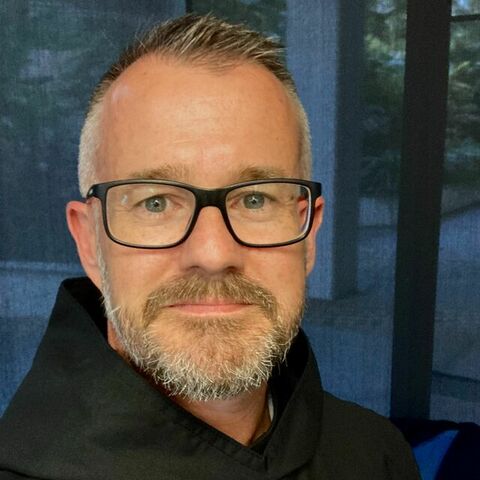
This is Mark Gladman,
Also known as Brother Frederick James,
Your friendly neighbourhood monk in dogs.
Welcome to Day 19 of our Journey of Reflections considering God is.
As we begin today,
I just invite you to sit.
As always,
Take a nice deep breath in.
And out.
And just look around the room where you are.
And as you do,
Just listen to the sounds that you can hear around you at the moment.
And the reason why I've asked you to do that.
Is because I've been thinking about.
.
.
How easily we miss things,
Especially the ordinary stuff.
And I talk and write a lot.
About ordinary stuff,
So this one's really close to my heart.
You know,
The ordinary things,
The ones that don't announce themselves,
The things that don't seem to deserve our attention.
The kettle boiling.
The dog waiting at the door.
The slow-moving traffic,
The bread on the bench.
The body getting dressed.
The laundry in the basket that needs folding.
A conversation that could have been rushed,
But it wasn't rushed.
The steam.
Coming out of your coffee cup.
A tree standing quietly.
In the morning.
The incredible unremarkable experience.
Of that Saturday afternoon.
We tend to recognise God.
Quite readily in the extraordinary stuff,
The powerful worship experience,
That rush or feeling we might get in a moment of prayer or meditation.
The beautiful church.
The moment of profound insight as we're reading.
The vision of the sunrise or the sunset and the streaky orange and pink across the clouds.
The prayer that seemed to reach deep down within us and somewhere beyond us.
And of course.
We encounter God in those places,
But I think we often forget that God can just be.
As easily and readily be encountered.
It's just that the ordinary is the place.
Where we've forgotten to look.
And I think that's one of the great movements that comes in the Christian story.
The Christian story suggests that God doesn't remain distant from material life,
But God becomes flesh,
Enters the ordinary.
That in creation we see God enter matter.
And in the incarnation.
In Jesus.
We see God encountered in a human face,
A human voice,
Human hands,
Human feet.
And this Jesus spends a lot of his life doing things.
That normally wouldn't make a religious highlight reel that you'd post on Instagram.
Talking.
Having a nap.
Attending the people.
Noticing.
Yes,
Jesus turns water into wine.
But he also sits at tables and eats.
He heals.
But he also listens.
He teaches.
But he also notices people that others have stopped seeing.
And he doesn't seem particularly interested in helping us escape ordinary life.
Instead,
He seems intent on showing us how to fully inhabit.
Ordinary life,
Which is.
.
.
I guess no surprise seeing as though one of the most profound things Jesus said was in John 10.
10.
Which I think was Jesus' manifesto.
Where he says,
I have come that you may have life.
And life in abundance.
How often do we think of that as something beyond our ordinary?
What if Jesus met?
I have come.
To show you how to live fully in every single ordinary moment as well.
So.
.
.
I don't think the sacred ordinary.
Is ordinary life with just a religious label placed over the top of it.
It's ordinary life,
But seen through a completely different lens that we don't normally wear.
The kettle's still the kettle and traffic's still traffic and laundry,
Unfortunately,
Is still going to be laundry.
But we begin to notice that existence itself is a gift,
That matter matters,
Bodies matter.
This moment isn't a disposable moment,
It matters.
That the person in front of us isn't an interruption to our spiritual life,
They're a part of it.
And I think that's where attention.
.
.
Becomes an act of love.
To notice.
And when we notice,
We're saying something,
Particularly if it's someone else.
You're not invisible,
You're not in my way,
You're not an object.
In the background of my life,
You are here.
And I'm willing to be here with you.
I think there's something deeply spiritual about paying attention because attention helps us recognize the God who's already present.
And the question we need to learn to carry is,
What have I failed to notice because I was looking somewhere else?
The sacred ordinary.
Asks us to slow down.
Slow down,
Not to do less,
But to inhabit more fully the moment.
That we're in and the thing that we're already doing.
I love how it's tik not han.
Talked about.
Doing this with a friend.
Who was eating fruit with him and this other gentleman was simply stuffing wedges of mandarin.
Into his mouth,
One after the other,
One after the other.
And Thich Nhat Hanh said to him,
Friend Stalked.
Eat your Mandarin.
In other words,
Stop thinking about whatever it is you're thinking and stop talking about whatever it is you want to talk about.
And instead of thinking of eating this mandarin as something extra and getting in the way of having a spiritual conversation or what have you.
Think about this moment as being part.
Of our sacred life.
And we.
Would hate that.
That idea really deeply.
I mean,
Imagine how your day would change if when you drank your coffee,
You actually drank your coffee.
That you listened to the person,
That you stopped to feel the ground beneath your feet,
That you notice the light.
That you receive the meal present to your body.
Let the tree be the tree.
Let Saturday afternoon be enough.
Slow down and fully envelop the moment.
Because I don't think God's waiting for life to be extraordinary.
I think God's here right in the middle of the ordinary stuff every single day.
And so maybe my friend,
The miracle isn't that the ordinary occasionally.
Becomes sacred.
I think maybe the miracle.
As that the ordinary has never been anything less than sacred.
And may grace,
Peace and love be with you as your eyes open to this sacred ordinary.
Today,
And every day,
In every moment.
Until tomorrow friends,
God's grace and peace be with you.