Hello friends,
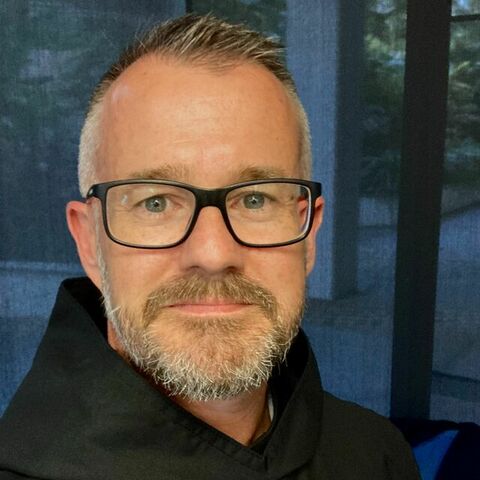
This is Mark Gladman,
Also known as Brother Frederick James,
Your friendly neighbourhood monk in dogs.
Welcome to another instalment in our series,
Look Again.
Now today,
Let's talk about SIN.
Not a particularly popular subject,
And that's probably because most of us have learned about sin.
As a list.
Don't do this,
Don't do that,
Don't think that,
Don't say that,
Don't go there,
Don't,
Don't,
Don't,
Don't,
Don't.
And if you break the rules.
.
.
Than you've seen.
So,
Christianity.
.
.
Becomes a kind of moral scoreboard.
Good people one side,
Bad people the other.
And the great spiritual goal is to get yourself onto the good side.
What if that's not actually the best way to understand sin?
What if sin isn't so much about breaking a set of rules,
But rather about becoming?
Divided.
Think about what happens when you sin.
Something gets broken,
Doesn't it?
A relationship,
Your integrity,
Your capacity to love,
Your connection with another person.
Maybe even your connection with yourself.
You know you're doing one thing.
But something inside you wants another.
I love the way Paul describes this when he says,
I do not understand my own actions.
I want to do one thing and I do another.
I don't want to do this.
And somehow.
Or do it anyway.
Nuts?
Not just rule-breaking though,
Paul there is describing fragmentation,
Something inside us that becomes divided.
And this is why the Bible story begins with a beautiful image.
But a very deep image,
Human beings created in relationship with God,
With one another,
With creation,
With themselves.
Everything connected.
God even says it's good and it's very good and then something breaks.
Suddenly there's hiding and blame.
And fear and shame and alienation.
The human beings hide from God and they hide from one another.
So they even seem to become divided within themselves.
And what happens next?
God comes looking.
Where are you?
God says.
I think that's one of the most incredible questions to contemplate.
In the scripture,
Because think about what's happened here.
What would the first words of the God in your image would have been?
What have you done?
Why did you break my rules?
But no,
This guard says,
Hey,
Where are you?
And that's because sin isn't simply about what you've done.
It's about where you've ended up.
You've become lost.
Disconnected.
Fragmented.
Curved inward.
Separated from love.
And this separated idea is important.
Because from that story,
If you jump ahead a little bit,
God gives the Ten Commandments to Israel.
Now,
If you've ever looked closely at the Ten Commandments,
You'll see that the first four commandments talk about our relationship with God and the remaining six talk about our relationship with others.
And that's interesting because it reminds us of something Jesus said about how we're called to love God with all our heart,
Soul,
Mind,
And strength,
And to love our neighbor or other as ourself.
So Jesus in effect took the Ten Commandments and broke them down into their core two facets.
Love God.
Love your neighbor.
But then.
.
.
When we read the Ten Commandments like that.
We notice.
That the things discussed in those Ten Commandments are things that breach or break or fragment relationships between us and God or us and our neighbor,
Who,
Remember,
Jesus taught was everyone.
Everyone is our neighbor.
And this opens up a whole new world about what sin might actually be.
Is about a breach of relationship.
It's not so much what action you took as much as what the outcome of the action was.
The action in and of itself.
Is not a sin.
The outcome of that action is what makes the action.
A sin.
And this is why Jesus was able to say in Matthew chapter 5,
You've heard it said,
Do not murder,
But I say.
If you call your brother an idiot,
You've committed murder in your heart.
I mean,
Calling someone a name.
In our human understanding is nowhere near as drastic as murdering them.
But when I understand that sin is about a breach of relationship,
Not about the level of intensity of the act.
That I have to understand that to call someone a name is akin to murder.
Why?
Because it breaks and fragments and breaches my relationship from another.
It separates me from love.
And it separates them.
From love.
And so all this is important because it gives us a completely different way of understanding salvation.
Because if sin.
.
.
Is just about breaking rules.
Then salvation looks like getting forgiven.
For breaking the rules,
But if sin.
.
.
Is disintegration,
Fragmentation.
A break or a breach,
Then salvation looks more like being made whole again.
And interestingly,
It's not just about being made whole in myself,
So salvation isn't just about me.
This wholeness.
Needs to be built between me and my neighbour.
Or me and God.
So there is an element of community.
Within this salvation.
And suddenly the language of Jesus.
Makes even more sense then,
Because Jesus keeps bringing people back together.
The outcast is brought back into community.
The sinner is restored.
The divided person is made whole.
The person who's been excluded.
Is welcomed.
The person who cannot see begins to see.
The person who can't walk begins to walk.
The person who's dead becomes alive.
And again and again,
Jesus is doing the same thing.
He's putting things back together.
And that's what grace is.
Grace isn't,
You know.
.
.
Pretending that nothing happened,
Or God,
Rather,
Pretending that nothing happened.
It's not God saying,
Yeah,
Don't worry about it.
Grace is God entering the brokenness and beginning the work of restoration and that's different.
Because if you've ever done something you deeply regret,
You know that God forgives you can sometimes feel like some sort of statement that's floating 10 feet above your actual life.
But restoration,
That's concrete.
It means becoming capable of telling the truth again.
It means repairing a relationship.
It means learning to trust.
It means becoming less divisive.
It means being able to apologize.
Means being able to learn to receive love,
Means becoming the person you were created to be.
Here's the bit where it gets a little bit uncomfortable,
Because sometimes we think sin is what other people do.
They greed.
And sexuality,
Or politics,
Or anger,
Or dishonesty,
Or bad choices,
Or failures but Jesus has this really.
.
.
Annoying habit of turning the spotlight.
Back on ourselves.
Because sin.
.
.
Doesn't identify the bad people.
Sin.
Is noticing the places where I've become less capable of love.
That's a much harder question.
Where am I becoming smaller?
Where am I becoming more afraid?
Where am I becoming more self-protective?
Incapable of listening.
Or where am I treating people as objects?
Where am I constantly making myself the center?
Where am I holding on to resentment because letting go would require me to surrender something?
Where am I divided?
That's where the spiritual work begins.
And that's why repentance is such a beautiful word.
Because then repentance becomes way richer,
Way more full than just stop doing bad things.
Repentance,
The word itself,
Metanoia in the Greek.
Means to basically turn around,
To change direction.
So this is a word about coming home to reorient ourself.
Repentance isn't feel bad about yourself,
It's come back.
Come back to love and truth.
Come back to God.
Come back to yourself.
Come back into relationship.
And that shifts the whole emotional tone of the thing.
Because shame says I'm bad,
But grace says,
Look,
Something in me is broken,
But I'm not beyond.
Restoration.
Shame is something that makes you hide,
But grace makes you come into the light.
Shame says something like,
Don't let anyone see,
But grace says,
Hey,
Bring it here.
And that's why Jesus,
I think,
Is often found sitting at tables with people who've failed.
And he never pretends.
That their lives are okay.
But what he's doing is he's showing them that failure doesn't have to be the end of the story.
You can come home.
You can begin again.
You can be made whole.
And that's probably one of,
If not the most radical thing that Christianity has to say,
That your worst moment does not become your identity.
That your failure doesn't become your destiny,
That the thing you regret doesn't get to name you forever.
Why?
Because God isn't finished with you.
The story's not over.
And that's why the Christian life.
Isn't fundamentally a become a better person project.
It's a journey towards becoming a whole.
Person.
People whose inner and outer lives line up.
People who don't have to pretend,
Who can tell the truth and receive love and give love,
Who can forgive and be forgiven.
People.
Who are slowly but surely becoming integrated,
Becoming whole.
One person.
Not a public version,
Or a private version,
Or a religious version,
Or an ordinary version.
Not the Sunday version and the fall apart on Monday version,
But the whole human being.
But maybe holiness is simply what happens when all the scattered pieces of your life begin to turn towards love and get put back together again.
So here's something to notice today.
I don't want you to walk away from this asking,
You know,
What sins have I committed?
I want you to ask a more uncomfortable question than that.
Where in my life have I become less capable of love?
Where have I become divided?
Where am I hiding?
Where am I protecting myself?
Where am I making someone else the enemy?
Where have I forgotten who I am?
And then don't punish yourself or spiral or rehearse your failures.
Just turn.
Repentance.
Turn around,
Do a 180.
Come back.
Towards love and truth and God.
Come home.
And I think that's what Jesus.
Has been saying all along,
Come home.
And let God make you whole.
I don't think sin is the story of bad people breaking God's rules.
I think it's the story of human beings becoming fragmented and God refusing to stop coming after them so that God can make them whole.
All we have to do.
Is look again.
And may grace,
Peace and love be with us and remain with us as we do.
Until tomorrow,
My friend.
Bye for now.