Hello friends,
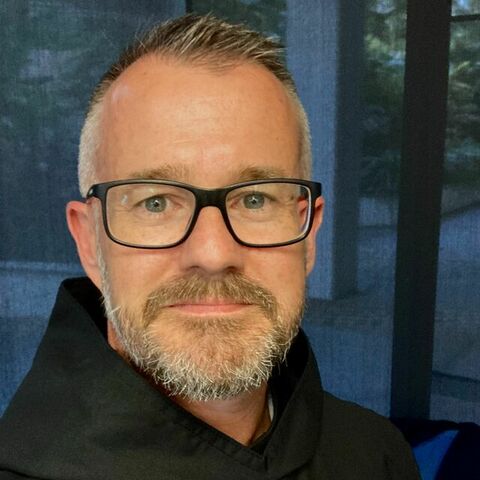
This is Mark Gladman,
Also known as Brother Frederick James,
Your friendly neighbourhood monk in dogs.
Welcome back to the way home.
In the first episode,
We reflected on the prodigal son and the courage it takes to turn towards home.
In the second episode,
We listened to the story of the lost sheep and discovered that sometimes we don't find our own way home.
Sometimes we are found.
Today we come to another of those beautiful resurrection stories.
This one about two disciples who were walking away from Jerusalem.
They're disappointed and confused and grieving.
And technically speaking,
If they're walking away from Jerusalem,
They're going in the wrong direction.
At least that's how it appears because somewhere along that road.
.
.
Something happens.
A stranger joins them.
A stranger who listens.
A stranger who walks with them.
A stranger who opens the scriptures and eventually they discover that the one that they thought was absent is the one who'd been beside them that whole time.
This is the story of Emmaus and maybe it's also your story.
So as we begin,
Let's just take some space to allow ourselves to come still.
Take a slow breath in.
And out.
And once again,
Breathing in.
And out.
Let your body relax,
Shoulders drop,
Hands rest comfortably in your lap.
Close your eyes if it's comfortable and safe.
Let the pace of your breathing slow down.
And just allow yourself to arrive here in this moment to listen and be and be held.
As we begin,
Let's pray.
Risen Christ,
Meet us on the roads that we're walking today,
Especially on the roads we walk because we're disappointed,
Confused and tired.
Walk beside us when we can't recognise you.
Open our hearts to your presence and teach us to discover that sometimes the road we think is taking us away from home might actually be the road which brings us home.
The text is quite lengthy.
We're just going to walk through the story and acknowledge some particular verses from Luke's Gospel in chapter 24.
So the two disciples are leaving Jerusalem after the death of Jesus.
They're talking together about everything that's happened.
So you can assume that means.
Everything.
And as they walk,
Jesus himself comes near and walks with them.
But Luke tells us,
Their eyes were kept from recognising him.
Jesus asks them what they're discussing and they tell him about Jesus of Nazareth.
They tell him about his death.
And Luke's reported them saying.
But we had hoped.
That he was the one.
To redeem Israel.
Now,
The first bit of that verse is worth hearing again.
We had hope.
And I wonder whether.
.
.
That's one of the saddest verses in the Gospels.
We had hoped.
Now,
This is not a declaration that they'd never believed or never cared.
But there was once a future that they could see,
A future with Jesus,
A future they believed.
Would unfold differently and then something happened.
And the future that they imagined disappeared.
We had hoped.
I wonder whether you know that feeling.
You had hope.
You'd hoped a relationship would work.
You'd hope the diagnosis would have been different.
You'd hoped the job would bring fulfilment.
You'd hoped that the church would be different.
You'd hoped someone would change.
You'd hoped God would have an answer to your prayer.
You'd hope that life would turn out differently.
And now you're walking.
Maybe you're even still moving.
Maybe still functioning,
Maybe still doing what needs to be done,
But something within you.
Has begun walking away.
Just take a moment in a short space of silence to sit with that phrase,
I had hoped,
And see whether something arises in you that completes that sentence.
I had hoped.
Now the disciples are walking away from Jerusalem and that's an important detail.
I don't think Luke again has put it there by mistake.
Jerusalem was where Jesus had died,
But it's also where the resurrection had been announced.
They're walking away from the very place where their hope lies.
Is being reborn.
And they don't know it.
And maybe one of the great mysteries of the spiritual life is that we can be walking away from something that we think is dead while God is already bringing something new to birth.
If you notice,
We often judge our lives from the middle of the story sometimes.
We don't know the ending.
We see the cross,
God sees the resurrection.
We see the absence and God might just be very well preparing the encounter.
We see a failure.
But what God might be doing is beginning a transformation.
We see a closed door.
When God might be opening another.
The disciples don't know any of this.
All they know is that they're disappointed.
What's interesting is Jesus doesn't stop them.
He walks with them.
And notice what Jesus does.
He doesn't immediately reveal himself.
He doesn't.
Rock up beside them and say,
Hey,
Surprise,
It's me.
And he doesn't tell them to stop being disappointed and he doesn't.
.
.
Give them a lecture on lack of faith or.
.
.
Why didn't you stick around a bit longer?
He walks.
And he listens.
And he asks questions.
Luke tells us that he asks them,
What are you discussing with each other?
While you walk along?
That's a beautiful question,
Isn't it?
And maybe it's one of those questions that Jesus is asking us today.
What are you carrying?
As you walk.
What are you talking about inside your mind?
What story?
Are you telling yourself?
What disappointment are you rehearsing?
What grief are you carrying?
What hope have you buried?
Jesus begins by walking with them in the direction they're going,
Which is the wrong way.
And he begins by listening.
And maybe we need to allow God to do the same.
With us.
Now for just a moment,
Imagine yourself on that road to Emmaus.
Feel the dust beneath your feet.
The warmth of the afternoon sun,
The road stretching out ahead of you.
You walking beside another person,
Talking.
You're sharing stories of what's happened.
Maybe even trying to make sense of it all together.
A stranger approaches and begins walking with you.
You don't recognize him,
He just walks.
Notice that presence with you.
This person,
This stranger,
Doesn't hurry you along or force you to change direction,
Just walks alongside you at your pace.
And in your time.
What would you want to tell him?
What would you say if you knew you could speak without being judged?
What will you tell Jesus about the road that you've been walking on?
As they walk,
Jesus begins to interpret the scriptures for them.
He shows them how the story they thought had ended.
Was actually part of a much larger story.
And later they say to one another,
Were our hearts not burning within us?
While he was talking to us on the road?
Interesting,
Their hearts had been burning before their eyes had been opened and that's not just interesting,
It's important.
Sometimes recognition comes later.
Sometimes we only understand God's presence retrospectively.
We can look back on a conversation,
A moment,
A friendship,
A season where we were hurting or suffering,
A decision.
A seemingly ordinary day,
And suddenly we realise,
Hey,
Wait.
God was there.
I didn't know it then.
But God was there.
And that's why the spiritual practice of remembering is so important.
We look back,
We notice,
We begin to recognize the fingertips of grace.
Just take a moment.
To think back over the last week.
Look for where love appeared.
Where did you experience kindness or unexpected patience?
Where did something awaken hope?
Where did you feel strangely at peace?
Where did your heart burn?
That moment when your heart burned.
Maybe God was there.
And then the journey continues.
Eventually they reach Emmaus.
Jesus appears like he's going to continue on and the disciples say,
Stay with us.
It's funny that those three words actually could have been the prayer for the entire series.
Stay with us.
When we feel uncertain or we're afraid or we can't see.
When our prayers seem unanswered,
When we're grieving.
When we're walking in the wrong direction,
God,
Stay with us.
And Jesus goes in and stays with them,
Sits at the table,
Takes bread,
Blesses it,
Breaks it,
And he gives it to them.
And then their eyes open.
Are open.
They recognize Jesus.
The stranger is Jesus,
The absent one.
He's now present.
The dead one is alive.
The journey away has actually become.
A journey home.
And what I love about Emmaus is that Jesus is recognized not in some dramatic vision or on top of a mountain or through a miracle that's spectacular and many people see it or whatever.
He's recognized at an ordinary table.
Breaking ordinary bread.
And maybe.
.
.
This is something we need to relearn,
That often God waits to reveal himself.
Through the ordinary moments,
Not the extraordinary ones.
God's there in meals and conversations and quiet mornings.
Through the person that listens or the stranger who shows kindness.
In that moment of silence or that text of scripture that suddenly speaks directly to us.
Or like the story in that Eucharistic moment through the bread,
The breaking of bread and the blessing and a shared table.
We simply need to learn how to recognize God.
In those ordinary moments.
And then something amazing happens.
The disciples get up.
And they returned to Jerusalem,
The same road.
That carried them away from Jerusalem now carries them back.
About the road itself has changed,
But they have changed,
Their circumstances.
Are still hard.
The cross hasn't disappeared,
The past hasn't been erased.
The struggles and all the tensions back in Jerusalem are probably still there.
But now they know something that they didn't know before.
Jesus is alive and he's been with them all along.
And that makes the road home.
Different.
Sometimes God changes us as we walk the same roads we think we've always trod before.
And maybe right now you're on an Emmaus road yourself.
Maybe you've walked away from something.
Maybe you've stopped praying.
Maybe you've become disappointed with God.
Maybe something you once believed doesn't make any sense anymore,
And you're tired.
And if that's where you are.
.
.
May you know that you don't need to rush back to Jerusalem.
You don't need to drum something up that's not there or pretend.
That everything's okay.
But I'd encourage you just keep walking because the risen Christ is waiting beside you now.
Even if you can't recognise him.
Even if your heart's confused,
Even if your hope is fragile.
Even if all you can say is we had hoped.
God is still there.
So as we come towards the end of our time of meditation,
Imagine once more that road you're walking.
Jesus is beside you.
You might not be able to see him,
But he's there.
And allow yourself to hear him asking.
What are you carrying?
And then,
Will you let me walk with you?
And in this short silence.
Just walk.
And maybe now imagine arriving at the table.
Jesus takes the bread,
Blesses it,
Breaks it,
Gives it to you.
Look into his face.
And in this moment.
You recognise him.
Your questions are still there,
Your disappointments are still there,
But suddenly you know,
I am not alone.
God of the risen Christ walk with us on every road.
Especially the roads that we'd rather not travel.
Meet us in our disappointment,
Listen to our stories,
Receive our grief.
And gently open our eyes to your presence.
When we can't recognize you,
Help us trust that you're still there.
When our hearts are cold,
Let them burn again.
And when we finally recognise you,
Give us the courage to turn towards home.
Stay with us,
Lord.
Stay with us.
And may grace,
Peace and love be with us in our walking and in our staying today and always.
Thanks so much for being with me again on the YHARM.
Maybe today.
You'll notice the one who's already walking beside you.
Until tomorrow remember sometimes the road home begins by discovering.
That God has been beside you all along.
Until tomorrow my friends,
Grace and peace.
Bye for now.