Hello friends,
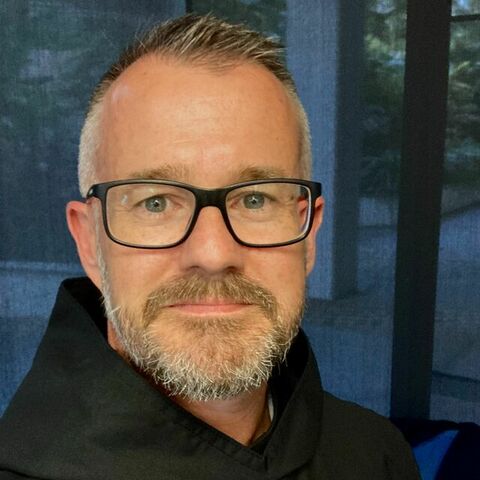
This is Mark Gladman,
Also known as Brother Frederick James,
Your friendly neighbourhood monk in dogs.
Welcome back as we continue our journey through Paul's letter.
To the Philippians.
In the last episode,
We began with Paul's opening greeting and discovered that the Christian life begins with God's grace.
We reflected on those wonderful words.
He who began a good work in you will carry it on to completion.
That promise reminds us that formation is God's work in us before it even becomes anything like something we would do or try and control.
Today.
Paul shifts from prayer to his own situation.
He tells the Philippians about his imprisonment.
And at first glance this might seem like something that's.
.
.
Just an update from an old friend who happens to be out doing some things but I think there's something in here that's much deeper.
Because through this little part of the letter,
Paul invites us to ask,
One of the great spiritual questions.
How do we see?
How do we see the world?
And even more so,
How do we see our circumstances?
So before we begin,
Let's just stop for a moment,
As always,
And allow ourselves to be fully here.
Let's take a nice slow deep breath in.
Let it out.
Notice the sounds around you,
Be truly present to where you are.
Let's bring your mind your heart and your body.
Into alignment.
And just become aware that.
As you notice what's going on,
That the presence of God is here with you too.
And not just when things are peaceful and quiet,
But also in the midst of some of the hardest moments in our lives.
So let's listen to Paul in Philippians 1 from verse 12 to verse 30.
I want you to know,
Beloved,
That what has happened to me has actually helped to spread the gospel so that it has become known throughout the whole Imperial Guard and to everyone else.
That my imprisonment is for Christ.
And most of the brothers and sisters,
Having been made confident in the Lord by my imprisonment,
Dare to speak the word with greater boldness and without fear.
Some proclaim Christ from envy and rivalry,
But others from goodwill.
These proclaimed crossed out of love.
Knowing that I've been put here for the defense of the gospel.
The others proclaim Christ out of selfish ambition,
Not sincerely,
But intending to increase my suffering in my imprisonment.
What does it matter?
Justice.
That Christ has proclaimed in every way.
Whether out of false motives or true.
And in that.
Rejoice.
Yes.
And I will continue to rejoice,
For I know that through your prayers and the help of the Spirit of Jesus Christ,
This will turn out for my deliverance.
It is my eager expectation and hope that I will not be put to shame in any way.
But that by my speaking with all boldness,
Christ will be exalted now as always in my body,
Whether by life or by death.
For to me,
Living is Christ and dying is gain.
If I am to live in the flesh.
That means fruitful labour for me.
And I do not know which I prefer.
I'm hard-pressed between the two.
My desire is to depart and be with Christ,
For that is far better,
But to remain in the flesh is more necessary for you.
Since I'm convinced of this,
I know that I will remain and continue with you.
For your progress and joy in faith,
So that I may share abundantly in your boasting in Christ Jesus when I come to you again.
Only live your life in a manner worthy of the gospel of Christ,
So that,
Whether I come and see you or am absent and hear about you,
I will know that you are standing firm in one spirit.
Striving side by side with one mind for the faith of the gospel,
And are in no way intimidated by your opponents.
For them,
This is evidence of their destruction.
Of your salvation.
And this is God's doing.
For He has graciously granted you the privilege not only of believing in Christ,
But of suffering for Him as well.
Since you are having the same struggle that you saw I had and now hear that I still have.
Now Paul writes these words while in prison.
We don't know certainly whether this is Rome,
Caesarea or Ephesus.
Scholars continue to discuss the possibilities,
But what we do know is this.
Paul has lost his freedom.
He can't travel.
He can't plant churches.
He can't preach in the marketplaces and so on.
The future for him is very uncertain,
And he might even be executed.
Now most people would naturally describe this as a disaster,
But Paul says these words.
Brothers and sisters know that what's happened to me has actually served to advance the gospel.
Notice that word actually.
He's inviting us to look again because things aren't always what they first appear.
One of the recurring themes through scripture is that God often works in ways we don't expect.
So,
For instance,
Joseph sold into slavery but eventually saves his family.
Israel wanders in the wilderness,
Yet discovers God there.
The cross appears to be defeat but becomes a place of resurrection,
And again and again,
God refuses to be limited by circumstance.
Now Paul has learnt to see his imprisonment through this larger story.
He doesn't deny that prison's difficult,
But he doesn't want to believe that prison can imprison the gospel.
And that's an important difference.
Because faith isn't pretending that suffering doesn't hurt.
But it's trusting that suffering never has the final word.
Paul explains that because of his imprisonment,
The whole Imperial Guard has heard about Christ.
Imagine the irony there.
The Empire believes it silenced Paul,
But instead,
Paul.
.
.
He's evangelising Caesar's own soldiers right there in prison.
Every guard who comes to watch him hears the gospel and the very people who are assigned to keep Paul captive become his congregation.
This reminds us that God often opens doors we'd never think to knock on ourselves.
Sometimes the place we least want it to be can become the place where God works most powerfully,
Either in or through us.
And I think we could all tell stories like that.
Maybe there was an illness that slowed you down long enough to rediscover prayer.
Or maybe a redundancy that opened the door to a new vocation.
Or maybe grief that deepened your compassion.
None of the experiences are good and I'm not trying to make light of them or trying to some sort of way romanticize our suffering.
Because Paul isn't romantic about it either.
But he sees as we should too.
Quite often in hindsight.
That God has an extraordinary way of bringing life from the places that seem most barren.
Paul then says something even more surprising.
Some people,
He tells us,
Are preaching Christ from envy and rivalry.
Others preach from goodwill.
Now imagine hearing that,
Even in the earliest church there were mixed motives.
Not every person who shared the gospel of Jesus was humble.
Not every leader was pure hearted,
Not every ministry was free from competition.
This should give us some hope.
Sometimes we imagine that the early church was perfect.
It just wasn't.
It was filled with ordinary people.
Just like ours.
But listen to Paul's response.
He says,
What does it matter?
But the important thing is that in every way,
Christ is shared,
And that's remarkable.
Paul refuses to become consumed by resentment.
His ego.
Has become smaller than the gospel.
And how often do we expend our energy?
Comparing ourselves with others.
Who's the more successful?
Whose church is the one who's biggest?
Who receives more recognition?
Whether we're seeing ourselves from top down or looking from bottom up.
But Paul simply asks,
Well.
.
.
Is the good news of Jesus being made known?
And if the answer's yes.
.
.
Then he rejoices.
And that's beautiful.
Freedom right there in that perspective.
And then we come to one of those well-known phrases from the Bible,
For me to live is Christ and to die is gain.
And to be honest,
These are words that I think have been misunderstood.
Paul isn't longing for death because life has no value,
And he's not encouraging us to escape the world some way.
Quite the opposite.
Paul loves life.
He wants to continue serving God.
He delights in friendships.
He enjoys seeing Christ formed in people.
But he's reached a place where his deepest identity isn't tied to preserving his own life.
Christ has become the center around which everything else revolves.
Paul is definitely not the sort to say to live his ministry or to live his success or to live his certainty.
He says to live his Christ.
And that's maybe the shortest description of Christian spirituality we'd ever find.
What does it mean to live?
It means to live in Christ,
To think with Christ,
To love with Christ,
To forgive with Christ,
To hope with Christ.
Everything else becomes secondary.
There's something here that reminds me of a beautiful tradition within Christian spirituality.
Many of the saints have spoken about what's sometimes called holy indifference.
Now this is an indifference in the sense of not caring.
It's a freedom from needing to unfold life according to our plans.
Paul reaches that place.
He says that if he remains alive,
It means fruitful to keep going.
If he dies,
He'll be with Christ either way.
Christ remains his joy.
Now,
Careful,
Because what you're hearing here.
.
.
Isn't Paul resigning to things,
It's profound trust.
And this is maybe one of the deepest fruits of spiritual formation,
That the more Christ becomes our life,
The less our peace depends on controlling the circumstances around us.
Because we know wherever we are,
Peace is there within us.
Towards the end of the chapter,
Paul shifts his focus back to the Philippians themselves.
Whatever happens,
Conduct yourselves in a manner worthy of the gospel of Christ.
Now that phrase conduct yourselves carries a little bit of a political overtone because Philippi was proud of its Roman citizenship and citizens were expected to live in ways that honoured Rome.
But Paul is redirecting that loyalty.
Your deepest citizenship,
He says,
Belongs somewhere else.
Your life is shaped by another kingdom.
And as we're transformed,
We bring a different way of being into the world around us.
And the source of that different way of being becomes visible through our way of life.
So what does this letter to the Philippians say to us today?
Well,
I think it starts with the question,
How are you interpreting your present circumstances?
Most of us,
By instinct,
Divide life into blessings and obstacles,
Good and bad.
But Paul brings another possibility.
What if even this moment,
However difficult it might be,
Contains an invitation from God?
Now hear me right,
God doesn't cause the suffering.
But God refuses to abandon us within it,
So maybe.
Christ is already at work in places that you've stopped expecting Christ to be.
And then there's another question,
What's at the center of your life?
If someone were to finish the sentence,
For me to live is.
.
.
What would naturally come next.
And think about all the things people could say.
Money.
Family,
Recognition,
Comfort,
And none of those things are wrong.
But Paul's inviting us to a place where God is at the center,
Allowing every other good gift to find its place around God.
And so today.
.
.
I'd invite you to pray.
With a simple question.
Think of one situation in your life that feels difficult or unresolved and hold it gently before God,
Asking,
Where are you already at work here?
And just remain open because sometimes the greatest gift of prayer isn't certainty.
But it's seeing things in new ways.
So let's close with a prayer.
God,
You were present with Paul in prison.
You were present with Joseph in Egypt.
You were present with your disciples in the storm.
Be present with us now.
Teach us to see beyond appearances.
Give us eyes to recognise your work,
Even in the difficult places.
Free us from comparing ourselves with others.
Help us to say with Paul,
To live is Christ and wherever that leads us.
May we remain rooted in your love,
Confident that nothing can separate us from your presence.
And may grace,
Peace and love go with us and remain with us today and always.
Thanks so much for joining me today.
Tomorrow.
We're going to come to what many consider the very heart of this letter,
The great hymn to Christ in chapter 2.
It's one of the most beautiful descriptions of Jesus in all of scripture,
And it invites us not only to admire His humility,
But allow his very mind to become our own.
So until then.
May Christ be the center of your life,
Your hope.
And your joy.
Bye for now.
You