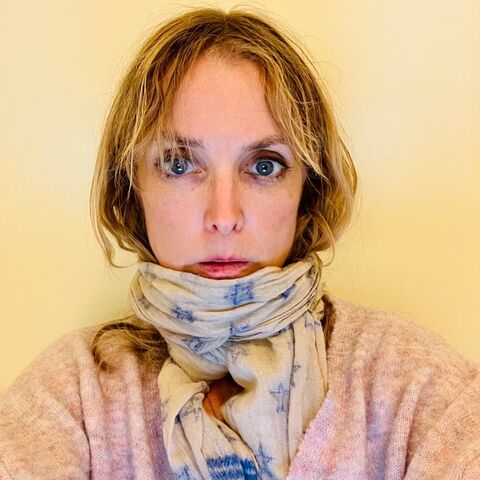
I'm here today with Kate Fleming,
The founding director of Bridge Initiative,
And she was a fashion designer,
Is,
Was a fashion designer,
Arts patron,
And entrepreneur,
Who moved into creating this organization focusing on climate change and art and how to bring this into our lives.
So what I want to say,
Kate is welcome.
Thank you so much for making time to come and see me.
And I want to hear about what you talk about in your bio on your website,
Just about what in the world took you to Antarctica in 2015.
How did you get from working in fashion in New York City all the way to Antarctica?
Well,
It really stemmed from my dad had this kind of bucket list trip that he wanted to go on all his life to Antarctica,
And he had been sick,
And he went into remission,
And still is in remission,
Actually,
But about five years ago,
When he first went into remission,
I said,
Let's,
Let's go to Antarctica.
That's the trip.
And I had also just read what happened,
Where did,
Where'd you go,
Bernadette,
Which is a movie that's out now,
But it was a book.
And funnily enough,
The movie just came out five years from the date of this trip that I went on,
About this Linbad expedition to Antarctica.
So I had been reading that when my dad was in the hospital,
And then he had said it's always been his bucket list,
And I said,
Let's go.
And so we went over New Year's to Antarctica on a not geo Linbad expedition.
And it was totally life changing.
I had never really,
Well,
First of all,
Going to Antarctica was.
How do you even get to Antarctica?
I mean,
I,
My,
My,
My,
My personal idea of Antarctica is like the,
Like the graphic relief globe from like elementary school,
Right?
Like the,
Just like that it was on the other side and it was all white,
And it was,
You know,
Had lots of mountains on it.
That's like,
That's as far as my like real personal idea of Antarctica goes.
I don't know how you get there.
Is there like a direct flight from New York City?
So there's flights if you're,
If you're really a scientist and you're going to the research lab.
But if you are going on a boat to Antarctica,
The most typical way is what Shackleton did when he just,
When he,
He was the first person to go to Antarctica.
And that's,
It's a boat ride two days across the Drake passage.
And that's leaving from Ushuaia,
Argentina,
And then going to the peninsula of Antarctica.
And it's the roughest seas in the world.
So just like an average day,
The waves are between 30 to 60 feet.
Whoa.
And you know,
It can get worse from there.
It's,
It's really intense.
And it's two days without seeing any land,
Which.
Wow.
Had you ever done anything like that before?
No,
No.
Wow.
Wow.
Okay.
I don't get seasick,
Luckily.
So,
But I,
But they do have pills that they just have in,
In little cups around the boat that just knock you out basically.
And then I ended up moving my mattress onto the floor because I just kept bumping out of my bed.
And then it was,
It's so rough that across like the galley and common areas,
They,
They put ropes and they tie knots in it so that if you're walking across a room,
You would have to hold onto a rope because you're just tipping and pitching from one side to the other.
Okay.
So I want to hear this whole story,
But I really have to interject right here because this is something really interesting.
Your father was suffering from a terminal illness of cancer,
I'm assuming you use the word remission and going to Antarctica was on the bucket list.
And that is wild if you know what you have to do to get there and you've already been through whatever I assume he had been through.
So he must have an adventure,
Some spirit.
He does.
He does.
I think it was a little more intense than what he had gambled for.
I think he was a little freaked out,
But then once he got there,
He loved it.
Yeah.
And what about you?
Do you,
I mean.
I loved it.
And I did,
I think I enjoyed it much more than my dad.
And certainly my mom was not into it.
She's a Florida woman.
She's not,
But she was being a good sport and doing it for my dad,
But I really loved it.
And my dad had always been interested in birds.
He did a lot of pro bono work for the Audubon Society.
And I think that's where his interest in Antarctica came in with the albatross because they fly from pole to pole and he really wanted to see them.
And we did see them and it was really amazing.
They fly from pole to pole without stopping,
Which is also incredible.
So,
Yeah,
I went on this expedition and it was an adventure,
Like an extreme adventure,
Like I'd never been on before.
And I loved it.
And it made New York and my life as a fashion designer seem really small and insignificant.
Even just being at sea and having like these endless seas,
No land in sight,
And then pulling up to Antarctica,
Like this frozen continent,
And all of a sudden seeing these little things in the water.
And I thought it was a bunch of fish.
And then I realized it was penguins.
And when they swim,
They kind of like jump out.
And it was just,
It was another world.
It felt like I was on outer space and I felt so small and insignificant in the scope of the universe because it's just a place,
Not for people,
Not for society.
It's just expansive.
And it's all white or blue or shades of black,
Gray,
Blue,
White,
You know?
There's no other colors,
But it's every single shade of those colors,
Which is kind of amazing.
So my mom found it really like disturbing to be at sea and to feel so small.
But for whatever reason,
I found it really liberating.
And it just made all the things that I'd been working so hard to do and get to where I was as a fashion designer in New York and the hustle.
It just,
I was like,
This,
It's not worth it.
This is what,
This is reality.
New York City and all that,
It's not real.
What is reality?
Like what,
What,
What,
What,
Talk,
Talk to me about your idea of what reality meant when you were standing on that dock,
Holding that rope.
Like,
You're like,
Wait,
This is reality.
What did that mean to you then?
And what does it mean to you now?
It's just like the creation,
Destruction,
Earth,
You know,
A planet that we're a planet floating in this solar system of endless solar systems of infinity,
You know?
And,
And Antarctica really has the ability to make you see that for,
For whatever reason,
Or it had the ability to make me see that.
And as opposed to?
This human centric kind of thing that we've created where we are the most important,
You know,
New York City specifically is the,
Is the place.
And we're all so important and stressed out in our little lives.
Like it just wipes all that away.
Right.
So that was a total flip.
You're not only flipping poles,
You're like,
And there's no like number of likes or followers that the Penguin has.
No service either.
So you can't even.
You can't even.
All right.
Not even any service to see if it's,
If it's what people are interested in.
Yeah.
And then it's just the scope of time for what,
Like looking at a glacier and this,
The sound or the lack of sound,
I don't know.
There were like,
There's some,
It's really windy.
Sometimes it was really still,
But these huge monolithic glaciers that are thousands and thousands of years old,
It makes you see time and our purpose and everything in a very different way.
And what kind of training or like lead up or,
Or introduction do they give you on these?
It was a National Geographic tour.
Yeah.
Yeah.
You have to get a lot of gear.
You have to get a physical and that's it.
They have really good staff,
You know,
On the boat.
They're all scientists or naturalists that are kind of guiding you that,
You know,
And,
And there's different levels of comfort and hiking things that you can do or not do.
A lot of people are a lot older and it's their bucket list trip because they want to go to every continent and Antarctica is the final continent,
Usually for a lot of people that were on this boat.
So yeah,
There's,
You don't have to like do a bunch of training.
They just really kind of take care of you.
And then they educate you every night.
You go and go to these lectures and they talked about what we saw.
And so there was a whale specialist named Dr.
Andy Sabo that was on the trip and he was just a really good lecturer and really funny.
And,
You know,
Whales are also amazing and seeing all the whales out there.
They're always probably the most popular naturalist,
You know,
The whale guy.
And I kind of became friends with him.
And when I was out there,
I was like,
I have to do something.
You know,
I want to make an artist residency in Antarctica.
Like creative people need to see this and,
And learn from scientists.
Like it was so fascinating.
I always thought scientists might be really dry and boring.
It was totally opposite.
So I was like,
I need to get people that are really influential and creative out here so they can understand this and they can see that even in this remote area,
There's habitat degradation caused by humans.
You know,
Even in Antarctica where there's no one,
There's plastic because it's floating from other places.
And so I was telling Andy that at dinner one night and he's like,
Well,
Why don't you come to Alaska?
I run the Alaska Whale Foundation.
It's still really remote,
But it's easier to get to than in the Arctic for sure.
And it's probably easier to coordinate a residency or something there.
And so that's how this all started.
What was it that made you need to tell him we have to share this with people?
I mean,
It was,
It was a spiritual experience for me for sure.
I can't describe really what it was like,
But I was like,
Everybody should see this or not everybody,
Because then they would be destroyed.
But people that are more creative and influential than me need to see this because it shattered everything I thought I knew.
And do you think it was the visual that was the biggest impact to you?
Do you think it was,
I mean,
It's so,
This I'm trying to unpack with you just a little bit,
Where you think it touched you,
Like in your body or in your heart or in your mind or as an artist or as a visual person?
Like,
What was the thing that you think really got you to need to take action?
It was all of the above,
But I have meditated for a long time and I felt like I was meditating the entire time I was there for the whole two weeks.
I was the most present I've ever been.
And I was so present in this other world,
Like outer space,
And sometimes it was so silent and I would just stare,
I would just sit outside freezing on the boat and just watch as we like,
It was an icebreaker.
So the tip of the bow of the boat has like a big icebreaker,
Then you're just going through crackling ice and just watching that for hours and then watching giant glaciers go by.
Whales,
Killer whales,
All the animals,
And then the sounds of like Weddell seals.
Weddell seals sound like you're listening to Led Zeppelin,
It's crazy.
I mean,
Everything about it was like astral travel meditation,
Just,
And then time was so slow and I just was so present.
I was so visually overwhelmed that I couldn't think about anything else,
If that makes sense.
If that makes sense,
Like.
No,
That totally makes sense.
And then,
And that makes sense why the impulse inside of you was then to share something artistic.
And,
And I guess that's kind of like,
You know,
What stands out to me about the,
The work that you're doing.
And,
You know,
I'll let you state the,
The mission of Bridge Initiative as it,
As it comes to you.
But what I really resonate with,
With you is this idea of sharing the beauty,
Of sharing the experience,
Of wanting people to be immersed in the,
In the,
The life force spectacle of it.
And,
And bringing the educational element in because so much of what we are bombarded with today are,
Is the disaster.
Yeah.
Right.
And so you were,
You were witness to the plastic in the middle of the end,
At the end,
Literal end of the earth.
But also,
But what was actually affecting you,
It sounds like to me,
Was the beauty.
A hundred percent.
It was the beauty.
And it was,
It was the wildness and it just felt like the universe.
Like I've been,
I always feel spirits or I can feel the vibe of places and civilizations.
So,
You know,
When I go to Europe,
I can feel the history,
The ancient people and all these things.
But going there,
You don't feel any of that.
You just feel the universe just expanse and time in its essence without human,
Humanity's kind of ideas of it.
And that's,
That's what was so amazing.
And I got kind of sad.
I mean,
I was sad and I had a video diary that I was doing while I was there.
And I spoke one night about how I wanted to make sure that,
That future generations could see this,
That this would still be there.
Because there's a sense it's so beautiful,
But it might not continue.
And it had been for so many thousands of years.
And the fact that we could destroy this and that the future generations wouldn't see that was really devastating to me.
But mostly it was,
It was the beauty that inspired me to even have that sadness.
Right.
Very pretty to move me.
Right.
The beauty,
The beauty is the inspiration.
You know,
I was thinking of a,
I had a chat with one of my heroines,
Terry Tempest Williams,
A naturalist and writer,
But she was talking about some of the politicians and land management people having this meeting about Bears Ear National Monument.
And she was telling the story about how they met in a room with no windows,
Like in the great Southwest,
They met in a room with no windows to decide the fate.
So I asked her,
I was like,
What is it that,
Why,
Why do these people want to go into this room with no windows instead of being in this place?
And so I put this to you,
You know,
You're sharing this and this,
This like invigorated you,
This inspired you,
This made you feel,
You know,
Full and energized and activated.
And,
But there is something beautifully terrifying about that too,
A glacier that's thousands of years old right in front of you.
So what do you think it is that,
That determines whether your response is one or the other?
I don't know.
I mean,
I know you said your mother didn't necessarily have such a great time.
Yeah.
A lot of people don't like to feel small.
You know,
I think society doesn't like to feel small.
I think people need to become more comfortable with it because it's the truth.
You know,
We are small,
We,
Our time on this planet is small and we're doing so much harm.
And if we,
If you go out and you see these things that have been there for thousands of years,
It really resonates on you,
But it's not how capitalism or society works.
So I think we need to kind of like get into a different headspace where we can feel comfortable being small.
And then you can experience these things in a more true way without it being like,
I think it becomes like,
If it's so big,
Then I mean nothing.
And then my ego hurts,
But it doesn't have to be that way.
Is that?
Yeah.
I mean,
I don't,
I don't know.
I mean,
I'm curious to me.
I like that you're using this word small and like putting it in,
In,
In terms of truth.
Like it's the truth.
Yeah.
You were just one person of whatever,
25,
I'm guessing maybe people that you were with or more,
I don't know.
And then however many glaciers and however many.
Do you know that like,
So if,
If,
If the world from the beginning of time was an hour,
Right.
We are,
We are at like 56 minutes that we've,
That humans have been existing.
So that's also like the concept of how small we are.
Like that humans being alive on this planet is such a small amount of time for the planet,
For the universe,
For the solar system,
For that glacier.
But look how much damage we've done.
Look how much we've altered the whole earth.
So we're,
We're at the same time,
Very small,
But we have a huge impact.
And it's kind of like,
How,
How do we want that,
You know,
To,
To alter this long scale?
Great.
So can you,
This is a,
I think a good flow into,
Can you say,
Like kind of sum up what the Bridge Initiative's mission is?
Like what,
What you,
Why you started this?
Yeah.
So after,
After that experience,
And then I took five years to kind of travel more,
Learn more,
Read more.
Cause I had,
I had gone to Parsons for fashion design and I realized I needed to be able to talk to someone that was a PhD,
You know,
Biologist.
But I came up with this idea about Bridge and,
And really taking artists out into pristine or,
You know,
As pristine as it is locations with scientists and organizations that are doing direct acts of impact on the ground and having the artists kind of learn about that and then creating public art about it.
Kind of highlighting the organization,
Like Alaska Whale Foundation in this case.
And,
And their mission through,
Through art and the idea that like art has the power to make a revolution irresistible or to make someone fall in love with something.
And when people fall in love with something,
They want to protect it.
Just like that experience in Antarctica changed my life and it became my mission to do what I can to protect the earth in the way that I can.
And this is what I devised.
Talk to me a little bit about that with the,
The distance between the artist and the,
The public.
So the,
The,
The mission is to go to these spaces with artists to then bring back art for the public.
So talk to me about how you see that as the right flow or how that,
How that,
How you see that working.
Well,
Certainly not everybody wants to or should go to Alaska,
Right?
Or any of these kind of remote places.
So yeah,
Just the idea of bringing an artist and,
And having them educated by a scientist who's talking about the data and what they're seeing.
And then the artist can interpret that into something that's a little bit warmer than data or,
You know,
Scientific reports or news articles that are filled with like climate change fear.
You know,
Art can be,
It can be much simpler and have a very profound effect.
And sometimes it's,
You know,
Going to be something of beauty and hope.
And sometimes it might be both beautiful and terrifying,
But I think art has the ability to kind of take the science of the climate crisis and make it into something that the public can understand and want to engage in.
Right.
But there is something really specific to what,
At least this first video that you've released and the project as it's gone so far with the photographer,
Whose name I've forgotten.
It's David Benjamin Sherry.
Thank you so much,
David Benjamin Sherry.
And in Alaska,
That is very romantic,
As far as I can tell,
As far as I'm gathering from it.
And,
And there's a different,
You know,
There was like a little bit of a different,
The earth art and the environmental art,
Like 60s through the 80s,
Kind of was,
Was a little bit more confrontational,
More of these kind of these installations that maybe weren't meant for people to see,
Unless you traveled there to go there,
It was conceptualized and done.
And then like the spiral jetty or something.
Yeah.
Yeah.
You know,
Go out there.
Yeah.
Or I'm like riffing here,
But I guess what I'm trying to parse out with you,
Just even in my own,
Own understanding of this is like,
Where does culture fit into these big social changes that we're trying to make?
So I'm also coming at it,
You know,
I say art,
But it could evolve to be in all different things.
It could even be a band one day that I take somewhere.
But I think I came into it in the way,
Like a marketing way.
I was thinking about how fashion can make things cool.
And we often use artists or musicians in the campaigns in order to make a brand really cool.
So I thought,
You know,
What am I good at?
I'm good at making things cool.
I worked in fashion for a long time,
And I need to make the earth cool.
So let's use artists and make campaigns to make,
You know,
Because conservation,
It has a long history of being kind of hippie,
Granola,
Crunchy,
Or man's world,
Like not geo,
All these men that have documented,
You know,
America,
Written about America and conservation.
So I wanted to take it and make it something a bit more appealing for everybody,
If that makes sense.
And so I thought,
Bringing artists and making campaigns.
And one of the things it's like doing PR for the planet,
Because I think we're at a place where the planet needs PR.
We're going to get people on board to change the way we live and engage with it.
Right.
So in a way,
It's the art of commerce,
And integrating that into a campaign.
Into a campaign.
So using the structures that are already there that may have been part of the demise to begin with,
To elevate and lift up what is the new brand?
I mean,
It's not as romantic as just being like,
You know,
Art in public places.
Yeah,
Just the idea behind my mind of how to make people change.
Sometimes you have to,
They don't change for the right reasons,
But everybody wants to do something if it's cool.
So if we can just get people to start,
You know,
It's surprising.
Right,
Absolutely.
No,
Totally.
So then back to this idea.
So okay,
So looking at it from almost like a branding,
Rebranding perspective,
And earth art,
Kind of bringing that into fashion,
And kind of out of the conceptual art world.
Right.
How does this,
How does this site,
There was,
You know,
The earth art movement had,
Was a lot about site specificity,
And place,
And you know,
Getting out of the galleries,
And you know,
I'm not a fashion person,
So I don't know the history of how fashion has related to that idea of coming out of the institutions.
How does that relate to this kind of rebranding?
Because it's so much about the place.
Right.
So it's bringing the place,
And making the place accessible into cities,
And into middle America,
And into places that people might not be thinking about it.
So with the Alaska project,
David Benjamin Sherry took these beautiful photos.
We have five of them for use,
And we made a short documentary,
But really we're making this billboard campaign that we just launched one in New York,
And now one's up in Omaha,
Nebraska,
And I'm hoping to fundraise to make more in,
Throughout America,
Leading up to the 2020 elections.
And it's not,
It doesn't have a political message per se.
It's a picture of a glacier,
And it says,
Warming signal,
Imagine a future where your children will never see this.
And then it has Alaska Whale Foundation's website,
And our website.
And so it's just trying to get people to think about nature as we're going in to vote.
We need to address this.
And there's other images that I will roll out throughout,
Up into 2020,
With different texts.
I'm not sure what that is,
So if you have ideas.
I'm open?
Sure,
Yeah.
But so that's,
It's just like,
We want to really put it all throughout middle America.
And then be able to write about,
In local press in Omaha,
Nebraska,
About climate change,
And about what Alaska is dealing with,
And how even in Alaska,
Their issues affect Omaha,
Or the melting in the Arctic.
You know,
It's not one place that's going to suffer.
Everything's interconnected.
So trying to bring that into their local newspapers,
And maybe their local news too,
In these cities.
I thought,
You know,
It's a nice way to just get the conversation from a bigger national perspective.
Hopefully we'll get press nationally,
But also trying to get local.
Great.
Congratulations,
By the way.
And that sounds really beautiful,
Of making it involved in people's lives.
So I'm going to ask the question about,
What is it that makes that important to someone?
You know,
This is like,
Maybe just,
I've watched too many Dem debates,
Or listened to too many podcasts on politics.
But what is it that then makes it important to someone who,
You know,
Well,
My child is never going to see a glacier,
And I just need them to be sure that they have nutritious food today,
And get to school on time?
Or what is it,
You know,
Like,
How does,
How does art and this,
You know,
Play into that?
Like,
How,
How do you,
Or do we need to address that?
Yeah,
I mean,
With our Florida Project Waterproof,
We're definitely going to talk about climate justice,
Which is just that.
And it's usually the poorest people,
Or it is going to be the poorest people that have the most to lose,
That are going to suffer first.
But for the Alaska Project,
I think it's,
You know,
Everybody can do something,
And not everybody can eat organic,
And not use plastic,
And people that are busy and just need to get their child fed,
Obviously,
They can't make all these changes.
It's really the government that needs to make all these changes.
It's not,
You know,
If you can make adjustments in your life,
That's great.
But policy change is what's going to really make the big difference.
It's not about everyday person's life.
This is about stop using fossil fuels.
So this is like a policy change.
I think everybody is going to be voting,
Hopefully.
So it's just,
They have the power,
Everybody has the power to make a vote that's going to make a difference.
And also just,
You know,
I think a lot of people,
When they think about Alaska,
It's scary.
They think about Sarah Palin,
Maybe.
You know her name?
I mean,
A lot of people are like,
Oh yeah,
I think about Alaska,
I just think about Sarah Palin.
I was like,
Well,
That's definitely not what Alaska is about.
And people think about those reality TV shows where it's like,
Last Man,
Alaska,
And it's a lot of fear.
So another thing is just getting out of that,
You know,
Fear of nature.
And let's make people see the beauty of it again,
Too.
I think we've disassociated,
And we all live in these cities.
And then you think about the wild,
And it's very scary.
And certainly,
It is something that you need,
If you are going in the wild,
You need to be prepared and be careful and cautious.
But it shouldn't be just a place of fear,
Thinking about the wild.
It should be beauty and reverence.
And that's another thing that I think just being able to bring that to people that are living in cities,
Or that may never even get to go out there,
But for them to have a fond place in their heart for it will make a difference,
I hope.
Yeah,
I was reading about,
I was reading about this,
This about John Constable painting these beautiful landscapes were painted in the brief hiatus between the end of the French Revolutionary Wars and the beginning of the Napoleonic Wars the following year.
And the tranquility of the image belies the wider political turmoil.
That's interesting.
So it seems relevant to what you're what you're offering.
Yeah.
You know?
I hope so.
And I guess I guess I'm curious,
As you get deeper into this,
How to how to resist or how to temper or how to how you how you are engaging with the climate crisis,
And this,
This desire to the tranquility of the image,
You know,
That sits in between this political turmoil?
Like,
Do you are you thinking about that at all?
Yeah,
I think I I mean,
I try to digest the climate crisis,
And then curate through bridge,
The tranquility while also addressing it,
But without the frantic chaos,
Which is hard on me,
Because I sometimes like I'm like,
I can't get out of bed.
Because I'm reading it all,
And I'm trying to understand it.
And then trying to kind of curate it and put it back out in a way that's been processed.
Tell me about that a little bit more.
So you can't get out of bed.
Like,
What's that like?
What happens that day when you can't get out?
I just watch a lot of Netflix.
Sometimes.
Yeah.
But what inspires I mean,
I'm interested in what you're every time I read the IPCC reports,
I have that kind of crisis.
And it's the International Panel of Climate.
What I can't remember the last I can't remember the acronym IPCC.
But it's it's a UN and it's international scientists all over the world that are working together.
And they they released these they've been last year,
They released four reports,
And it's devastating.
And it doesn't it's not good.
And what is what's the most devastating thing to you about it?
Like,
So what is it that makes it what I'm trying to get to,
Mostly for the listeners,
Just because I think that this is an experience that you're not alone in,
Even though you're so much deeper into it than than the majority?
What is it that makes it devastating?
And then what is it that actually gets you back out of bed?
Well,
I mean,
It's not it's the future.
Even if we right now stop burning fossil fuel,
According to these reports,
Basically,
In 20 years,
And in 50 years,
Certainly,
The world is not going to be the way it is.
It will never be this beautiful.
It will never be this perfect again.
And there's it does,
I don't know that we we can fix that we can make it less horrible,
Or we can have a go to total chaos.
So that's kind of this horrible reality.
There is,
There is some positive things people are talking about,
Like carbon recapture and getting back to pre industrial levels of carbon by doing mass plantings of trees.
Like I was just at the UN General Assembly.
And there is this new idea,
I can't remember the name,
But trying to actually bring us back pre industrial revolution carbon levels,
Which would make the earth better than it is today.
And that's really interesting.
But you know,
I don't know that we have the power to do that.
Because currently,
Our administration isn't doing anything.
And they're actually unrolling all these laws and the EPA is not existing.
And they're opening up national parks,
And they're getting rid of clean air acts.
So got it,
I get that I'm getting the vibe,
The whole vibe.
Okay,
Sorry.
But now I understand like,
I get the I get that where that would lead that kind of thinking that whole train of thought is going to spiral into,
Okay,
I'm just gonna check out and see what the latest crime scene is on Netflix.
So so then once you're done binge watching a series,
And what is it that has been helping you get back to it?
I am inspired for by the future generations are young,
The young people that are that are being activists right now,
And how educated and smart and passionate they are.
And,
And even,
I decided not to have kids because I want this to be my child for many children.
You know,
I want I want the world to exist for the future generations.
And then the kids that are teenagers right now are so inspiring.
And I want to do this for them.
And so I just get myself back together and try to figure out,
You know,
Something I can do and something that won't shut people down.
And,
And then I also look at the solutions.
And we have all the solutions,
We have all the clean energy solutions.
And it's just about changing policy.
So that's great.
And there's all these other new innovations that could recapture carbon.
If we get the politicians and the whole world on board,
It's solvable.
Plus,
You're making this beautiful archive of these natural places for us to engage with in a in a in their present,
Most pristine state.
Yeah,
That's the objective.
Correct?
Yeah.
Correct.
Yeah.
And so it's very,
Very loving,
Very communal.
And I appreciate very much your inspiration to create this and to lead and to nurture the youthful revolution that's coming behind it.
And I just want to support them.
And which is why like the first billboard says,
Imagine a future where your children will never see this because they just came here to New York during the UN General Assembly and addressed all the world leaders.
And it was so inspiring.
And I want to continue pushing their voices out,
You know,
And I'm an adult that but I want to be able to do something as I said,
You know,
Greta Thornburg said,
Do something.
And so I want to be one of the adults that's trying to do something for them.
That's fantastic,
Kate.
That's really moving.
So,
So you have a really nice log of this,
This Alaska project.
And,
And I'm not sure if you wrote this or not.
I imagine you did.
Day two peril straight to Warm Springs Bay,
Baranoff Island.
We wake early and take the skiff to shore at Hannes Bay on the northeast coast of Baranoff Island.
The tide is low so the clams resting in the wet sand greet us with fountain like spurts.
We wouldn't want to eat them,
Andy cautions.
This is peril straight,
A 40 mile long passage named for a fatal incident during a fur seal hunting expedition.
In 1917,
Excuse me,
In 1779,
Native loot hunters ate poisonous shellfish from the straight and 150 people died as a result.
Noted.
I just really loved this entry because it has everything in it.
And also it has this I didn't write it.
I can't take credit.
Okay.
Arianne,
Who works with me on bridge,
She wrote it and she's an amazing writer.
Well,
She did a wonderful job.
She was on the expedition.
Yeah.
Fantastic.
So,
But what I love about it is it kind of contains the whole story just in that little paragraph because here it is 1779 pre-industrial revolution and 150 people died from eating poisonous shellfish.
So just to just play,
You know,
The other side,
Here is mother nature,
The earth in 1779.
If you can do the math,
Cause it's 2019,
You know,
Exactly how many hundreds of years ago that was.
I can't do that.
But,
But yeah,
They're going to hunt seal and they eat this shellfish and it's over it's current.
It's 150.
What is this relationship between this piece in reality,
Your war in nature,
The balance of nature,
The balance of the human and the,
And the animal of earth and animal.
What is it that you think we can take from that story?
Well,
I mean,
Yeah,
Nothing in nature is in,
I mean,
Certainly Alaska and Antarctica are very violent places.
It's,
You know,
Even as an animal living there,
If you're a seal,
It's not a great life.
You know,
Have,
We have killer whales hunting and stalking you.
And there's just violence,
The weather,
You know,
It's something powerful.
And we also are the same in our,
In our effect upon the earth or the earth's effect upon us or our effect upon one another.
I mean,
Everything's not always warm and fuzzy and you know,
Nature is beautiful,
But it's also powerful.
And it's also not always nice.
It's,
It's just like,
You know,
How people aren't always nice.
No one's,
We all have these,
It's like a polarity planet and we all kind of function in that.
Yeah.
So it just seems to me like when confronted with the brutality of nature,
It's sometimes easier for us to hold it or accept it in terms of these people dying from eating the shellfish or the seal being constantly terrorized by the killer whale.
Or I just saw,
I don't know where on the internet,
Some,
The,
The winning nature photography prizes of a fox.
Oh,
Terrifying like a badger?
Yeah.
Like this,
This terrified,
Terrified little,
And it was,
It was comedy.
It was supposed to be like comedy and horror.
And cause the,
The little like prairie dog badger thingy looks hilariously personified and,
And there's something in that,
In that excuse,
I think that might becoming extinct in human thought.
It's like,
Well,
Nature is inherently violent and you could say,
Well,
You know,
So mother nature,
The glaciers are going to melt and they're going to flood your town and they're going to wipe you out.
So that's how it is.
So what is it to be a peace earth activist or a peace artist or someone who says,
Okay,
Sure,
But I'm going to show you this beautiful,
You know,
Brown bear and I'm going to show you all these seals lounging on the cliff.
And I'm going to show you this forest light that is unbelievably beautiful.
I mean,
I hear what you're saying and I,
Yeah,
I think it is the polarity of nature.
But if you say that about,
You know,
Oh,
Well,
Nature's so violent and,
You know,
It's going to melt anyway.
And,
You know,
Maybe we're better without it.
We could say the same things of us and our wars and our hypocrisy,
You know?
So I think,
I don't think it's an argument.
I think if you look at our society and you look at nature,
They're reflections of each other.
The thing is,
Is that the thing is,
Is that nature can live without us and we can't live without nature,
You know,
The earth can continue on and it will without us,
But without this whole ecosystem and it's our life support.
So if we want to continue,
We can't look at it that way.
So it's like the great global peace treaty between humankind and mother nature that we're negotiating right now.
And this example of what you're creating is such a beautiful way of leaning into that and kind of,
From my point of view,
Taking that polarity and melting it,
For lack of a better word,
Into,
You know,
Blending it into the art.
I hope so.
Thank you.
Yeah.
So that we can see ourselves in that beauty.
And I think that,
You know,
Back to this image of you standing facing this glacier and someone else on the same trip seeing that,
Or these,
Or Terry Tempest Williams on the,
In the great Southwest,
Or one of these politicians in a room with no windows,
Is like,
I see you seeing yourself reflected in that.
Yeah.
Right?
And I see her seeing her own beauty reflected in that.
So how do we get the guy in the room with no windows to see his own beauty reflected in that and want to hold that?
Or do we?
Or do we need to get him to do it?
Or we just need to keep getting all the people that are inclined to do that?
We have to realize that,
I mean,
This is not very uplifting,
But what I really believe is that we are in World War III,
And it's us against nature.
And we don't even realize it.
And we've been in it for quite a while.
And so the first step is to realizing that the people that are in the war room,
Which is that no window room,
They need to realize they're in a war room.
And then come to terms with that.
Wow.
Right.
And they are,
But they haven't thought of it that way.
But you know,
The future,
I really deeply believe in 50 to 100 years from now,
The future is going to be looking at us,
And they're going to see that very clearly.
And we are going to be judged.
So it's what side do we want to be on?
I mean,
It's obvious we want to be on nature's side.
Right.
Well,
We want to be on nature's side.
I think that It's our side,
Too.
Our side is nature's side.
That's what's the most ironic thing.
Right.
There's only one side.
Yeah.
And this is where the reality aspect comes in,
Where you say,
Oh,
No,
This is reality.
This is the universe.
It's there's only one side.
Yeah.
There's only one.
Yeah.
Well,
Kate,
There's,
We obviously have a lot to talk about.
And there's so,
So much to look forward to with the Bridge Initiative.
I encourage everyone,
Please,
To go to bridgeinitiative.
Org and check out the blog and the recently released beautiful short little documentary.
If you're in New York City,
Go to see the billboard on where and where?
It's on Canal and Lafayette.
Canal and Lafayette.
And it's up until?
October 26,
Maybe a little longer.
Okay.
And if you're in Omaha,
Nebraska,
I don't know exactly where it is.
Look for it.
Go on bridgeinitiative.
Org and you can find it.
Yeah.
And follow Kate's beautiful Instagram at bridgeinitiative,
Correct?
Bridgeinitiative.
Org,
All one word.
Bridgeinitiative.
Org,
All one.
And thank you.
I really look forward to continuing this conversation.
Thank you.
Me too.
And the next one about peace with your project,
Because I think it leads right into what we ended with.
Perfect.
Yeah,
Absolutely.
Okay.
Thank you so much.
Thank you.