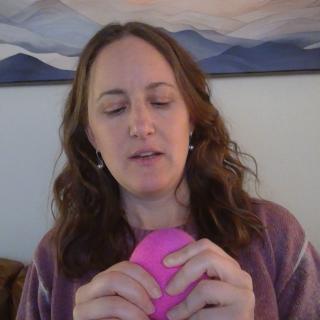
This practice is called micro adjustments for the neuro divergent body.
So when we set ourselves up for meditation sometimes we hold these expectations of how our bodies are supposed to look or feel,
And often can bring in some rigid expectations around that.
So here we're going to learn some slight little posture corrections that you can try out on your own.
It's all about finding what really works for you because everybody's body is different.
So what I want to guide you to do is to tune in to how your body actually feels as we try these things out.
So usually,
Often we'll take a seated position meditation and you can just begin by swaying a little bit,
Left and right.
Let your body just shift its weight to one side.
Kind of almost like it's bumping up against the sides like a bowling alley right the ball is just bumping up against the bumpers.
And then same thing,
We can go back and forth.
Just letting our body have some sway and movement in it.
Playing with how you're holding your body and where you're holding the tension or where the force is coming from.
And actually let yourself kind of be like a spaghetti noodle a little bit.
If that feels helpful.
And then find.
.
.
The center line.
In this way,
So my rear body kind of settles into position.
We can take a kind of a little check in with our posture as we start to meditate so often a good place to check in is with the shoulders.
And we can see to the shoulders want to experiment with rolling backward a little.
Moving forward a little bit.
You can just go between the two of those see which one feels best for you.
Noticing what your posture tends to be like.
A lot of us are bent over at a computer often and have more of a forward leaning posture.
You know,
The correction here is not to.
.
.
Sit upright forcefully.
The correction is just a gentle opening.
Gentle opening with the shoulders.
Opening the chest and opening the heart.
This sets your mind up better to be comfortable in meditation.
If you're straining too hard in your posture,
You're going to be setting your mind up for more strain as well.
You can try just like tilting your head or turning your head.
Side to side and just take note of how that feels for you.
Come back to middle,
You can see about tucking your chin a little bit.
Versus extending it.
Where is your body actually feeling support?
And then dropping down through the.
.
.
Core here we want to feel our weight.
We want to feel the rib cage is not flaring open,
That we're not carrying all this strain on our necks and backs,
But that our rib cage is actually aligned straight down over the pelvis.
You can feel that and I'm using my hands to just guide my way down from my ribcage to my hips.
Feeling a straight line there give myself a little Wiggle.
Come back to the shoulders and the neck.
Finding seeing now just checking in if this feels like a good posture for you,
Or if there's any other adjustments that you might need to make.
When we set ourselves up for meditation,
We want to be restful and at ease,
And especially for the neurodivergent body that can be extra fidgety,
It can be extra sensitive,
Sensitive to pain.
There's all kinds of experiences we carry in us that we just want to do our best to set ourselves up in a way that works for us.
And the adjustments are not meant to be over corrections and not meant to be rigid,
But just tiny little micro adjustments.
To feel into your body and let your nervous system relax a little bit more.