Hello there,
It's Mandy here.
Thanks for joining me tonight and welcome back to Elizabeth and her German Garden by Elizabeth von Arnim.
Elizabeth von Arnim's parents were concerned when she became 22 that their petite and beautiful daughter's marital chances were rapidly diminishing.
A tour of Europe was organised with the aim of finding her a suitable husband.
This had consequences far exceeding their expectations.
She met the newly widowed Graf Henning von Arnim Schlagenfen,
A member of the German aristocracy and a friend of the Wagner family.
He was captivated by the talented,
Charming and vivacious young woman and two years later,
In February 1891,
The couple were married in London.
But on with the story.
We've reached chapter two and before I go ahead,
Please feel free to make yourself really comfortable.
Settling down into your chair or your bed,
Relaxing your hands,
Dropping your shoulders and softening your jaw.
That's wonderful.
If you're ready,
Then I shall begin.
May the 10th.
I knew nothing whatever last year about gardening and this year know very little more.
But I have dawnings of what may be done and have at least made one great stride,
Tea roses.
The garden was an absolute wilderness.
It is all round the house,
But the principal part is on the south side and has evidently always been so.
The south front is one storied,
A long series of rooms opening one into the other,
And the walls are covered with Virginia creeper.
There is a little veranda in the middle,
Leading by a flight of rickety wooden steps down into what seems to have been the only spot in the whole place that was ever cared for.
This is a semicircle cut into the lawn and edged with privet.
And in this semicircle are 11 beds of different sizes,
Bordered with box and arranged around a sundial.
And the sundial is very venerable and moss grown and greatly beloved by me.
These beds were the only sign of any attempt at gardening to be seen,
Except a solitary crocus that came up all by itself each spring in the grass,
Not because it wanted to,
But because it couldn't help it.
And these I had sown with Ipomoea,
The whole 11,
Having found a German gardening book,
According to which Ipomoea in vast quantities was the one thing needful to turn the most hideous desert into a paradise.
Nothing else in that book was recommended with anything like the same warmth,
And being entirely ignorant of the quantity of seed necessary,
I bought 10 pounds of it and had it sown not only in the 11 beds,
But around nearly every tree.
And then I waited in great agitation for the promised paradise to appear.
It did not,
And I learned my first lesson.
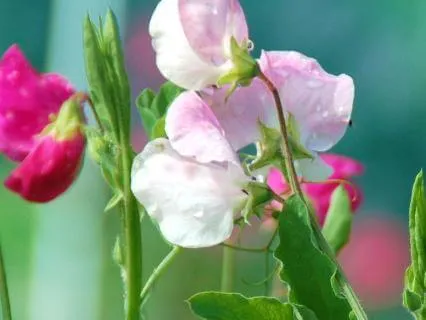
Luckily I had sown two great patches of sweet peas,
Which made me very happy all the summer,
And then there were some sunflowers and a few hollyhocks under the south windows,
With Madonna lilies in between.
But the lilies,
After being transplanted,
Disappeared to my great dismay,
For how was I to know that was the way of lilies?
And the hollyhocks turned out to be rather ugly colours,
So that my first summer was decorated and beautified solely by sweet peas.
At present we are only just beginning to breathe after the bustle of getting new beds and borders and paths made in time for this summer.
The 11 beds around the sundial are filled with roses,
But I see already that I have made mistakes with some,
As I have not a living soul with whom to hold communion on this,
Or indeed on any matter.
My only way of learning is by making mistakes.
All 11 were to have been carpeted with purple pansies,
But finding I had not enough,
And that nobody had any to sell me,
Only six have got their pansies,
The others being sewn with dwarf mignonette.
Two of the 11 are filled with Marie Van Huet roses,
Two with Viscountess Folkestone,
Two with Laurette Messimer,
One with Souvenir de la Malmaison,
One with Adam and Devoniensis,
Two with Persian yellow and bicolour,
And one big bed behind the sundial with three sorts of red roses—seventy-two in all—Duke of Teck,
Cheshunt Scarlet,
And Prefet de Limburg.
This bed is,
I am sure,
A mistake,
And several of the others are,
I think,
But of course I must wait and see,
Being such an ignorant person.
Then I have had two long beds made in the grass on either side of the semicircle,
Each sewn with mignonette,
And one filled with Marie Van Huet,
And the other with Jules Finge and the bride,
And in a warm corner under the drawing-room windows is a bed of Madame Lombard,
Madame de Wattvie,
And Comtesse Ritza du Parc,
While further down the garden,
Sheltered on the north and west by a group of beeches and lilacs,
Is another large bed containing Rubens,
Madame Joseph Schwartz,
And the Anne Edith Gifford.
All these roses are dwarf.
I have only two standards in the whole garden,
Two Madame Georges Bruon,
And they look like broomsticks.
How I long for the day when the chee roses open their buds!
Never did I look forward so intensely to anything,
And every day I go the rounds,
Admiring what the dear little things have achieved in the twenty-four hours,
In the way of new leaf or increase of lovely red shoot.
The hollyhocks and lilies,
Now flourishing,
Are still under the south windows,
In a narrow border on the top of a grass slope,
At the foot of which I have sown two long borders of sweet peas facing the rose beds,
So that my roses may have something almost as sweet as themselves to look at until the autumn,
When everything is to make place for more tea roses.
The path leading away from this semi-circle down the garden is bordered with china roses,
White and pink,
With here and there a Persian yellow.
I wish now I had put the teas there,
And there have misgivings as to the effect of the Persian yellows among the chinas,
For the chinas are such wee little baby things,
And the Persian yellows look as though they intended to be big bushes.
There is not a creature in all this part of the world who could in the least understand with what heart-beatings I am looking forward to the flowering of these roses,
And not a German gardening book that does not relegate all tea roses to hot houses,
Imprisoning them for life and depriving them forever of the breath of God.
It was no doubt because I was so ignorant that I rushed in where Teutonic angels fear to tread,
And made my teas face a northern winter,
But they did face it under fir branches and leaves,
And not one has suffered,
And they are looking today as happy and as determined to enjoy themselves as any roses I am sure in Europe.
May the 14th.
Today I am writing on the veranda with the three babies,
More persistent than mosquitoes,
Raging around me,
And already several of the thirty fingers have been in the inkpot,
And the owners consoled when duty pointed to rebukes.
But who can rebuke such penitent and drooping sun bonnets?
I can see nothing but sun bonnets and pinafores and nimble legs.
These three,
Their patient nurse,
Myself,
The gardener,
And the gardener's assistant,
Are the only people who ever go into my garden,
But then neither are we ever out of it.
The gardener has been here a year,
And has given me notice regularly on the first of every month,
But up to now has been induced to stay on.
On the first of this month he came as usual,
And with determination written on every feature,
Told me he intended to go in June,
And that nothing should alter his decision.
I don't think he knows much about gardening,
But he can at least dig and water,
And some of the things he sows come up,
And some of the plants he plants grow.
Besides which,
He is the most unflaggingly industrious person I ever saw,
And has the great merit of never appearing to take the faintest interest in what we do in the garden.
So I have tried to keep him on,
Not knowing what the next one may be like,
And when I asked him what he had to complain of,
And he replied nothing,
I could only conclude that he has a personal objection to me,
Because of my eccentric preference for plants in groups,
Rather than plants in lines.
Perhaps,
Too,
He does not like the extracts from gardening books I read to him sometimes,
When he is planting or sowing something new.
Being so helpless myself,
I thought it simpler,
Instead of explaining,
To take the book itself out to him,
And let him have wisdom at its very source,
Administering it in doses while he worked.
I quite recognise that this must be annoying,
And only my anxiety not to lose a whole year through some stupid mistake has given me the courage to do it.
I laugh sometimes behind the book at his disgruntled face,
And wish we could be photographed,
So that I may be reminded in twenty years' time,
When the garden is a bower of loveliness,
And I learn it in all its ways,
Of my first happy struggles and failures.
All through April he was putting the perennials we had sown in the autumn into their permanent places,
And all through April he went about with a long piece of string,
Making parallel lines down the borders of beautiful exactitude,
And arranging the poor plants like soldiers at a review.
Two long borders were done during my absence one day,
And when I explained I should like the third to have plants in groups and not in lines,
And that what I wanted was a natural effect,
With no bare spaces of earth to be seen,
He looked even more gloomily hopeless than usual.
And on my going out later to see the result,
I found he had planted two long borders down the sides of a straight walk,
With little lines of five plants in a row.
First five pinks,
And next to them five rockets,
And behind the rockets five pinks,
And behind the pinks five rockets,
And so on,
With different plants of every sort and size,
Down to the end.
When I protested he said he had only carried out my orders and had known it would not look so well.
So I gave in,
And the remaining borders were done after the pattern of the first two,
And I will have patience and see how they look this summer before digging them up again,
For it becomes beginners to be humble.
If I could only dig and plant myself,
How much easier,
Besides being so fascinating,
To make your own holes exactly where you want them,
And put in your plants exactly as you choose,
Instead of giving orders that can only be half understood from the moment you depart from the lines laid down by the long piece of string.
In the first ecstasy of having a garden all my own,
And in my burning impatience to make the waste places blossom like a rose,
I did one warm Sunday in last year's April,
During the servant's dinner hour,
Doubly secure from the gardener by the day and the dinner,
Slink out with a spade and a rake,
And feverishly dig a little piece of ground,
And break it up,
And sow surreptitious ipomoea,
And run back very hot and guilty into the house,
And get into a chair and behind a book,
And look languid,
Just in time to save my reputation.
And why not?
It is not graceful,
And it makes one hot,
But it is a blessed sort of work,
And if Eve had had a spade in paradise,
And known what to do with it,
We should not have had all that sad business of the apple.
What a happy woman I am,
Living in a garden,
With books,
Babies,
Birds,
And and plenty of leisure to enjoy them.
Yet my town acquaintances look upon it as imprisonment,
And burying,
And I don't know what besides,
And would rend the air with their shrieks,
If condemned to such a life.
Sometimes I feel as if I were blessed above all my fellows,
In being able to find my happiness so easily.
I believe I should always be good,
If the sun always shone,
And could enjoy myself very well in Siberia on a fine day.
And what can life in town offer,
In the way of pleasure,
To equal the delight of any one of the calm evenings I have had this month,
Sitting alone at the foot of the veranda steps,
With the perfume of young larches all about,
And the May moon hanging low over the beaches,
And the beautiful silence,
Made only more profound in its peace,
By the croaking of distant frogs,
And the hooting of owls.
A cockchafer darting by,
Close to my ear,
With a loud hum,
Sends a shiver through me,
Partly of pleasure,
At the reminder of past summers,
And partly of fear,
Lest he should get caught in my hair.
The man of Roth says they are pernicious creatures,
And should be killed.
I would rather get the killing done at the end of the summer,
And not crush them out of such a pretty world,
At the very beginning of all the fun.
It has been quite an eventful afternoon.
My eldest baby,
Born in April,
Is five years old,
And the youngest,
Born in June,
Is three,
So that the discerning will at once be able to guess the age of the remaining middle,
Or May baby.
While I was stooping over a group of hollyhocks,
Planted on the top of the only thing in the shape of a hill that the garden possesses,
The April baby,
Who had been sitting pensive on a tree stump close by,
Got up suddenly,
And began to run aimlessly about,
Shrieking and wringing her hands with every symptom of terror.
I stared,
Wondering what had come to her,
And then I saw a whole army of young cows,
Pasturing in a field next to the garden,
Had got through the hedge,
And were grazing perilously near my tea-roses and most precious belongings.
The nurse and I managed to chase them away,
But not before they had trampled down a border of pinks and lilies in the cruelest way,
And made great holes in a bed of china roses,
And even begun to nibble at a jacmanii clematis that I am trying to persuade to climb up a tree trunk.
The gloomy gardener happened to be ill in bed,
And the assistant was at vespers,
As Lutheran Germany calls afternoon tea,
Or its equivalent,
So the nurse filled up the holes as well as she could,
With mould,
Burying the crushed and mangled roses,
Cheated for ever of their hopes of summer glory,
And I stood by,
Looking on dejectedly.
The June baby,
Who is two feet square and valiant beyond her size and years,
Seized a stick much bigger than herself,
And went after the cows,
The cowherd being nowhere to be seen.
She planted herself in front of them,
Brandishing her stick,
And they stood in a row and stared at her in great astonishment,
And she kept them off,
Until one of the men from the farm arrived with a whip,
And having found the cowherd sleeping peacefully in the shade,
Gave him a sound beating.
The cowherd is a great hulking young man,
Much bigger than the man who beat him,
But he took his punishment as part of the day's work,
And made no remark of any sort.
It could not have hurt him much through his leather britches,
And I think he deserved it,
But it must be demoralising work for a strong young man,
With no brains,
Looking after cows.
Nobody with less imagination than a poet ought to take it up as a profession.
To be continued.