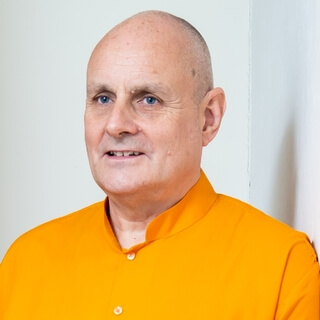
And this episode is called A Sense of Self and it's part of the Buddha Dharma series.
In Buddhism,
One of the most difficult teachings for people to understand is anatma or non-self.
The doctrine states that in humans there is no permanent entity that can be called a self or a soul.
This denial of any soul or self is what distinguishes Buddhism from all other major religions such as Christianity and Hinduism and it gives Buddhism its uniqueness.
The teaching is not only difficult,
It's also controversial and one of the most poorly understood teachings in Buddhism.
Many teachers believe it's more important to teach about karma and rebirth,
But I would disagree.
Most people usually misunderstand these teachings and they end up reinforcing the sense of self.
They believe their karma gets attached to that self and then that self is reborn.
So personally,
I believe,
If you want to reduce your suffering in this life,
You should understand the teaching of non-self.
This sense of being a permanent,
Solid,
Autonomous self is an illusion and the problem is this illusion is so ingrained into our ordinary experience.
We have a sense of a permanent individual self,
But that's all it is,
A sense,
A feeling.
If I ask you,
Who are you?
You may tell me about your job,
I'm a lawyer,
A doctor,
A teacher and so on,
But this is not who you are,
This is your work.
If you change your job,
Would you stop being you?
So you are most definitely not your job.
You may tell me about your family,
Your nationality.
I'm from a wealthy or a middle class or a poor family,
I'm Indian,
British,
African and so on.
Again,
That is not who you are,
It is just you in relation to others.
You may tell me you are a Hindu,
A Muslim,
A Christian etc,
But that's your religion,
It's not who you are.
You may say that you are your thoughts or feelings or emotions,
But these are all impermanent,
So they can't be you.
The same goes for your body or your experiences,
They are all impermanent,
So none of them can be you.
We can go on with this exercise forever,
But everything we find will be impermanent and superficial.
There really is nothing within us that is independent and never changing.
So if you are thinking here that Buddhism is saying you don't exist,
It isn't.
What it's saying is,
You do not exist in the way you think you do.
We are not permanent,
Individual,
Solid entities.
Instead,
We are changing moment to moment,
Like the water flowing down a mountain stream.
Giving ourselves a fixed name or identity doesn't make us permanent,
It is just a convention we have come up with so we can talk about ourselves.
If you took me apart and laid all my bits and pieces on the floor,
You would not find an inherently existing Yeshe.
So,
A question everyone asks when they come across this teaching is,
If I am not who I think I am,
Who am I?
Instead of a permanent self or soul,
The individual is compounded of five factors that are constantly changing.
These collection of five changing processes,
Known as the five aggregates,
Are the process of the physical body,
Of feelings,
Of perceptions,
Of responses,
And of the flow of consciousness that experiences them all.
You can hear more about this by listening to the podcast called How We Experience the World.
When we identify with the process of the physical body,
We get attached to our physical form.
When we identify with the process of our feelings,
Our perceptions and our responses,
We become attached to them.
Our sense of self arises whenever we grasp at or identify with these patterns.
The sense of a self is perpetuated because we pay attention to only the surface of our experiences.
We never take the time to delve deeper.
We identify with what we like and don't like,
What we want and don't want – our dreams and our beliefs.
We think our thoughts,
Feelings,
Emotions and physical sensations are a part of us instead of seeing them as passing phenomena.
If we allow ourselves time to observe these processes coming and going,
We would be able to see them as just experiences that arise and fall away,
And not as a self.
If we had a permanent self,
We would never be able to change.
So if we want to grow and change,
We need to let go of this idea that we have a self that defines us.
The next question people ask when they hear about non-self is,
So what?
Why should I care if I have a self or not?
This idea of a self produces harmful thoughts of me and mine,
Desire,
Selfishness,
Craving,
Attachment,
Hatred,
Ill will,
Conceit,
Pride,
Egotism and other defilements,
Impurities and problems.
In fact,
In Buddhism,
It is said that the illusion of a self is the source of all of our suffering.
When we identify with our physical,
Emotional and mental experiences,
We become attached to them.
The threat of losing any of these is deemed a threat to our whole existence,
But we are going to lose them because they are impermanent.
This means the illusion of a self is setting ourselves up for failure.
When we observe the rising and falling away of all phenomena,
We see that everything arises from nothing and then goes back to nothing,
And this includes our thoughts of feelings,
Emotions and physical sensations.
If we examine our experiences in this way,
We begin to see that our thoughts,
Feelings,
Emotions and sensations are not a self.
This allows us to let go of our attachment to them.
This in turn releases us from our suffering.
So,
You may still be thinking,
If this teaching of non-self is true,
Then who is listening to this?
I would answer you,
A growing,
Changing being that is in constant flux and not a solid,
Permanent individual self or soul.