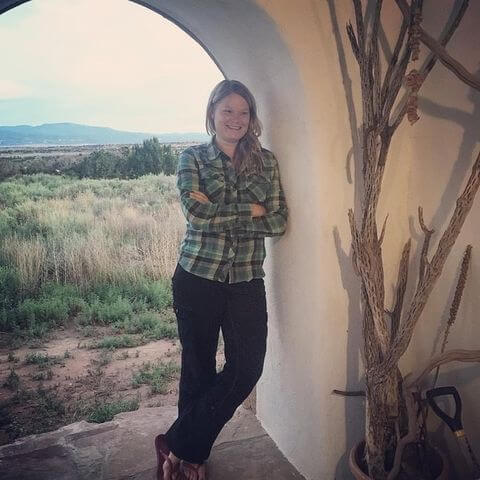
I get to interview a special friend today,
Sasha Gwynn Anderson,
Who describes herself as a mother,
Goat milker,
Corn grower,
Word writer,
And radical Christian.
I first met her when I started my internship with the Faith Network for Immigrant Justice,
Which works to solve issues around immigrant detention,
Helps educate communities about immigration issues,
Tries to create just immigration laws,
Among many other social justice projects.
Sasha is a fierce advocate on many fronts,
But it was really witnessing her work with the Faith Network that really opened my eyes as to how one individual could have such a positive impact.
On her Twitter feed,
There's a quotation from Arun Dohati Roy that encompasses just a part of what drives Sasha.
There's really no such thing as the voiceless.
There are only the deliberately silenced or the preferably unheard.
Sasha is trying to give a voice for those who are silenced,
Who are deliberately ignored or unheard,
And she's passionate and a resolve.
I think you'll absolutely hear that in this interview.
It was such a pleasure to talk with her.
And now,
Episode 64 of Bite-Sized Blessings.
And I even,
When I was a kid,
Bought at a Bible store these things called testaments,
And they're literally mints that have like a cross on them.
And when somebody asks you for a mint,
You're supposed to hand them the mint and then give them your testimony.
But I just ate all the mints.
So I'm Sasha,
And I am the mom of Winnie and Georgie and Hilty.
And I am Choctaw.
I'm an enrolled citizen of the Choctaw Nation of Oklahoma,
All descended matrilineally through my mom and her family,
My grandma,
My great-grandma,
My great-great-grandma,
On and on.
And I am an Episcopalian.
I consider myself a radical Christian.
I am a product of Oklahoma and New York City and New Mexico.
And I don't know,
I guess I would say I'm an activist in a way through the school board and through volunteer work and that kind of stuff.
I know I just loved when I saw on your Facebook page,
And you were running for school board.
Yeah.
Yeah.
And I just thought,
Oh my gosh,
She's a shoe-in.
Oh,
Thanks.
Well,
I didn't have any opponents,
So that was helpful.
But I was really excited about it.
I was like all ready for it if we had to run a race.
What does being a radical Christian mean to you,
I guess?
Well,
I think it means following the gospel sort of above all else and really taking into account the sort of radical teachings of Christ that call on us to kind of divest ourselves of wealth and welcome the stranger.
I don't think I live up to this in any way,
But not just welcoming the stranger in sort of like I vote for candidates who support immigrants' rights or I donate once a month to an organization,
But really radically opening your home and yourself and everything to people who are not like you.
For me,
I follow liberation theology,
So it's all about a preferential option for the poor.
It's all about centering the oppressed and the poor and the hungry and everything that we do.
It's about bringing ourselves to hunger,
Bringing ourselves to oppression,
Bringing ourselves to poverty in solidarity with others.
Yeah,
And fighting for those things.
It doesn't mean using litmus tests like abortion.
It doesn't mean using litmus tests like gay marriage or those sorts of things.
And it's not about Christian nationalism at its core.
It's so the opposite of it.
For me,
It's more of a universalism than it is a nationalism.
So that's what it means for me.
A lot of it's very political,
But I also think Christ was very political.
I was christened in the Episcopal Church,
And then I went to the Episcopal Church until I was five.
My mom's family was Episcopalian,
And my mom's family lived in Oklahoma,
And that's where our Episcopal Church was.
And then when I was five,
We moved to Texas,
Which is where my dad's family was,
And they were Southern Baptists.
So I grew up in a small Texas town going to the Southern Baptist Church until I was about 12.
And then we moved back to Oklahoma,
And the rest of my family went to an evangelical,
Non-denominational church where it was like,
You can wear jeans and eat donuts,
But just don't be gay,
Because that's really bad,
But you can wear jeans.
So I would walk.
We only lived about half a mile from the Episcopal Church,
So I would just walk to the Episcopal Church on Sundays.
I found it to be really beautiful,
And it made me feel like a lot less.
.
.
I got a lot of fire and brimstone theology,
A lot of substitutionary atonement theology,
Just a lot of really intense theology from the Southern Baptist Church as a kid,
And then also going to church with my friends growing up,
Because I was in Oklahoma.
So going back to the Episcopal Church was always this huge palate cleanser for me.
And so I decided to be confirmed when I was 12.
I didn't really tell my family.
I was just like,
I'm going to this class at church at two every week,
And then I just ended up confirmed.
So that was my raising in the church.
I grew up.
.
.
So I didn't grow up on the Choctaw Nation.
I grew up what they would call an urban native.
So I grew up around my family who was Choctaw,
My big extended family who was Choctaw.
And within that family,
It was Nazarene or Church of Christ primarily.
From my interactions with the leadership of the Choctaw Nation,
That tends to be more conservative Christian in terms of theology.
I'm not saying that the people themselves are politically conservative,
But the theology tends to be more conservative.
But of course,
Then there are folks who go to the Native American church or folks who use more traditional ways.
But those are not like.
.
.
That's not what we get in our tribal newsletter.
I just threw it away.
I could have shown you,
But in the tribal newsletter,
It's like a description of Revelations.
They do a Bible column in the tribal newsletter.
And so this week it was focusing on Revelations.
And so there's that.
But the first white person in my family on my mom's side was a Methodist minister.
We're also the third largest tribe in the nation.
So the diversity of spirituality in the Choctaw Nation,
I think is the same as any other demographic group.
But there is a lot of reclaiming and reconnection going on with traditional spirituality and religious practices.
Indigenous people are not a monolith.
Like even within our own tribes or even within our own clans or even within our own families,
Just like in any other culture,
There's going to be multiple truths and everyone's going to have a different perspective.
And I think a lot of times Native people are seen as sort of a monolith.
I was reading the Rachel Held Evans book and she started talking about miracles and she started talking about,
You know,
The miracle of childbirth.
And then she starts talking about faith.
It's so funny because growing up like in the Baptist church,
Everybody's you're called to tell your share your testimony,
Share your testimony with people.
And I even when I was a kid bought at a Bible story,
These things called testaments and they're literally mints that have like a cross on them.
And when somebody asks you for a mint,
You're supposed to hand them the mint and then give them your testimony.
But I just ate all the mints.
Like I didn't do anything with them.
I just ate all of them because I was like,
This is crazy.
Like I'm not going to like start talking to people about my 12 year old testimony or whatever.
And I certainly like would never describe what I'm going to describe to you as like a testimony.
But it is for me,
The kind of return to faith was really miraculous because,
You know,
I grew up really loving the Episcopal church and I'm really glad that I came of age when I did,
You know,
That I returned to it at the age of 12,
Because that was a really,
Like a really good time for me to kind of inquire and,
And have a stable spiritual background because a lot of the messages I was getting then or that I was sinful or that,
You know,
Like I was going to go to hell and I have OCD.
And so a lot of that like scrupulosity really sinks in where you really become very afraid of,
Of,
Of hell.
And so I then grew out of my faith and became an atheist and my grandfather who really raised me.
I mean,
He was really the only kind of positive male influence that I had in my life.
And I lived with them off and on.
And so he died and he was also my confirmation sponsor.
He's also the person who sort of brought me to the Episcopal church and he had all these books about Anglicanism and like,
He would always get into these spiritual debates with our rector and he was just like a big thinker,
But he always like returned to the Episcopal church.
And so he passed and when he died,
I was just absolutely gutted.
It all happened really quickly.
He was 67 years old.
He was still really young and I didn't believe in God.
And so we were there in this church where I'd been baptized or my parents had been married,
Where I'd been confirmed with him as my confirmation sponsor.
And I'm dressed on black and I'm mourning and I'm sitting there thinking like,
I don't believe in God.
There's nothing here.
There's no like afterlife belief.
There's no,
And I not just,
I didn't believe in God,
But I didn't really believe in anything.
I didn't have a spiritual system at all.
And I was 21,
I guess at the time or like 20 about turn,
About to turn 21.
And I just didn't have anything.
And I remember feeling really sad about it.
Not that I was going to change my mind,
But just like a little,
Not a little,
But a lot sad.
And then a year later I was trying to think of something to do for the anniversary of his death.
And so I decided I would go back to St.
John's,
The church,
You know,
That had been this special place for us.
You know,
Even the smell like really reminded me of him.
And so I went back and I stood in the back.
There was a new priest there who was not the priest of my childhood.
And I was like,
Okay,
We'll give this guy a chance.
And he preached this sermon about how Christ's death did not absolve us of doing good works,
That there was sort of this like idea of either faith or works.
Right.
And so it wasn't that he died so that we didn't have to do good works,
But rather that in dying,
He sort of freed us up to do good works.
That like we could actually now do works that weren't born out of fear because we didn't have that fear anymore,
But that we could now do works that were of acts of goodness.
And I was like,
Oh,
Okay,
That makes sense because I always wondered why we were sort of set up to fail,
Why we were sort of like made sinful and then,
And then sort of set up for like thousands of years until this guy came.
I mean,
Was it our fault that we were made this way?
I mean,
I guess if you go back to like Adam and Eve,
Okay.
It always felt like a trap to me.
And so like hearing it explained this way,
It felt a little less like a trap.
And I was like,
Okay,
I don't believe in God right now,
But this guy maybe knows what he's talking about.
And so I'm going to come back and listen to him because I find him to be interesting.
So I came back to listen and I started becoming a regular churchgoer,
But I was still an atheist,
But it was like this weird muscle that I was working on.
And so in just coming back,
This very routine,
Basic kind of monotonous sort of thing,
I just returned to faith.
And the miracle is that it wasn't like a come to Jesus moment.
It wasn't a bright flash of light,
Which I had had.
Like I have a lot of those experiences from when I was younger.
And I guess maybe those are miracles in a way,
But in a lot,
In a lot of ways they scared me,
But this was just like an exercise plan or something.
It was like,
I just came back every Sunday and I listened to this guy.
His name was Dwight Hel.
I listened to him and I thought like,
He's not trying to trap me.
He's not trying to trick me.
He's not trying to guilt me.
And it's the Episcopal church who knows maybe 20% of the people sitting there were also atheists.
Like,
You know,
Like there's not,
You don't like get an ID check at the door.
The fact that I continue to be faithful or full of a belief in God.
And that's the other thing.
Belief in God is in and of itself miraculous because it doesn't make any fucking sense.
It doesn't make any sense.
It's just like having kids,
Like having kids doesn't make any sense.
You can't explain it.
I mean,
People who try to do these like logical explanations of their faith or like argue with people who are atheists over why they should believe or why they shouldn't believe.
It's like,
It's absolutely ridiculous because the miracle is that you believe in something and it doesn't,
I'm not just saying that as a Christian or even as an Abrahamic faith in any faith that anyone believes in,
Right?
It's absolutely a miracle because there's nothing logical that ties you to that faith.
But you keep coming back to it.
It's the same as with parenthood.
Like you keep coming back every day,
Even though it makes no sense.
It's all totally messed up.
You know,
Like it just is so wild.
And I would never argue with someone that me having faith isn't just absolutely whack-a-doodle because it is.
I went to church hungover.
I went to church smelling like cigarettes.
I would wake up from sleeping over at a guy's house and get up and go to church.
And like when my husband and I first met,
I think the first time I slept over at his house,
And you know,
We had probably been drinking a lot the night before and I woke up at whatever amount of time and I was like,
All right,
I got to go to church.
Do you want to come with me?
And he's like,
You got to do what?
You're doing what?
And I was like,
I'm going to the Episcopal church.
We have mass in 20 minutes.
Would you like to go with me?
He's like,
Who are you?
And I was in my twenties.
So it was sort of like wild living person,
But got up every Sunday and went to church and I would go by myself.
I was housing insecure for a long time.
And I would just drop my stuff off somewhere and go,
You know,
Like drop my suitcase off and go to church,
Go to an Afro Caribbean Anglican church and in Brooklyn.
And in a way it was sort of like,
It didn't jive with the rest of my life,
But I had to do it.
And there is another actually like pretty miraculous piece of this that I,
That I am forgetting,
Which is that I also had an eating disorder growing up and it got really bad when my,
Um,
When my grandfather passed.
So I decided to speak out at a national eating disorder awareness week luncheon for faculty at our university.
And so I gave my story of how hard it was to be a student with an eating disorder.
And a woman came up to me afterwards and thanked me for,
For doing that.
And then she saw me at St.
John's or had been seeing me,
I guess for weeks,
Cause she also stood in the back.
She sent me a note later and I don't even remember how she would have gotten me the note,
But she sent me the note and said,
Thank you for sharing your story.
I've seen you standing in the back,
Just so you know,
There's a chapel that's open 24 hours a day that you're welcome to go to at any time.
It just felt like confluence of that,
Of her knowing that she had seen me in the back of the church and then connecting with me about this story at the time worked in university administration,
But then had a calling and became a priest.
But I just felt so shocked that she had like seen me standing in the back.
I thought I was totally invisible because it was just so special to me that this person pulled together my university experience and my eating disorder experience and my spiritual experience.
She really saw me.
She was,
She was a miracle for sure.
Just a question and you don't have to talk about it if you want to,
But you were talking about having these flashes of,
I think you said light or insight when you were a kid and they were scary.
Was it because,
Because they were unexpected because it was surprising because they were intense?
What was scary about them?
Well,
They were unexpected and surprising.
They weren't seen by other people around me.
And I was also at the time,
Very,
Very focused on the second coming of Christ and very afraid of the second coming of Christ.
And so whenever I became overwhelmed with like a spiritual moment or like when I would see light emanating from people,
I became very afraid that it was a sign of the rapture.
I mean,
It sounds ridiculous,
But I'm like,
I'm a lot less now I'm sort of like,
Maybe there will be a sure,
Like whatever,
But like,
I'm not sure I believe like the way that I believe about the second coming is different than the way I believed about it then,
Which is I think a little more like a left behind movie or something like that.
And I think about it now,
You know,
But yeah,
But I was really afraid of the second coming and of judgment.
Like Christ is going to judge some little 12 year old kid for thinking a boy's butt was cute or something,
You know,
Like,
Like that's it.
I'm going to have to answer for this and I'm probably going to go straight to hell.
Well,
It sounds like you had,
I mean,
As a child,
You had a gift and you could see things that other people couldn't see,
But if you don't know what's going on and you have that kind of theology,
Those stories about rapture in your mind,
No wonder it was terrifying.
I mean,
Any child would probably think they were losing their mind.
Yeah.
I mean,
My mom getting in the car to go to the grocery store was terrifying because what if she died and she hadn't said the sinner's prayer or like whatever.
I remember going to a gym one time and it was like with some friends who were Southern Baptist and they did this play where like two girls got into a car crash and one of them hadn't told the other one about God.
And so her friend,
She hadn't told about God.
They literally mimicked hell fire and she couldn't talk to her friend because now her friend was in hell.
And I'm like 12 years old.
No wonder having these wonderful spiritual moments,
You know,
Which I still have,
I think every time I take communion,
I would call that like one of these feeling very in communion with the whole communion of saints past,
Present,
Yet to come.
I mean,
For me,
That kind of stuff beats the faith out of you.
No,
I completely agree.
And part of me thinks that you having these flashes of light or seeing these things as a kid,
It's almost like you had this overt invitation from God back then,
You know,
To participate,
To co-create kind of God's plan on earth,
God's vision of earth.
And it's,
It's scary if you don't know who's inviting you or what the invitation is.
Yeah,
Exactly.
But at the same time,
It sort of sustains you in thinking like there's something bigger than what this,
This middle-aged man is telling me about my sinful nature.
Do you kind of have this vision of yourself as becoming clergy in the Episcopalian?
Yeah,
I would like to,
I mean,
I'm not in the stage of my life.
So I went out to the same priest that I talked about.
I went out to lunch with him when I was like 24 and I said,
I've been called to become clergy.
I've been called to the priesthood and I want to know what my next steps are.
And as he said,
Your next steps are to meet with the vestry and begin the discernment process.
And the day before I was supposed to go to meet with the vestry,
I was hospitalized for depression.
I had just extreme,
Extreme depression and it was becoming a threat to my life.
And so I was hospitalized.
And so as soon as I got out,
You know,
I think I had a friend call him when I was,
When I was in the hospital and I got out and said,
This is not the time in my life.
Like God is telling me pretty clearly,
You've got a lot of work to do before you can be this to others.
Like you need to work out your own stuff first.
And I'm realizing that now too,
Like I've got to work out my own stuff first and like working out my own stuff right now looks like being on the school board.
It looks like raising my children.
But once I'm through that stage of life,
I would very much like to go to seminary and become a priest.
I also have to finish my bachelor's degree.
I haven't finished my bachelor's degree.
So that's like a weird hurdle I have to cross is taking a bunch of liberal arts classes so that I can go to seminary and God will tell me when it's time.
Oh yeah.
It's interesting when God tells you something it's time for something sometimes it's gentle.
Sometimes it's not.
Yeah.
And I've discovered that it's less painful if you just say yes the first time.
Exactly.
Yeah.
Cause it's not going to stop.
Thank you so much for listening to episode 64 of Bite Sized Blessings.
The podcast all about the magic and spirit that surrounds us.
If only we open our eyes to it.
I'm so grateful to the intentional and intelligent Sasha Gwyn Anderson for finding time in her busy schedule to give me this interview for more of an example of just who Sasha is in the world.
Visit her Twitter feed at Sasha Gwyn.
There you'll find sentiments that express just who she is.
Her dedicated and resolved voice is all about lifting others up.
I need to thank the artists who created the music for this episode as well.
Frank Schroeder,
Taiga Sound Productions,
Alexander Nakarada,
Music L.
Files,
Klaus Appel and Sasha End.
For complete attribution please see the Bite Sized Blessings website at bite-sized-blessings.
Com.
On the website you'll find links to other people,
Artists,
Books and music I think will lift and brighten your day.
Thank you for listening and here's my one request.
Be like Sasha.
Be the witness for those who have no voice and then use your own voice to lift them up.
Yeah,
It's,
I just you know,
Oh my god.
I'm sorry.
He's trying to open the door too.
It's like I can't get away from him,
I'm sorry.
Is he singing?
He's singing.
Oh my god.
How did,
How long did it take him to learn how to open the door?
Not very long.
They kind of push open but if I lock it then they'll just bang on the door and it's actually a lot louder than.
.
.
Okay.
Sorry.
No,
No,
That's that's so fine.
That was,
You know,
I had like the perfect bird's eye view to watch your dog open the door.
And I was like,
I was totally expecting one of your kids.
And then a dog walks in the door and I was like,
Oh,
What just what just happened?