So today we are continuing our journey through the Bhagavad Gita.
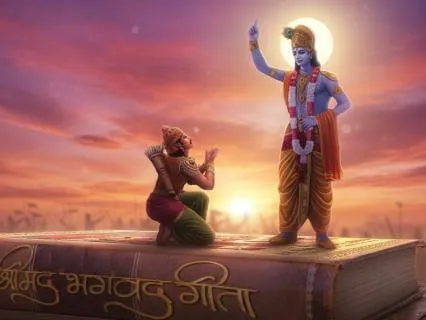
So the story of the Bhagavad Gita takes place on a battlefield,
And this is a story in the middle of the Mahabharata,
A great Hindu epic.
The hero of our story is Arjuna,
And Arjuna is on a chariot driven by Krishna.
Essentially there's a huge family feud between cousins.
Their parents,
Their fathers were brothers,
And the one brother was blind,
And he was the oldest,
And he was supposed to be king.
But because he was blind,
It went to his younger brother.
The older brother,
The blind king,
Had a hundred sons,
A hundred evil sons,
And the younger brother had five sons who were virtuous.
And over the course of many decades,
The kingdom was split.
Even though the good sons should have had the kingdom to themselves,
The evil sons tricked them through many,
Many stories in the Mahabharata.
And again in the first talk that we did for this,
We go into a lot of depth into that to really understand what this is all about.
But what's interesting to look at the Gita is Arjuna is on the side of the good.
He's the middle son of the good ones,
And he is ready for battle.
He is ready to reclaim the kingdom.
He is ready to now put the people of the kingdom in the hands of benevolent leadership as opposed to the evil ones.
And so Arjuna asks Krishna,
Drive me into the center of the battle so that I can see everyone that is there.
And he goes out into the center,
And he looks around,
And he sees family and friends on all sides.
Because of course what happened is when the younger brother died,
His children were all raised by the older brother.
So the five good sons,
Quote,
And the hundred evil sons,
Quote,
Were all raised together.
And so they were raised by the same teachers.
They have the same grandparents.
They have the same lineage.
They have the same friends.
But some,
For example,
One of their great teachers,
Drona,
Who we're going to talk about today,
He believed deeply in tradition.
He believed deeply in the importance of whatever tradition was,
That's what you do.
And because his role in society was to serve the current king,
Which was the eldest evil son at this point,
He had to be on the wrong side of the battle.
Their grandfather also deeply believed in tradition,
And so he also stayed on the side of the evil king and the evil brothers.
And these two are significant for our talk today.
And what happened was Arjuna looked around,
And he was devastated.
And he said,
How can I kill these people?
These are my friends.
These are my teachers.
These are my grandfathers.
No good can come of this.
And in the middle there,
He slinks down into the chariot and says to Krishna,
I cannot fight.
I will not fight.
And now one of the challenges is,
And one of the reasons that the Gita is very difficult sometimes to understand,
Is it's considered to be a literal war between people.
But the battlefield is called Kurukshetra.
And Kurukshetra is like the the battlefield of the heart,
Or Kuru.
Kuru actually is the,
This is the lineage of the Kuru,
Of King Kuru.
These are the people.
And Kshetra is like the place of pilgrimage,
The place where we go.
What this is really a story about is the story of our inner heart.
The story of the parts of us that knows virtue and love and kindness and courage,
Which are played by the good brothers,
The five good brothers.
But then there are other aspects of us that really harm us.
And these are the hundred evil brothers.
And I mean,
We don't want to get caught up in the language of evil,
Good and evil and all that.
But just to imagine that these could be our senses,
These could be anger,
Self-doubt,
Bitterness,
Samskaras,
Karmic patterns,
All the things that we take into our lives that seem to rule us.
You know,
You can have a realization and you can say,
That's it.
Starting today,
I'm going to be optimistic.
I'm gonna meditate for 20 minutes a day.
I'm gonna drink more water.
I'm gonna,
I don't know,
Do whatever.
I'm gonna exercise 20 minutes.
I'm gonna do the thing.
And then all of a sudden,
Something happens.
Or nothing happens.
But sheer habit and lifetimes of patterns just get in the way.
And three weeks later,
You wake up and you're like,
Why am I still doing these things?
And this is what's really interesting when there's a hundred evil sons and only five good guys.
Because that's often what it feels like inside of us.
Like it feels like there's a hundred aspects of us that are working against us.
We have this vision of what we want our life to be.
And then when push comes to shove,
Why am I here again?
Why am I in a job that I don't like?
Why am I in another relationship where I feel like I have no freedom?
Why am I eating in ways that I know harm me?
Why am I thinking in ways that I know create depression and anxiety?
Why am I here again?
Oftentimes we feel like Arjuna.
We feel like we just want to slink down in our chariot and say,
I give up.
I can't do it.
I don't want to fight this anymore.
I don't want to fight the bad guys.
I don't want to fight the good guys.
I don't want to do anything.
I'm just gonna give up.
Now Krishna is our highest self.
And this isn't like a highest self that isn't us.
The highest self is you.
The highest self is your divine self within.
And this is really important to understand that within the Hindu teaching,
I mean there's a lot of many,
Many,
Many teachings in Hinduism,
But within this particular teaching there's like Brahman,
Which is all where God manifests everywhere in the world.
Everywhere.
But Atman is the God within.
This lives within every single one of us,
Right here,
Every one of us.
This is Krishna.
This is your highest self speaking to you.
And Arjuna is your soul.
And so last week we looked at it and it was like Arjuna slinks down into the chariot and Arjuna kind of mocks him.
What's wrong with you?
Get up!
This is not becoming of you.
What are you thinking?
And you kind of think,
Why is he being such a jerk?
But what he's really doing is saying,
It's so you can keep fighting.
You know better.
This is your life.
This is your lot.
You're here to actually engage in this battle.
And I know even the language of battle is a little triggering.
Why does it have to be a battle?
Can't we make it a dance?
That's what I would say.
But the reality is we must engage.
Later on in the Gita they use the word yoga.
And they use the word yoga a hundred and fifty times.
But this is not Hatha yoga or Kundalini yoga or any of these kinds of yoga or Bhakti yoga or Jnani yoga.
It's none of those.
This is literally yoga to yoke.
Where you actually are yoked to a wagon.
That you are actually,
All your attention is in.
That's what the Gita is about.
That we must stay yoked to life.
We have to stay yoked to the journey of self-actualization,
Of living the life.
To actually removing the patterns and the karma so that we can live our Dharma.
So we can actually live the life that deep in our hearts knows exists.
Like it's almost like we all know that somewhere inside there is a straight road that we can walk if we're paying attention.
But instead we're walking along and then we trip and we end up in some kind of weird cycle.
And sometimes we can be in that cycle for 20 years.
And then we get out of that situation whether it's a relationship or a lifestyle or a job or whatever.
And then we start to find our way again.
This is the journey.
And in order to stay that path,
To find our path that really allows us to thrive,
We have to fight.
We have to take it seriously.
We have to take this life seriously.
Because if we don't and we just take our foot off the gas,
Guess who wins?
Those hundred evil sons,
The cousins,
The senses,
The karmic patterns,
The self-doubt,
The anger.
That's what wins.
So we need to actually play.
And that's really the one of the big teachings in the Gita.
So I'm going to read a little bit about what we talked about last week.
And then a little bit beyond what we're doing this week.
And then we'll focus in on what we're doing.
So again,
The players in today's talk,
Arjuna,
Our hero,
Warrior,
Krishna,
His charioteer,
His highest self.
And then he mentions two other players.
He mentions Drona and Bhishma.
And Drona was kind of their martial arts teacher.
He was a great teacher in their world.
And Bhishma is their grandfather.
It's all the cousin's grandfather,
And very beloved grandfather also,
Who very openly said he didn't want to fight on the side of the evil sons.
He actually did want to fight any of those,
But he couldn't because of tradition.
So we are in chapter two.
I'm reading from Stephen Mitchell's version,
But it doesn't matter.
You can read from any version.
So I'm just going to back up a little.
So Arjuna has just described all of his angst to Krishna as to why he doesn't want to battle.
Having spoken these words,
Arjuna sank down into the chariot and dropped his arrows and bow,
His mind heavy with grief.
As Arjuna sat there,
Overwhelmed with pity,
Desperate,
Tears streaming from his eyes,
Krishna spoke these words to him.
Why this timidity,
Arjuna,
At a time of crisis?
It is unworthy of a noble mind.
It is shameful and does not lead to heaven.
This cowardice is beneath you,
Arjuna.
Do not give into it.
Shake off your weakness.
Stand up now like a man.
Arjuna said,
When the battle begins,
How can I shoot arrows through Bhishma and Drona,
Who deserve my reverence?
It would be better to spend the rest of my life as a pauper begging for food than to kill these honored teachers.
If I killed them,
All my earthly pleasures would be smeared with blood.
And we do not know which is worse,
Winning this battle or losing it.
Since if I kill Dhritarashtra's men,
We will not wish to remain alive.
I am weighed down by pity,
Krishna.
My mind is utterly confused.
Tell me where my duty lies,
Which path I should take.
I am your pupil.
I beg you for your instruction.
For I cannot imagine how any victory,
Even if I were to gain the kingship of the whole earth or of all the gods in heaven,
Could drive away this grief that is withering my senses.
So the part we're going to look at today,
So it's chapter two,
Verses four through six,
If you are looking at a different version of this.
And these are the phrases.
Arjuna said,
When the battle begins,
How can I shoot arrows through Bhishma and Drona,
Who would deserve my reverence?
It would be better to spend the rest of my life as a pauper begging for food than to kill these honored teachers.
If I killed them,
All my earthly pleasures would be smeared with blood,
And we do not know which is worse,
Winning this battle or losing it.
Since if I kill Dhritarashtra's men,
We will not wish to remain alive.
Dhritarashtra is the blind king,
The father of all the evil sons.
So the first thing that we want to look at here,
First of all,
We can understand this,
Right?
Who wants to kill,
You know,
A beloved grandfather or a beloved teacher?
Like,
It weighs heavy in our hearts,
As it should.
This is a noble thing.
Now,
When we look at the roles that Bhishma and Drona play in our consciousness,
This is where it's interesting,
Because the Gita is about freeing our mind to experience the ecstasy of life.
So first,
Let's imagine Bhishma.
Bhishma is the grandfather.
In this instance,
Bhishma represents our ego,
Who we believe we are,
Who we want to be,
Who we are attached to being.
This is who Bhishma is.
And Drona are all of our bad habits that we've learned over our lifetime.
They often will say that if we are in a Bhishma state of mind,
We are in a place where we are just so attached to who we believe we are,
We can't imagine anything else.
Or if we are in a Drona state of mind,
That we are so addicted to finding pleasure in life and avoiding pain,
And we are so convinced that everything around us is our whole experience,
That we have no chance of freedom from that.
Like,
We are actually within mental slavery of our habits.
And so this is often what it feels like,
Especially when you're in a,
When we're on a spiritual journey,
And someone says,
You need to transcend your ego.
You need to release attachment to all these things that you love and hold dear.
And I don't mean people and all that.
I'm talking about attachments to the world.
Isn't this what it feels like?
That you are,
If someone says to transcend your ego,
In your heart,
You're like,
But,
But this is,
This is who I am.
This is who I've always been.
How could I,
How could I do that?
Like,
It feels like family.
It feels like I am,
I am putting arrows through who I really am.
And this is really,
Really painful.
And similarly,
If I was to say to you,
You need to release attachments to all of your bad habits,
You'd be like,
Oh,
No,
No,
No,
No,
No,
My morning coffee,
That,
That sets me straight.
That's what I do,
Or that thing that I do on my way to work,
Or this thing that I always,
Oh,
No,
No,
No,
You don't understand.
Like,
This is required.
Required.
There's that sense that we will instantly come to the defense of whatever that is,
Because you don't know what that's gotten me through.
You don't know what that's done.
I mean,
You know,
Without that,
I don't even know who I'd be.
And we,
We defend them,
Like they are beloved family.
And that's interesting.
So first,
Let's think about Bhishma.
Think about the grandfather,
Think about the ego,
Who we are,
Who our family has been,
To imagine that he represents the lineage that we are.
And to imagine what does it really mean to transcend that,
Or in stronger words,
To destroy that?
What are we really saying?
Our ego is often our personas,
The people that we want to be,
The personas that we put on at work,
The persona that we put on in relationship.
It's an amazing thing,
You know,
How often we want to have like a romantic relationship.
And very often,
We have the biggest persona there,
That we want to be seen as being easygoing,
Or we want to be seen as being sexy,
Or a great provider,
Or the wise one,
The stoic one,
Or the wild and the crazy one.
And the crazy thing is,
Is it's like the persona is something we believe we have to be in order to be in relationship.
But think of how limiting that is.
You know,
Like it's so limiting to have these personas,
These ideas.
We aren't allowed to grow,
We aren't allowed to change.
Within families,
This is why families of origin are so hard.
We get fixed in the personas of some point of our life.
Maybe we were a rebel when we were a teenager.
Maybe we were the easy kid,
Maybe we were whatever.
Maybe we were the oldest,
The youngest,
The middle,
Doesn't matter.
But families have a habit of holding us in the personas of the past.
And they don't even realize that we've changed or we've grown.
And even we will walk,
We'll be living a completely different life.
We'll go home for the holidays,
And drop into that persona ourselves.
And we won't let ourselves grow and change.
We'll just,
Oh,
This is who I've always been.
This is what they expect of me.
This is,
You know,
I've always been the one that helped.
I'm always the peacekeeper.
I'm always the one that helps do the dishes.
I'm always the one that everyone can count on.
Or I'm always the one no one can count on because screw them,
I'm not going to go because,
You know,
You don't know what they did to me when I was young.
You know,
And this is all ego.
It has nothing to do with what happened.
It doesn't matter whether they were horrible,
Kind,
Doesn't matter.
What we have internalized as our persona in their presence is a fiction created in our mind.
It's not real.
And it is so limiting on our path.
But to think of how intimate it feels.
It's so intimate.
It feels like this beloved grandfather that's been with us forever.
Our ego holds our history,
Stories that we cling to,
Good and bad.
The stories of good that say,
No,
I,
You know,
I come from a great family and we have lots of wealth or we own properties or we're important or whatever,
Or we are highly educated or we are the craftsmen or we were whatever.
Or the negative stories that,
Oh,
Well,
I went to the school of hard knocks.
You know what I'm saying?
Yeah.
Can't,
I got a lot of street smarts.
That's me because I don't trust anybody because if you'd been through what I'd been through,
Then you wouldn't either.
And yeah.
You know,
Or you,
We have a victim story.
Can't get along.
Everybody always picks on me.
I'm always the one that everybody gets on.
You know,
What are the stories that we are still telling?
Like to really deeply understand that there is a million ways to tell every story.
We're choosing one for some reason.
The reason we're choosing it is significant.
But as long as we live in that,
We are forever limited.
Our ego needs validation from others.
We need other people to see us.
We need other people to believe that we're doing the right thing,
Or we need other people to believe we're doing the wrong thing to justify our rebellion power.
It's very interesting to look at that ego that we are.
So the question is,
What would life be like if you had no ego?
The ego in this sense,
I don't mean the ego like,
I'm Katrina and I love reading and long walks and hot baths.
I don't mean that ego.
I mean the personas that we live,
The attachment to who we think we are,
The attachments to stories.
What would we be left with if we let go of our ego?
I would love to know your thoughts in the chat.
When I say that,
What would it feel like to let go of all the stories,
All the personas,
All the attachments to who we think we are?
What would that feel like?
Bliss,
Freedom,
No judgment for self or others,
Clarity,
Lightness,
Openness,
Connection,
Unity,
Rethinking identity,
Abundance,
Opportunistic,
Constantly evolving,
The opportunity to choose a new way of living.
Isn't that wild to think what that feels like?
Open for all kinds of experiences,
All kinds.
Freedom,
Source,
Yes,
Limitless,
Safety,
Clarity,
Shining self.
So this is this really interesting teaching of letting go of the ego.
You could imagine this on the battlefield,
On the battlefield of our hearts,
How important this is.
Like you can battle all the things out there if you want,
But if we can't get rid of that ego,
We're in big trouble.
And it's one of the number one things we're sure we can't do.
No judgment to others or towards ourselves.
Uninhibited.
So now we're going to move on to Drona.
Drona representing our bad habits.
And when I say bad habits,
I mean limiting habits.
So the habits are connected to the senses,
The desire to experience pleasure,
The aversion to pain.
And so the first thing that comes up is of course this craving versus aversion.
And as soon as you have a craving for something,
How much trouble we're in.
It's like,
Oh,
I just,
I so want this,
Or I so want that,
Or,
Or even the,
The mental journey that says,
Oh,
I love this.
This is my favorite.
This,
I just want to have this for the rest of my life.
I want this forever and ever.
I just love this.
It's like this mental chatter about how much I love this pleasure.
And it creates this weird obsession in the mind that this is the only way I can enjoy things.
If I have this pleasure,
I have this pleasure.
I have to have this pleasure.
And it doesn't matter whether it's things you see,
Things you hear,
Things you feel,
Things you taste,
Things you smell.
It doesn't matter,
But it becomes this obsession with pleasurable things,
Which of course creates its alternative,
The things I hate.
Oh,
I can't stand being cold.
Oh,
I hate that.
Oh,
I can't,
Oh,
I hate spicy.
I can't stand that.
Oh,
It's too loud.
Everything's loud.
I can't stand the music and everything's just,
And we have all this aversion again,
Which creates this insane in the brain.
Like when you think of how much brain space is spent thinking about the things you like,
Or you don't like,
Or the things you want,
Or the things you don't want.
And it sounds kind of like a funny teaching sometimes,
But let's say,
Imagine.
So for me,
I personally,
I really love sunshine and warmth.
So I can easily be that person that's like,
Oh,
I hate cold,
Which is hilarious.
I'm a 56 year old woman living in Canada in a snow belt.
It's cold.
It's minus 12 today out there.
It's the snow is crunching under your feet.
So me living in a perpetual mental discussion of,
Oh,
I hate cold.
Darn it.
It's snowed again.
I can't believe how cold it is.
It doesn't matter if it's true.
It doesn't matter if it's uncomfortable.
So what?
I'm cold.
What is this obsession and this aversion to discomfort?
Because we've done this thing in our mind that we think that pleasure is good and discomfort is bad.
And again,
This is all in the mind.
None of this is real.
I could be in a sauna and I could walk outside in the cold and it could feel so wonderful.
Or I could be thinking,
Man,
Nanaimo bars are the most delicious things in the world.
I love it.
It makes me drool just thinking about having a Nanaimo bar.
You know,
What's better than one Nanaimo bar?
Ten Nanaimo bars,
Which of course we know probably isn't good.
The good,
The bad thing,
That's just some weird judgment we've placed on it.
What is the truth?
Oh,
I love the taste of Nanaimo bars.
Cold makes me uncomfortable.
That's it.
There doesn't need to be any great big hairy thing in my brain going on and on and telling stories about this and that.
So like,
For example,
Let's say,
Let's just say you're a 56-year-old woman living in Canada who's not fussy on the cold.
Let's just pretend.
And somebody says,
Oh,
I've just bought you a two-week trip to Jamaica and you get to stay at this all-inclusive resort and it's so warm and you're going to be able to swim in the ocean and it's going to be so wonderful.
And I think to myself,
Oh,
I love Jamaica.
I love warmth.
Yes,
I love it.
So now all of a sudden my mind is thinking about Jamaica and it's thinking about all these things.
It's thinking about the pleasure and it's thinking about how amazing it's going to be.
And then I have to go outside to my car to get groceries and it's so cold.
This is going to be terrible.
And it's going to just be awful because,
Oh,
I can hardly wait to get to Jamaica.
Oh,
This weather.
And I go on this crazy ride between my hatred of the snow and my love of Jamaica.
But you know where I'm not?
Here.
I'm not even remotely present as my mind is going in this insane,
Seesaw,
Nutty thing.
I'm not present at all.
I'm just oscillating between my absolute craving for warmth and my aversion to cold.
Instead of just simply saying,
Hmm,
That'll feel nice.
And just letting it go.
Habits are also really interesting.
Negative habits.
And then you go on vacation,
You realize you're still not fulfilled,
Right?
The truth is I love comfort and yummy things.
Another theoretical truth is I should have everything I love all the time.
These two separate thoughts don't work very well together.
Totally.
And it isn't that we aren't meant to experience joy.
And it isn't that we aren't meant to experience pain.
If we touch a hot element,
We are meant to take our hand away from it and then get on with our life.
And if we eat something delicious or feel something wonderful,
We are meant to like sink into that experience and feel grateful and just love it.
There's nothing wrong with that.
But we don't need all the mental chatter about it.
So if you were to imagine a couple bad habits of yours,
Like to really think about them.
For example,
For me,
I love getting up and having a coffee in the morning.
Bad,
Good.
I don't need to get into some big thing whether or not coffee's right or wrong.
But it's weird that it's a habit.
That's what's weird.
What if some days coffee is the last thing that my body actually needs?
What if it's the last thing my body needs is this stimulant?
What if one morning the best thing I could do is actually just have warm water and lemon?
Or maybe fennel tea.
Or maybe nothing at all.
The problem with habits is we're not actually paying attention to the current moment.
We've created a pattern based on maybe a 24-hour clock or a weekly clock or something like that,
That says at this time I always have this.
I have a habit where if we're going on a road trip,
I must go through a drive-through and get snacks.
Here in Ontario,
Canada,
It tends to be Tim Hortons.
It's interesting.
I watch myself thinking,
You don't even want anything,
Katrina.
But the habit is so deeply ingrained in me that that's what I do.
My mind is telling me,
But that's what makes it fun,
Katrina.
That's what makes it a road trip.
If you don't have snacks,
It's not even a road trip.
The road trip won't even be fun without it.
But I'm not even paying attention to me.
I'm not even satisfying a craving.
I'm not even seeking pleasure in that moment.
It's just a habit.
It's a mental pattern that I have done so many times for so many decades.
I think it's second nature.
I think it's part of who I am.
And that groove is so deep in my inner record player.
I can't even imagine not doing it.
If I didn't do it,
I'd spend the next half hour wondering where the next Tim Hortons was.
Do you know what I mean?
But this is like all of the weird habits.
And habits can be all kinds of things.
They can be worry.
Worry is a huge habit.
Worry about our kids,
Worry about the money,
Worry about the politics,
Worry about the world,
Worry about this,
Worry about,
Worry about what?
Worrying about Christmas,
Worrying about you.
This is a habit.
It's just a habit.
It's not real.
It's a fictional story that somehow we tell ourselves that this is helpful.
Maybe we get off on it.
Maybe we just enjoy the juice of drama.
But for some reason we have learned over time that worry is normal.
But it's just a habit.
Oftentimes even when we're seeking pleasure or pain,
Or avoiding pain,
Because we have this direct wiring of,
You know,
I eat.
We're really going after Nanaimo bars.
I eat the Nanaimo bar,
If you've never had one,
They're just delicious.
And I have this instant sense of pleasure.
And that wires so quickly into my brain that I may not even consider the long-term effects.
If I keep having a Nanaimo bar every day,
What am I going to feel like in a year?
How's my pancreas going to be doing?
How are my joints going to be feeling?
When you really think about the long-term effect,
Even imagine something like worry.
Just imagine,
You know,
If you can kind of go inside,
We all worry about something.
Like,
That's a thing.
Imagine the state of your nervous system,
Spending an hour a day worrying about something.
Okay.
Now imagine every day for a year,
Spending an hour worrying about something.
What does that feel like in the long run?
It's exhausting.
It wears us down.
And this is one of the challenges when we become addicted or attached to the senses,
The evil cousins of the Gita.
We only think of the instantaneous thing,
Even the discomfort.
Something inside you says,
Okay,
You know what?
I have got to get off the couch.
I have got to get active.
Okay.
You know what?
I'm just going to start getting up every morning.
I'm just going to go for a walk.
I'm going to get up,
Go for a walk,
Start my day.
And then the next day you wake up and the bed is so warm and you don't want to get out.
So you don't.
But what if you did?
Because again,
Why didn't you?
Because you have an aversion to discomfort.
Is this a good thing?
And again,
I'm not talking about staying in abusive relationships or things like that.
You know,
We have to act on pain.
I'm talking about new habits that actually are really good for us.
If we have an aversion to discomfort,
We're in big trouble if we ever want to evolve.
Because all evolution happens outside of our comfort zone.
All of it.
We don't evolve when we're comfortable.
We have to release the attachment to the aversion of discomfort.
And when we do that,
Amazing things are possible.
You know,
Someone might say to you,
I can't believe you've gotten up every morning and gone for a walk.
That's amazing.
I couldn't do that.
I'd be so uncomfortable.
And the person's like,
I know,
I was so uncomfortable.
I'm still uncomfortable.
But man,
I feel so much better after.
You know,
It's really interesting about habits.
So they say that,
You know,
Things that fire together,
Wire together,
That when you do something over and over and over and over and over again,
Eventually it becomes this neural pathway in the mind,
Which is why it feels like it's impossible to stop,
To overcome.
Well,
They say that there are a hundred billion nerve cells in the brain,
Like brain cells.
And each one of them communicates with each other through something called a synapse.
So if you look at all the permutations and combinations of ways that the brain cells can communicate with each other,
It's like,
Imagine this number 25 with 30 zeros behind it.
This is how many ways the brain could wire itself together.
One way they describe this was if you took every potential nerve connection,
Brain cell connection with a synapse there as a piece of paper,
And you stacked all those pieces of paper on top of each other,
The height of that pile would be 16 billion light years high.
These are the possible ways that we could be developing habits.
These are all the possible neural pathways we could have in our mind.
So what happens when we are stuck in one bad habit?
What happens?
We are so limited.
We're so limited.
It's like we've shut out all the other possibilities in the universe.
All the infinite possibilities that we could be experiencing here on earth,
Just because we have these habits.
And the crazy thing is,
One of the parts of the verse,
Which I'll reread in a second,
Is,
You know,
That Arjun is like,
But if I kill this,
If I kill them,
Everything will be bloodstained.
For the rest of my life,
I will walk around just with blood on this victory.
I'll be just,
You know.
Well,
The funniest thing is,
Sometimes when I hear that,
I honestly think,
Wow,
That's exactly what my ego and my bad habits would say.
Oh,
No,
No.
Don't you give me up.
If you give up this habit,
Do you have any idea how much your life is going to be horrible?
Horrible.
It's going to be terrible.
You are going to regret this big time.
It's just a funny thing.
When you think about how deeply wired we are to say,
No,
No,
No,
You can't,
Can't let it go.
And yet if we do,
Imagine what's possible.
Imagine what's possible in the world,
In our lives.
So craving equals suffering,
Created by being stuck between what we wish we have and what we wish we haven't.
How do we appreciate all the things we are stuck in that we can't help judge as awful?
I may not totally understand your question,
Althea,
But one of the differences is that when we're stuck in a situation,
That's a different thing than a habit,
And it's a different thing than our ego.
A situation is our circumstances,
And it's very external to us.
And if we judge that our situation is awful,
Then we have choices to make.
We change them if we can,
And if we can't,
Then we figure out why we're there.
And we figure out what is it that if I'm meant to be here because I actually have no choice,
Which is possible.
Most of the time,
We do have choice,
We just don't like the choice.
But if we actually don't have choice,
Then we look at it and say,
Okay,
Then what's going on?
But inside of that,
We look at our ego,
We look at our habits.
Is the reason that I cannot leave or I cannot change this because I have a persona that I am maintaining?
Can I not do this because I require this or I like this comfort or I'm afraid of this?
So in this particular stanza,
We're looking at our attachment to our ego and our personal habits,
Not so much our circumstances.
So I'm just going to read,
Reread it for a moment.
So I'm going to back up a little.
As Arjuna sat there,
Overwhelmed with pity,
Desperate,
Tears streaming from his eyes,
Krishna spoke these words to him.
Why this timidity,
Arjuna,
At a time of crisis?
It is unworthy of a noble mind.
It is shameful and does not lead to heaven.
This cowardice is beneath you,
Arjuna.
Do not give into it.
Shake off your weakness.
Stand up now like a man.
Arjuna said,
When the battle begins,
How can I shoot arrows through Bhishma and Drona,
Who deserve my reverence?
It would be better to spend the rest of my life as a pauper,
Begging for food than to kill these honored teachers.
If I killed them,
All my earthly pleasures would be smeared with blood,
And we do not know which is worse,
Winning this battle or losing it,
Since if we kill Dhrishtarastra's men,
We will not wish to remain alive.
So this brings me to the final point.
Have you ever had that feeling where you're on a spiritual path and people are saying,
Transcend your ego,
Experience bliss,
Let go of the bad habits and your attachments to these things,
And experience what else is possible?
And some part of us thinks,
Well,
What's the point in spiritual enlightenment if I'm not getting to enjoy the earthly pleasures?
What's the point of doing all this if I'm not even me anymore?
This is sort of this weird fear inside that all my pleasure comes from my ego,
Or I need to be my ego to experience pleasure.
And aren't all these things,
You know what I mean,
Like we have this weird idea,
And this is what Arjuna is saying.
Why do it even if I win,
And I battle them,
And I transcend the ego,
And I release all my bad habits,
Is life even going to be any fun anymore?
Like what's the point?
And this is really interesting.
Yes,
As Kirti says,
If we kill Dhrishtarastra's men,
We may not wish to remain alive.
A profound way to state the fear of change.
Exactly.
This is sometimes our greatest fear,
Because we have so much attached to the pleasure that we experience now,
Or even the pain we experience now.
Sometimes we are very attached to the struggle,
And the victimhood,
And wherever we are.
Huge deal to go forward without that.
So again,
Imagine what would life be like if we had none of those habits?
And I don't mean expansive habits like meditating every day,
Every day,
Or doing yoga,
Or doing art.
I don't mean good habits,
Expanding habits.
I mean all the other habits.
What would that be like?
Isn't Arjuna supposed to trust his teacher Krishna?
Is this a test of that?
So brilliant,
Leslie.
What if we could trust our inner highest self?
What if we could release all the attachments to all the habits and everything that we've learned to be so familiar with,
And just follow our truth?
And imagine where that would lead us.
Where would our life take us in full faith within?
So is that passage like the quote,
What would you do if you had no fear to stop you?
Exactly.
Not only no fear,
No habits,
No history,
No nothing.
Just clear.
What could life be like?
There's so much freedom in trust.
Exactly.
I literally had this conversation with someone five years ago when I first began meditating and studying spirituality.
Totally.
So having trust that things will change is helpful,
But trying to balance trust and neutrality with accountability and action is difficult.
There's something really wonderful when we stay present.
We just trust that we'll make the right choices,
New choices.
The interesting thing is that Krishna is teaching Arjuna to kill the bad relatives,
The bad habits.
Exactly.
Yet non-violence is held in high regard.
Totally.
So maybe the fact that I'm losing my memory is a blessing.
I can now decide who I want to be rather than trying to remember who I was.
Honestly,
Well,
People often say that,
You know,
As we get older,
People think,
Oh,
I just can't remember things like I used to.
But I'm thinking,
I think it's called wisdom.
I think it's letting go of things that are no longer relevant or important.
So something to ponder this week.
What would life be like if I let go of all the personas and who I think I am?
Letting go of the ego.
And what if I let go of my bad habits?
What if I could allow my mind to rewire in any of the millions of ways,
Billions of ways that it could?
What new habits,
What new ways of living are possible?
Well,
Thanks,
Everybody.
This has been wonderful.
I hope you have a wonderful day and a wonderful week,
And hopefully I'll see you Friday.