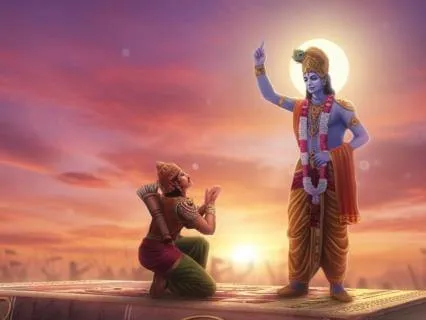
So today we are looking at the Bhagavad Gita.
And this is the Stephen Mitchell version.
So you can use any version that you'd like.
Today we are doing verses 54 and 55.
At this point in the journey,
This is a conversation between Arjuna,
Our hero,
And Krishna.
The Lord,
God,
Our highest self,
Your highest self.
Arjuna being all of us,
All of us in our human selves.
Krishna being that divinity within or that highest self that can guide us.
The story takes place on a battlefield.
Battlefield between members of his family,
Almost like a civil war,
And he's connected to all sides.
And he becomes very depressed.
When he realizes he doesn't want to engage in this war.
And so on the surface,
It's like,
No,
Well,
Fighting's wrong and all that kind of thing.
But the true interpretation of the Gita is that this space that he is having this battle is actually his heart.
This is the field of consciousness.
Where we're living in the world and sometimes it's really hard.
And sometimes if it gets hard enough for long enough,
We don't even want to engage and we just sort of withdraw.
It's almost like.
You know,
The fight or flight,
We go to freeze,
Flop,
You know,
We just sort of,
I just don't want to do anything.
Ironically,
In the land of my favorite band Rush,
There's a great line in one of the songs that says,
But if you make no decision at all,
You are still making a decision,
Which we all know.
So this is where he is.
He just doesn't want to do anything,
But that doesn't work any either.
And we all come to places like that.
So for the last.
40 verses or so.
Krishna has been trying to get him out of his slump.
He's trying to get Arjuna,
Because at that point Arjuna slumps in the chariot and just says,
I give up.
So Krishna's been like,
You can do this,
And here's why,
And imagine a life like this,
And imagine a life like this,
And Arjuna's like,
I don't want to hear it.
I don't want to hear it.
And at this point,
It's a turning point.
This is a point where all of a sudden Arjun is like,
Okay,
Like,
And you know that moment in our lives where all of a sudden something clicks.
And we stop feeling like a victim of our circumstances.
We stop pitying ourselves for everything we've been through.
And we're not arguing anymore.
We're not arguing with the inner teacher.
We're not arguing with the universe.
We're actually going,
OK.
Okay,
I hear you.
So now what then?
And that's the point that Arjun is at now.
Like so.
Verse 54.
Arjuna says,
Then how would you describe the man whose wisdom is steadfast,
Krishna?
How does the wise man speak?
How does he sit?
Stand.
And Krishna says,
When a man gives up all desires that emerge from the mind,
And rests contented in the self by the self.
He is called a man of firm wisdom.
I'm just going to repeat that.
Arjuna says,
How would you describe the man whose wisdom is steadfast,
Krishna?
How does the wise man speak?
How does he sit,
Stand,
Walk?
And Krishna says,
When a man gives up all desires that emerge from the mind,
And rests contented in the self by the self.
He is called a man of firm wisdom.
I want to read another version of number 55.
The Blessed Lord said,
When a man completely casts off all desires that have gone deep into the mind,
When he is satisfied in the self.
Through the self alone.
He is said to be of steady intellect.
What does that mean to you?
How would you?
Repeat that to yourself or to someone else.
Paramahansa Yogananda says,
Oh Arjuna,
When a man completely relinquishes all desires of the mind,
And is entirely contented in the self.
Self is capitalized in all of these.
Verses by the way.
And is entirely contented in the self,
By the self.
He is then considered to be one settled in wisdom.
Is he aligned with his mind and soul?
Yoga is the cessation of the chitta vrittis.
It all comes back to that teaching.
Recognize the oneness.
I am.
Letting go of all expectations on all levels.
Inner peace.
Being in this moment,
Which is all we have.
It's so interesting,
Right?
When you think of releasing the desires of the mind.
And fully resting in the Self.
Capital S cell.
Oh,
You're smart.
Connection to self above all.
Being satisfied and content in being with self and not attached to any outside things.
Yes.
A long journey completed.
Hmm.
So let's for a moment,
Let's imagine the difference.
Between the desires of the mind.
And the Self,
The capital S,
Self.
What's the difference?
Between the desires of the mind.
And the capital S,
Self.
You know for me i think of the self like this.
Endless,
Infinite space,
Endless possibilities.
My connection to my divine self.
The capital S self knows what we really need.
Ooh,
That's a good one.
Whereas the mind is limited.
The desires that come out of our mind.
It's very often limited by our past.
You know our imagination is often a combination of things we've already experienced or they're experiences from our past only we've somehow elevated them.
But they're not always new.
Right,
It's hard to sometimes imagine something brand new coming.
The self achieves self-sourced satisfaction and the mind craves external satisfaction.
Yes.
The self is complete unto itself.
Right?
To think of that when the self is complete.
It's not nothing.
It's almost like the mind,
The desires of the mind are this tiny,
Narrow band of possibilities.
But the self.
Is all things.
It is everything.
And there's something really interesting about that.
Because our world Our reality is defined by our thoughts.
I mean,
That's our reality.
I mean,
If I look outside,
And I see something,
I might think,
Oh,
That makes me so happy,
And someone else might think,
Oh,
That makes me so sad.
Maybe it's raining,
And one person's a gardener,
And they're like,
Wow,
We so need this rain,
I'm so happy,
And I'm getting married today,
And I'm like,
Darn it,
It's raining.
The only thing that's defining our realities is our mind.
So it's really easy for us to think that the desires of our mind are everything.
Because our mind is literally creating our reality.
But the journey of yoga.
Helps us also.
This is an and,
It's not an or.
It helps us also connect.
With our eternal self.
Our big S self.
Then what happens?
Then we see both.
Resting in an awareness of the oneness of all things.
The ego is real,
But it's the role we are playing and it isn't real.
Exactly.
It goes along with the thought that we are not the mind,
We are not the body,
We are an infinite being,
A soul.
Exactly.
So when we think of what what thoughts we have.
If you imagine the thoughts you've had today.
Or the desires you've had today.
Or the desires that are driving the actions of today.
How many of them are driven by fear?
How many of them are driven by unconscious patterns?
Well,
It's just the way it's always been.
It's just,
That's what I do every day.
This is who I am.
This is my life.
Is it who you are today,
Even if it was who you were yesterday or maybe even for the last 40 years?
Is it really who you are today?
The chances are we're just going to continue from yesterday.
Like it's the same day.
What if we're not?
Our mind loves patterns.
And the wild thing is when I imagine what's possible in my life,
When I imagine what's possible in my business or my relationships or even what's possible when I go to the Rush concert this weekend,
It's only my best guess.
And my best guess is based on everything I know right now.
But the reality is the experience could be far beyond.
Or just simply not what I expected at all.
And the hardest thing about that,
You know,
When I say that,
It's like that teaching that says that.
As our animal selves,
Our primal self always goes to the worst case scenario.
As a survival mechanism.
And so sometimes we don't want to think about all the possibilities,
Or we don't want to accept any potential possibilities outside of my current realm,
Because what if I don't like it?
What if it's bad?
What if I go to the concert and it's terrible?
What if something bad happens?
So then all of a sudden it's like,
No,
No,
No,
I don't want to think about that.
So I'm just going to go back to.
Thinking about all the possibilities that I like,
And then I'm going to create a reality,
And I'm going to create 10 possible scenarios that I already know so I can control the possibilities.
It's fair.
That is a fair fear.
This is a primal wiring of survival.
It's not a bad thing.
It's not like a character fault or something.
It's just what we are.
And this is why it's so interesting to have some kind of yogic practice.
What does yogic practice mean?
What does yogic mean?
Something that connects you to your divine self.
Maybe it's meditation.
Maybe it's chanting.
But it isn't just something that we like to do.
It isn't something that just makes us feel good.
It's something that reminds us that we're bigger.
Connects us to a deeper self.
The video that I uploaded.
A couple days ago to Insight Timer.
It's a chanting meditation.
It's rah,
Mah,
Dah,
Sah,
Sah,
Say,
So,
Hung.
The amazing thing about yogic techniques.
Is that they work underneath the mind.
When I chant rah,
I am actually creating a resonance with my heart center.
You know,
Where they say that Atman lives my divine self.
And when I connect my throat chakra with my heart chakra through sound.
It's like we're changing the landscape underneath us.
And when we change the landscape of our mind,
Things start to look different.
And we didn't even consciously change our thoughts.
But the landscape is different.
Magic you grew up in a very anxious home.
Maybe there was a lot of yelling or substance abuse or fighting or who knows what there was.
But for whatever reason,
You grew up.
Always sort of on edge because you had to be again,
Pure survival.
So this becomes your normal.
And you don't even know,
You're a child.
And one day you're 40 and inside you're thinking,
Well.
But everybody feels like this,
Right?
I'm pretty happy compared to my friends.
But from that landscape,
We are interpreting everything around us.
Something happens and we jump,
Or we don't trust that person,
Or we don't have faith in that idea,
Or I'm worried to do that,
Or I can't take that risk right now.
And we're making intelligent choices.
We're making intelligent choices based on the landscape that I know.
And then all of a sudden you take up some kind of yogic practice.
Let's say,
Like meditation or chanting.
And all of a sudden,
The chanting starts to soothe the nervous system.
And the nervous system starts to cool down.
And then all of a sudden someone does something that would have totally triggered you before.
And for the first time in your life,
You just sort of look at them and you think,
Wow.
That person must be having a really bad day.
Same person,
Same everything.
But the landscape changed.
And that's a lot what this particular sutra is about.
That when we have had transcendental experiences.
And what does that mean?
It just means that we've touched infinity.
We've touched the divine.
And everybody here now,
Everybody listening,
Has touched the divine.
Whether it's in a sunset,
Whether it's in intimacy,
Whether it's in silence,
Whether it's holding a child,
Whether it's just simply a moment of happiness,
Climbing a mountain and getting to the top and having your breath taken away,
It creates these tiny seeds that says,
This world is bigger than anything we could ever imagine.
You know,
It's like that great saying that the world isn't stranger than we can think.
It isn't stranger than we think.
It's stranger than we can think.
And it's these experiences we've had that make us just stop.
The mind stops.
Everything stops.
And when the mind stops,
We access.
Our true selves.
And the more often we access that.
And it's not through the mind.
You can't stop the mind with the mind.
That's why we create or we use some kind of yogic practice.
Because the yogic practices.
Quiet the mind,
Whether it's a pranayama or something that helps quiet the mind so we have a few more experiences of oneness,
Of quiet,
Of stillness.
And so.
How does Krishna answer this question?
So he's basically saying.
Arjun is asking,
What does a person of wisdom look like?
How does a person of wisdom walk,
Talk,
Sit,
Act.
So here's my question to you,
And I'd love to know your answer.
How do you define?
A person of wisdom.
What does that mean to you?
What are they like?
Grounded.
Centred.
Thoughtful quiet and listens.
They don't feel the need to say anything.
Consider the big picture.
Honest.
They're like a steel pond.
Observant,
Authentic.
Calm and patient.
No attachment to the material world.
Present and not using it as their personality.
One who quietly knows and listens openly with unconditional love.
Content.
I'm drawn to them because they are so accepting.
Compassionate with detachment.
Isn't that interesting?
Compassionate with detachment.
This is essentially what they're saying.
Detached from the desires of the mind,
Which can also be,
Imagine someone listening to you and you're telling them a story.
They're not attached to your story.
They're not attached to the choices you make.
They're not judging you for being right or wrong.
They're like,
Hey.
We've all got a journey to take.
Just listening.
Kind and listening.
So here's a question.
So these people that we're talking about.
Do they pay their bills?
Do they have relationships?
Do they stand up for what they believe in?
Do they say no when they need to?
Do they say yes when they need to?
Sure.
Sure they do.
They have to make money like everybody else.
They enjoy love and people just like everybody else.
There's things they believe in,
There's things they feel called to,
Just like everybody else.
But they do it.
With this inner contentment with the self.
It isn't about being withdrawn.
You don't have to be a recluse.
So many times people said grounded.
What does grounded mean?
Grounded doesn't mean we're aloof and off in the heavens and we don't care.
Grounded means we are right here on Earth,
Right now.
We know what grief is.
We know what sadness is.
We know what anger is,
And it's real,
And we are grounded in it,
Rooted.
Isn't that interesting?
That a person of wisdom is here on the planet.
With everyone.
They're not in an ivory tower.
They have not transcended the needs of humanity.
They live in the world.
And they know that we are all divinity in human form.
Imagine,
Imagine walking around.
And every person.
Even people that are difficult.
They're all divinity in human form.
What's life like when you feel like that?
You've inspired me to come out of my cave.
It's a real thing.
Because the world is crazy.
And again,
To not be attached to the desires of the mind.
So what are some of the desires of the mind?
I wish the world was different.
I wish that person would understand.
I wish that person wasn't like that.
I wish this would happen.
I wish that was,
I wish,
I wish,
I wish.
These are desires of the mind.
Are they reasonable?
Absolutely.
They define our reality.
They define our hope.
They're just simply,
This is how I feel.
That's cool.
We have to have feelings.
There's nothing worse than people that don't have feelings anymore.
We have feelings.
And We know something else.
That's what makes it rich.
That's what makes our experience rich.
And that's why.
In yoga,
We cultivate what they call a witness mind.
A neutral mind.
It isn't that we simply sit in witness of the humans.
Ah,
Look at those little humans,
Caught up in their day-to-day issues.
It's not that kind of witness.
It's a person right in the thick of it.
But we're also watching.
So how do we cultivate the witness mind,
The neutral mind?
This is where,
You know when we learn how to meditate and we close our eyes?
Let's just do this for a moment,
Okay?
Hold on,
I'm gonna talk for a minute more.
So.
Everybody has different interpretations of how the mind works,
How the brain works.
In Kashmir Shaivism,
In Tantra,
They see the mind as having three different parts.
Manas.
Manas is the interpretation of what we see.
So if I'm looking at my computer right now,
That what I see is going into my brain and going,
Ah,
A computer,
And look,
There's 112 people here,
And oh,
Look,
Leslie just said something,
And ET just said something.
So this is my brain interpreting what I'm seeing.
That's manas.
Chitta in this system.
Is our memories.
So my manas looks and says,
Oh,
Look,
Leslie said something.
Chitta says,
Hey,
I remember Leslie.
She comes all the time.
That's cool.
That's Chitta.
So they're having a little conversation.
And then.
Buddhi is my intellect.
And Buddhi then says,
Oh,
Cool.
Yeah,
I totally agree with what she's saying.
Oh,
That's interesting,
Right?
And our brain is basically this combination of manas and citta and Buddhi talking to each other.
And not that the Sanskrit matters,
But they call that those vikalpas,
Thought forms,
That are always bouncing around inside,
Like kind of like a pinball machine,
You know,
Oh,
And I have an opinion about that.
And I have an opinion about that.
And guess what else?
And here's a,
And I disagree with that.
Oh,
I agree with that,
You know,
And it's normal.
All of this is completely normal,
Part of being human,
Very important,
Otherwise we can't drive cars and we don't know that we really should go see a Russian concert.
It's all very important.
But just for a moment.
Let's close our eyes.
Unless you're driving.
And let's just breathe deeply for a moment.
And now you may have thoughts rolling through your mind right now.
So just look at them.
Imagine they're like little balls.
Little colored balls.
And they're kind of.
.
.
Touching each other which then creates another thought which creates another ball which creates another ball and they're all kind of banging and against each other.
And now imagine the self.
That is watching the balls.
Someone is observing your thoughts inside of you.
That is your witness mind.
That is who you truly are.
The one who is observing.
The pinballs inside your mind.
So this is why when we meditate,
So let's say for example,
We're sitting here and we're breathing deeply.
And very often the instruction is,
If thoughts come into your mind,
Let them float by.
Like logs flowing down a river or clouds.
Floating through a blue sky.
What's happening here?
Is You are practicing.
Being the sky,
And the cloud at the same time.
You are practicing being the river.
And the logs.
At the same time.
We don't have to stop the thoughts.
Thoughts,
That's just normal.
That's human experience.
The key is to begin to experience them with the oneness.
Experience the thoughts with the context of infinity.
With endless possibility.
Imagine the power of that.
That every time you have.
A worrisome thought.
You close your eyes,
You take a deep breath in.
And instantly you remember.
There are more possibilities here.
There might be thousands of other possibilities.
Than the single thing I'm afraid of.
How different is that?
You know,
Do we still engage with what's actually happening?
Sure we do.
But then we also are aware that it's part of a bigger picture I may not understand.
I often think of my.
My relationship.
Lots of you guys have met.
William.
And I think,
Wow.
Am I ever glad that all those previous guys didn't work out?
But at the time,
It's devastating.
I mean,
You shed a lot of tears over it.
But if there is a little voice inside of your head that says,
I guess it wasn't meant to be,
That something better is coming.
You still cry.
You still grieve.
You still have all the feelings.
That's what we're here for.
But we don't.
Die.
It doesn't own us.
Doesn't turn into depression.
It doesn't turn into a pattern.
We just simply allow it to be the movement of life.
That obviously.
.
.
That was not.
.
.
Best in my,
It wasn't in my best interest.
Like,
What a wonderful way to think of it.
Paramahansa Yogananda when he talks about this,
The wise person.
I love this,
He says.
He beholds the entire material world.
As a God-saturated cosmos.
The wise person.
Beholds the entire material world.
As a God-saturated cosmos.
I love that.
I also love this next one.
He also said,
That when we achieve the state of steady intellect,
Steady intellect,
Wisdom,
We rise above the limitations.
Of life and society.
So normally when we teach about detachment,
Right,
It's really weird because you're like.
.
.
How can you just let go of everything?
How can you let go of what you care about or the people you love and all that?
But the idea.
That we rise above the limitations.
Of life in society.
That changes everything.
But I really love that.
I love that.
It's the limitations we transcend.
And so then,
One of the things he says is.
.
.
Our lives present a synthesis.
Of individual and cosmic existence.
A synthesis.
Of individual and cosmic existence.
Isn't that cool?
The other day.
.
.
I was outside and I'm watering my sisters.
Gardens.
She's a very prolific green thumb.
And you look at all the different plants.
And you think.
Who designed thousands of different kinds of plants?
Like when you really think of the earth,
When you really think that all these different life forms created from carbon or however deep you want to go into the molecules,
And there's trees and grass and onions and peppers and birds and dogs and cats and clouds and everything,
And you're just like,
When you really go there,
It's like,
This place is so miraculous.
Like it's so miraculous.
So then all of a sudden you go around,
And when you're smelling a rose,
You're not just smelling a rose going,
Oh,
That's nice.
The kind of rose is so and so and so.
You're like.
Whoa.
A rose.
Then I know I sound like I just smoked a joint or something,
But you're like,
Really though?
Isn't that something?
And to live like that,
And to even meet another person.
You know,
Imagine you meet a new person.
And they could be all manner of.
I'm going to say attractive or repulsive,
But don't think of looks.
You know how some people you just are simply attracted towards for some reason,
And other people you're sitting with them and you're just like,
Where is this person coming from?
Imagine instead.
You are just in awe.
Of the creation of this other person.
Like you're just like.
.
.
Wow!
What are the million experiences that brought you to this point?
It is absolutely mind-bending.
And so then all of a sudden,
Every time we do that.
We cultivate a little bit of wisdom.
It's so interesting how the more we realize we really don't understand,
The more we realize how vast the infinite spaces that we live within.
The more we get to enjoy the roses.
The more we enjoy the people that are difficult,
The more we enjoy challenges,
The more we enjoy sunshine,
The more we enjoy everything.
That's sort of the merging of the two.
And then the more we enjoy all the things,
The more we realize,
Wow,
This is such a great,
Big,
Amazing world.
Maharishi Mahesh Yogi.
He said,
On the surface of the mind.
Desires continue.
This is normal.
But deep in the mind.
They no longer exist.
Isn't that interesting?
On the surface,
Desires still exist.
Deep in the mind.
They're gone.
You know,
That feeling?
That of course I have to do this and I want this and that.
But deep down,
It doesn't matter.
It'll happen.
It'll happen this way or that way.
And if that doesn't work,
Then this will work.
But this,
There's like a deep It's funny,
I don't want to use the word faith.
Because.
There's so much religious connotation around that.
But it's like that.
It's this deep connection to the whole.
And every one of us has a connection to the whole.
Every one of us.
Has it.
It's not even something you have to cultivate,
It's something deep inside of you,
You already have it.
And when we connect with it,
We know this.
Can I share the exact title of the book?
So.
We are reading from the Bhagavad Gita of Stephen Mitchell Jesenia.
Some of the quotes that I'm quoting,
One is coming from this one,
Maharishi Mahesh Yogi on the Bhagavad Gita.
Also,
Some of them come from this guy.
Paramahansa Yogananda's version of the Bhagavad Gita.
Those are my main main texts that I look at.
I get it,
I try to practice this,
But really I'd like Katrina to come help deal with some of the nonsense I did.
Yeah.
Yeah.
We all need a little help from our friends,
You know.
All right so I am just going to re-read.
The two stanzas.
And I would love to know your takeaway on this.
Arjuna says.
How would you describe the man whose wisdom is steadfast,
Krishna?
How does the wise man speak?
How does he sit,
Stand,
And walk?
Krishna says,
When a man gives up all desires that emerge from his mind.
And rests contented in the self.
By the cell.
He is called a man of firm wisdom.
I would love to know.
What you take away from this today.
If there was something you wanted to write on a sticky note and put it on your fridge.
What would it be?
Remember.
I am awesome.
What a great word.
Awesome.
Compassionate with detachment.
Be still.
This too will pass.
The miracle of a life,
One's life.
It was very profound as to where I am in my practice to let go of limiting expectations,
Compassion with detachment.
I'm on my way to firm wisdom.
Keep focusing on recognizing and leaning into my witness mind.
Be the calm within the storm.
The wisdom of the wise ones is that they have a knowing heart.
All things are impermanent.
Be in this moment.
And what I'm grateful for.
Just let go.
That's good.
Well,
Thank you,
Everybody.
I hope you have a wonderful week.
See you guys later!