Welcome to Dreambirds,
A limited series of sleep stories drawn from The Bird Study Book,
First published in the early 1900s.
Before we begin,
Take a moment to get comfortable.
Settle into your bed,
Feel the softness of your pillow,
And let your body sink into a state of calm.
Allow the day's worries to fade away as you prepare to drift into restful sleep.
Imagine yourself stepping into a serene countryside,
Where the air is filled with the sweet scent of blooming flowers and the gentle rustle of leaves in the breeze.
Here,
Time slows down,
And the only thing that matters is the quiet joy of spotting a bird as it flits from branch to branch.
Close your eyes and picture the sky,
Where graceful birds glide effortlessly,
Leading you into a dream filled with tranquility.
The Life About the Nest In view of the fact that birds display much activity about their nests,
There is a great advantage in studying the nesting bird.
Once you have located an occupied nest,
And by quietly watching for a time,
Your Field Glass and Bird Guide will usually enable you to learn the owner's name.
If you do not know where any nest is to be found,
Go out and hunt for one.
This in itself will be an exciting sport,
Although it should be pursued with good judgment.
Children unattended should not be permitted to hunt nests in spring.
A very excellent way to find one is to keep a sharp watch upon birds at the time when they are engaged in nest building,
By noticing every bird suspected of being interested in domestic affairs.
You are pretty sure to see one before long,
With grass,
Twigs,
Rootlets,
Or something of the kind in its bill.
Now,
Watch closely,
For you are in a fair way to discover a nest.
The bird may not go directly to the spot.
If it suspects it is being watched,
It may hop from twig to twig,
And from bush to bush,
For many minutes,
Before revealing its secret.
And,
If it becomes very apprehensive,
It may even drop its burden and begin a search for insects with the air of one who had never even dreamed of building a nest.
Even when unsuspicious,
It will not always go directly to the nest.
From an outhouse,
I once watched a blue jay with a twig change its perch more than thirty times before going to the fork where its nest was being built.
Sometimes,
A bird may be induced to reveal its secret by placing in its sight tempting nesting material.
By this means,
Mrs.
Pearson,
Last summer,
Found a redstart's nest.
Discovering a female industriously hopping about near the camp,
And suspecting what it was seeking,
She dropped some ravelings of a white cotton string from the veranda railing,
Letting them fall where the bird could see them.
These proved most acceptable,
And the redstart immediately appropriated them,
One at a time,
With the result that she soon betrayed her nest.
Early morning is the best time of the day to find birds working at their nests,
For then they are most active.
Perhaps a reason for this is that the broken twigs,
Leaves,
And dead grasses,
Wet with the dews of night,
Are more pliable,
And consequently more easily woven into place.
For nesting sites,
Birds as a rule prefer the open country.
Rolling meadowlands with orchards,
Thickets,
And occasional streams are ideal places for birds in spring.
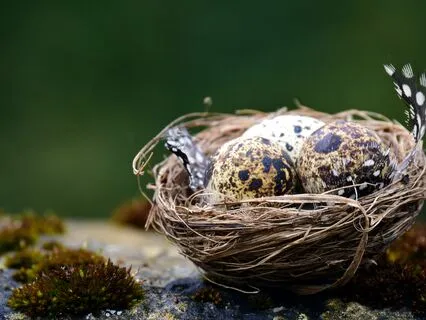
The full complement of eggs laid by a bird is known as a set or clutch.
The number varies greatly with different species.
The leech's petrel,
Myrrh,
And some other seabirds have but one egg.
The turkey vulture,
Morning dove,
Hummingbird,
Whippoorwill,
And night hawk lay two.
Various thrushes,
Such as the robin,
Very,
And wood thrush,
Deposit from three to five.
Four being the most usual number.
Wild ducks,
Turkeys,
And grouse range from eight to a dozen or more,
While quails sometimes lay as many as eighteen.
Eggs are variously colored,
And some are so marked that the blending of their colors with those of their surroundings renders them inconspicuous.
Thus,
Those of the killdeer,
Sandpiper,
And night hawk,
For example,
Are not easily distinguished from the ground on which they lie.
Many eggs that are laid in holes or other dark places are white without markings of any kind,
As illustrated by those of the chimney swift,
Belted kingfisher,
And all woodpeckers.
In such instances,
Nature shows no disposition to be lavish with her coloring matter where it is not needed.
Behavior when nest is discovered.
After the young are hatched,
It is even easier to find nests by watching the parents.
The nestlings are often hungry at all hours,
And the old ones are visiting the nest at frequent intervals throughout the day.
Birds behave very differently when their nests are discovered.
A cuckoo will glide away instantly and will make no effort to dispute your possession of her treasures.
A crow will also fly off,
And so will a wild duck and some others.
On the other hand,
The mockingbird,
Robin,
Or shrike will raise a great outcry and bring about her half the birds of the neighborhood to pour out on you their vials of wrath,
Unless you have the good judgment to retire at once to a respectful distance.
Warblers will flit from bush to bush,
Uttering cries of distress and showing their uneasiness.
The morning dove,
Night hawk,
And many others will feign lameness and seek to lead you away in a vain pursuit.
A still larger number will employ the same means of deception after the young have been hatched,
As,
For example,
The quail,
Killdeer,
Sandpiper,
And grouse.
However much a bird may resent your intrusion on the privacy of its sanctuary,
It is very rare for one to attack you.
I remember,
However,
A boy who once had the bad manners to put his hand into a cardinal's nest and had a finger well-bitten for his misdeed.
Beware,
Too,
Of trying to caress a screech owl sitting on its eggs in a hollow tree.
Its claws are very sharp,
And you will need first-aid attention if you persist.
Occasionally some bird will let you stroke its back before deserting its eggs,
And may even let you take its photograph while you are thus engaged.
On one occasion I removed a turkey vulture's egg from beneath the sitting bird.
It merely hissed feebly as I approached,
And a moment later humbly laid at my feet a portion of the carrion,
Which it had eaten a short time before—a well-meant but not wholly appreciated peace offering.
Lessons to be Learned An infinite variety of interesting things may be learned by watching birds at their nests,
Or by a study of the nests themselves.
How many persons have ever tried to answer seriously the old conundrum,
How many straws go to make a bird's nest?
Let us examine critically one nest and see what we find.
One spring,
After a red squirrel had destroyed the three eggs in a very's nest,
Which I had had under observation,
I determined to study carefully its composition,
Knowing the birds would not want to make use of it again.
The nest rested among the top limbs of a little brush pile,
And was just two feet above the ground.
Some young shoots had grown up through the brush,
And their leaves partly covered the nest from view.
It had an extreme breadth of ten inches,
And was five inches high.
The inner cup was two and one-half inches deep,
And measured the same across the top.
In its construction,
Two small weed stalks and eleven slender twigs were used.
The latter were from four and one-half to eight inches long.
The main bulk of the nest was made up of sixty-eight large leaves,
Besides a mass of decayed leaf fragments.
Inside this bed was the inner nest,
Composed of strips of soft bark.
Assembling this latter material,
I found that when compressed with the hands,
Its bulk was about the size of a baseball.
Among the decaying leaves near the base of the nest,
Three beetles and a small snail had found a home.
The very,
In common with a large number of other birds,
Builds a nest open at the top.
The eggs,
Therefore,
Are often more or less exposed to the crow,
The pilfering jay,
And the egg-stealing red squirrel.
This necessitates a very close and careful watch on the part of the owners.
At times it may seem that the birds are not in sight,
And that the eggs are deserted.
But let the observer go too near,
And invariably one or both old birds will let him know of their presence by voicing their resentment and sending abroad their cries of distress.
A wide variety of material is used by birds that build open nests.
Cotton and feathers enter largely into the composition of the lining of a shrike's nest.
In Florida,
The mockingbird shows a decided preference for the withered leaves and stems of life everlasting,
Better known as the plant that produces rabbit tobacco.
The nest of the summer tanager is made almost entirely of grasses,
The outer half being green,
Freshly plucked blades that contrast strikingly with the brown inner layer with which the nest is lined.
Many of the thrushes make use of large,
Flat leaves,
And also of rags and pieces of paper.
Robins stiffen their nests by making in them a substantial cup of mud,
Which,
When dry,
Adds greatly to the solidity of the structure.
On the island of Cape Hatteras,
There are many sheep,
And many prairie warblers of the region make their nests entirely of wool.
The most dainty structure built in this country by the bill and feet of birds is the nest made by the ruby-throated hummingbird.
When completed,
It is scarcely larger than an English walnut,
And is saddled on a small,
Horizontal limb of a tree,
Often many feet from the ground.
It is composed almost entirely of soft plant fibers,
Fragments of spider's webs sometimes being used to hold them in shape.
The outer sides are thickly studded with bits of lichen,
And practiced indeed is the eye of the man or woman that can distinguish it from a knot on a limb.
Although the hummingbird's nest is exceedingly frail,
There is nothing on record to show that any great number of them come to grief during the summer rains.
It is,
However,
Not called upon for a long term of occupation.
Within a month after the two white eggs are laid,
The young depart on their tiny pinions.
Young birds that require a longer period for growth before leaving the nest are furnished usually with more enduring,
Abiding places.
In the case of the bald eagle,
The young of which do not fly until they are many weeks old,
A most substantial structure is provided.
It was on the 20th of January,
A number of years ago,
That the writer was first delighted by the sight of a bald eagle's nest.
It was in an enormous pine tree,
Growing in a swamp in central Florida,
And being ambitious to examine its contents,
I determined to climb to the great area in the topmost crotch of the tree,
131 feet above the earth.
By means of climbing irons and a rope that passed around the tree and around my body,
I slowly ascended,
Nailing cleats for support as I advanced.
After two hours of toil,
The nest was reached,
But another 20 minutes were required to tear aside enough of the structure to permit climbing up one of the limbs on which it rested.
In doing this,
There were brought to view several layers of decayed twigs,
Pine straw,
And fish bones,
Showing that the birds had been using the nest for many years.
Season after season,
The huge structure had been enlarged by additions.
Until now,
It was nearly five feet in thickness and about four feet across the top.
At this date,
It contained two fledglings,
Perhaps three weeks old.
Having been led to believe that eagles were ferocious birds when their nests were approached,
It was with feelings of relief that I noticed the parents flying about at long rifle range.
The female,
Which,
As is usual with birds of prey,
Was the larger of the pair,
Once or twice swept within 20 yards of my head,
But quickly veered off and resumed her former action of beating back and forth over the treetops 200 yards away.
Nests in Holes The members of the woodpecker family,
Contrary to certain popular beliefs,
Do not lay their eggs in hollow trees,
But deposit them in cavities that they excavate for the purpose.
The bird student will soon learn just where to look for the nest of each species.
Thus,
You may find the nesting cavity of the red-headed woodpecker in a tall stump or dead tree.
In some states,
It is a common bird in towns and often digs its cavity in a telephone pole.
Some years ago,
A pair excavated a nest and reared their young in a wooden ball on the staff of the dome of the State House of Raleigh,
North Carolina.
On the plains,
Where trees are few,
The telegraph poles provide convenient nesting sites for woodpeckers of various species.
While traveling on a slow train through Texas,
I counted 150 telegraph poles in succession,
39 of which contained woodpeckers' holes.
Probably I did not see all of them,
For not over two-thirds of the surface of each pole was visible from the car window.
Not all of these holes,
Of course,
Were occupied by woodpeckers in any one season.
Flickers,
Or yellow hammers,
Use dead trees as a rule,
But sometimes make use of a living tree by digging the nest out of the dead wood where a knot hole offers a convenient opening.
The only place I have ever known them regularly to nest in living trees is in the deserts of Arizona,
Where the saguaro or tree cactus is about the only tree large enough to be employed for such a purpose.
In the northern states,
Flickers sometimes chisel holes through the weatherboarding of ice houses and make cavities for their eggs in the tightly packed sawdust within.
They have been known also to lay their eggs in nesting boxes put up for their accommodation.
In traveling through the pine barrens of the southern states,
One frequently finds the popular chinaberry or pride of India tree.
Here are the places to look for the nest of the hairy woodpecker.
In that country,
In fact,
I have never found a nest of this bird except in the dead slanting limb of a chinaberry tree.
The member of this family which displays the most originality in its nest building is the red cockaded woodpecker.
It is a southern bird and the abode for its young is always chiseled from a living pitch pine tree.
This in itself is very unusual for any of our eastern woodpeckers.
The bird,
However,
Has a still stranger habit.
For two or three feet above the entrance hole and for five or six feet below it,
All around the tree,
Innumerable small openings are dug through to the inner bark.
From these little wells pour streams of soft resin that completely cover the bark and give the trunk a white,
Glistening appearance,
Which is visible sometimes for a quarter of a mile.
Just why they do this has never been explained.
It is true,
However,
That the sticky resin prevents ants and flying squirrels from reaching the nest,
And both of these are known to be troublesome to eggs and young birds.
A simple plan,
Which is usually successful in finding out if a woodpecker is at home in its nesting hole,
Is to strike a few sharp blows on the tree with some convenient club or rock.
After a little treatment of this kind,
The bird will often come to the entrance and look down,
As if to inquire into the meaning of all this disturbance.
If the nest has been newly made,
Many fragments of small chips of wood will be found on the ground beneath the tree.
Variety of Situations The student who takes up the subject of nest architecture will soon be impressed not only with the wide assortment of materials used,
But also with the wonderful variety of situations chosen.
The grebe,
Or water witch,
Builds one of the most remarkable nests of any American bird.
It is a floating raft,
The buoyant part of which is the green stems of water plants,
Not bent over,
But severed from their roots and piled across one another.
On this platform is collected decaying vegetation,
Gathered from beneath the water.
Here the eggs are deposited,
And are carefully covered with more decaying vegetation when the bird desires to be absent from the nest.
Variations in Families Sometimes there is wide variety in the character of the nests of different species,
Classified as belonging to the same family.
The flycatcher group is a good example of this fact.
Here we have as one member of the family the kingbird,
That makes a heavy,
Bulky nest,
Often on one of the upper,
Outermost limbs of an apple tree.
The wood peewee's nest is a frail,
Shallow excuse for a nest,
Resting securely on a horizontal limb of some well-grown tree.
Then there is the phoebe,
That plasters its cup-shaped mass of nesting material with mud,
Thus securing it to a rafter or other projection beneath a bridge,
Outbuilding.
Or porch roof.
Still farther away from the typical flycatcher's nest is that made by a perfectly regular member of the family,
The great crested flycatcher.
The straw and other substances it collects as a bed for its eggs and young is carried into some hollow tree,
Old woodpecker hole,
Or nesting box.
Often a cast-off skin of a snake is used,
And sometimes the end is permitted to hang out of the hole,
A sort of scarecrow perhaps,
Intended for the notice of annoying neighbors.
Meager nests.
Heretofore,
Mention has been made only of the nests of birds,
Built with much labor,
And usually constructed in trees or bushes.
A very large number of species,
However,
Lay their eggs on the ground with little or no attempt to gather around or beneath them any special nesting material.
The killdeer's eggs are simply deposited in a slight hole,
Scratched in the earth,
Usually in an open field or on a rocky hillside.
The only lining is a few grass blades or smooth pebbles.
To protect them from enemies,
The birds depend much upon the peculiar marking of the eggs,
Which makes them look like the ground on which they lie,
And this seems to be a sufficient safeguard for the eggs and offspring of the species.
The nighthawk lays her two eggs on the bare ground in a field or open woods,
And the whippoorwill's nest is on the fallen leaves of a thicket at any spot which the bird happens to select.
The gulls so common along our coast and about the larger lakes make substantial nests as a rule,
But not always.
I have found them on the islands along the coast of Maine,
Containing not a dozen blades of grass,
A seemingly scant protection against the danger of rolling away to destruction.
On the sandy islands of the Atlantic coast,
From Long Island southward,
Many species of terns make nests by simply burrowing a slight depression in the sand among the seashells.
Some of the seabirds of the far north,
As for example the moors and auks,
Often lay their eggs on the shelving cliffs exposed to the sweep of the ocean gales.
These are shaped as if designed by nature to prevent them rolling off the rocks.
They are very large at one end and toward the other taper sharply.
When the wind blows,
They simply swing around in circles.
Although we sometimes speak of the bird's nest as its home,
Such really is not the case,
For the nest of the wild bird is simply the cradle for the young.
When the little ones have flown,
It is seldom that either they or their parents ever return to its shelter.
As our story comes to an end tonight,
Hold on to the peaceful images of birds in their nests,
Each one unique and perfectly crafted.
If you're still awake,
Let your mind wander through a series of pictures of a variety of nests,
Some tucked high in the trees,
Others nestled in cozy nooks,
Each providing warmth and safety to the birds within.
As you drift to sleep,
You may wish to focus on your breath,
Perhaps counting each one in and out,
Slow and steady,
As you settle into a restful sleep,
Cradled in comfort.