So you have a neutral event.
And then in the interpretation,
That's where you have the impression and that's where you have the suffering.
The term that the Stoics used was fantasia.
And that's like another way of saying it.
And it's good to know that word because it kind of hints at the root of it,
Which is fantasia.
Sounds a lot like fantasy.
It's sort of like the conjuring of the mind.
So this would be any mental event that prevents itself to your awareness,
Sight,
Sound,
Memory,
Someone's tone of voice.
It's quite,
It's quite a broad term.
And the crucial detail here is impressions arrive preloaded with claims about reality.
So in every impression,
There's a sort of a truth statement,
Like this is how things are.
And we go through life just never questioning that.
And if we do question it,
It will be after the fact.
You know,
If you have an argument with someone,
Then like the next day you may say,
Yeah,
I probably wasn't very fair.
Like then you kind of realize that your impressions were off.
But the idea with a lot of stoic practice is that we can catch that impression early.
When you have an impression,
You have this preloaded truth statement.
So instead of just seeing someone frowning,
You physically see in your perception that someone that is angry at you there's a story with it.
And so before you've even evaluated everything,
There's a claim already baked in.
So first you have this impression,
So it's like an untested truth claim that just arrives.
Your mind conjures it up,
It fantasizes about it.
And it comes with this claim.
The next.
Part of the sequence is the ascent.
Have you heard about the Ascent?
This just means whether you endorse it or not.
And the word endorse is important as well,
Because for you to assent to something.
Think of it like you would have to get on a stand somewhere and say,
This is true.
So it's sort of like endorsing a political candidate or something,
Being like,
I believe in this person.
You're kind of doing that with the impression if you believe it.
And if you think about it,
If you act on that impression as being true,
Then you endorse it.
Why would you act on something if you didn't fully believe it's true?
So someone looks at you the wrong way.
The impression is they disrespect me,
Then you retaliate.
Why would you retaliate if you didn't endorse it?
You're saying,
I think this is true,
This impression.
So if you assent to something,
You accept it and then you endorse it.
And if you withhold assent,
Then you question it or claim it.
Third,
You have impulse.
This is after you've had this assent,
Whether you endorse it or not,
You get this sort of motivational force within that is kind of prompting you to take action.
Usually when we have a belief that we believe,
There's some sort of movement that is stirred up in our soul about wanting to do something with it.
It's very rare that,
Let's just say that.
Someone cut you off in traffic,
Right?
You have the impression they're a terrible driver and they did that on purpose.
You believe it,
You endorse it,
You assent to that truth claim.
You really just go,
OK,
Well,
I guess I'm just going to carry on with my day.
You then have this impulse to shout,
To.
.
.
Take revenge,
To do something.
There's a motivation within,
There's like a spark of something.
And then after the impulse,
You have passion.
There are healthy passions and unhealthy passions.
But the passion is sort of like the Stoics didn't use the word emotion.
They used the word passion.
But it's kind of similar.
It's like the fully fledged emotion.
So when you hear a Stoic saying something like you have some level of control over your emotions,
They don't mean you have control at stage four.
They mean you have control at stage one.
So obviously if you're in the full grip of rage or you're incredibly sad,
It doesn't make sense for someone to say you can control your emotions.
You don't control them there,
You kind of control them earlier on in the sequence in step two,
The ascent.
So it's kind of true and not true at the same time.
An impression arrives claiming she's angry at me.
If you accept it,
If you assent to it,
If you endorse it,
It will then become a belief.
This is true.
I accept this truth statement that the impression brought towards me.
Then you get this emotion and impulse and then actions follow.
But if you do as Epictetus says,
Every impression you get,
Examine it.
It just remains an impression.
It remains sort of like a projection on a screen that you can kind of look back and stand back and go.
Is this true?
Is it not true?
What exactly am I looking at here?
You know,
I don't fully endorse everything that my mind conjures up.
And then you're free to gather information,
Test it,
Be a bit more scientific or Socratic with it.
And now you can have some freedom.
I love reframing,
But for me,
The point of stoic reframing is not to just take something negative and make it positive,
It's to see the world more accurately.
That's the idea.
So whenever I've done a CBT exercise or I've tested my impressions,
I don't end up with something that's less accurate.
If I'm doing it right,
I'm ending up with an interpretation that's more accurate.
When you withhold the scent.
It doesn't mean that you.
.
.
To fully believe that that person wasn't a jerk to cut you off in traffic.
Because that might come later.
It's more about loosening the grip.
So you can get to a point where you can kind of say,
I don't really know for sure.
My body's telling me.
That there's a problem,
But I'm humble enough to go,
I don't really know.
I probably shouldn't fully endorse this.
A good question I like to ask people as well is,
I do this with a bunch of things,
Is how much money would you bet on it being true?
That's a really good way for you to kind of get to the root of what someone actually believes.
I think this person.
.
.
Hates me or something like that.
All right,
Just pull a random example up.
You could say,
Okay,
How confident are you about that?
I'm super confident.
Okay,
Would you bet your entire house on that?
Um,
Oh you know,
And then you start to really see like how much someone believes it.
And sometimes it will be yes,
Sometimes it will be no,
But that's a question you can ask,
You know,
What would I need to know in this situation to bet everything I own for it to be true?
Because it doesn't make sense that you'd ruin your day,
You'd get angry,
You'd get upset.
And yet you don't even fully believe it anyway?
For me a little.
Let me see what you are.
And what you represent,
Let me test you on the discourses.
So appetitis is.
.
.
Almost seeing the impression here.
As He's almost personifying it,
Like he's talking to the impression,
Like communicating with it.
You know,
Like,
Oh,
Hello,
Impression.
Can you wait for me?
Can I get to know you a bit better?
Can I see what you really represent?
Can I test you?
He's engaging with it.
Which I think is really nice.
It's like a different way of working with your emotions than a lot of us do in the modern world.
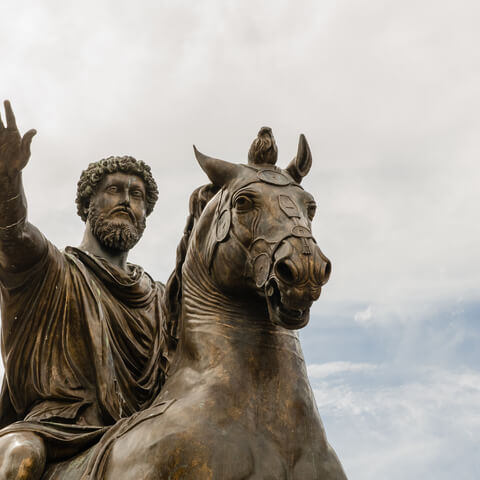
So Marcus Aurelius says,
Say nothing more to yourself than what first impressions report.
You've been told that someone has spoken ill of you.
That's what you've been told.
You have not been told that you've been harmed.
So Marcus Aurelius is noticing the fact,
Right?
The neutral report,
The observation,
Someone spoke ill of you.
That's what you've been told.
That's what you know.
The addition and therefore you've been harmed.
That's the story or the fabrication or the actual level of the impression that comes.
And Marcus is saying,
I don't assent to that.
I don't think I've been harmed.
I'm not going to just accept that.
I'm not going to accept that I need to feel bad.
And yet so many of us do.
And this is really fast.
Knee-jerk reaction that happens.
Little aside in stoic psychology.
Even before the impression comes,
You have something called the first movement or the protopassion or protopathy.
And this is sort of like,
If you hear a loud noise,
You get that reaction in your nervous system.
And this is not within your control.
That's okay.
Stop shaming yourself over those first movements.
That's not the focus here.
The focus is on the ascent.
It's normal to have emotions that come up and they can come up strong too.
So you have this first movement.
You have the impression,
And then you have this freedom,
Which is whether you assent or don't assent to the narrative.
And that's what Marcus is doing here,
Right?
It's a fact,
And then it's the addition.
So the first movement,
Your body reacts before the mind deliberates.
Involuntary,
Blameless,
Even the sage pinches.
We don't want to get rid of the flinch.
We don't want to judge ourselves for the flinch.
We don't want to say that we're not good Stoics and not good people because we have few links.
We just want to catch it before this narrative arrives.
Okay.
I want you to think of a situation from the past week that triggered a strong reaction.
And I want you to think about what actually happened.
What would a camera show?
You can write this down,
Like,
Think about it.
And then ask what did you add.
What interpretation,
Judgment,
And story did you add?
Fact?
What would the camera show?
And what did your mind add?
Another thing as well you can do is.
I'm surprised people don't do this more.
But when it comes to these stoic exercises,
We tend to practice it with ourselves only.
Like we have a negative feeling and then we have to figure out what's the impression,
What's the story I'm adding to it.
Do I endorse it?
You can do this with other people.
If you're watching a movie,
You can ask,
Oh,
What's the impression of that main character?
You know,
What narrative are they adding to it?
And you can just constantly practice almost like you're seeing the matrix,
You're seeing the impressions and you're seeing the ascent.
The goal is not for us to feel like elated walking on cloud nine in a state of enlightened bliss when we do this exercise.
It's okay to be like 5%.
You know,
More relieved or calm,
That's okay.
We're going to just keep building.
All right,
The appetitus challenge.
This is going to be something that for you to practice more in real time.
That was a,
That was a more like longer exercise.
So when an impression hits and you can do this from now on.
Silently say you are an impression and not at all the thing you claim to be.
And you can even visualize the story or like the truth claim.
As like a character or an entity,
You can personify it like Epictetus is doing.
You can actually speak to it like,
Oh,
I see you.
I see your impression.
You know,
I know what you are.
You're an impression and not the thing you claim to be.
Almost like there's this kind of a story that's coming in your mind,
It's like whispering truth claims to you.
Like you are not good enough or whatever it is.
And you don't need to argue with it.
This is another mistake I think people make is they start like looping thoughts in their head,
Like you're not right,
But then the voice comes back.
The impression is like,
Yeah,
But what about this?
And then you're now like stuck in your head arguing.
And that can get messy.
Uh,
The key is just noting the Buddhists do this as well.
They have like noting techniques.
They meditate.
A thought comes up,
They just go thought.
Feeling comes up,
They just say feeling.
You know,
It's just like a form of mindfulness.
You do this with impressions.
An impression comes you just go impression.
Not a fact,
Just impression.
Right.
And this is.
I'd like to be able to say that if you do this once tomorrow,
Your life is going to be different,
But it doesn't work like that.
Ideally becomes a way of life.
So now this is.
.
.
A four-step process for truly,
Deeply examining your impressions.
When they arise.
You won't need to do this with every impression.
You might just want to ask one question.
But I would recommend you do this when you are having a journaling session.
Every day or every week you can think back to the thing that really triggered you or the really stressed you out and then run it through this.
So the first question is,
What is the impression claiming?
What's the full claim?
I like to imagine the impression is like a thing speaking,
You know,
Like,
I'm almost like a salesperson or something like trying to tell me a story.
I imagine that it's a voice talking.
What's the claim?
So the second one is,
What are the raw facts versus the addition?
We've already just run this exercise.
Third one,
Is this about something within my control?
That's a really,
Really important one.
Because if it's not.
.
.
You have permission to let it go to some degree.
And that was actually one of the first questions that Epictetus would ask himself about his impressions.
Is this within my control?
The dichotomy of control is very,
Very,
Very fundamental to Stoicism.
If someone is triggering to you,
Their behavior is not within your control.
What they do tomorrow is not within your control.
What they say or think is not within your control,
But your interpretation and your response are within your control.
So.
An important note about the dichotomy of control,
It doesn't mean you stop caring about things outside of your control.
And then the fourth question is,
Am I inflating?
A preference into a demand.
So as I'd like hardened into I need.
And you can sometimes find this with the word should.
So those are the four questions.
What is the impression claiming?
What's the raw fact versus the addition?
Is this about something within my control?
Am I inflating preference into a demand?
And then evening review,
It's one of the cornerstones of stoic practice.
Before bed,
What did I notice?
Where did I give a scent too quickly?
Where did I catch myself?
Okay,
So the impression is not the truth.
It's a claim and it can be checked.
This is where your freedom is.
And,
And yeah,
I just,
I.
I think that there's enough here for you to practice with.
Start making progress towards noticing your impressions.
And um.
.
.
Withholding a scent or giving a scent.
And it's really important for Stoicism to practice this skill.