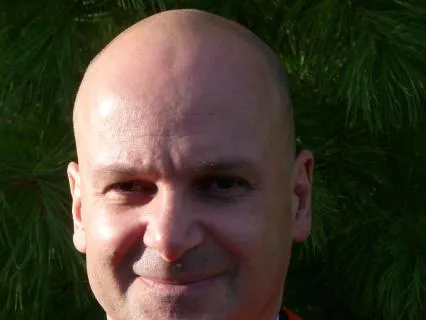
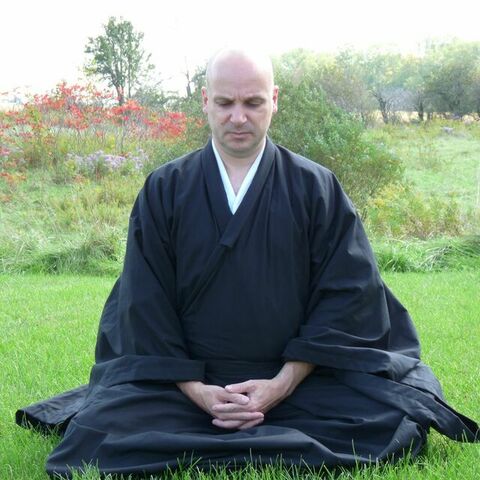
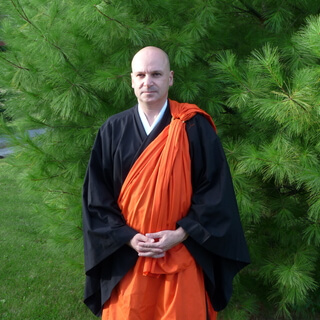
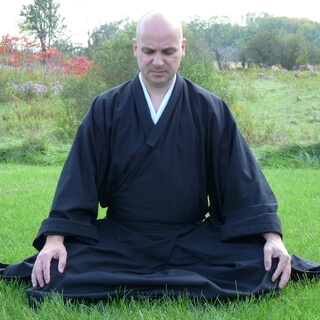
Hello,
It's me,
Joe,
The Autistic Buddhist.
And in today's session,
I would like to talk about goals.
More specifically,
The time it often takes to achieve a goal.
I think it's safe to say that we all want to achieve something or obtain a goal at some point.
Whether it is something basic,
Like going shopping for groceries.
Something technical,
Like learning to play an instrument.
Or something personal or spiritual.
Like becoming less anxious and more calm.
In pursuing our goals,
There's often a dynamic generated by the ego that hampers our efforts and sometimes causes us to give up the goal altogether.
And that is that often the ego wants what it wants now.
It has very little patience.
And it doesn't help that we live in a society where immediate gratification is amplified.
Other than offering a product that people enjoy,
Pizza stores,
Burger places,
Ice cream shops,
Are popular because they can give you what you want.
Now,
You don't have to wait any extraordinary period of time.
You can get your product nearly right away.
I know a baker and she bakes pies.
To bake a pie from scratch takes a long time.
I can go to the grocery store,
Buy a pie,
And come back to her home.
Before she is even halfway done making her own pot.
I understand that in today's world,
Time is important,
And a convenience helps us get things done more quickly so we can move on to other things.
But I'm not really speaking about that.
What I want to speak about is the goals we set for ourselves.
Aimed at self-improvement,
Like eliminating an unbeneficial habit.
Or an unproductive dynamic.
And when we set ourselves to achieve a personal or spiritual goal.
And aim to achieve it as quickly as possible,
We will almost always fail.
And when we fail,
We feel disappointed in ourselves.
Let me give you an example.
I've mentioned before in previous sessions that I go running for exercise.
I run five days a week.
My distance is five kilometers per run.
And I've been running for exercise for about 30 years.
Many times,
People have approached me for advice.
As they want to start running for exercise two.
And they asked me how to get started.
And I always say the same thing,
You need to start slow.
Set your alarm on your cell phone for seven minutes,
Go for a walk,
And when the seven minutes ends,
Return to your starting point.
And then.
.
.
We can build from there.
7 minutes can turn into 20 minutes.
20 minutes can turn into a light jog.
A light jog can turn into a short run,
And so on.
But to date,
No one seems to have followed that advice.
And when I meet with that person again,
And I say,
How's your.
.
.
Goal to become a runner going,
I usually get this kind of answer.
Well,
Joe,
I just went for a run one day.
It was a beautiful day to see how far I could go.
And then I had a hard time breathing and my leg muscles were aching and I just gave up.
I guess running isn't for me.
And so it goes with other things aimed at self-improvement as well,
Like meditation or self-awareness.
Many of us know that learning takes time,
But sometimes the ego gets in the way.
It hampers or stops our willingness to be patient.
Let me tell you about a goal that I wanted to reach,
Which took quite a long time to get to.
Sometimes I get agitated and disrupted.
So I set a goal to get rid of that behavior for myself.
I started by planning out a road map for myself.
And discovered that I became aware of my disruptive,
Agitated behavior after it happened.
I also used a journal to track the behaviors and identify key trigger points.
So my roadmap was the recognition of where I was and where I wanted to be.
There were three steps in my plan.
First was to recognize the behavior.
After it happened.
Secondly,
Was to reach a point where I would recognize the behavior while it's happening.
And thirdly,
Was to reach a final point where I could recognize the behavior emerging before it happened.
Now,
Recognition after the event.
If I had ignored my roadmap,
If I had wanted to do this quickly.
It would not have turned out well.
I very likely would have failed and been disappointed.
My point in all this is that it took time to get from where I wanted to be to where I was.
From recognizing the behavior after the event to now,
Where I can see the consequences of the behavior before the behavior actually happens.
For me,
The key was recognizing up front that this was going to be a long process,
That improving myself,
Making myself a better person,
Was going to take some time.
So I never became dissuaded that I wasn't getting to where I wanted to be faster because I had already accepted that this was a long journey.
If you want to improve yourself,
Be aware of two things.
First,
As I said,
Nothing is going to happen quickly.
I have been meditating daily since 2005 and I still learn new things and improve myself.
Secondly,
Be patient with yourself.
The habit you are trying to break,
Or the behavior you're trying to get rid of,
It took a very long time to grow inside you.
And it's going to take a very long time to uproot.
I hope this session was of benefit to you and that you found it useful.
And goodbye.