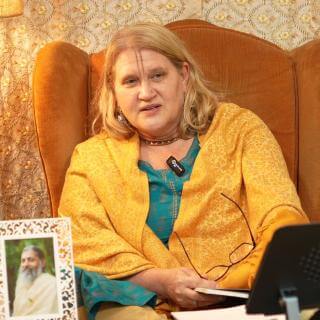
Welcome everybody.
We are going to keep moving with our story.
So.
Before I move to the next chapter,
Chapter four,
Does anybody have any insights,
Questions,
Reflections about all the jealousy we talked about?
Does anybody want to share something before we kind of close that chapter for now?
I have a question or.
.
.
Last week I briefly mentioned about my relationship with Babaji and there was some notion was there,
There may be some jealousy and that for you,
A trend was there.
And I tried to explain how I have high regards for him and then during the end of the appreciation,
That was also brought up.
If you know your capability and know your other's capability,
So I was I could not find Now where is my jealousy?
What other thing I should look for it?
I'm not sure.
That's kind of a very personal question that I don't want to get involved with,
So I would say,
You know,
Read through the book again,
Read through the chapters,
Read about my jealousy,
My symptoms of jealousy,
Research it maybe in general jealousy,
But I feel like that's a really personal thing that.
.
.
I don't really have the right to speak on for your jealousy with Babaji.
I feel I'm not an expert on that.
That's for you to figure out.
OK,
Thank you.
OK.
Anything else?
So first of all,
I would like to thank you for your courage and courage of those who.
.
.
Ah,
Clues,
Different.
And those who share their feelings of Joseph,
Very instructive.
I can just share my job to my sister.
I have a twin sister.
This is quite special.
We are together all our life.
In fact,
Now she's still in Russia.
But we studied it in the same kindergarten and then in school and high and high.
We played together and of course there was some jealousy regarding the attitude of our parents because sometimes I was punished more severely than my sisters.
There was this type.
In some particular type of jaws,
I would say,
When?
And we became.
.
.
Adult and still we were together.
She went to my high school,
Engineering high school.
I went to her institution and finally she found one husband in my institution.
And.
.
.
At that time I felt some challenges,
How my sister who is with me all the time and now she becomes independent,
She goes away with some other men and she's mine.
We are together all the time.
And when I got married I felt similar from her side.
Interesting.
Yeah,
That's natural.
Yeah,
But still I would say our relations still are always friendly and we are tightly related.
And here I have some question about this regarding also some case of Babaji told us once that one Muslim king Um.
.
.
Killed the doctor who saved him.
So my question is.
.
.
So there is a very high range of.
.
.
Expression or action for this for the same feeling of jealousy because even being jealous we can still be keep friendship with some people and on the other hand on the other extreme Well,
Some.
People kill each other.
What is.
.
.
What is the marker?
Who defines.
Or which degree of action is done according to this feeling,
Because feeling,
The nature of feeling is common,
But the consequences are quite,
Extremely different.
So what's the question?
What is the reason which determines the action or behavior of people who have this feeling of jealousy?
What drives people to act on their jealousy?
Yes.
What drives people to act on their jealousy?
Yes.
And then to what extent?
As I see,
In our case,
It's quite slightly subtle and we keep friendship.
Yes.
No problem.
On the other extreme,
There is murder and so on.
So what is,
Is it just gunas or samskara or what?
What happens when people go to such extremes?
When they have jealousy.
This is a lack of awareness.
So when you're jealousy,
I always use the example of having to pee,
Right?
So if you have to pee and you're aware of it,
You're not going to pee your pants,
You're not going to urinate on yourself,
Right?
Unless you have a problem.
But otherwise,
As an adult,
If you're aware,
Oh,
I have to go to the bathroom,
You're going to figure out a way to get to the bathroom.
But with jealousy,
For example,
It is so subtle,
And there's so much shame around it,
And nobody wants to have it,
That we ignore it,
We push it down,
We blame the other person,
We criticize the other person.
So as we're doing that,
It's building up.
It's getting stronger and stronger and stronger,
So we're not having awareness of it.
And then it's going to drive us to act in a very bad way.
And then we're going to rationalize with our ahamkara why that that's okay.
So it's coming from a lack of awareness.
If we are aware,
And we're actually trying to take responsibility for our feelings,
And we say,
Oh,
I'm jealous of my sister.
I got to keep,
You were aware of it.
You noticed it,
Like,
Oh,
I'm jealous,
You know,
That doesn't feel good.
But I still love her.
I'm gonna try to focus on the fact that she's getting married or she has a boyfriend and the happy part,
Right?
But if you're not aware of it.
.
.
You can sabotage the whole relationship.
You can hurt her,
You could have even tried to kill the guy,
Maybe,
If your jealousy got so strong that you're not aware of it.
And jealousy also makes you blind.
So to me,
It's very obvious when somebody is jealous.
It's very obvious.
But they have no idea.
If I say,
You're jealous,
They'll be like,
What are you talking about?
No way.
I love Vedic psychology.
But it's obvious that they don't.
So that's the thing.
If you have a lack of awareness,
You're not going to see it all in yourself.
And that causes you to act because your thoughts and your feelings drive your behavior.
But the way to stop it is your buddhi comes in and goes,
Whoa!
I'm jealous and I'm having a very bad thought.
Let me try to control that.
But we don't do that because jealousy is so.
.
.
Push down.
Like anger is an obvious one,
You can't hide your.
.
.
I mean,
You know when you're angry you're burning.
Excuse me.
But jealousy is not like that.
And when it comes out,
We always have a very good reason why that person.
Deserves to or why.
Whatever,
We have very many long list of excuses of why,
Even the guy who killed the guy.
The Muslim who killed the Ayurvedic doctor,
He has a good reason,
Very good reason.
So jealousy is like that.
It's not an obvious one.
So the whole idea in Vedic psychology is to raise your level of awareness,
Not of the other person,
Of yourself and your feelings,
So you can manage them.
So that's the thing.
I mean,
Of course,
Jealousy is coming from some scars,
But that's like a very general answer.
But it's lack of awareness of the samskara that's the problem.
And then lack of taking responsibility for it.
Because you might even be aware of it,
But still you don't want to really deal with it.
So remember last time I was talking about that awareness meter?
So you can make a meter for your jealousy and say,
Okay,
When my jealousy is like three out of 10.
This is the kind of thought I have.
The feelings,
Because there's more than one feeling around jealousy,
Like three might be like.
.
.
Some more mild feeling,
But seven out of 10 might be like hatred.
Discussed you know so you can map your feelings out you can map out along with the levels of your awareness of jealousy You can map out your thoughts what you think when you're out of three when you first start getting jealous versus what you think when it gets more intense,
Turning the heat up to 10,
And you can write down your behaviors.
Like if you're a three,
You can still be friends with your sister.
No problem.
But when you're a seven.
You probably can't even be around her.
Maybe you wouldn't even be able to go to her wedding if you were a 7 out of 10 with the jealousy,
You know?
So yeah,
It's a good question,
What's driving it.
Uh,
You've mentioned this before.
So you mentioned that Babaji was.
.
.
Not congratulating,
But was somehow happy that you had the courage to recognize this negative feeling of jealousy in you.
And so my question is,
Um.
.
.
You talk also about awareness,
So then this courage to look at something negative.
And take action in a positive way to rectify,
No?
So,
From where it comes more from the or how it comes,
Because not everybody is aware what is really happening.
As you said,
The jealousy makes us blind.
The buddhi gives you the awareness.
And the courage comes generally,
I think,
From the father samskara.
If your father believed in you and your father helped you fight up against the bully and he didn't beat you and he didn't beat you down,
You know,
Then you're going to have courage in your life to really look at things and really say,
Because he was behind you the whole way,
Your whole childhood,
You know,
So if you have the buddhi,
That awareness of the issue first and then the courage comes from that.
That strong father figure in a positive way in your childhood.
You know,
Being supportive,
But,
You know,
Standing up for what you believe in.
You know,
All of that,
If that's happening through 18 years by the time you're an adult.
Then you're courageous to say the truth.
Because he supported you hundreds of times the whole way along,
You know?
But many people don't have that experience.
They have a father who beat them down,
Ignored them,
Criticized them,
Molested them.
I mean,
So many bad things,
You know.
So then,
If they are courageous,
They won't come and hurt you.
A healthy way.
It'll come up as a bully or something.
Distorted.
Thank you,
Good question So there is a difference between jealousy and envy.
Do you distinguish?
Why don't you?
I think that's your expertise.
Because I heard last time Purushottam Prabhuji saying that if we all do seva for Babaji,
Then we should not be jealous.
But.
.
.
At least as far as I understand it,
Envy is more that you want to have something that somebody else has,
Whether it is a position or.
.
.
Or some wealth or whatever it may be.
That does not really.
.
.
Um.
.
.
Correspond with the jealousy feeling.
It has to be solved in another way.
Unless in Vedic psychology you see differently.
No,
Go ahead.
So then how would you describe how to solve envy versus jealousy?
Yeah,
In envy then one has to see that,
Oh,
What is the importance of having more money,
For example?
Or why would I want to have a car like my neighbor?
So that's easier to solve,
I think.
But jealousy is usually,
According to dictionary,
And yeah.
When you feel an emotional lack of love from someone,
It can be the parents,
Or the teacher,
Or the husband,
Whoever it is.
I think that's more subtle and more difficult to solve.
Like the Muslim man that you were saying,
To me that seems more like envy,
Not jealousy.
But that's why I was asking if you see the same,
But I see different.
It's a different.
Dynamic.
That's important.
Yeah,
That's important.
I usually just focus on jealousy,
Because I'm dealing with emotions.
But it's good to say,
To actually distinguish the two so people can pinpoint it.
The main issues that I'm seeing are very intense jealousy.
But it's good to have the distinction.
Yes,
Because everyone doing a seva for Babaji,
For example,
To me that comes more under envy.
It's not solving the jealousy issue.
They are different things.
The jealousy would be that wanting to have more intimacy with the Guru and the envy is more like going about I want to have that seba or.
.
.
That is more important,
Or a position,
Or something.
They are two different things.
Jealousy is more difficult.
Because it's more related to the emotions,
And we're more about external things.
Thank you.
Anger is not an emotion.
I don't know,
I don't really focus on it.
I just call it jealousy.
Definitely,
If you look it up,
There's definitely distinctions between the two,
Which is why I'm having her talk in it,
Because I just lump them together.
But what she's saying is true,
And then each person has to look in their heart and say,
Am I jealous because of this Ava thing,
Or am I envious?
They have to look at the definitions and figure it out,
But for me,
I just.
.
.
People aren't coming that clear about it.
Usually it's a jealous of a boyfriend or jealous of a girl.
It's a love relation jealousy.
I haven't had somebody who's been like,
Can I meet with you to talk in therapy because I want that Mercedes,
That he has a better version of it,
Or I want that Seva.
So that's why it's not really my expertise beyond the jealousy.
So if someone's saying envy and they're talking to me,
It's still pretty much jealousy.
Not that NIMBY doesn't exist,
But it's just therapy in my little world of therapy.
I'm doing.
And what I was talking about was jealousy for me,
My story.
Anything else?
Relax.
Okay.
Go ahead,
Bushman.
Thank you.
So,
I guess my question is,
I'm jealous in the workplace.
For example,
I feel jealous sometimes of my colleague.
We both have complementary skills.
Sometimes his skills are in demand,
Sometimes mine.
I know that I need him and he knows that we need to work together.
But at the same time,
I feel that if I don't promote myself,
I won't get,
Like,
Good enough raise.
There is also competition for limited resources like raise and bonus.
There is some competition,
But I feel conflicted about it.
I feel jealousy,
But if I don't act on that jealousy,
Maybe I won't get more rates.
Maybe I should act for other sites,
And maybe if I act,
And if it is like politics is rejected,
Then I'll get screwed.
So then I won't get that.
So I feel conflicted about it.
I have to play politics in the company,
But at the same time,
I feel conflicted about it.
What is the object of jealousy in the workplace?
Your conflict is if you should act on it or not.
Yes,
If I don't have complete insecurities,
I will have a fire inside.
That won't happen.
I won't get enough rain or go to sleep.
How do you know?
Like if I don't promote myself,
Then people won't know what work I've done and after promoting myself,
I have to contrast with somebody else,
Right?
Otherwise,
How would I get like more layers and more without competing?
So what I would say is that you have to nurture your inner child first.
You have to take care of your feelings first and then act from a non-jealous place,
You know?
Your inner child is the one who's jealous.
Your inner child is probably,
My guess is,
Jealous of your big brother or something.
Like it's owed some scars.
So if you work on that first,
Calm that down.
It's natural to compete,
Especially in business.
But complete from a place where you're not hateful or you're not trying to hurt him.
You're actually competing to compete against yourself.
The last version of you,
A year ago when you had your last review or something.
How can you do better than Bhushan before?
And do it with a calm,
Clear mind.
Their head after you tell your inner child that you're great,
We're doing well,
You know,
We don't have to crush this guy,
We can try to do better than ourselves.
You know,
Then it'll be from a more authentic place.
It's just little Bushon having a temper tantrum,
You know,
The jealousy.
Yeah,
Big thumbs down.
Thanks.
OK.
Hi Krishna.
I think what is.
.
.
Hi Krishna.
I think what I struggle with is I feel that awareness is already hard.
But even if one is aware,
They may not have the strength to act on it,
Because they've already degraded their level of consciousness.
Their mind might be more in namaskaraja,
And that might force them to,
Despite knowing,
Not being able to act.
So how does one get help to act,
Even though they might be aware?
That's a good question.
And that's true.
That's actually what happens.
That's part of the process.
First you become aware of your behavior that you don't want to be doing.
And that's so frustrating because you're watching yourself still doing it.
So,
First is the awareness,
And then is actually stopping,
And then acting in the right way,
Right?
So,
If you're first aware of yourself,
Maybe you act on it still,
The next level would be you're aware of it and you don't act on it,
But you still can't do the quote-unquote right thing,
The subject thing.
But when you are feeling jealous,
Just say,
And you want to compete against that guy,
That's a very strong energy.
So the best thing to do is use the energy on a piece of paper.
Write it down.
Write what you want to do.
Just to get it out.
It's like vomiting out some toxins,
You know?
Write down what you want to do.
Get it out.
If you need to record it,
Say it in a recorder.
Just do something to get it out physically.
So then you can say,
There,
Done.
And if you need to reread it to yourself and be like,
Yeah,
Smash him or whatever,
Get it out.
Because otherwise we hold it in and it comes out sideways in a very usually not so nice way.
So that way you're honoring it.
And if those of you who are working with your inner child,
Talk to your inner child about it and be like,
I know you want to smash him.
I know you do.
I know that that's the only way you think that I can get this promotion.
And I know you actually want me to go slash his tires after work so he can't make it in tomorrow or something.
You can think of the worst thing possible that your inner child would want you to do.
So that feels very validating,
You know?
So first validate the whole thing and then say,
But you know what?
I have to do the more septic thing and I hear you how nice that would be,
But the consequence of that would be,
So that's when you start using your septic booty and saying,
You know,
If we did this.
At the minimum,
It would bring us down.
Into a more negative state,
But also there's usually other consequences where you hurt people,
You hurt relationships,
You disturb your own mind.
And you get them slapping back.
You create a lot of disturbance.
So you kind of think through it after you first vent.
Then think through and then say,
So now that we've done that,
Let's try to do the more suffocating thing.
And sometimes the suffocating thing is not doing the right behavior towards them.
It's just trying to be neutral and not act in a negative way.
I mean,
Sometimes we get so jealous you can't even be in the person's presence,
You know?
So maybe you can't go to the event or something,
But at least stay home and vent it out.
And try to calm yourself down.
So I would say it's a process with multiple,
You can tell as you're getting better and better at it.
But at the beginning,
I would say be gentle and try to maybe just do one little step.
One step towards it and then congratulate,
Celebrate yourself because then you'll get a new samskara saying,
Yeah,
Yes,
I'm not stuck.
You know,
There's not only black and white,
It's not only like.
.
.
Blast in some not nice way or be a perfected person.
There's all those gray areas in between.
So try to do one step in that direction you're trying to move towards and then celebrate.
Acknowledge yourself for that.
Be like,
Yeah,
Okay,
I did something different this time.
Even if you just write down your feelings.
Say,
I'm so jealous of this guy and write down those,
What are the feelings?
Anger,
Hatred,
Disgust.
You know,
Write this down and say,
Okay,
Good,
At least we got the feeling.
That feels so good.
Just to do that.
You don't have to write a whole book.
What do you think?
I've found about you and Leighton in journaling,
And I agree that that's important.
I mean,
Writing has helped.
It really gets you out of the emotion and brings it back to your intelligence.
I guess where I've been struggling with is after writing,
I think this has happened to me a couple of times where I feel like,
Okay,
I need to,
I'm feeling something.
Okay,
Right.
I write four pages,
Five pages.
And then I'm like,
OK,
I feel all right.
Now I go back to life.
But then I'm just writing,
Writing,
Writing.
And so it seems like I'm just scratching an itch.
It's not a solution.
And I can see I'm going in recurring themes again and again and again when I write.
I'm not able to get out of that.
And that's causing a sort of desperation,
Frustration that what I'm writing about,
About those emotions,
I'm going in circle,
I'm not going any deeper.
Next time you're going to vent the same thing,
Right?
And actually,
If you don't do the next step,
You're actually fortifying that some scar we're trying to get rid of.
So first,
We got to vent,
But then the next step is to validate.
Okay,
And so the way to validate would be,
What I would suggest is this technique that you can do where if whatever your dominant hand is,
When you vent,
You write with your non-dominant hand.
So for example,
I'm right-handed,
You know,
So I would not be venting with my right hand.
This is your adult self,
The logical side,
Your dominant hand.
So if you take your non-dominant hand,
Which is basically your emotional side and your inner child,
And you vent with that,
And it's going to look so weird.
It looks like a little kid writing.
Good,
That's good that you can see that that's basically your your inner child being like,
This sucks and I hate him and I want to punch him.
Great.
So keep writing with that non-dominant hand until you get it out.
Don't judge how you're writing and don't think about it.
Let it come out and surprising actually because you're connecting to another part of your mind.
Than the other part of your brain.
Just the feeling part without the thinking and the critical judgment side.
So after you've vented that way,
Then switch to the other hand,
Your dominant hand,
And now you're the parent.
Where you're the adult,
You're the nurturing adult saying,
You know what?
I'm so sorry.
Of course you're feeling jealous of this guy.
Why does he always have to be better than you?
Why does he always get first?
Why does your boss like him better?
You've seen him sleeping on the job.
He's actually not that smart.
I mean,
You're smarter than him.
Whatever you need to say to validate the points as the adult of that child.
Then it completes the samskara and we would say digest it in a way.
Because if you just do the venting,
It just makes those same thoughts stronger and more fortified.
We don't want that.
We just want to validate,
And then the adult self comes in,
And when you do that,
Then those parts that have been very stuck,
In a way,
You could say,
In the samskara,
They get digested a little.
They have now the adult version.
That child's feelings.
They've come together.
So you have the feelings and then you have the adult validating,
But then the adult pulls you out into the present moment.
So after you validate the feelings in there,
Then now you keep the pen in the right hand and you say,
Okay,
But you know what,
This is actually just some bad feelings probably from,
You know,
You're jealous of your brother.
And if you can't tie it to the samskara,
Okay,
You're jealous of this guy.
So you see how far back you can go if you can connect it to a childhood jealousy,
And if not,
No problem,
Just connect it to the current person.
But then from there,
Pull them to the present moment and say,
Then you have to help them see how is this going to help you.
After he's been validated.
So the final thing is pull him out of that ditch,
That hole of the samskara,
Into now.
And say,
How is this thinking going to help you?
Let's think.
I know you're thinking and I know you're feeling it.
I'm with you.
But in life,
Let's play it out.
This is what actually a good father does with kids.
Play it out.
Do you think it's a good idea to skip school?
Like when I was young,
My father would be like,
Because I would be like,
Dad,
We had a very good relationship.
So when I was a teenager,
I'd say,
Can I go to a party on Saturday night?
And he'd be like,
Are they going to be drinking alcohol?
And I'm like,
Yes.
He's like,
Are there going to be boys there?
I'm like,
Yes.
And he's like,
Then you can't go.
I'm like,
Can we talk through some options?
And he would talk through options with me.
So we had a very nice relationship.
I would be very honest with him.
And then he would explain,
If you go there and you drink alcohol and they have a boy,
You're probably going to do something you don't want to do.
And I'm like,
Like what?
I mean,
He would explain it to me.
So that is actually what I do with myself if I'm thinking through an option and I'm struggling with a feeling.
And I'll say,
OK,
First you validate the feelings.
And then I think,
Now if I act on those,
Here's the consequence.
Thank you for watching.
So you help your inner child,
But you first see him,
And then you kind of take him by the hand,
Your inner child,
Or your emotional self,
You could say.
And say,
OK,
Now let's be realistic here.
If we act on this jealousy,
Let's see what could happen.
And then he can write with his left hand,
And then you can parent him.
Or help them,
But not by criticizing,
Not by shaming,
Being like,
Yeah,
I hear you,
I know you really want to do that,
But.
.
.
You know,
We wanted to have a good weekend,
Remember?
And I think this is going to ruin our weekend,
Because probably if we do that,
We might get fired.
You kind of bring them into reality of maybe some unintended consequences as well.
It might feel really good in that moment to do that,
But how do you think it would,
You know,
If we play it out?
Because a lot of times in our emotions,
We do spontaneous things without thinking through the unintended consequences,
Which could happen a year later.
Or 10 years later,
Or a month later.
So there's lots of ways to do it,
But it's like using the buddhi with the manas.
The manas is all the emotions that are coming from some scars.
And then the buddhi is the one who comes in and says,
OK.
In a kind way,
You know,
Digesting the feelings,
Validated digesting and then pulling through to the present moment and talking about consequences and then talking about,
So maybe we can do a happy medium.
For example,
A lot of my clients,
If they struggle with anger,
At least in the U.
S.
,
There's something called rage rooms.
So I'll say,
Go to a rage room,
You can rent it for an hour,
Get the bat and hit the crap out of the glass and curse and yell and bring the picture of the guy that you hate and beat him up to,
Just get it out,
Fine.
That might be an option instead of doing something to him.
So there's lots of ways you can kind of deal with it that you can get it out.
Without actually doing it to the person,
You know?
And then at the highest level,
What a good father would do also would be to remind the person of their nature,
Of their svabhava.
You know,
You're not the two same people.
So you're seeing him like this,
You know,
You're looking with blinders on,
But if you actually look at your whole self.
.
.
You have a lot more to offer than trying to compete with this one little ant,
You know?
Look at your whole self.
Jealousy comes when you can't see yourself.
If you can see yourself and you're situated in yourself,
What are you jealous about?
You're blissful in your own nature,
You know?
So jealousy is when you're completely focused on the other and you're not in you.
And you don't see your good qualities.
You're too focused on the other person and what they've got going on.
And that's also the fault of the father,
You know,
Not helping you see who you are,
What you're good at,
And cheering you on for the whole childhood.
So that's also part of the role of parenting with the right hand.
Is saying,
I know that you're jealous of him about that,
But look at you.
You know,
If it's about trying to get someone's love and he's getting it and you're not,
Then stop focusing on trying to get it from that person.
Give it to yourself.
Validate yourself.
It's exhausting to try to get love from someone else.
Nobody can do it full time for you,
You know?
Love or attention,
You know.
Thank you so much,
Martha.
There's so much content,
I actually need to see the recording.
This is really good.
Thank you so much.
My pleasure.
Good questions.
Hare Krishna.
Hare Krishna.
Okay,
Anything else before we go on?
Okay,
So let's move to number four,
Chapter four.
Okay,
This one is titled,
My Biggest Crisis Turned Into My Biggest Opportunity.
Okay,
So we're out of the basement.
We're out of the basement now of the ashram with the girl that I was jealous of,
And now we're going to go back in time.
Back in time.
So there's another journey that I went through years ago.
Before my journey to India.
Long before I had the good fortune to meet Babaji and Dr.
Chauhan,
And before I arrived in the warm embrace of Mother India in 2015.
This journey was my journey of loss.
It began in August 2002 on a very hot and humid day in Hanover,
New Hampshire.
Where my family had gathered for a reunion.
I was 30 years old and working as a jet-setting market research consultant in Boston.
I had just arrived home in New Hampshire from a six-hour round-trip drive to pick up my grandmother from the airport.
She had flown in from Florida for a family get-together.
We were having like a family reunion.
One of my sisters had just arrived from South America,
Where she was a Peace Corps volunteer in a rural Paraguayan village.
Another of my sisters had driven two hours from the congestion and pollution of the city,
Fighting through the noisy traffic of Boston.
To reach our peaceful country home on the hillside.
My youngest sister had traveled about two hours from her university on the other side of the state.
My cousins and aunt and uncle had made the big trip from New York City.
Our family home had an oversized kitchen.
Which opened into a vast living room with 22-foot high ceilings.
I don't know what that is in majors,
But they're tall,
Maybe like this.
They're really high.
Huge panoramic floor-to-ceiling windows showcase the captivating view of the rolling Vermont hills.
So where I grew up,
We grew up on a river,
And the river separated the two states.
It was really pretty,
This kind of rolling river that separated those two states of New Hampshire and Vermont.
And our land was kind of up on a hill.
And then you go to the bottom of the land,
And there's the river.
And you could swim across to the other states.
And kids from Vermont.
We grew up in New Hampshire,
But the kids from Vermont also went to our school,
Because our town was so small,
We didn't have enough kids for a school.
So half the kids were from a different state,
Which is weird in the US.
Because you don't usually go to a school from a different state,
But we were all at the same school.
There was only like 100 of us in the class.
But um.
.
.
So my mom had been busy all day making delicious food for our guests.
When I opened the front door,
I was met with the mouth-watering aroma of freshly baked bread.
Whenever I came home,
I would be spoiled by endless tasty treats from my mom's organic bakery.
It was called Harvest Moon.
And this day was no exception.
There on the wooden kitchen table beckoning me was my all-time favorite,
Her homemade milk chocolate coconut muffins.
They were bite-sized golden round delights.
The bright-sized golden-brown delights were surrounded by an assortment of bright colors.
Radiant green fresh arugula salad,
Bright pink watermelon slices,
Creamy yellow corn salad,
Dark white rounds.
Of goat cheese contrasted by juicy red tomatoes and dark green basil leaves.
It was a delight for the senses.
The mood of the house was festive.
We hadn't all been together like this in a long time.
So the kitchen was buzzing with chatter and laughter.
And you can see,
If you have the book,
That's a picture of our house.
That was our living room.
And there's the views of the Vermont hills.
So this house we built,
Our family,
We built it together.
So in high school,
When I was growing up,
That's when we built it.
So I'm the oldest in the family.
So the youngest is 10 years younger.
So she basically grew up in this house.
But for me,
I was almost out of the house when we were building this.
I think we bought the land.
We searched for years for the perfect land because my dad was like that.
So he found the perfect land and then it took years of building the house and he hired this architect and the architect would come and the whole family had to agree every time.
So we'd be meeting like,
No,
No,
No,
No,
No.
I want my room there.
We should have a gym in the house.
Let's have a pool.
Everybody was saying everything because there are six people in the family and then we're like,
We can't afford a pool.
Okay,
Come down.
Gym?
Okay,
Maybe we could use one room for everything.
But we should have a TV room.
So anyway,
It was very fun to build this house and it looks like a nice house and it was,
But we didn't grow up with a lot of money actually.
So the money came later.
So what happened was when I was Because I'm the oldest,
I grew up in a house with no money.
We grew up in a tiny apartment.
My dad went to MIT,
And he was a student.
He was getting his PhD at MIT.
So all those four or five years,
I was in this very small,
Crappy apartment with three girls in one room,
And my mom and dad in the other room.
A very different thing than a house like this.
So I grew up very.
.
.
Conscious of not having any money and having to be very tight with money and not having very much.
But once he finished his PhD,
Then he got a good teaching position at Dartmouth College.
It was a very nice university.
We moved to this town.
And then he started a software company on top of that.
So he became a very seasoned professor and a software company.
So then when the money started rolling in,
Then we went and bought this land and built this beautiful house that I only got to live in for like a year before I went to college.
So I don't have a ton of good memories.
I mean,
I have a lot of memories,
But not from my childhood.
It's not really my childhood home.
It's my youngest sister.
She got spoiled.
Totally different life.
She had a really nice car.
She had this big fancy house.
But for me,
If you saw the pictures of where I grew up,
You would be like,
Oh.
Anyway,
This is a little side story.
So seeing everyone else so happy temporarily distracted me from my own low mood.
Why?
Well,
For just 24 hours before our family reunion,
I had broken up with my boyfriend of six years.
Or I should say he had broken up with me.
He was the love of my life.
We had traveled and lived around the world together.
But when the time came for settling down in marriage,
He just couldn't do it.
And as the years went by,
He was becoming more distant and completely absorbed in his work.
He chose to spend his time playing golf,
Drinking beer,
Hanging out with the boys,
And making money.
And he would spend less and less time with me.
We had dozens of talks about how I wanted to get married and start a family,
Which always ended up with me in tears and him sitting there looking indifferent.
He would tell me he wasn't ready and that he needed more time.
I would be pacified for a while,
But not really.
So on August 1st,
2002.
After another lonely weekend,
Followed by a week of waiting for him to call,
Which he never did,
We finally broke up.
It was a Thursday night and I was dreading spending yet another weekend sitting at home hoping my boyfriend would call me.
I sent him a text message because he was always working and he would never answer his phone.
I wrote,
I can't do this anymore.
We never spend time together.
Maybe we should end things.
And his reply,
OK.
After six years of a relationship.
And that was the end of that.
I was shocked.
I was devastated.
He didn't even care enough about me to call and say goodbye.
It was horrible.
I cried all night and I could not stop.
The next morning I called my boss and I kept it together long enough to explain the text message breakup.
She encouraged me to take the day off and use the weekend to recover.
Without delay,
I acted on her compassionate advice.
And I drove the three hours to my family home in New Hampshire,
Crying the whole way.
I called my father as he always had something helpful to say in my times of despair.
He listened while I poured my heart out.
And then tried to pull me out of my narrow mindset by telling me that I should not let some guy bring me down.
He suggested that maybe I should move somewhere new and start fresh like Hawaii.
He's like,
Forget it.
What's so good about Boston?
Just go to Hawaii.
And he's showing me pictures.
Just pick anywhere.
You can start fresh.
I almost did it.
I could feel his passion through the phone when he said,
You can do it,
Jez.
Go for it.
There's this whole big world out there.
And he's just one stupid guy who doesn't appreciate you.
I will help you move to Hawaii or some other place with tropical weather like I know that you love.
Come on,
Cheer up.
My father's words always had a way of expanding my view.
And this conversation was no exception.
Like my mom,
Whenever I'd be upset about something,
She would listen and just kind of validate.
But she wouldn't try to get me to think bigger.
She would probably listen to me crying about him and saying,
I can't believe this,
And overanalyzing,
Maybe he's going to call me tomorrow,
And maybe we'll get back together.
Whatever I'd say,
She would just hold the space for that and go along with it.
But my dad would always be like,
Come on,
It's just one guy,
Hawaii.
So he always expanded my thinking in such a nice way.
The next day,
The day after the family reunion,
The day,
Sorry,
The day of the,
So that was the day before.
I was basically crying on the couch and my dad was trying to lift me out of my depression.
And so the next day,
The day of the family reunion,
I was still crying on the inside,
But on the outside I was smiling and hanging out with my relatives and laughing at their jokes and trying to pretend everything was okay.
I noticed that my father was not there in the kitchen,
Nor in the living room.
I asked my mom where he was,
And she said that he had gone for a run with one of my sisters.
My father was an avid runner.
Having competed in a marathon and a triathlon just a few years previously.
Within a few minutes,
He entered the kitchen,
His tan skin glowing green.
With sweat from.
His rigorous run.
He flashed me a big smile,
And his sparkling blue eyes warmed my heart.
You can see the picture of him there.
I had the urge to give him a hug,
Our usual custom,
But I resisted.
I thought to myself that I didn't want his sweat to get all over my clean party outfit.
That I would wait until after he had showered for his reassuring embrace.
I waved hello to him from across the kitchen.
And as he lifted his arm to wave back,
Something very strange happened.
He suddenly collapsed.
And he fell to the ground.
I'll never forget the sound of him hitting the hardwood floor with a big thud.
We had these really nice hardwood floors and his whole body just slammed down and he didn't break his fall with his arms.
He just slammed on very hard that it was such a.
.
.
A strong sound.
And that sound haunted me in the dark hours of the night for many years.
My mom exclaimed,
He fainted.
Oh my God,
It was too hot for him to be running because it was August.
It was really hot where we lived for like two weeks out of the year.
Most of the time it's cold.
But it was very,
Very hot and humid.
And so she thought,
Oh my God,
He fainted.
It was too hot for him to be running.
Get him some water.
I scrambled to pour him a glass and then knelt down by his face to give it to him,
But he wouldn't open his eyes,
And he was breathing very heavily,
Struggling for breath.
His eyes rolled back in his head.
The other family members became frantic and started screaming.
My dad uttered,
Water.
With a steady hand,
I held the glass to his mouth for him to take a sip.
But he couldn't move his lips.
So the weather spilled down by the sides of his face under his blue t-shirt.
Already damp with sweat.
He started making a loud,
Guttural moaning sound as he gasped for air.
One of my sisters called 911.
So in the US,
911 is emergency.
If you need emergency help,
You call that number,
911.
The operator instructed her on how to do CPR to try to resuscitate him.
Another one of my sisters began pumping his chest hard while my cousin,
Who was a doctor,
Put her mouth to his,
Forcing breath into him.
He wasn't responding.
I was holding his hand trying to soothe him.
My younger sister,
The one who had been on the run with him,
Was yelling,
Don't give up,
Dad,
You can do it,
Just like he had yelled to her so enthusiastically from the sidelines over all those years on the basketball court.
And just how I remembered so vividly two years before.
Hearing him shout the very same words to his father when the doctors were taking his father off life support.
Hoping against all hope that he would breathe on his own.
Just like my dear dad's plea to keep his own father alive didn't work.
The same was true for my sister's desperate attempt.
My father was pronounced dead at 5.
45 p.
M.
On Saturday,
August 3,
2002.
Cause of death,
Heart attack.
Within two days of my life,
I had lost the two most important men in my life.
My boyfriend and my father.
A double whammy.
It's something I would not wish upon even my worst enemy.
I was numb.
How could I go on without my father?
He had been such a huge force in my life.
My advisor,
My friend,
My mentor,
My cheerleader,
My teacher,
My coach,
And my number one fan.
After the initial shock subsided,
I was left feeling troubled by this question.
How could an athletic,
Non-smoking,
Non-drinking,
Vegetarian,
55-year-old man just drop dead like that from a heart attack?
My sister's mother and I met with a cardiologist in an effort to get an answer.
The cardiologist humored us and proudly educated us on human anatomy.
He showed us a model of a plastic heart and explained how cholesterol can build up in the veins and arteries,
Which was the cause,
Which was the case for my father.
But this answer didn't satisfy me.
My question probed at something deeper.
Given my father's healthy diet and active lifestyle,
How the heck did he get high cholesterol?
I continued my desperate search for answers by meeting with a Chinese doctor,
A Tibetan doctor,
And a naturopath.
Yet still no dice,
No answer.
Sufficed.
Finally,
I came across an Ayurvedic doctor.
I asked the same question.
And this doctor had a very unique answer.
He told me that my father had died of a broken heart.
He said it was an emotional problem that caused his heart to build up with cholesterol over time,
Causing the fatal heart attack.
Aha,
That was the missing link.
Finally,
We had arrived at the root cause of the problem.
I was fascinated by this mind-body connection that the Ayurvedic doctor had so gracefully explained.
I innocently asked my mother what she thought about it,
Thinking she might not agree with the Ayurvedic doctor's explanation,
Because surely my father could not have been broken-hearted when he died.
But I was wrong.
My mom revealed a big secret.
She and my father had privately decided.
That after 33 years of marriage,
They wanted to divorce.
They hadn't wanted to ruin the family reunion with this news,
So they decided to keep it a secret and inform us later.
As it turns out,
The week before my father died,
He had quietly moved out of the family house into a hotel.
Maybe when he walked into our kitchen,
That late summer day and saw my mother and all of our family members,
It was just too much for his heart to bear,
Knowing that it was over between him and my mom.
Perhaps his sensitive heart just gave out on him.
Rendering his body lifeless on our kitchen floor.
The answer to my question would not bring my father back,
But at least I could understand the true cause of his death.
I'll just pause here because I know that was very heavy to read all that.
Does anybody want to ask anything or share anything?
It might have been surprising to actually hear it,
All those details.
Anything?
I could keep reading,
But I read for a while without stopping,
So I just want to check.
I feel very sorry that you have to go through this very hard experience and in such a moment everything has changed so much in your life,
You know?
And then finally you are there and on top of it By understanding the cause,
The probably cause that your father was broken heart basically,
So it's really like overwhelmed me and I'm really feeling very sorry for that.
Thank you.
Hmm.
Anything else?
Keep going.
I think somebody's hand is up.
Thank you so much.
I just wanted to acknowledge I've read your book on the way back from India,
And I haven't gotten into it until now with these classes here.
Just to hear you verbalize these things out loud also,
Teaching and help us.
From your experience,
It's just very brave.
Thank you.
Yeah,
Thank you.
And nice to see you again.
I'm glad you're here.
Absolutely.
Thank you.
I'm happy to be here.
Okay,
You know another thing is just the interesting timing of this chapter right because actually I used to be a grief counselor Of course,
I was not interested in death and dying and grief and grieving but after my dad died That's my how my path took me I was interested actually in learning about what happened to him Not only talking to that doctor,
But what is the whole process of death and dying?
What's grief?
What is grief and grieving?
So I got into that I started studying it I worked for a hospice as you know doing free grief work at first just to get educated on it and One thing that I learned there,
And especially also as a grief counselor,
Was that the holidays are the hardest time of year for grief.
You know,
So it's just interesting the timing is that this is a couple weeks before Christmas,
You know,
And usually like at least in the U.
S.
That's when families get together,
You know,
And it's very,
That person,
Like my father,
He was like ridiculous at Christmas.
He was so funny at Christmas time.
You know what he would do?
He would run around the house and he would make,
He would like,
Because just think,
You're in the house,
He's the father,
And it's his four daughters and my mom.
What were you going to say?
And so he kind of like,
You know,
It was hard for him to relate.
There's no boys,
No men,
You know.
So he would just get very silly and playful and he would like sing Christmas carols and he would,
You know,
He would sing them really loudly,
Obnoxiously,
You know.
He would whistle really loud.
He's a very funny personality,
You know.
He would run around the house and make a sound like a horse.
Like he's get,
Like,
I don't know where he goes.
He'd be like,
And we're like,
What are you doing,
Dad?
And then we'd have our friends over with the girls.
And he would come and try to play with us.
But he didn't know how to be around women,
Basically,
Around girls.
So I have so many nice memories of him.
And then every year,
He would try to get us each a present.
But he had no idea.
So he'd buy the most hideous sweater.
And he'd be like,
Here you go,
Happy.
And so then we would make jokes.
We'd be like,
Dad,
Good try.
Send it back.
Give me the receipt.
And he would laugh.
And he'd be like,
Oh.
So anyway,
I have a lot of nice memories of him.
Christmas memories about him,
But that's,
I guess,
A side story.
But the main point is that,
So if something came up for you when I'm reading this,
It may just be sad because you lost somebody or because you're relating to the story,
But also the whole underlying thing around holidays and grief and losing someone,
It gets highlighted.
Everybody probably has someone that you loved and lost that you have memories around the holidays.
That they were a happy person in your life and they're not here anymore and so that's something to just be aware of if you're feeling sad,
It might also be related to that.
Were you going to say something,
Vida?
Just check.
Oh,
Mosquito.
OK,
Bushan,
Were you going to say something?
Yeah,
I have a question.
Thank you for reading this.
It's quite,
I mean,
It's very,
It's very touching when you read this.
So my question is,
Did you ever feel also a sense of anger or blame,
Especially after your mother told you that this had,
This whole situation,
Did you blame your mother?
Because if that relationship hadn't happened,
Perhaps your father could have been alive,
Or then something your sisters had done,
Or something you had done different,
Which maybe could have prevented it.
In the absence of anger,
Blame,
Regret of what he could have done differently or what others could have done differently,
Sajjapal would not have died.
About around his death.
You're asking if I felt a sense of blame around myself or others around his death?
Yeah,
That's a good question.
I didn't blame my mother.
That was much later when I went into therapy.
But during this time,
I was 30,
I wasn't in therapy,
I wasn't interested in anything spiritual at all.
I was actually a business executive.
So I wasn't deep thinking about that,
About the blame.
I just actually was,
Which is really sad,
We had to clean all this stuff up after he died.
And on his dresser,
Where he kept all his clothes,
Right on the top of the dresser,
There's a whole article about high cholesterol.
And in the second,
He had highlighted the tests you should get done if you have high cholesterol.
And then as we were,
So he didn't get it done,
You know,
So I was kind of like angry at him that I was like,
I wouldn't even say angry,
But like sad that he didn't follow through on that.
And also,
So he didn't follow through on that because he found out he had cholesterol that he probably could have gotten on medicine.
The other thing was when we were cleaning through his other records,
We found a stress test,
Which you have to run on a treadmill and get your heart tested to see.
And he didn't pass it.
He had very bad marks on that.
I don't think he did.
And he had to pay more for his insurance,
But he still didn't do something about it.
It so.
He wasn't really taking care of his health,
You know,
Physically.
And I think we realized also as we started talking to people and connecting all the dots that he wasn't,
You know,
Maybe,
We aren't sure why,
But,
You know,
Mentally he wasn't making good decisions at the end of his life,
Including having an affair.
So we don't really know what was going on with him.
I just felt overall sad for how his life ended because he was a really good person and he spent his life helping the world.
But he didn't.
He just made some bad decisions.
So I didn't really blame my mom or him.
It was more like regret,
Like,
Oh shoot,
I can't believe he had this article.
And then,
So then we all actually went and got the test for us,
For my mom and sisters and I,
For our cholesterol.
Just at least.
To keep track of that.
Later in therapy,
I got mad at him for many things.
But not then and blamed him for me.
Okay.
So while we were reading this,
Your story,
I felt very touched,
Very sad also.
And I just wanted to ask you,
Can you explain why we feel this way?
Is it that it reminds us of our own experiences?
You know,
Hearing how nice your father was and then thinking of,
Oh,
How my father was nice.
Or maybe not.
This kind of thing,
I mean,
Is it always related to my own samskaras and how can I use this as a tool to understand my samskaras better?
Yeah.
Yeah,
It's definitely some scars,
Because what else would it be?
You know,
There's definitely some scars that you have to figure out which one's getting triggered,
You know,
Because not everybody probably felt the same way.
Some people might have been touched because of the samskara of losing someone they love.
Some people may be touched because,
Oh,
My dad was like that.
Some people may not be touched because they're like,
My dad's not like that.
I'm jealous.
So you figure out what feeling you had and then what some scar it might be related to.
It may not be related to father at all.
You have to see how you got touched,
What the feeling was,
And then you've got to figure out,
Okay,
What's some scar,
At least category it might be in.
Okay,
So what else it could be,
You know,
Just my thoughts,
What else it could be,
This,
You know,
Having the emotions now on the screen of my mind,
Would be,
You know,
You explained in these classes on empathy that there's these mirror neurons and we,
You know,
Kind of connect to other people also in,
You know,
In a way and absorb their emotions a bit.
That's coming from some scars.
If you haven't had this experience yourself,
You can't have empathy for someone who has it.
That's the whole thing.
That's why if you had a really bad childhood and nobody was empathetic to you,
How are you going to be empathetic to someone else?
But if you had empathetic parents,
Then it's easy to be empathetic for someone else,
Because you're drawing on all these experiences.
So the mirror neurons is just like the modern psychology way to say it,
But it's coming from empathy.
Coming from Simskara.
Empathy comes from some scars.
You have to have a similar experience to have empathy for that particular thing.
Some scars.
Some scars,
Some scars,
Some scars.
I have to run,
Because I have to go to an appointment.
But let's keep talking next week.
I'm sorry.
This place is going to close in half an hour,
And it takes 10 minutes to get there.
So sorry to cut it off.
But we'll come back next week,
OK,
You guys?
Thank you very much,
Everyone,
For being here.
Haribo.