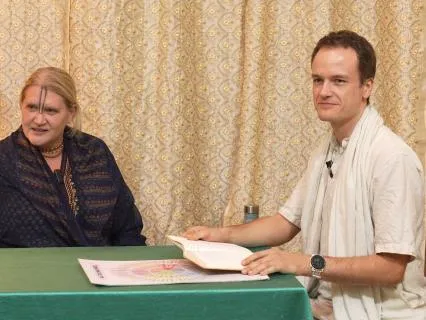
Ulas is going to read a letter he wrote.
It's a new program,
A new format.
Some of you weren't even here last week,
So this is only the second time we've done the Ask Dr.
Joe Shee.
Kind of.
I guess,
Right?
And if you are interested in doing it,
You yourself can also do it.
You just have to write a letter with whatever problem you have that you want to talk about in public,
And then you post that letter on the Kajabi.
In other words,
If you've registered for this,
There's a space there,
And you'll see Vilas's letters there,
And the other people who have written letters there,
And your letter may or may not be chosen.
Sometimes we might hear back from us and say,
You might need to change a few things.
Or sometimes it might not be appropriate for a group setting.
But you can give it a shot and put it there.
And you'll get more ideas when you hear more people.
And so every week will be probably a different topic,
A different person.
And we'll see how it goes.
But I know that last week,
I'm sure you got a big breakthrough.
So every week will be different.
We don't know what's going to come,
Because it's alive.
Session,
Right?
So let's start with how you feel.
I feel actually peaceful.
Good.
Hmm.
Yeah,
Mostly Peace Corps.
But also a little bit curious to see what's going to happen.
And I also feel.
.
.
Yeah,
A little bit of vinyl there,
Also feel,
Yeah.
And actually,
Yeah.
And then I'm thinking.
While preparing for that,
I thought,
Oh,
I couldn't get a little bit more into your shoes when you wrote your book about issues that you had and Babaji helped you through and how you put it all in public.
Yeah,
I started to appreciate that more because now I wrote my issue and I felt more anxious.
You kind of feel exposed,
Right?
Yeah,
Exactly.
It takes a lot of courage to do this.
A lot of courage because you don't know how it's going to go and you don't know what everybody's going to think and it's being recorded and it's going to be online,
You know,
So thank you very much for making yourself vulnerable.
So,
Dear Dr.
Joshi.
Thank you for the opportunity to ask you for advice.
I often come late to important meetings with friends.
In classes and also sometimes at work.
Um.
.
.
Trains,
Buses etc.
I usually catch at the very last minute.
Now what I tried is,
I enter all my appointments in a digital calendar with reminder notifications,
For example one hour and five minutes before the event.
That improved the situation.
However,
When I know that in five minutes I have to leave or I have to join the meeting.
I often get into stress.
And I get tunnel vision.
For things other than my commitment.
It's as if I'm dreamwalking sometimes and I try to do just one more thing and one more thing because now I feel energetic I feel productive.
And I also feel guilty that the other thing is not done yet.
And.
.
.
Until then.
I leave late and then I feel guilty about leaving late and now getting into the next problem.
So my question therefore is,
How can I prevent this tunnel zone where no rationality works so that I can be more punctual?
Good.
How do you feel now?
Hmm.
Now I feel a bit more.
.
.
Anxious but also.
.
.
Yeah,
Curious.
What you're going to say.
So you got the hard part out,
You got your letter out,
So now we're going to just explore a little.
So can you read your question again?
How can I prevent this tunnel zone where no rationality works?
So that I can be more punctual.
Okay,
Tell me about what rationality have you tried that doesn't work?
You said no rationality works,
Right?
Yes.
So what have you tried?
I sometimes explain to myself that no,
No,
No.
I have this appointment now,
I have this dinner with my friends.
Uh.
.
.
Now replying this email or trying this other thing at my work or cleaning this or doing this some other thing.
That's not.
.
.
That's less important now.
Yeah,
That's the rationality I'm trying to.
.
.
Way what should be done actually right now.
I often acknowledge that,
Oh yeah,
It's less important,
But I still do it.
Okay,
So what do you think that's about?
So the rationalization is just like.
.
.
Of a duck's back,
Right?
It's not penetrating.
Yes.
Why?
Why do you think?
Because it makes sense,
Right?
Yeah.
So what I'm thinking is that.
.
.
Usually there must be some feeling behind,
Because the emotions are stronger than the.
.
.
Than the logical mind in my case in this situation.
To the logical mind,
That's your booty,
Saying,
Wait a minute,
Come on,
I don't want to be late for my friends,
We've got to stop this now,
That other stuff's not that important.
So that's the booty,
So then what's happening?
Is overtaken by some program that is running on autopilot.
And what also happens is that in these situations,
I.
.
.
The logic often is also a bit faulty.
Afterwards I realized it didn't make sense,
But in the moment it was like,
Oh yeah,
Yeah,
Yeah.
So for example,
I think,
Oh,
I have this dinner now,
And oh,
But I don't want to come empty-handed.
Oh,
Let me quickly prepare something.
Then I think,
Hmm,
But people have told me it would be better.
That they would prefer me being punctual now.
But still,
I think,
No,
No,
No,
I have to prepare something.
For example,
Yeah.
And.
.
.
Let's take another angle for a minute.
Have you ever been early to something?
Yeah,
Sometimes.
How does that feel for you?
Not on time,
But earlier.
They're 10 minutes.
You're the first person.
Have you ever been the first person somewhere,
Like at a dinner?
Out of something you're supposed to be at.
Where you didn't have something you had to do,
But you're just like,
Right?
Try to remember one time and how it felt.
Um.
.
.
Maybe.
.
.
I think I have different feelings.
So it can be that I'm Pick one time.
Okay.
One time,
A specific instance,
When you arrived early at something.
So the most frequent thing is then I feel more restless type and I think then,
Oh I'm wasting my time,
I have to do something.
Let's go to the restless,
Not the thought that goes with it.
Why would you feel restless if you're early to something?
Is it really just because you're wasting your time because you have to do something that's so important?
Those thoughts and the feelings don't have to go together.
I mean,
The thought could be a rationalization,
But the feeling of restlessness is interesting,
Right?
What could that be about?
Why would you feel restless if you're a few minutes early to something?
What does it mean to be early to something?
Were you early to things as a kid?
Did you arrive early to think?
Okay,
Tell me more about that.
Mmm.
Yeah,
For example,
Going to school,
All those kind of things.
Was usually last minute or slightly late.
And always sprinting,
Sprinting,
Running,
Top speed,
By bicycle always.
High high speed.
Yeah,
That's also catching the bus or train.
Only with sprinting,
Sometimes,
You know,
When I go out of the door.
Already top speed.
So you have been doing that a long time.
Yes.
It's not a new thing.
Yes.
And so in your childhood,
Can you remember a time when you were early to something?
Or was it pretty much not like that?
Sometimes I have to wait also,
The doctor's appointment or.
.
.
Maybe to music school.
Sometimes but.
.
.
Okay,
So the main thing was,
I mean,
Even if you're waiting,
It doesn't mean you're early.
It means that you were on time and the doctor was late,
Is my guess.
Okay,
So basically your pattern was you were always last minute or late in the childhood,
And why was that?
What was the system that created that?
Well,
If you ask like this,
Then I would say… OK,
So I think… Instant.
I.
.
.
I did things myself,
The scheduling,
The going,
The coming.
And I just didn't really learn how to do it.
So your parents didn't bring you to school?
No.
Where were they?
At work or busy with my siblings.
Okay,
So for you,
As a little boy,
You had to think,
Oh,
I'd better get to school now,
Or school starts at this time.
So you had to figure out how to manage your time without anybody helping you.
Yes,
So only the first week.
At school in first grade I went with my mother by bicycle and after that I went alone.
And did you get there on time that day?
No,
I don't remember.
But one time in your life you remember your mom taking you to school.
First grade.
No,
I don't remember that.
I thought you said first grade.
You went with her one time by bicycle.
No,
During the first week she told me.
I know it because she told me that for the first week.
Oh,
For one week she took you.
Exactly.
And then afterwards I said I can do it myself.
I'm not a small baby and I can do it myself.
Okay.
And then that's what I did.
So first grade you're six.
Yeah.
So from age six you've been taking yourself to school and appointments and everything on your own?
Yeah,
Mostly yeah.
What do you think about that?
Yeah,
It's crazy.
If I watch now as a child of six years old,
I think that's funny.
For most children probably a bit early.
Can you put a feeling word in there?
Like,
Feeling for whom now?
You,
Your inner child,
Who is six and had to figure out all that stuff.
Mmmmm.
Guilty,
Anxious?
Guilty for what?
About what?
Page for being laid.
Okay,
But before that,
How did you feel for that little boy?
Watch a little boy trying to figure out how to get to school by himself,
How to get to his appointments.
And then late is also hard,
But.
.
.
What do you think about that little boy who had to go through that,
Or how do you feel for him?
Um.
.
.
I feel sad and disappointed.
Do you think that his mother and father were authoritative?
What type of parenting style is that?
When you let a six-year-old figure out their whole own scheduling.
What type is that?
I think this would be neglectful,
Or maybe permissive,
A little bit,
But not neglectful.
So you have a neglectful mother,
Or father,
Or both,
Right?
They're not really paying attention to you.
You have to figure it out yourself.
That's been since you were very little.
I'm sure not just about getting to appointments,
But we're talking about that now,
Right?
So then now,
As an adult,
You're still doing it.
The only difference is what?
My body group and now you're doing it to yourself.
You're the parent of your inner child.
So you're being neglectful.
To inner child,
You're just the prompter,
You're just passing that on.
So that original samskara came from mom and dad,
But if you step outside of inner child and don't act just on the conditioning.
.
.
You'll see that you're just repeating what's comfortable.
You will purposely sabotage,
That's why even if you could be on time,
If you've set your life up so perfectly,
You live across one building over from where you have to be in class,
For example,
Or something,
You'll still.
.
.
Procrastinate and be late because you have to fulfill that samskara.
You have to continue to make that one work.
Which is I neglect myself and I'm going to be late and it's going to be hectic and stressful.
So you unconsciously create conditions to make yourself continue to behave that way,
Unless you realize that's what's happening.
It will feel so weird,
That's why I'm saying,
How did it feel to be on time?
How does it feel to be?
It feels weird.
You might even actually leave and run to the grocery store and come back just so you can be late.
Yes,
I do this.
Give me five.
That's right.
That's your inner child driving.
Trying to make sure that you still have that same stressful,
Hectic experience.
That's what it is.
That's why it doesn't work to be like I set the alarm for one hour.
Who cares?
You'll always find a way to be late.
As long as you live on that samskara of being neglected.
So when you realize,
I don't deserve to be treated like that,
I didn't deserve to be treated like that,
And I don't.
And I'm not going to let my inner child feel that he's not worth it.
You know,
Taken care of.
And then if you came early,
Imagine how that would feel.
You can set your space up,
Or maybe if it's a party you can set some things up,
You can help out,
Or whatever it is.
But part of the thing about having neglectful parents is that you also are fearful of emotionally intimate relations.
So if you come late,
You can be sure that people are not going to like you.
So then they're not going to really want to talk to you.
Except for those people who had parents who also neglected them,
And then they'll try to get closer to you.
But the main point is that you'll continually sabotage yourself with this procrastination.
And you'll have lots of reasons,
But the real thing,
That's why I'm saying that there's lots of excuses why.
I have to do this one last thing.
That's just what he's made up.
But the real thing is I need to be late because I've been late because I deserve to be neglected.
I deserve to be treated like that,
So you'll continue to treat yourself like that.
Until you realize that your parents aren't driving anymore,
You are.
And you deserve to be taken care of,
You deserve to show up early,
Not on time,
Early,
So you can relax,
So you can socialize maybe even a little bit.
You know,
But that's very scary.
For him.
He's shaking in his boots going,
Oh my God,
Socialize?
I'm not worthy.
I don't even know what to say.
I don't want to connect with people.
It's too scary,
Because when I connect with people,
They hurt me.
So I'd rather just be late.
And that kind of pushes people away,
Actually,
When I'm late,
Right?
You can be sure that it's kind of annoying to people so they're like,
Oh.
What do you think?
Amen.
Yeah,
I think.
This makes sense,
Now that I'm… acting on a program of and a belief of Yeah,
I'm.
.
.
I'm worthy of being neglected.
Not worthy to be taken care of.
And.
.
.
That can play out like this okay And your ahamkara comes in and rationalizes.
So that's just that.
That's not very deep.
It's going to always throw up reasons to be.
Maintain that samskara.
Of being late and of being neglected.
Yeah,
It's strange because it.
.
.
Because there's no advantage in that.
In being late now.
So just looking at it now,
It looks like.
.
.
That's pretty stupid.
What should I do?
Well,
You could say that,
But the advantage is not about being late,
But this fear of emotional intimacy is actually part of it.
So if I'm late,
One,
I can't connect with people who are here.
And two,
You're always flustered.
Then you can't really actually make emotional connections.
So that keeps him safe.
So that's still an advantage until he's ready to be emotionally intimate.
Been that scary for him because he got so hurt.
More in the stress mode.
Yeah,
Like this makes you feel very exposed,
But so does showing up early to class or early to something else.
It's exposing.
It's like,
Oh,
I have to share my heart.
I don't want to do that.
Let me do 100 things before and be all flustered and then do something last minute and then be late.
And then I just kind of mix myself in,
You know.
Yeah,
See,
That's your MO.
So.
Now what to do?
What do you think?
Well,
It sounds like I have some re-parenting homework.
And.
My energy has to grow up and learn that.
It's.
.
.
Not okay to be neglected.
I wouldn't say he has to grow up.
That's too fast.
It's going to be an 18-year job.
You,
As the father,
Have to become mature.
You,
Not your inner child.
He's very little.
You have to stand in now and take care of him.
He's little and he needs you for a long time to grow up.
So he's already like,
What?
I've already had to do all this other stuff on my own,
And now I have to grow up?
Like,
Now?
So he needs to be taken care of and nurtured and driven to school and come early and set some nice things out and talk to a few people.
See?
That's uncomfortable for him.
But if you do it with him and you prepare him and say,
We're going early,
I'm not even going to set an alarm.
Because it's not about the alarm.
See,
He feels restless when he comes early.
Because he's scared of emotional intimacy.
So you become emotionally intimate with him and say,
I've got you.
No person here can hurt you.
It's not possible for anybody to hurt you like mom and dad did.
Because I'm your father,
I'm the adult taking care of you,
So I've got you.
But this is healthy for me as your father.
I need to go.
Early,
Make relations and all that,
And you're safe.
You just relax.
So he needs to understand that you need to understand that you're the father and you are going to be driving the car and parking and getting there early.
And if he's freaking out,
You can talk to him in your head.
Just talk to him.
And say this isn't like the old days.
We're in a new chapter now,
New country,
Whole new place.
We don't need to run in that program anymore.
You can acknowledge you might feel scared,
That's fine.
But you don't fall for all the tactics.
And it will take time,
But as long as you're aware of what's driving you and why,
And how it's not really serving you.
But at the same time,
How he's afraid of emotional intimacy,
So that part is still serving you.
So then you have to talk to him about that.
Say,
Nobody can hurt you.
You're safe.
But I do need to get to these things on time or early so I can live my life the way I want to.
Got it?
Yes.
How do you feel?
I feel a bit surprised.
I also feel.
.
.
Hmm.
Insecure.
Hmm.
Yeah.
I feel insecure about,
Okay.
Know what to do.
I mean,
I heard you now speaking,
And I know what to do.
So he feels insecure.
As the father,
You've got this.
Change now.
It creates some insecurity.
In him.
Don't imagine.
Remember I talked about imagination?
He's feeling insecure because he's scared.
You're not.
You know what to do.
You're smart and you've got this.
And you have to tell him that.
I see that you're insecure,
I'm not.
This isn't that difficult.
I know how to do it.
And I'm going to do it.
And I'll hold you.
And we're going to undo it.
But see the difference,
You know?
So now I'm going to ask you again,
How are you,
Vilas,
The adult feeling?
Okay,
So.
As the adult,
I feel.
Do I feel enthusiastic?
Yeah.
Make this change.
And I feel also.
.
.
Oh my goodness.
Yeah,
I feel awesome.
Optimistic and Happy about the inside?
And.
.
.
Also grateful.
And you took the time and we could talk about it.
Good.
Good job.
Thank you very much.
Thank you very much.
Thank you guys for listening.