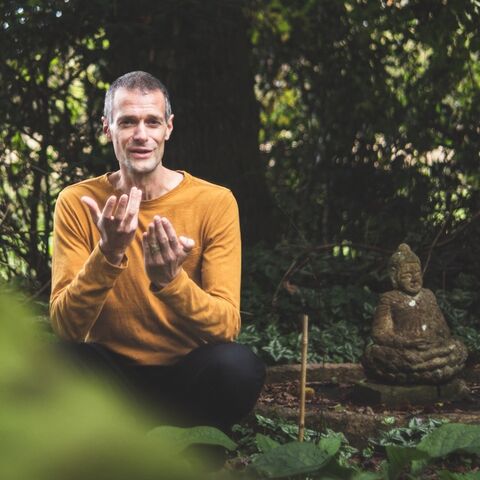
Dhamma and meditation teacher Beth Upton,
Whom I've chatted with before,
Recently gave a three-part teaching called Truth,
Suffering,
And Liberation.
I've edited out most everything except my responses to Beth's questions,
And to keep this short,
There's inserted overdubbing for context where too much was edited out.
I encourage you to search out the entire video if it sparks interest or for added clarity.
Beth offered a short teaching on her more practical and condensed version of the universal beautiful mental factors from the Abhidhamma,
Then led a guided meditation.
Those beautiful mental factors are faith,
Mindfulness,
Non-greed,
Non-hatred,
Morality,
Balance,
Tranquility,
Lightness,
Softness,
Flexibility,
Uprightness,
Proficiency.
This edited version starts with Beth asking how the meditation went.
Did any 40 years have a different experience of being with those beautiful mental factors?
Examples came up.
So examples that exemplified and examples that ran contrary to the factors.
So it was kind of like a review that came up every once in a while,
And then there was like a felt sense of each quality,
Especially at the end.
I just kind of like felt into the whole felt sense of the entirety of it.
So these are the beautiful mental qualities from the Abhidhamma.
Because I've heard them translated,
If that's right,
A little bit differently sometimes.
I guess I was thinking more of the technical language.
I really appreciate your translation of them.
It seemed a little more practical and yeah,
And down to earth.
Translation always a bit of a controversial issue.
In the Abhidhamma we have some,
I think a little bit unnecessary technical things going on.
For example,
They say lightness,
There is two types.
There's lightness of consciousness and there's lightness of the other mental factors.
But in reality,
Lightness is lightness and similar for some of the others.
But yeah,
The basic gist is the same.
Like realty,
I think is one interpretation of one of those.
That's just the word that doesn't cross everybody's vocabulary these days.
It's good to have an arcane understanding of some language,
But also practical as well.
This question comes up far too much in our tradition.
What's wieldiness?
What does it mean?
I think of like proficiency with the sword.
If you can wield something,
You know how to use it.
Well,
I don't know.
Actually proficiency is a different one.
And my teacher once gave this example when we asked what's the difference between wieldiness and proficiency.
It's Kamanyata and Bhaganyata.
He gave a really beautiful example where if you imagine a piano player,
Wieldiness is their fingers can move freely around the keys.
And proficiency is because of practice,
They play it correctly.
I want to bring in a discussion about how these mental factors do and don't interact with the world at large,
Just to keep us on theme.
Just as a sort of a prompting question,
I'm happy for this discussion to go where it goes,
But as a prompting question,
I'm interested to know what stands in the way of us being with these mental factors in the world and what helps us.
It's generally mindfulness.
We can never have too much mindfulness,
Especially when that's interpreted as remembering.
So if we do have somewhat of proficiency in these,
All it takes is to remember to bring these to mind.
I mean,
That's the biggest thing that comes to mind right now.
But to push you a little further,
Josh,
So what external factors give rise to mindfulness and what external factors make it really difficult for mindfulness to arise?
That's a profound question actually.
If I knew,
Well,
Just interpreting mindfulness as remembering,
If I knew how the memory process worked,
I mean,
You could probably be a billionaire.
But then apply that to individuals and then different causes and conditions and environments,
And then you have a whole complex matrix of things that are ebbing and flowing and arising and passing away.
So in generalities,
I don't know.
So yes,
I want to throw that back to you,
Beth,
Please.
Yeah,
So I don't want to answer the question because I want to leave it to a discussion,
But I'll just say,
For example,
So I've got like 10 years of monastic practice and I know what it's like to meditate deeply.
And I know how difficult it is to maintain that when I'm in central London.
So it's the,
I don't know,
Conceptually at least,
It's the same Beth,
It's the same set of faculties.
If I'm in the caves in Spain or in central London or in a monastery and yet there is a difference in the mindfulness.
And so what's happening there?
I think I'm not the only one who has that kind of experience.
And so what's happening there?
Yes,
Environment,
Support and intention,
Right,
Are what's being valued.
So those things change usually when we step outside to central London,
Just for example,
What is the environment like?
What's being valued by everybody around us and where is the support?
What's being supported and what energy,
What's being fed energetically?
Wholesome or unwholesome things usually.
That's the question.
Which contexts help us to pay wise attention and which contexts don't?
When Aaron shared,
He talked a lot about the noisiness and the freneticness contexts where our tranquility is compromised.
Sometimes it amazes me how much my mind will fall into wholesome states just as soon as there's a bit of quiet.
As soon as there's a bit of quiet.
But then if we think about all of the ways that we propagate noisiness in the world.
Has anybody ever heard the saying,
This is fairly new to me though,
Too,
It's hear it to clear it.
That's kind of cute that it rhymes.
What does it mean?
Well,
I guess my understanding of it is,
You know,
At least in my experience early on in my practice became,
You know,
Almost hypersensitive to stimuli,
Right?
Even just meditating and hearing cars go by and then noticing the aversion,
Right?
And then it's almost like a formal meditation practice.
A lot of times it's conditioning us to only have like meditative benefits if we have the container of kind of a perfect environment or an ideal environment for meditation.
So it's almost like the more we do that,
The more we're conditioned,
Possibly not going to be wrong,
Please jump in here,
To have the benefits of meditation in an ideal condition.
So I don't know if that's logical,
That plays out.
Hear it to clear it,
It's more kind of like we're bringing a perception.
I wonder if this could be,
I don't know how skillful it is,
But instead of perceiving noise or a sound as an obtrusion into our experience,
What if we were to flip that perception and say,
Okay,
What we hear is actually being,
Whatever needs to be cleared out of our experience,
It's kind of more like a willful process.
So if we hear something,
We're clearing,
I don't know,
Our aversion to it.
Any maybe unwholesome qualities,
Unskillful qualities,
Unwise qualities that the mind might associate with this loud sound.
So if we're,
Hear it to clear it,
If that brings to mind a perception of clearing instead of intrusion,
Right?
So I don't know if anybody's following me here.
So it's kind of like bringing a willful perception as a temporary antidote to any kind of ill that we're experiencing with sounds.
I don't know.
Yeah.
So I think that's,
It's a very useful framing that we don't develop aversion to disturbances or defilements because then we start a negative cycle and it snowballs.
So not only is there a sound,
But then we hate the sound and then we feel guilty for hating it.
And then we're frustrated.
Then we think of getting nowhere.
Then we think,
Oh God,
I'm a hopeless meditator.
So on and so on.
The aim of the practice is to be able to engage with life wholeheartedly.
And we have no gentle context to train in.
We have no nursery.
We've got really quite polarized,
Especially in the West where you're either on retreat or you're out there fending for yourself.
And so many meditators experience deepen in their practice and then their practice collapses and then they deepen their practice in retreat again and then their practice collapses.
And I'm interested in finding ways to bridge that so that we don't have to have this dilemma that Kendall is speaking to.
This brings up the idea of fear and that's been a popular topic of a Dharma talks here recently.
And I think it's so important because fear seems to underlie so much of this when we're,
You know,
It's,
Yeah,
It's pretty obvious.
And then,
You know,
I think Sam Vega here is this is Beth is bringing up the spiritual urgency here because it really is or isn't,
You know,
Is this really important to us to,
To,
Um,
To break out of this loop of deepening practice and then having that go away and then getting distraught and then buckling down again and relooping the cycle over and over.
And then,
You know,
What's,
Uh,
It's kind of like we get used to that cycle.
Maybe I don't know.
So what's going to,
Yeah,
What kind,
How can we penetrate into that to,
Um,
Start to break that apart?
Right.
And,
Uh,
Towards more of the deep deep end or deepening of it.
Beth asks,
How can we bring these beautiful mental factors into our lives?
Again,
The perceptual level,
Right?
So every moment we have an opportunity for Dharma practice,
People will go on game shows and TV for challenges,
Right?
For frivolous things.
But we have that opportunity every moment for a practice.
So if we're not already experiencing,
Um,
Holt are these beautiful mental qualities in our everyday experience.
We can ask how might I view this situation differently to cultivate,
Uh,
Mental qualities are to how can I see this situation in a way where I can see these mental qualities,
Beautiful mental qualities,
And then our response,
We can ask,
Well,
How might I respond to this situation that helps further cultivate beautiful mental qualities.