Wholeness,
This is Josh Dippold from IntegratingPresence.
Com and today I have Beth Upton again with me.
Beth,
How are you doing today?
Oh,
Good,
Thank you.
This goes to Abhidhamma questions.
I watched this seven-part series.
These are just questions that arose while watching this.
People that don't know Beth Upton,
Since we're limited on time here,
I'm just going to refer you to our past post.
Okay,
So let's jump really deep in here and,
Well,
I don't know about really,
But these are the questions that came up.
So when we're talking about materiality,
There's this thing called the kalapa,
Right?
There is.
Can you briefly tell folks what this is and then also describe the visual details.
Is it possible to language,
Verbally describe the visual details of a particular kalapa?
Yeah.
So,
Um,
Oh,
Before I start,
If for anybody watching the video,
I just wanted to say,
Don't get distracted.
Sometimes I'll close my eyes just to listen to you.
Yeah.
So,
Um,
When we practice vipassana meditation,
We're practicing to see three characteristics that are common to all of reality.
So obviously different aspects of reality have different characteristics like black is black and blue is blue and happy is happy and sad is sad and different things are different.
But all of reality has three characteristics in common.
All reality is impermanent,
All reality is suffering and all reality is non-self.
And this is one of the core teachings of the Buddha.
So when we practice vipassana meditation,
We're practicing to see these three characteristics,
But these three characteristics are true on different levels.
So it's sort of,
There's a common sense level of impermanence where today is,
What day is it today,
Josh?
Today is Monday?
Monday the third.
Today is Monday.
Yeah.
Yeah.
Just for the,
The,
The date it's October 3rd,
2022.
And I think Beth just froze up.
Beth are you still with me?
Yeah,
I am.
So there's a common sense level of impermanence,
But the deeper level of impermanence,
The level that will liberate us is seeing reality on the level that it's momentarily coming into and out of existence.
And this is the level on which vipassana practice starts is that we're able to see reality on the level of momentary phenomena coming into and out of existence.
And that's split broadly into two.
So for the material world,
That means we're seeing the whole of the material world,
Including the body as made up of tiny little particles that are coming into and out of existence.
These tiny little particles in Pali we call calapas.
And for the mind,
The correlate is that we see the mind not as one continual stream of changing experience,
But rather as individual moments that are arising and passing away one after the other.
So we call this breaking down the compactness of reality into momentary phenomena.
And for the physical world,
That means we break down what seems like a compact,
Solid physical experience into this momentary experience of particles coming into and out of existence.
Those momentary particles are called calapas.
Different calapas have different physical characteristics,
Which accounts for the diversity of the physical world.
But although different calapas are different,
All calapas have eight characteristics in common.
And these are the four elements.
So all calapas have a port of fire and wind,
Which means all calapas have a degree of hard,
Soft,
Rough,
Smooth,
Heavy light.
All calapas have a viscosity,
A degree of,
You say,
Flowing and cohesion.
All calapas have a temperature,
Which is the fire element.
And all calapas have movement or opposing movement.
This is the wind element.
So pushing and supporting.
All calapas then have color or light.
All calapas have smell and taste and a quality called oja.
So when you ask about the visual characteristics of calapas,
The only characteristic of calapas that is visual is their characteristic of light or color.
None of the other characteristics are visual in any way.
We know those characteristics directly with our wisdom,
Not through any visual characteristics.
So only the light of a calapa is perceived visual.
So the other characteristics are determined by like the wisdom eye,
Right?
Or it's sometimes called.
But now how does that actually work in perception?
Meaning like how is that discerned?
So when we're looking,
Especially if in the mind's eye,
I'm presuming the individual calapa now discerning the elements of something so tiny,
Something that pops so far,
So quickly in and out of existence.
So actually determining the degree of earth element in the three,
The various things of earth element.
Is it just like a intuitive sense?
Is it a felt sense?
Is it just a knowing somehow?
Can you describe how the other elements are discerned or the other features of a calapa are discerned?
Yeah.
So the existence of all momentary phenomena,
Both physical and mental in the mind are defined by what we call their characteristic,
Their function,
Their manifestation,
And then their causes.
And that's what makes something exist.
It exists because it has a characteristic and a function and a manifestation and a cause.
And that's the power of wisdom is to be able to identify things by their characteristic,
Their function,
Their manifestation and their causes.
And the characteristic,
Again,
Almost always isn't visual.
So the materiality with a visual characteristic is light or colour.
But hardness has its own characteristic that isn't visual.
The thing is that oftentimes our perceptive habits are conditioned so much through overusing our eyes and our ears.
But as we meditate more and more,
We get in the habit of identifying things with non-visual characteristics.
We all know this on the level of concept.
So for example,
If I were asked you to bring to mind what is the characteristic of irony,
You can identify that through its characteristic.
It doesn't have a visual characteristic.
It has its intrinsic characteristic.
So it's a very coarse example because it is a concept,
But momentary phenomena also are identifiable through their individual characteristics.
And how we do that in practice is to start with more coarse forms.
So you start with recognizing the earth element in your bones.
And then you're recognizing the earth element in something more subtle and more subtle still in a group of calappers until eventually the mind is sharp enough to identify the earth element in one calapper.
Yeah,
In a way I know what you mean,
Right?
But there's like this old saying,
Like,
Was it judge or some trial or something like,
You know,
What is pornography?
And he said,
Well,
I'll know it when I see it,
The definition of it.
So irony is a good example too.
It's a strange analogy.
Yeah,
Right.
It's a strange analogy.
Very,
Very so.
It becomes clear when we do it.
So it's not necessarily directly known with the senses,
Right?
But it's almost like.
.
.
No,
At that stage we're not using the senses at all to know these momentary phenomena,
Even the light we're knowing directly with the mind.
Okay.
So I'll just go,
I was going to follow that to a question that might be more related,
But I'll just go on over.
How can there be an essence as in nutritive essence,
Or is this maybe an inaccurate translation?
Because when I've studied things and it seems like they're,
In Buddhism,
They talk about there's really no inherent essence in hardly anything,
Right?
Now I don't,
I really don't know how to explain that very well,
But do you know what I mean here?
So if you try to boil things down.
.
.
I think what they're referring to when they say no inherent essence is two things.
First of all,
They are speaking about the,
They're speaking about perceptions,
Concepts being created by the perceiver.
So a chair is only a chair because somebody external to the chair has made a boundary and labeled a concept.
They're speaking about there being no permanent essence of the conceptual world,
About that being created in the eye of the perceiver.
And that's a really important understanding because that's what gives rise to the illusion of self.
Self is a concept in the same way that chair is.
And as there's,
In the same way that there's no chair essence inside of the chair,
It's a projection onto reality.
So too is self.
There's no essence of self.
It's a projection onto reality that we create.
Sometimes also when we speak about there being no essence,
We're speaking about no soul,
Which is essentially saying there's nothing permanent.
But when we speak about Oja,
Which they translate as nutritive essence,
We're speaking about a momentary phenomena.
And we're speaking about a characteristic of a Kalapa,
Which is essence-y in the sense that it can produce another Kalapa.
So this is almost like a reproductive of that mobility or like some kind of substance that fuels it,
Right?
Yes.
Okay.
Yeah.
And okay.
I know you don't know this.
Actually,
I don't know that you don't know this,
But it's an interesting question.
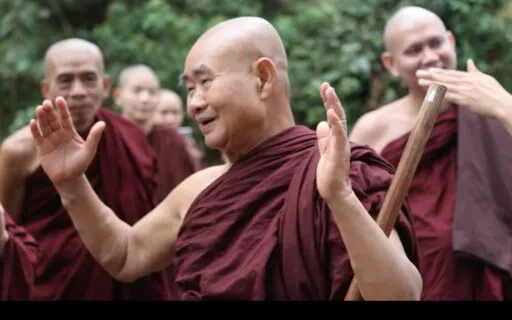
The first picture in this post,
If you look on the inside of Paidau's arm,
There's these like lumps,
It looks like.
And I was wondering what they are on the inside of his right arm.
I don't know if you can see those,
But I just thought I'd point that out.
I'm sure Beth is not a doctor and knows for sure what that is,
But maybe she does.
I don't know.
So there it is.
I don't know actually.
No.
Okay.
So did the Buddha teach specific kasina meditations?
From what I understand he didn't.
And there doesn't seem to be an extended teachings in the suttas on kasina meditations.
There's a lot in the suttas on kasina.
Oh,
There is.
You can find them all over the place.
Yep.
Yep.
So very often the Buddha will use the light kasina or the earth kasina,
For example.
So the one that comes to mind right now is the sutta on emptiness,
Where the Buddha uses the earth kasina to speak through different stages of emptiness.
And then we can find the kasina peppered all throughout the suttas.
I guess what I'm getting at is like no detailed instructions.
I'm just not including the commentaries,
Because I don't know much about the commentaries or sub-commentaries.
Like the degree of instructions that are in the sutta maga.
Do you know what I mean?
So that's not only true for kasina practice.
That's true for all meditation.
We don't find any sutta where the instruction is as detailed as it is in the commentaries.
The suttas we can think of as outlines,
Guidelines.
And it's why the commentaries are important,
Because they are there to interpret.
The commentaries are often like a dictionary.
They take these words,
Which it's like an outline in the sutta.
And then they explain this is what's meant by this word.
This is what's meant by this word.
And it's one of the dangers of not relying on the commentaries is what happens when we don't use the commentaries.
The only alternative is to invent our new commentary.
Well,
What I understand this word to mean is this.
How I like to think what this means in practice is this.
Then we have to think whose commentary is likely to be more reliable,
The ancient commentators or our own.
Depends on the skill level,
I guess I would say,
And the accuracy of the translation.
But so what you're saying is that there are the details,
More of the details and mentions of Kṣṇa meditations do come from the commentaries,
Not the suttas,
Even though kṣṇas are mentioned in some of the suttas.
Kṣṇas are mentioned extensively in the suttas.
And it's quite clear that they're used to practice through the jhanas.
And that's really clear in the suttas.
And then as with all of the types of meditation,
Including anupāna and vipassana and the fleshing out of the māsās,
Kṣṭhāna,
Sūta and all of these things,
We find all of the details are in the commentary.
I see.
So what is the supportive nature of the air element or how is the air element considered supportive?
Because when I hear it defined,
It's one of the ways the air elements described as being supportive.
Do you have you heard this before?
Do you know what this means?
Because I would think all the elements would be have some supportive nature because,
You know,
At least this physical form is made up of all four elements.
And if there's an imbalance,
Then there's not going to be as supportive as if there was a balance of elements.
Right.
Do you know what I'm getting?
So we don't mean psychologically supportive.
We mean supporting as opposed to pushing.
So here pushing is a force which causes movement and supporting is the translation that we use for the force that opposes or restrains movement or hold still.
So it's a physical characteristic.
And that's what we mean by the wound element pushing and supporting,
Causing and opposing movement.
It's funny,
The English language here is something supportive you think would help you.
But if it's actually opposing or restraining,
Well,
I guess actually that can be a help sometimes too,
Depending on the situation.
So again,
We're just speaking about the physical characteristic of what causes or opposes movement.
Yeah,
That was a kind of a sidetrack commentary on language there.
OK.
So this is,
Is it possible to discern pre and post calapa phenomena as in being able to discern the causes and conditions leading up to the arising of a single calapa and or how the perishing of a single calapa could influence condition and or be the cause to subsequent phenomena?
So basically saying,
Can you tell before the causes and conditions before the arising of a calapa and then how it perishes,
Depending on how it perishes and other causes and conditions,
How that might influence subsequent?
Not sure I understand the question.
You just repeated it.
Yeah.
So I say what we can do is we can discern past materiality and future materiality.
And we can also discern the causes and effects between past and present and future materiality.
And also we can discern the cause and effect between past mentality.
So mind moments and present mentality and future mentality and the causal relationships between the materiality and mentality.
So how all of those things are relating to each other.
At some point,
Our discernment hits a limit of complexity.
So we can't say,
Oh,
Because this calapa perished,
That means I will die one day earlier or something like that.
Our discernment hits a limit of complexity,
But some of the cause and effect we can discern.
Yeah.
I was going to say this probably feeds into the imponderables of knowing everything about kama before full Buddha.
Right.
Because it's incredibly complex.
So we,
When we practice,
We're aiming to see the main types of cause and effect,
And especially those types of cause and effect that keep us getting born again and again and again,
Keep us suffering again and again and again.
We're not looking at the calapas to try and figure out rocket science or quantum physics or anything like that.
But at the same time,
You know,
That is a,
I mean,
Just imagine the potential that's possible of the Buddha's mind where he can just basically pay attention to any and know it pretty much everything about it.
And yeah,
And just,
I mean,
Like even just in a,
In a single mind moment,
How many potential kalapas can be observed,
You know,
In a potential and then thinking about all that led up to each individual,
One of those,
The causes and conditions,
And then what they might lead to what they might,
How they might affect when they perish or don't perish at certain time period.
It's just,
It is really mind blowing to try to,
I mean,
That's just a small portion of what's.
The experiment of the kalapas is fascinating.
And when we are doing the practice,
We also need to remember our aim,
Which is to make an end of suffering.
And sometimes we can have a little bit too much clinging to just knowledge for its own sake.
So the purpose really of seeing the kalapas again,
It's not to like learn rocket science or quantum mechanics,
It's to understand that everything's momentarily perishing.
And that momentary perishing is inherently suffering.
And that momentary perishing is inherently non-self.
And when we're seeing this clearly in the mind,
We'll want to escape or want to make an end of suffering.
Very good reminder and distinction.
So yes,
Realize enlightenment first.
OK,
So could reality be significantly shifted,
Altered,
By or with different perceptual modes,
Such as by variations and how kalapas are perceived by meditators?
So now this is what I mean by this is if you have meditator A at its same skill level as meditator B,
OK,
And now they're really ripe,
Let's say,
And now they only need instructions on how to see this basically or how to look at it.
And so meditator A gets certain Abhidhamma instructions that significantly differ from meditator B.
And so now they're both looking into and just discerning things.
And seeing and knowing things that they didn't previously know before these instructions,
But because meditator A has certain instructions that vary significant meditator B,
How might these so those two examples,
I mean,
You could put in more specific examples with each one,
But can how can reality could reality be significantly shifted or altered by how they're how they're viewing and seeing and knowing phenomena?
Basically also what this is on a perceptual level,
More than likely.
So an example would be like,
OK,
A Christmas tree,
One person might see a Christmas tree and think,
Yeah,
There's that stupid holiday again that everybody only cares about.
Read.
I hate it.
I don't want to have any with it.
And while another person might see a Christmas tree,
Oh,
You know,
This is great.
I get to spend time with family and friends and I get to share gifts.
So I don't know if you can see where I'm where I'm getting at here,
But depending on the instructions,
Depending on the instructions,
Can ones.
Well,
It depends on what the instruction is.
Obviously.
So,
I mean,
If they were both going to be actually seeing ultimate reality,
So if they're both actually seeing,
Clappers arising and passing away,
The instruction couldn't be radically different because they're going to be doing the same thing.
So if we are genuinely seeing ultimate reality,
Then it is what really exists independent of the perceiver.
And perception is included in ultimate reality.
So we can also observe how perception is working as part of that.
Perception becomes the object of awareness as well.
But if the instruction were not to see ultimate reality and to see concept or invent something in your imagination,
Then of course you will perceive it differently.
Sure.
So,
How to discern this,
Right?
So this is where teachers and friends and feedback and study come in of how we know we're not being diluted on what's being seen as far as more towards ultimate materiality and mentality.
Yeah.
So if we're perceiving things on the level of nama and rupa,
If we're perceiving ultimate reality,
Which means it really exists independent of the perceiver,
Then we'll notice that we can't break down the compactness any further and it's momentarily arising and passing away.
And if we're on that level of things momentarily coming into an out of existence,
We can't break down the compactness further,
Then it's really existing independent of the perceiver.
When perception adds something to what really exists,
Then we've developed what we call compactness.
That perception aggregating things and adding things makes things compact and in a group.
When we break down that group,
We're back with ultimate reality.
And so usually at that stage of meditation,
If the meditator is adding something,
Aggregating something,
Their wisdom is sharp enough that they know that's what they're doing.
Because again,
We can also watch the momentary arising and passing away of what the mind is doing.
So if the mind is doing something coarse,
Like adding an image or aggregating something,
There's a sharp awareness that that's what the mind is doing.
Because again,
Perception is an object of awareness at that time.
So it depends in your question what the instruction is,
If the instruction of one meditator is break down compactness and see ultimate reality and the instruction to the other meditator is make stuff up in your mind.
Of course,
They will have very different experiences.
But if they are both observing nama rupa,
Then it will be the same,
Because it's what really exists independent of the perceiver.
Do we have time for a few more?
Like the follow up would be like,
How does imagination work?
You know,
How can if one conjures images or imagines things,
You know,
What is the source of that?
I mean,
It's sure it's caused,
It's also conditioned.
It's what?
That's just perception.
That's just that's the function of sanya.
That's the function of perception.
And it's very,
Very complex conditioning of our perception.
It's how memory works and learning works.
And so if I tell you to imagine a Christmas tree to use your example,
Then you've got very many past impressions,
Past sanyas of Christmas trees that all weigh in to create your current imagination.
I'm talking more about sense phenomena that is there is no like labels for it,
Like it's it hasn't been in kapoor.
And so there's kind of a grasping to previous perception,
But sometimes some things don't even fit in,
You know.
Do we have time for a couple more Beth?
We've got three more minutes.
Three more minutes.
OK,
How does well,
This is what determines a kalapa's location and how does this work?
It depends on the cause of the kalapa.
There are two types of kalapas that are produced by a previous kalapa.
And so their location is determined by their parent kalapa.
So kalapa is produced by temperature,
Which is produced by the previous kalapa.
And they're often produced in the same place as the kalapa that perished before them.
And then kalapa is produced by oja,
Produced by nutritive essence.
So again,
They're just produced by the preceding kalapa.
Then there are kalapas produced by mind.
And so where they are produced depends on whatever is happening in the mind.
For example,
If there's the intention to wiggle your finger,
Then mind form kalapas will be produced in the finger with the wind element predominant that will work towards moving the finger.
If there's the intention to speak,
Then kalapas will be produced in the vocal cords and so on.
And then there are also kalapas produced by karma.
And their location is determined by our karma and our past clinging.
So for example,
Our past clinging to see colors has produced kalapas in the eye that are sensitive to light.
And our past clinging to taste has produced kalapas in the tongue that are sensitive to flavor.
So different causes produce kalapas in different places.
Now I'm just thinking like,
Okay,
Has this reality and all realities been structured with this system of materiality and a kalapa?
If we could trace back eons and eons,
Is the structure of how these kalapas are structured?
Has it always been the same?
With the Buddha saying there's no discernible beginning,
Or he couldn't detect any discernible beginning and discernible end.
But I wonder the variations on the fundamental nature of this type of reality and if it varies by realm.
But we'll just we'll leave that as a rhetorical question for now.
All right.
We'll just finish with this.
How does adimokkha or decision work?
Yeah,
So adimokkha is,
Again,
It's a momentary phenomena.
So it's a mental factor that arises in some moments.
And the function of that mental factor is basically to say this way.
And it has a strong conditioning effect on following mind moments to go that way.
It's a strong conditioning effect,
But it's not insurmountable.
So if an adimokkha arises in a different direction or lots of craving arises in a different direction,
There's a chance that that conditioning won't win,
If you like.
But yet we can cultivate adimokkha to keep on pointing us in the same direction again and again and again.
This is what we do,
For example,
If we're focusing on the breath and like,
OK,
Back to the breath,
Back to the breath,
Back to the breath.
The very gentle adimokkha there that's building a habit,
If you like.
And there's more course forms of that.
Like if you make an adimokkha,
I don't know,
I will never drink alcohol again.
And if it's really strong,
Then it's a strong conditioning force on the future mind moments that stay in that direction.
And who's perceiving that adimokkha and then who's choosing whether to follow it or not?
Or,
You know,
How strong is it determined?
So we'll have to leave it for another time.
Thanks so much for humoring me here,
Beth,
Because I originally said the answer to these questions are for me basically to increase concentration and wisdom and just answer them for myself.
All right,
Beth.
Great questions,
Josh.
All right.
Good to see you.
Likewise.
Bye now.
Bye.