Hi everyone!
Today I wanted to make a quick video on how to do a resentment inventory.
Now,
If you're part of a 12-step program,
You probably know how to do this and are really familiar.
But if you're not,
I'm really excited to share this tool with you.
Now,
In the 12 steps originated in Alcoholics Anonymous,
The fourth step is made a searching and fearless moral inventory of ourselves.
Now what does that mean?
Well,
First and foremost,
I do have a 14 day video course that I made in one day on the 12 steps for codependency,
Boundaries,
And people pleasing.
And so if any of this is interesting to you,
The specific course video on the fourth step is 17 minutes.
So I really do a deep dive on the inventory and all parts of it there.
But for the purpose of this video,
I just wanted to talk about the resentment part.
Now,
What is a resentment?
So,
Re-sentiment,
Continuing to feel something that has since passed.
It's like when you get angry in the moment,
But the moment has passed.
The moment might have passed quite a long time ago,
But part of you is still reliving those sensations,
Emotions,
Feelings,
And thoughts.
And so a resentment can go back to childhood.
You can cop a resentment yesterday.
You could be future tripping about the resentment that you're going to feel.
And a resentment is going to feel different in all of our bodies,
Respectively.
For me,
When I'm feeling really resentful,
I know that I'm feeling resentful.
There's a tightness in my chest.
There's a pit in my stomach.
And the most important indicator for me is that a lot of sticky thoughts.
Now,
Sticky thoughts to me are thoughts that continuously pull my attention without my permission.
And so if I'm sitting in a meditation practice,
For example,
And I'm noticing my thoughts continuously go back to that same place That's a sticky thought.
And for me,
Resentments are some of the stickiest of thoughts.
And so going back to that fourth step inventory,
There are three parts,
Resentments,
Fears,
And relationships,
Quite literally sex conduct,
But we'll say relationships.
And so we're going to focus today on just the resentments.
So if you don't have a piece of paper and a pen,
I recommend pausing this video now and getting one so that you can write down the columns that are going to be useful for your inventory.
So go ahead and pause right now and grab something to write with if you want.
I don't know why I'm pausing.
If you're gonna pause the video.
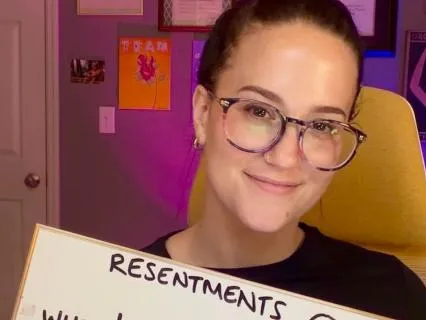
I have a whiteboard,
And maybe that's why you clicked this.
Maybe you saw the thumbnail with the whiteboard,
And I'm really excited because it's new,
And now I can teach things more visually.
So our resentment inventory is going to have four columns.
I'm going to show you it after I tell you them.
And so it's just going to be a title,
Column,
Title,
Column,
Title,
Column,
Right?
And so the first column is who slash what.
So go ahead and write that down.
Column 1.
Who slash what.
We'll get to the other ones a little bit later.
But here's the first one.
Who or what?
Now,
As you can probably deduce,
This is going to be a list of people,
Places,
Ideas,
Institutions that you resent.
Now if you're thinking,
Well of course I resent this political party,
Whichever one you might resent,
We treat those resentments the way we would treat any other resentment.
So whether it's a personal dynamic in your life,
Or it's an institution that really angers you that you're constantly spinning out about,
A resentment is a resentment.
Write it down.
So you can either pause now and just write a list of everyone and everything you resent,
Or you can keep going and then fill this in at the end.
It's totally up to you.
I do recommend doing one column at a time,
But that's just me.
So,
Column one,
Who or what do you resent?
You make the list.
Column two.
What is the cause?
What's the lie?
Now it's important to note here that we are taking an inventory.
This is an inventory for us.
This is not an inventory on the other person.
And when I say that,
That means you are not to write an entire novel of all of the reasons you resent this person.
So I'll give an example that I feel like is probably relatable.
Let's say you resent one of your parents.
And so.
.
.
Who?
Mom.
Why?
I'm sure you could write a literal book of all of the reasons,
But for this purpose,
We are going to dilute.
Maybe not dilute.
We're going to boil it down to the absolute causes and conditions.
So we trim the fat.
So resent mom.
Why?
She wasn't there for me.
Right?
Maybe there's addiction,
Right?
Her alcoholism.
I'm just trying to make things up as I go.
And so you can bullet a couple main things,
But what we don't want is Example after example after example,
Right?
So maybe you resent a friend because they have a pattern of Flaking and not showing up and you're exerting more effort in the friendship than they are You can write that down pattern of avoidance feels imbalanced So we've got columns one and two.
Who do we resent or what?
Cause,
Why do we resent them?
This may be eye-opening for you if you've never really thought about why.
And another piece here is whenever I've taken someone through the 12 steps or been taken through them myself or done an inventory like this in a more professional setting with someone,
I always ask them.
What's your relationship with yourself like?
Do you resent yourself?
Because if so,
Add yourself to the list.
We treat all resentments the same.
So maybe it's,
Who do I resent?
I was at the top of my list the first time I did this.
What is the cause?
Oh man,
I could have written a novel of all the reasons I resented myself.
You know,
I got sober in a 12-step program when I was 20 years old,
And while that's young,
I still experienced a lot of destruction and caused a lot of harm to people at that time.
And so I was full of self-resentment.
And by the time I did a fourth step for the first time,
I thought there was no way I would ever forgive myself.
But through this process and the rest of the 12 steps,
Not only have I forgiven myself,
But I can see where my past can benefit others,
And it makes it useful in a really beautiful way.
I'm happy to say I do not resent myself today.
I still fall short,
I still make mistakes,
I still mess up royally,
But my access to self-compassion,
Self-forgiveness,
And correcting the trajectory so I can be intentional about attempting to not make the same mistakes has changed dramatically.
So,
Who do you resent?
Big list.
What is the cause?
Put it on there.
And if you have a short list,
That's fine too.
If you feel like your list could fit four notebooks,
I've seen that firsthand.
So meet yourself where you're at.
Now.
Here's the third column.
What are the effects?
Now,
In the big book of Alcoholics Anonymous,
There are really clear-cut directions,
And it says that we choose from the following.
Does this resentment affect,
And you can choose multiple,
My self-esteem,
Pride,
My pocketbook,
Like finances,
Finances,
Finances.
What else is there?
Personal relations,
Sex relations.
There's like a list of things.
I would just say,
Look at what in you this resentment is affecting.
Is it affecting your ability to concentrate at work or be present with your family?
Is it affecting your sleep?
Is it affecting your pride,
Your self-esteem,
Your ego?
Right?
What is this resentment that you are experiencing?
No one is doing anything to you.
This is your resentment.
And we're starting to take accountability for that.
We're not taking accountability for the other person's part.
We're looking at our part.
And so what does this resentment affect?
And now,
The last one.
What is my part?
Now here is where people tend to bristle.
What is my part?
Now,
A couple of caveats.
As a trauma-informed therapist,
I would never ask someone that has experienced any kind of trauma at the hands of another person to look at what their part is in terms of the trauma itself.
And what I mean is that if you have experienced let's say sexual or physical abuse,
My part doesn't mean what was my part in the abuse happening.
That is victim blaming and shaming.
I would never do that.
But it does give us an opportunity to look at,
What is my part in holding onto this resentment?
Have I gone to therapy?
Have I processed it?
Have I done trauma work around it?
And even then,
I know there are circumstances where one can't afford therapy or might not have health insurance,
But if it's avoidance of like,
No,
I just don't want to deal with it,
That of course is a trauma response.
But at a certain point we need to look at.
How far am I willing to go to heal?
So if I am in my own suffering,
The cyclical suffering of this human plane of existence,
What am I willing to do to heal and free myself of this resentment?
So I'm going to go through all of them with some hopefully tangible examples.
I am coming up with this on the fly.
I don't have a script and I'm not pausing this video at any point.
Thank you for bearing with me.
I'm still really excited about the whiteboard.
So let's say who?
These are my examples from years and years and years of hearing people's fourth step inventories.
Who?
Mom.
Why?
Wasn't there for me.
Affects self-esteem,
Personal relations,
Sex relations,
Pride,
Probably finances if one is blaming their spending habits on their childhood.
What is my part now?
This might not resonate with you,
And that's OK.
I don't know what is true for you.
This is what I've been taught.
So when I was 20 years old and came into a 12 step program and was doing the fourth step with a sponsor and she did my part with me.
She said your part with this parent is expectation.
Seemed like pretty low expectations to care for your kid.
And she was like,
No,
You have expectations for her to be someone that she's not.
Your hurt is real and your pain is real,
But the resentment that this parent should have been different is on you.
They've never shown you evidence of being different.
So why do you continuously show up to that relationship and then get surprised,
Frustrated,
And resentful when they're acting exactly like they always have?
And in wise words of Al-Anon,
Going to this person for emotional availability is like going to a hardware store and looking for bread.
You can walk up the aisles over and over and over,
But it's just not there.
And at a certain point,
It's your responsibility to leave the hardware store and go look at a bakery.
And so healing our childhood wounds is very real,
And I do recommend some one-on-one work.
And.
.
.
My part is.
.
.
This person isn't just my parent.
They are an adult.
Kind of who tried to make it work,
Who has their own shortcomings and pains and unresolved trauma.
And me projecting what I think they should be on them is my part in keeping this resentment alive.
Now I can heal my inner child and I can practice self-forgiveness,
But what part of me is not forgiving them?
And again,
This is nuanced if there's abuse involved,
But When in doubt,
We look at what our part in holding onto the resentment and keeping the resentment alive is.
So let's do another example.
Who do I resent?
Myself.
Why?
I cause a lot of harm.
What does it affect?
Pride,
Self-esteem,
Personal relations,
Right?
It affects a whole lot.
What is my part?
At a certain point,
Instead of saying,
OK.
Yeah,
This is really painful because I caused a lot of harm.
I'm now going to focus on what I can do now and what I can do differently and how I can keep healing myself.
And at a certain point,
Not practicing self-forgiveness is just,
It just becomes martyrdom,
Right?
I'm a martyr.
I'm a victim of my own narrative.
Resenting myself and then continuously creating scenarios that validate my core irrational belief,
That is a cycle that I am perpetuating.
It's not happening to me.
So those are two examples with a parent and with myself.
Your examples are going to be really different.
And again,
My part doesn't mean look for ways to shame yourself.
That's not what that means.
My part is,
As my first sponsor said to me,
Hannah,
You're 20 years old,
At the time.
When are you going to stop blaming how you are now on what happened to you when you were younger?
And I was like,
And then,
I mean,
Not ironically,
I was listening to The Power of Now by Eckhart Tolle recently,
And he said,
As long as we are attached to our pain as an identity,
We are never going to heal.
It's actually a really phenomenal quote and I'm gonna look for it right now.
As long as you make an identity for yourself out of the pain,
You cannot become free of it.
As long as part of your sense of self is invested in your emotional pain,
You will unconsciously resist or sabotage every attempt you make to heal that pain.
This is us taking responsibility and accountability for our part.
In the way that we are reacting to the world and to others?
What is my part in keeping this resentment alive?
Maybe I'm scared to heal from it and put it down because I've made it part of my identity,
Right?
Everyone is different,
But this is just straight out of the 12 steps,
A resentment inventory.
Hope it was helpful.
Feel free to ask questions.
I'm kind of bracing myself for potential negative reviews and comments.
It's still really scary to me to be making these videos and The good thing is,
And I'm not saying this ironically,
Is that when I read something that feels really hurtful and harsh,
I have an inventory that I can use so that I'm not holding on to resentment and I get to keep walking through my fear and doing what I love.
And I could make another video on a fear inventory,
But I do the same exact thing.
So instead of who,
It's what,
What am I feeling fearful of?
Negative reviews and comments on Insight Timer.
What is the cause?
I've gotten some really harsh ones and I've cried.
What does it affect?
Self esteem,
Pride,
Ego,
Like it affects everything.
But what is my part?
My part is thinking that.
.
.
Ooh,
Oh my God,
My dog.
My part is maybe basing my self-esteem on how I'm being received by others.
My part is maybe.
.
.
Having a really strong aversion to being judged or,
Uh,
Like received in a negative way.
That's my part.
Like,
Yes,
It's human and it's normal,
But what the other option is for me to contort into something that I think is more palatable for the masses.
And the reality is that if I'm authentic and I'm existing from this authentic moment,
I'm not going to be everyone's cup of tea.
Or maybe you watch this video and it brings you so much anger for reasons that don't have to do with me.
And so my part would be taking it personally when I get a one-star review.
Now,
Can I learn from the feedback and the comments?
You know,
I received something where someone was really upset that I was cursing a lot.
Message to me was I felt really aggressive.
I was able to learn from it and say,
Oh,
I'm going to be more intentional with my speech.
And so my part is ignoring the fact that so many people send me nice messages and I only focus on the ones that are scary and hurtful because I'm human and that is part of my makeup.
But my part is If I wasn't willing to continue to put myself in the arena,
That would be my part,
Right?
It's like letting fear take over.
And so I do fear inventories the same way I do resentment inventories.
Financial insecurity is the what?
What's the cause?
My business has been changing a lot.
What does it affect?
My finances,
My self-esteem,
My security.
But what is my part?
My part is not trusting the universe.
For me,
The Tao,
The Tao Te Ching,
Like not trusting the Tao,
Thinking that I can manage all outcomes in every area of my life.
Not just making a budget and looking at it,
Right?
Like I get to look at my part and when we turn towards our resentments,
Towards our fears,
It really is incredibly empowering to look at,
Oh my God,
I am not a victim of life and its circumstances and I get to deconstruct and free myself of the fears and resentments that can sometimes keep me stuck.
Oh,
20 minutes.
That was a mouthful,
But I hope you got something out of this.
And if you didn't,
And you want to share your thoughts in a review,
I invite you to be kind about it.
And if you're not kind,
That's okay because I get to work through that.
I get to work through that fear of being seen and keep showing up and that's on me.
So thank you for watching.
If you're still here 20 minutes later,
I appreciate you.
Go check out my course if you feel like it and I'll see you soon.