Welcome to this brief yoga and meditation practice.
We will begin by practicing in a standing position.
Place your right hand on your chest.
Place your left hand on top of the right.
Relax your shoulders and elbows.
Take a breath,
Focusing on each face.
Inhalation,
Feel your chest rising.
And exhalation.
Here,
Blow the air gently through your mouth.
If you like,
Once again,
Inhale.
And exhale.
Now we can relax our arms to the sides.
Notice the position of your feet.
If they are far apart,
Bring them closer together,
Parallelly.
Then rise your gaze in front of you to eye level.
This will help you position your head correctly.
Feel that your shoulders are also in their natural position.
Relax outwards.
Try straightening your up back a little.
If you feel a little rounded,
Lift your chest with a breath.
We pause just for a moment in this initial position.
This is a basic posture called Samasthiti in yoga.
It is a stable,
Standing position of the body,
As the Sanskrit word sthiti suggests.
Sama means equal.
Equal to the right to the left.
This position thus expresses balance.
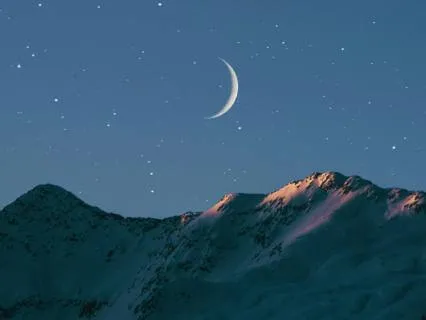
Which we are now going to modify slightly with the Ardha Chandra pose,
Which is the Crescent Moon pose.
We will describe the shape of the crescent moon with our bodies.
Inhale as you rise your right arm outward to the height of your right shoulder.
Exit.
The arm will be extended to the right.
Bring the palm of your right hand upwards,
And then,
Again,
Inhale,
And as you exhale,
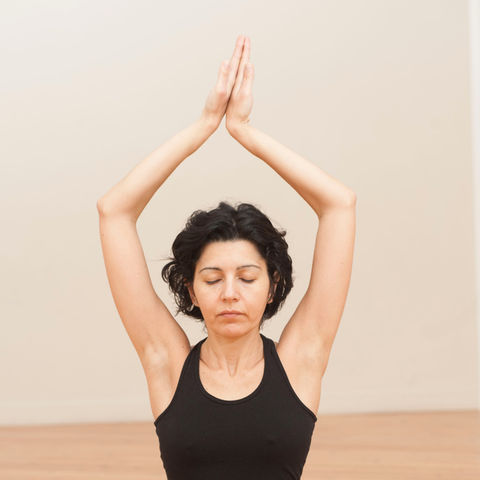
Continue rising your arm upward until it reaches a vertical position.
Next to your right ear.
Keep looking forward and pay attention to your breathing.
The air coming in.
And out of your nostrils.
And the outgrowing.
Of the air is especially important.
Now,
Pay attention to your balance.
Inhale,
And as you exhale,
Lean your torso to the left.
Your extended right arm will follow the movement of your torso and will lean slightly.
Don't bend it.
Your elbow should remain extended.
And the fingers of your right hand should be extended as if you were trying to touch the ceiling.
Or the sky if you are outdoors.
Hold this new position,
Feeling the lengthening of the entire right side of your body.
And listen to the rest of the body,
The support of your feet,
Your left arm remaining relaxed alongside your body.
Now inhale while remaining still and exhale repeating the movements to return.
Your torso returns to the upright position.
Your right arm returns to the vertical position.
And then slowly open outward to the right with the palm of your right hand returning downward and slowly following the closing.
Your right arm comes closer to your body and your breath follows the entire movement.
We have returned to Samasthiti.
Now let's continue with the left side of the body.
As you inhale,
Raise your left arm to the left side up to the shoulder height.
Exhale and bring the palm of your left hand upwards.
Then inhale again and as you exhale reach the vertical line.
The arm approaches your left ear.
Inhale.
As you exhale,
Bring your attention to your torso,
Which you can then tilt laterally to the right.
The raised arm will follow the gesture.
And it will help you describe this new crescent moon shape.
Ardha Chandra with your body.
Let's skip the position for a moment.
A yogasana should always be held for a few breaths.
As you hold this pose,
Breathing consciously,
If you've shifted your gaze elsewhere,
Bring it back in front of you.
To eye level.
You'll feel the stretch on the left side of your body.
Now let's release the pose attentively.
Lift your torso as you inhale.
Your left arm returns to the vertical line.
Exhale and extend your left arm outward,
Turning your left palm downward again,
Continuing until your left arm is close to your side.
We return to Samasthiti and now we can release this last position as well so we can sit down and continue with the meditation.
If you already know a classic meditation position,
You can certainly choose to practice it now.
Otherwise,
We can simply sit on a chair,
As long as the chair is suitable and allows us to sit with our knees at hip height,
The soles of both feet flat on the floor,
And our heels in line with our knees.
The back should be straight and unsupported.
It should be an upright,
Balanced position that we can maintain with minimal effort.
The knees and feet should not be close together,
Rather they should be a little wide apart,
Roughly the distance between our hips.
Now,
Let's bring our attention to our shoulders,
As we did before,
And to our chest,
So as to stay upright and relax our arms.
Bring your hands to rest in your lap.
The palm of your right hand embracing the back of your left with the tips of your thumbs touching.
As an alternative,
The hands can also be relaxed with fingers relaxed.
Or separated,
Resting on the thighs,
With palms facing up.
And,
If you like,
Bring the tips of your index fingers and thumb together on each side.
Relax your wrists.
Feel your abs relaxed like garlands of flowers.
Relax your other fingers.
Now,
Keep your gaze always straight ahead,
At eye level.
You can gently half close your eyes,
But not completely.
You will spontaneously continue to perceive your position from the base upwards.
You read?
You're back.
Where you are sitting.
Your feet.
This position of stillness is maintained by your breath.
This time,
Your breath will no longer be guided.
Observe your breath as it happens naturally.
And you stay like this,
Listening to the silence.
At the beginning,
We guided the breath.
We saw it during the poses and asanas of yoga.
Now let the breath proceed spontaneously.
The only thing to do is to observe your breathing.
This will probably lead us to feel even small movements or sensations in the body,
Small adjustment movements.
If you need it,
You can adjust the position,
Especially if it makes you uncomfortable.
Don't force yourself.
Modify,
Even slight change the position if you need to.
Without getting discouraged.
Continue.
Don't stop.
Let yourself be guided by the image of the position you just practiced,
The gentle half-moon posture.
And feel your body,
Which is now in a balanced position.
The eyes are half closed.
A contact with the outside.
The eyes are not completely closed.
Let's make sure that the perception of the external light remains.
If you find your mind wandering elsewhere or something unexpected distracts you from concentration,
Take this opportunity to stay with this very moment.
Remember your motivation and continue.
We wouldn't be here if we didn't really want to learn how to manage these moments.
It's natural for our mind to be drawn to the outside.
But,
As yoga teaches,
The mind also has another natural quality which we simply need to cultivate.
If we focus on the spontaneous perception of the body.
On the bread,
And we do so without hurry.
We have chosen a time to dedicate to this.
And the mind has a great capacity for concentration.
The mind has both tendencies to go outward to be distracted and to go inward,
To gather,
To concentrate.
And with meditation we cultivate the capacity for concentration.
Let's give ourselves a few more moments to stay in this space of calm for the mind and of practice,
Of care for the body.
Let's conclude this practice mindfully before gently opening our eyes.
Return to your intention for this practice with gratitude.
If you like.
Gather your hands towards your chest as we did at the beginning.
For a moment.
In gratitude.