Hello friends!
In today's episode I'm going to tell you some stories from Finnish mythology and old festivals,
Spring and summer holidays.
Enjoy!
Let's start with Hela.
Hela was celebrated on the 1st of May to mark the arrival of summer.
The festivities included singing and dancing,
And people enjoyed drinking ale and meat.
The word Hela originates from the Swedish word Helk,
Which means sacred and holy.
One of the traditions involved lighting bonfires and ringing bells.
These actions were intended to ward off evil spirits.
Children often tied little bells to their hands and feet as part of the celebration.
Drinking played a significant role in Hela,
With larger drinking vessels used than usual.
This was part of a fertility ritual aimed at ensuring a successful harvest in the upcoming autumn.
Hela signified that summer was approaching,
The snow had melted,
Spring showers became more frequent,
And flowers began to bloom and leaves started to grow on trees again.
It was customary to visit springs and lakes to fully enjoy the arrival of summer.
Hela gradually faded away with the arrival of Christianity.
The name of the festival transformed into Valpuri.
After Saint Valpurka,
The tradition of children wearing bells on their hands and feet continued,
As it was believed that this would keep the cattle safe and help cows produce more milk.
Cows were led to the fields,
And bonfires were burned to ward off wolves.
Valpuri was known as Witches' Night,
During which it was thought that evil witches were active,
Putting farm animals and children in danger.
To keep witches away,
People placed branches of alder trees and broomsticks in front of their doors.
The presence of a broomstick would make witches believe there was already a witch residing there,
Deterring them from entering the house.
The night of Valpuri,
Occurring from April 30 to May 1,
Was considered a liminal space between the living and the spirits,
Making it opportune time for spellcasting.
During this night,
All kinds of mischievous imp might cross over to play tricks on people.
Superstitions.
Fishing was forbidden during Valpuri to prevent fishing luck from disappearing in the future.
Handling sharp objects was encouraged to avoid accidents for the rest of the year.
Taking a bath in the river during Valpuri was believed to heal various ailments.
Akkainviikko.
Woman's week.
Akkainviikko,
The woman's week,
Is a week in the Finnish calendar when there are only name days of women.
Week takes place between 18th and 24th of July.
And here's the list of the name days.
18th of July,
Fredrikka and Rikka.
19th of July,
Saara,
Sara,
Sari,
Sarita,
Salli and Salla.
July 20th,
Maarit,
Maaret,
Marketta,
Markareetta,
Reetta and Reeta.
21st of July,
Hanna,
Hannele,
Hanne,
Johanna,
Jenni,
Jenna,
Jonna and Joanna.
22nd of July,
Matleena,
Mataleena,
Magdalena,
Leena,
Leeni,
Lenita.
23rd of July,
Olka,
Oili and 24th of July,
Kristiina,
Krista,
Kirsi,
Kirsti,
Kiia,
Tiina and Tinja.
The origins of the week can be traced back to Christianity,
As it included the feast days of two saints,
Mary Magdalene on July 22nd and Saint Kristiina on July 24th.
The celebration of this week began in Finland during the 16th century when the Catholic Church sought to convert the populace to Christianity.
However,
This often resulted in the blending of Catholic saints with Finnish female deities.
As a result,
The beliefs surrounding this week were primarily rooted in paganism and related to farming,
Occurring during a time when people were heavily engaged in agricultural work.
Women's week,
As it was called,
Was characterized by a mix of beliefs and customs.
Notably,
It was often quite rainy during this period,
And farmers typically dreaded rain since it could hinder their work in the fields.
Women's week was also referred to as a flea week because it was believed that during this time,
All kinds of bugs,
Fleas and mosquitoes would harass people.
Traditionally,
People employed various tricks and spells to get rid of these pests.
Women's week has not been celebrated for many centuries,
Mainly because farming is not as big part of the culture as it used to be.
Name days are actively celebrated only in two countries,
Finland and Sweden,
Although they have existed in other parts of Europe as well.
The origin of name days dates back to the 15th century and the Catholic saints.
Historically,
Women's week was a popular time for visiting friends,
Especially if they were celebrating a name day,
Allowing people to enjoy beverages and food together.
In Finland today,
Name days are still celebrated.
Individuals often congratulate the person whose name day it is with cards,
Bouquets of flowers and small gifts.
Juhannus,
The Midsummer Juhannus,
Named after John the Baptist,
Is a Christianized name for a very old festival.
There wasn't a specific date for Ukonvakat.
If spring was particularly warm,
The celebration could take place as early as May,
But it was commonly celebrated around the summer solstice.
Ukko is the Finnish god of the sky and thunder,
And he is also considered a god of fertility,
As he brings rain.
The name Ukko refers to an old man and was an honorary title given to those who had reached old age.
Similarly,
Akka was the title given to an old woman.
The term Ukkonen means thunder in Finnish.
When Ukko was in a good mood,
It would either rain or be sunny.
However,
When he was displeased,
Storms would occur,
And lighting would be seen in the sky.
Unlike many thunder gods in Europe,
Ukko is not depicted as a warmongering deity.
He has a more benevolent,
Grandfatherly demeanor.
Finnish mythology does not have a dedicated love god or goddess,
At least as far as we know,
But Ukko was often invoked in love spells.
Likely due to his role as the god of fertility,
He was also associated with abundance,
Bringing spiritual richness,
Including romance.
Those who sought it.
Ukko was worshipped to ensure a good harvest in the autumn.
Ukko is closely associated with farming and agriculture.
It is believed that before Ukko's emergence and the arrival of agriculture,
People worshipped the Thunderbird,
Known as Ukko's Lintu or Ukko Lintu,
As a totemic god.
The Thunderbird is represented by the eagle,
Which flies low,
Just before a thunderstorm,
In search of flies,
Over still water.
The word Vakka refers to food sacrifices.
Vakkas were food baskets filled with bread,
Vegetables,
And ale.
The festival was typically celebrated in nature,
Often near a body of water.
People would eat,
Drink,
Sing,
And dance.
Today,
Midsummer customs in Finland closely resemble those of pre-Christian times.
The summer solstice marks a time of youth,
Vitality,
Long nights,
Happiness,
And the flourishing of nature.
It is an ideal period for performing spells related to growth,
Love,
Farming,
And fertility.
Homes were thoroughly cleaned,
And yards and gardens were decorated with flowers,
Hay,
And fresh tree branches.
Small cottages made from birch branches were also constructed,
Providing a lovely place to enjoy coffee in the cool shade during warm weather.
The symbolism of all the greenery represented the abundance of summer,
Which was also a blessing wished for people's lives.
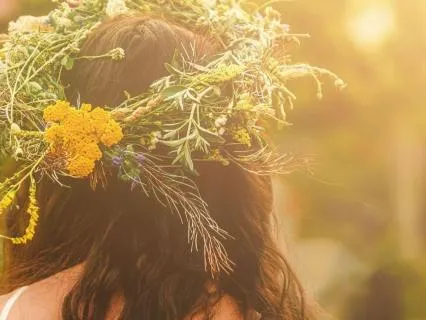
Wreaths made from plants and flowers were worn during Midsummer,
And were placed on the heads of cows and horses,
As it was believed this practice would protect the animals.
Burning bonfires was a common tradition.
These communal events invited participation as people threw old furniture into the fire.
Bonfires symbolized fertility and the sun,
While warding off evil spirits during the night.
The following day,
Farmers could gather ashes from the bonfire to scatter in their fields,
Promoting healthy grain growth.
Traditional foods associated with the summer solstice included dishes made from eggs,
Milk,
And cheese,
As well as strawberries and raspberries.
Popular foods also included pancakes and beverages,
Such as mead,
Wine,
Ale,
And juices made from berries.
Many love spells were performed during the summer solstice.
One of the most popular spells still practiced today involved picking a selection of five,
Seven,
Nine,
Or twelve different flowers,
Binding them together and placing them under one's pillow.
In the night,
It was believed that the person would dream about their loved one.
Another spell involved circling a well naked,
While holding flowers,
Usually seven or nine times in a clockwise direction,
With the intention of seeing the reflection of the loved one in the water.
The most powerful midsummer flowers include lily of the valley,
Anemones,
And marigolds.
During pre-Christian times,
The societal views regarding women and marriage were more relaxed.
For instance,
If a woman was pregnant at the time of the wedding,
It was generally not considered a significant issue.
During the summer solstice,
It was believed that the spirits of treasure would clean their treasures.
If someone countered will-o'-the-wisp,
It meant that buried treasure was nearby,
And they could dig it up without being disturbed by the spirit of the treasure.
However,
They had to carry the treasure home silently and not speak about it to anyone.
Additionally,
If they heard strange noises behind them,
They should not stop or turn around.
It was also believed that natural springs transformed into vodka on midsummer night.
According to one tale,
If someone planned to take some of the vodka with them,
They should leave some silver for the spirit of the spring.
Dew was considered magical,
And was collected in bottles for later use in various forms of magic.
It was known to heal ailments ranging from ear pains to rashes.
Washing one's face with the dew on the morning of the summer solstice was said to grant beauty for the entire year.
Moreover,
Those who drank the dew received a beautiful singing voice.
Here is the summer solstice bell for Vellamo.
Vellamo,
Queen of waters,
Here in the light of the sun's longest day,
In the glimmer of the midsummer glow,
I call upon thee,
Mighty one,
Ruler of the waves,
The deep blue sea.
Vellamo,
Mistress of current wide,
Whisper your wisdom in the wind's breath,
Grant your strength to the tides and waves,
Flow with the moon,
Dance with the sky,
By the fire of the solstice sun,
By the gleam of its golden crown,
Weave in threads of the earth's heart.
We call the spirits from the water's depths to guide our souls to bless this day.
Mighty Vellamo,
Rise and sing,
Your voice a melody on the breeze,
Wrap the shores in your cooling embrace,
Bless our waters,
Our boats,
Our hearts.
May the storms be gentle,
The seas serene,
And may our spirits find peace in your reign.
By the power of the eternal light and the depths where the waters are still,
We honour you,
Vellamo,
With this song.
As the sun fades and the night takes a flight,
Grant us your blessing on this sacred day,
As the solstice turns and the stars come forth.