So,
Welcome to session two of this series on the book called Adult Children of Emotionally Immature Parents.
This is the second session and today we are going to be talking about the four types of emotionally immature parents,
Okay?
So,
Thank you for being here.
Hi Beth,
Hi Becca,
Working on healing since our last session.
Amazing,
Becca,
I'm happy to hear that.
BD says,
I have a book recommendation for you,
Audiobook is so good,
Breath by James Nestor.
Thank you,
BD,
For the recommendation.
So,
Before getting into the topic,
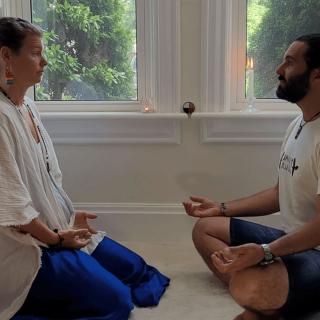
Let's just do a grounding exercise to get into the session,
To transition,
Okay?
I invite you to close your eyes.
I invite you to get comfortable and just enjoy the sound of the singing bowl.
Just become aware of your breath.
Become aware of any tensions that you may be feeling in your body.
You can breathe into them a few times if you want to release some tension.
My invitation to you today in this session is to be very,
Very gentle with yourself,
Very,
Very gentle with others,
With your parents,
And with any people who comes to mind in any of the dynamics that we're going to be talking about,
Okay?
So,
Just be gentle,
Be compassionate,
Be curious.
And the goal of today's session is not to blame,
It's not to criticize,
It's not to be hard on ourselves or others.
It's rather an invitation for awareness,
An invitation to notice,
An invitation for healing opportunities.
And we're going to be talking about most likely generational trauma.
This is not trauma that only happened in your generation,
In our generation.
This is most likely something that has been happening from generations to generations,
To our grandparents,
To our parents,
Now to us,
And the dynamics keep kind of going down.
This is our opportunity to notice them and to heal them in whatever way feels good to us.
Hi,
Melody,
First time here.
Thank you so much for joining.
Hi,
Leon Wills,
Great to see your smiley face.
Happy to be here.
Thank you so much.
Hi,
Peta.
Yeah,
So for those of you who are new,
I did session number one on this series about this book last week,
And there are recordings available of all the sessions that I do.
You can find them on my profile link on InsideTimer if you are interested in watching them.
So today we're going to be talking about the four types of emotionally immature parents.
So the book talks about basically the four kinds.
It gives a brief description on each kind,
And then we can dive deeper into each of them.
And the book also shares some stories of fictitious people and how their situations are,
Because sometimes we really relate to stories,
To a real life example,
To put things into perspective,
To maybe shine the light on how those dynamics show up in relationships.
But basically,
The book says that these types,
She's just trying to categorize them somehow,
Put them in a box so that we can kind of see.
But many times there is a blend in these types,
Okay?
Maybe your parents are not just one type.
They maybe have traits of different types,
But maybe there is a specific one that resonates the most with.
Just making you aware,
And it is my situation,
That you may see yourself reflected from two angles here.
You may see yourself reflected from being a child of an emotionally immature parent,
But you can also be on the other side.
You can be the parent and you can see behaviors that you reflect yourself in,
In the way you are being a parent to your children.
And when I was reading this again for a second time,
It's just so,
Yeah,
It's so amazing how many of these things I see myself reflected in.
And it's like,
Wow,
I really need to work on that.
Wow,
That shows up a lot in my life.
Oh yeah,
That totally me when I am under stress.
So again,
Please be very gentle,
Be very compassionate,
And don't use this information to blame yourself,
To criticize,
To point the finger.
Use it for healing.
Use it for awareness.
Use it to start making different conscious decisions,
Okay?
That's my invitation.
So please do that.
Isadora,
The book is called Adult Children of Emotionally Immature Parents,
Okay?
This is a series of talks that I am doing,
And this is session number two.
There are six sessions altogether.
And if someone wants to type the name of the book in the chat,
It's by Lindsey C.
Gibson,
So that you guys have that information.
But if you type it on Google,
It's very easy to find,
Okay?
So basically,
All these four types that we're going to talk about of emotionally immature parents,
Each of these types,
The book says,
They are going to undermine a child's emotional security in different ways,
Okay?
So basically,
Limited empathy and unreliable emotional support,
Lack of sensitivity.
So these are some of the main traits that are going to happen in a lot of these four types,
Okay?
Thank you so much,
Viviana,
For typing that in the chat.
Thank you so much.
The name of the book.
So are you guys ready to start with these four types?
Are you guys ready to dive in?
And the idea here,
I don't have a specific structure.
I feel that I'm going to share these four types with a brief description of each of them,
And then I can read the summary and kind of say what all these four types kind of are,
And then we can dive deeper into them if you want to,
And as time allows,
Okay?
Beautiful.
So the first type is emotional parents,
Okay?
Emotional parents.
This is the first type of emotionally immature parents.
Emotional parents are run by their feelings,
Swinging between over-involvement and abrupt withdrawal.
So basically,
From being really involved into completely disconnecting and just disappearing,
Basically,
Emotionally speaking.
They are prone to frightening instability and very unpredictable,
Very difficult to predict their behavior.
Overwhelmed by anxiety,
They rely on others to stabilize them.
They treat small upsets like the end of the world and see other people as either rescuers or abandoners.
So it's a very black and white mentality.
It's a very kind of worst case scenario mentality with very little things.
It's a big,
Huge drama about very little things that maybe are not as important.
So these are emotional parents,
Okay?
Again,
This is the short description of that,
And then we can dive deeper into it after,
Okay?
We're going to have time,
Okay?
Okay.
So type number two is driven parents.
Type number two is driven parents.
Driven parents are compulsively goal-oriented and super busy.
They can't stop trying to perfect everything,
Including other people.
Although they rarely pause long enough to have true empathy for their children,
They are controlling and interfering when it comes to running their children's lives.
So that's type two,
Driven parents,
Okay?
Very goal-oriented,
Very controlling,
High expectations.
Type number three,
Passive parents.
Type number three,
Passive parents.
Passive parents have a laissez-faire.
This is a French word that means basically just don't do anything.
It's a have a laissez-faire mindset,
Basically a mindset of allowing anything,
A mindset of letting things flow,
A mindset of not controlling anything,
Not setting boundaries,
Just letting things be,
And avoid dealing with anything upsetting.
So it's basically an avoidance mechanism,
Right?
They are less obviously harmful than the other types,
But have their own negative effects.
They readily take a backseat to a dominant mate,
Even allowing abuse and neglect to occur by looking the other way.
They cope by minimizing problems and not making a big deal about things.
So basically this kind of passive parents,
They avoid,
They let things be,
They will avoid conflict and upsetting conversations,
And they will look somewhere else instead of taking the required action that sometimes may be necessary.
So this is the passive parents,
Type number three.
And then the type number four is rejecting parents,
Okay?
The type number four is rejecting parents.
Rejecting parents engage in a range of behaviors that make you wonder why they have a family in the first place.
Whether their behavior is mild or severe,
They don't enjoy emotional intimacy and clearly don't want to be bothered by children.
Their tolerance for other people's needs is practically null,
And their interactions consist of issuing commands,
Blowing up,
Or isolating themselves from family life.
Some of the milder types may engage in stereotyped family activities,
But they still show little closeness or real engagement.
They mostly want to be left alone to do their thing.
Yeah,
Marjorie,
Laissez-faire attitude approach.
That was,
Yeah,
That's the word.
It's a French word.
I looked it up because I didn't know what it meant.
And it's basically,
It means allowing to do anything.
It means letting things flow.
It means don't do anything,
Don't get involved.
So that is the type of mindset that the passive parents normally show,
And she uses that word.
T3 says,
Was just listening to the author's discussion of this disentangle from emotionally immature people,
Which has been very helpful.
I actually listened to that too.
Becca recommended it.
This is from the Conscience Life Conference,
I guess,
T3.
A do-what-you-will attitude.
BD,
Yeah,
It also means a do-what-you-will.
Basically,
Do what you want,
Right?
I am not going to interfere.
And sometimes that,
Especially for kids that are young,
They need some sort of structure.
I mean,
You don't have to control them,
But you have to set boundaries.
You have to keep them safe.
They need to learn where the limits are.
And it's important,
If you are completely passive,
Then they won't know where the limits are.
They won't have any boundaries.
And as they keep growing up,
Those boundaries are going to keep expanding and then bigger problems are going to start arising.
And then it will be very difficult to do something about it.
So I think she refers to that kind of mindset of not getting involved,
Not being there.
She's seen a bunch of different podcasts,
Really were very specific in instruction for managing your participation or not.
Yeah,
T,
In this series,
I'm going to be covering the rest of the book.
And there are specific strategies on how to change our expectations when we are dealing with emotionally immature parents so that we enter the interactions in a way that we are not setting ourselves up for failure all the time.
And we are not living in fantasies that things are going to magically change or we are going to get our needs met or any of that,
Because most likely that won't happen.
So how can you enter those interactions and how can you navigate these in the best possible way?
And the book has a bunch of strategies and we will discuss them in another session.
OK.
Yeah,
Marjorie,
Thank you.
Yeah,
It's a term used mostly in economics.
But yeah,
Clarification.
Beautiful.
What was the first type called?
So the fourth type that I talked about,
The first is emotional parents.
The second is driven parents.
The third,
Passive parents.
And the fourth,
Rejecting parents.
OK.
So basically,
She says in the book,
After she says none of the types are able to consistently act in ways that would make a child feel secured about the relationship.
OK,
So none of the types are able to consistently act in ways that would make a child feel secure about the relationship.
So that is the main trait between all of these types.
And then it kind of,
There are different dynamics that happen on each kind.
But basically,
The main trait is that there is not a healthy environment where children feel secure and it's a predictable environment that feels safe.
My parents are a mixture of all of these four types.
Yeah,
Adela,
Absolutely.
You may find them to be a mixture.
You may find dynamics that are from them.
Me,
I see some of these dynamics from all of the types sometimes.
But I really see a very specific one,
Especially for my father.
And then I see another specific one,
Especially for my mother.
And of course,
They complement each other perfectly,
Right?
But yeah,
Me as a father,
I also see myself reflected in many of these adjectives that she describes.
And when we go in more depth,
We are going to learn more about each type and then we are going to probably see more things that we may relate to.
Yeah,
I'm sure a lot of parents overlap several types.
Yeah,
Absolutely.
So this is why like anytime you try to encapsulate or create labels,
You are always missing things out.
You are always imposing structure on something that maybe doesn't need to.
But this is for you to have an idea of the four types and the main traits of each type.
And of course,
You are going to find a mixture majority of the times.
Okay.
So how are you guys feeling so far?
Are you guys doing fine?
Is there anything you want to share before we dive more into each type?
And then before we dive into each type,
There is also a summary that I thought it was.
So the summary says all four types of emotionally immature parents are self-involved and insensitive and therefore emotionally unavailable to their children.
Their lack of empathy makes them hard to communicate with and difficult to connect with.
They are all afraid of genuine emotion and seek to control others for their own comfort.
None of them make their children feel emotionally seen.
All are draining to be around in their own ways.
And ultimately,
All interactions center around them.
In addiction,
All are incapable of true interpersonal reciprocity.
So that's kind of the summarize,
Right,
Of what the result is.
Okay.
So Melody feels overwhelmed.
Can I ask why,
Melody?
What's coming up for you?
What is making you feel overwhelmed?
Do you see yourself reflected?
Do you see your parents reflected?
Susan says,
Where can I find what you just read,
The summary?
So the summary is at the end of the emotional pattern and it's on page 112 in my book.
Okay.
But basically,
At the end of chapter four,
There is a summary.
And that's what this is about that I found very interesting because at the end,
All these four types,
Those are the main traits,
Right?
Being emotionally unavailable for their children,
Self-involved,
Insensitive.
They don't like emotional intimacy.
They don't feel comfortable with that.
They may manipulate so that they get what they need.
Everything is all about them.
There is a lack of empathy and reciprocity.
It feels draining to be around them.
So they are basically energy suckers.
You just feel like you don't feel well in their presence.
So these are some of the traits of the four types.
No matter what type,
That's kind of the normal feelings and the normal dynamics of all of them.
So much resonance.
This analyzes,
Express and verbalize everything I have felt my whole life,
But couldn't express or explain.
Wow.
That must feel really liberating,
Validating,
And also overwhelming at the same time.
I can imagine how it must feel really emotional.
That resonates exactly to my partner.
Yeah.
Yes,
I see myself in these patterns.
Melody,
I see myself too.
And it's kind of scary sometimes.
Some of the things I was reading is like,
Holy smokes,
That's me.
Maybe I don't have a hundred percent tendency,
But there is some in there.
And it's,
Yeah,
It's scary.
Mine are definitely driven,
Controlling and judging me based only on productivity.
Yeah.
It's almost a broken up way of.
.
.
So let me see that the comments are flying by now.
It's almost a broken up way of describing narcissism,
But that term is so overused.
It can be hard to specify what's happening in our own situation.
Yeah.
Traits of narcissism is also something that can show up in any of these kinds.
So the book talks about narcissism tendencies too.
And yeah.
We're recognizing that I did take on some of these traits and emotional.
Yeah.
My parents were controlling and emotionally abusive.
Yeah.
Saddest thing about being a child of such parents is that no one explains them to you when you are a child.
So you feel you are the defective one,
That the way they treat us is your fault.
Yeah.
That's something that the book talks about.
Anytime you feel that what's happening is your fault,
That is a very big indicator that you are in an environment that probably is not very emotionally mature.
I heard in the pathology of productivity.
Yeah.
Prioritizing productivity over emotional intimacy and over validating emotions.
Very important,
Right?
There is a time for doing,
And there is a time for being,
For being present.
There is a time for allowing emotions to be expressed.
And we parents need to learn how to do that more.
We need to learn how to slow down and how to model that for our kids.
And it's not easy,
Especially when we are rushing out of to work in the morning and we don't have a lot of time and maybe they are having a tantrum and we just don't have the time or capacity.
So we need to learn how to do that more.
Absolutely.
I love that she clarifies because everyone must identify on some level.
Self-reflection is key.
Yeah.
Majority of the times this kind of traits and this kind of emotional immature dynamics,
Normally self-reflection is not a part of that because if they could self-reflect,
They probably will change.
They will heal.
They will apologize.
They will change their behavior,
Right?
But many times that is not a trait that is present in there.
And on the surface,
Everything looks perfect.
Yeah.
When we dive into the driven parents,
It says that,
That from the outside,
It feels that everything is good.
It feels that the parents are taking full care of their kids and they are really involved.
So it's very difficult to notice the impact that that is having in the kids.
So it's a very interesting dynamic that sometimes is not obvious.
I think the difference between emotionally immature and narcissistic personality disorder is that the form can be healed.
Only 4% of NPD people actually heal from it.
Yeah.
So BD,
You will notice that when we dive into the emotional pattern,
That is the first one,
It talks about narcissistic,
Borderline personality,
Psychotic,
Bipolar disorders.
All of that is in that.
So we can dive deeper into these kinds if you guys want to.
Are you guys interested in diving deeper into each kind?
We have some time still.
The reasons for feeling unsafe as an adult are becoming more clear as we progress through the book.
Yeah.
Okay.
So let's dive in and then we can keep the conversation going after,
But I'm happy to also just talk if that's what you guys need.
Okay.
I don't have to perform anything.
I don't want to be a driven teacher right now.
I don't want to impose more,
But yeah,
We can dive into each kind if you guys want,
Or we can keep chatting about your experiences,
Whatever you guys feel.
Someone asked if the parents are aware of their immaturity.
So Isadora,
I don't think they are,
Because if they were aware of their immaturity,
They would probably start doing something different.
And the problem I think is that many times the awareness piece is not there yet.
The self-reflection piece,
The willingness to Many times the awareness piece is not there yet.
The self-reflection piece,
The willingness to self-reflect,
It is not there yet.
And keep in mind that,
Guys,
We are so lucky.
I'm sitting here having a beautiful book,
Having a beautiful computer,
Having the internet,
Having Insight Timer as a platform,
Having access to podcasts,
To anything I need.
My parents didn't have any of that.
My grandparents,
They were born in a hut in the middle of nowhere.
They were working the land.
They barely knew how to read.
So just keep that in mind,
Okay,
That we are in a situation that is so beautiful.
It's so easy to heal these days.
It's so easy to find information,
Find help,
Read books.
Scientists are showing up with all these topics.
We just have to consume the content,
Be willing,
Be curious and do the work.
But before my parents didn't have any of that.
So just keep that in mind too.
I'm not excusing them,
But I'm also becoming aware that all the stuff that we have around now and we have access to,
It wasn't there before.
Like the internet came up when I was 20 years old.
So I just want to put some context,
Okay,
So to make sure that we are aware of that too.
So with that said,
I would love for us to take the responsibility to look at these things and to start doing something different,
Start changing this generational trauma that we have been living.
So let's dive into the emotional pattern,
Okay,
And some of the big traits here.
So the emotional pattern,
I'm just going to read some of the main takeaways that I think are important,
Okay?
Everyone in the family feels like they are walking on eggshells.
So you are walking on eggshells.
It doesn't feel safe to be you,
To express you are always tiptoeing around because you don't want to awake the beast.
You're kind of like keeping things cool.
I am afraid of something happening.
So it doesn't feel truly safe to be,
To show up fully,
Right?
At the severe end of the spectrum,
This is for the emotional pattern,
Okay?
Type number one.
At the extreme of the spectrum,
These parents are quite frankly,
Mentally ill.
They may be psychotic or bipolar or have narcissistic or borderline personality disorder.
At times they unbridle emotionally,
Can even result in suicide attempts or physical attacks.
People are nervous around them because their emotions can escalate so quickly.
This is actually my father.
Yeah.
Emotions can escalate so quickly.
Absolutely.
From zero to a hundred,
Like that.
From being his best friend to being his enemy,
A hundred percent.
That was one instant,
One minute,
Boom.
And you will see what happened here.
Yeah.
Due to bipolar disorder.
That's my father.
Absolutely.
But basically lack of emotional self-regulation,
They escalate very quickly and it becomes scary.
It becomes like unsafe to be around them and you don't know what to do.
Okay.
Alternating episodes of high and low mood.
So the mood changes dramatically in a very short amount of time.
And many times you don't know what to do.
They have difficulty tolerating stress and emotional arousal.
So we are going back to the emotional self-regulation piece.
They don't know how to self-regulate themselves.
So their mood is like,
It's a wave of emotion,
Right?
Ups and downs.
They see the world in black and white terms,
Very extreme mindset.
They keep score.
They hold branches.
They are controlling others with emotional tactics.
And their fluctuating moods and reactivity make them unreliable and intimidating.
So you're basically scared of them.
Family life always revolves around their moods.
100%.
It's all about what's happening to that person.
The rest,
We don't matter.
It's not important.
There is no space for the rest.
It's all about them.
Although they often control themselves outside the family where they can Although they often control themselves outside the family where they can follow a structure role within the crucible of intimate family relationships,
They display their full impulsivity,
Especially if intoxicated.
It can be shocking to see how no horse bird they can get.
100%.
We are on the emotional pattern,
On type number one.
And then to finish,
Many children of such parents learn to subjugate themselves to other people's wishes.
Because they grew up anticipating their parents' stormy emotional weather,
They can be overly attentive to other people's feelings and moods,
Often to their own detriment.
Yeah,
That was more information about the emotional pattern.
This is my mom and somewhat myself.
Yeah,
So this is actually my dad.
100%.
100% in every trait.
Not all the time,
But when he was high,
When he was on the high of the bipolar,
Yeah,
Very extreme,
Very extremist,
Very like,
It's either black or white.
It's very difficult to find something in between,
Right?
And of course I have those traits too,
Somehow.
Learning how to manage them differently,
But I do have all those traits and they show up sometimes.
That hit home for me.
Yeah,
This describes my mother and she handed down those traits to me.
Of course,
Melody,
We learned from our parents,
Right?
They were the ones who raised us.
Did you notice you picked up these traits from your dad?
Ella,
Absolutely.
100%.
Do I follow them the same way?
No.
Am I aware of the majority of them?
Yes.
Am I aware of majority of them?
Yes.
Am I willing to change them?
Yes.
Am I self-reflective?
80% of the time,
I can.
20% of the time,
I would say I am lost in the dynamic and I need time to regroup,
To come back because it feels very uncomfortable,
Very emotionally charged.
But yeah,
I see myself in many of these and it's scary actually.
I think that in my family,
My sister developed schizophrenia when she was 14.
At that time,
I was 13 and then my father followed suit with bipolar disorder.
So I was living in a very difficult household for like 10 years before I left the house.
And my mom,
She was falling more on the passive pattern,
I will say.
Not with me.
She was very involved with me,
But with my father,
She will be on the try to follow suit,
Try to avoid conflict.
They can be overly attentive to other people's feelings and moods,
Often to their own detriment.
100%.
My mom and I,
That's what we did.
Because everything was around my dad's mood at that moment.
And he was the ruler of the home.
He was the person who was making the money.
He was the person who had the more energy,
The more leadership.
And don't take me wrong,
My dad is a beautiful person.
I had a lot of fun with him.
I learned a lot of things from him.
But some of these traits,
They did show up every now and then.
And there were some times where he will have attacks of bipolar disorder.
And sometimes I remember having to call the police and like in the movies,
They will come,
They will grab him,
He will be in his world.
People were following him.
We were,
What were we?
We were spies.
We were looking,
We were spying him from I don't know what organization.
And he truly believed that we were the enemy.
And he would just be screaming at us,
What are you fucking doing to me?
Sorry about the world.
It was very traumatizing.
Oh my God.
Yeah.
So that was the emotional parent.
Makes me feel very ugly at this moment.
Yeah.
We are all in healing together.
Absolutely.
It feels like living near a volcano.
Always the risk of explosion.
Wow.
That is a really good way to put it.
It feels like that.
You're kind of deep toying around and you are afraid of the volcano to explode because you have no idea what you're going to be doing if that happens.
So you guys want to dive into the type two,
The driven parent.
And I know that this,
We could be hours on each kind.
But today I just want to give you a taste.
And if it's too much,
We can stop here.
Okay.
So it is,
I don't have an agenda.
It is really your choice.
How do you distinguish the behaviors of the instigator parent versus other parent who reacts to the instigator?
Of course,
Both are toxic to family.
Yeah.
Mia,
I think it will change depending on every specific situation.
And this is something that when we are trying to heal,
When we are trying to become aware of a specific dynamic,
It's really helpful to be very specific and to pick a very specific example so that you can work with that specific example.
Because if not,
It's very easy to get lost.
It's very easy to generalize and make assumptions.
Yeah.
I always wonder why I felt responsible for the happiness and mood of everyone around me.
But the fact that my mom is so emotionally insane and volatile,
It makes sense.
I'm only starting to heal now.
Yeah.
Emma,
The book talks about that.
You become the parent of your parents.
And then you have to take on responsibilities that are not yours at that age,
But you have to,
They fall on you because your parents are not emotionally mature enough to take care of you that way.
So you have to take care of yourself and sometimes them.
So yeah,
It's very interesting.
Isn't it tragic that by the time we realize the damage has been done?
Yeah.
Isadora,
It makes sense.
And the only thing that we can do is use this present moment to start behaving differently and use every future present moment to use this information to embody something different.
That is the only thing we can do.
We cannot go back and change what happened,
What they did to us,
What we did to them,
But we can actually grow,
We can heal,
We can become something different.
And then from that place,
Maybe we can make amends,
Maybe we can have conversations,
Maybe we can forgive,
Maybe we can ask for forgiveness,
Maybe we can do something else,
Right?
So let's dive to the driven parent.
Okay.
Let's dive into the type number two.
So driven parents are the type that tends to look most normal,
Even appearing exceptionally invested in their children's lives.
Being driven,
They are always focused on getting things done.
Whereas emotional parents are obvious in their immaturity,
Driven parents seem so invested in their child's success that their egocentrism is hard to see.
So this is what some of what you guys were saying that it was difficult to recognize,
Right?
This is the driven parent.
Okay.
The type number two.
Most of the time you wouldn't notice anything unhealthy about them.
However,
Their children may have trouble with either initiative or self-control.
So because their parents are controlling them so much,
The children actually lose the capacity to be independent,
To make their own decisions,
And to discover what is it that they need or want,
Because that's always imposed from their parents.
So that's why it says,
Paradoxically,
These very involved,
Hardworking parents often end up with unmotivated,
Even depressive children.
So they expect everyone to want and value the same things they do.
Their excessive self-focus manifests as a conviction that they know what's good for others.
Goals take precedence over the feelings of others,
Including their children.
So goals are more important than emotions and feelings that may be happening.
So driven parents usually grew up in an emotionally depriving environment.
They learn to get by on their own efforts rather than expecting to be nurtured.
Often self-made,
They are proud of their independence.
They fear that their children will embarrass them by not succeeding.
Let me read that one more time.
So driven parents are usually one more time.
So this is about the driven parent,
Type number two.
They fear that their children will embarrass them by not succeeding.
Yet they can't offer their children the unconditional acceptance that will give them a secure foundation from which to go out and achieve.
So just pay attention to that dynamic.
Pay attention to the expectation that that children may feel on their shoulders from their parents.
Whether they mean to or not,
Driven parents make their children feel evaluated constantly.
An example would be a father who makes his kids practice the piano in front of him so that he can point out their mistakes.
So this was a bit more information about the driven parent.
And again,
You may see traits of these different types in your parents.
So it's normal.
Wow,
I think this was what my dad experienced with his parents.
Yeah,
BD,
Becoming aware.
And if you had the opportunity to to know your grandparents well,
You may be able to do that.
To know your grandparents well,
And to know the dynamics that they had when they were little,
And the dynamics that your parents had when they were little,
That will also help you be way more compassionate.
I always imagine my dad and my mom when they were little,
Three,
Four,
Five years old,
And I imagine them,
I visualize them in their environment with my grandparents,
And I ask them a lot of questions to try to understand how was the environment,
What did you do,
How was the relationship with your father,
With your mother,
What did you like,
What didn't you like,
What did you want more of?
And that really helps me put things into perspective and understand and have empathy for understanding the way they are acting and where is that coming from.
And as I was saying,
This is all generational trauma.
This is all parents doing the best they can,
The best they know with their children.
But we always,
It feels that no matter what we do as parents,
We are always going to miss something.
We are always going to do something wrong.
We are always going to traumatize our children somehow,
But hopefully we are aware of it and we can make amends and we can correct,
Right?
That's why emotional intimacy is so important to have with your kids,
Because if they feel safe to share and to call you out,
And you allow that for happening and you apologize and you change,
Then you are modeling that for them too,
And they won't be as afraid to show up and to express what they need.
This makes so much sense about how I felt when I was around them.
Even though we also had so much love and affection in the house,
There was still this undercurrent that we couldn't be imperfect.
Yeah,
Amazing.
Yeah,
Amazing BD.
I hope that this is something positive that you can get information out of.
Let's do the passive parent if you guys want to,
Or are you guys good?
Hearing you talk about growing up with a bipolar father is helping me empathize with how my father must have been traumatized by his father's boots of depression and paranoid schizophrenia,
As well as his mother's hoarding and eccentricities.
Yeah,
Everything has a huge impact,
Right?
Especially on children.
And if that was the household,
I can imagine how difficult it must have been.
And I was lucky that the mental health didn't come into my home fully until I was 13 years old.
So at least I wasn't three or four,
Okay?
At least I had some more resources,
More capacity,
More independence.
And I don't know how I stayed sane.
I don't know how I could find self-care practices.
I don't know how my intuition told me to go to the hiking club.
And every weekend I would go on hikes to the mountain with other people.
And I knew that I needed that.
I knew that if it wasn't for those experiences,
I wouldn't be sane.
Honestly,
I wouldn't.
So I probably wouldn't have the opportunity to have done those things if I was younger.
So I can imagine how those experiences must be terrifying for a three,
Four,
Five,
Six-year-old.
It must be really,
Really difficult.
A very different experience for sure.
The goals of our ancestors could have been survival.
Becca,
Absolutely.
My grandparents were coming out of wartime.
So really,
Like healing wasn't the mainstream word in that time,
Right?
People were not even open to the idea of doing something that wasn't providing food and creating safety and taking care of the basic needs.
And taking care of the basic needs.
That's why I was saying that we are in a very privileged situation right now.
Majority of us here,
We have safety.
There is no war happening outside.
We have a home.
We have social circle around us that supports us.
We have access to information.
We have access to resources.
So yeah.
Survival,
Absolutely.
Yeah.
You guys want to do the passive parent?
We only have 10 minutes left.
And we have two types.
So we don't have to do them if you don't want to,
If it's too much.
Yes,
Please.
Okay.
So the passive parent.
Passive parents aren't angry or pushy like the other three types.
But they still have negative effects.
They passively.
So basically,
It says that they basically,
They will often partner with more intense types who are also immature,
Which makes sense given that people with similar emotional maturity levels are attracted to one another.
So yeah,
The passive parent normally will have the tendency to,
Because they are kind of muted.
They are kind of like,
They let things happen.
They let things flow.
They don't engage.
They don't control.
They don't lead.
So they normally pair with someone that is stronger than them.
And they will live for them,
Basically.
And that,
I see my mom reflected in that.
Compared to the other types,
These parents seem more emotionally available.
But only up to a point.
When things get too intense,
They become passive.
They withdraw emotionally and hide their heads in the sand.
They don't offer their children any real limits or guidance to help them navigate the world.
They may love you,
But they can't help you.
So passive parents are as immature and self-involved as the other types.
But their easygoing and often playful ways make them much more lovable than the other three types.
They are often the favorite parent and can show some empathy for their children as long as doing so doesn't get in the way of their needs.
Passive parents may use their child to meet their own emotional needs.
Primarily,
There needs to be the focus of someone's affectionate attention.
They enjoy the child's innocent openness and can get on the child's level in a delightful way.
This kind of relationship is never completely comfortable for the child because it possesses the risk of making the other parent jealous and may even feel sexualized.
While passive parents often enjoy their children,
Have fun with them,
And make them feel special,
The children sense that their parents aren't really there for them in any essential way.
In fact,
These parents are famous for turning a blind eye to family situations that are harmful to their children,
Leaving their kids to fend for themselves.
When the mother is the passive parent,
She may stay with a partner who demeans or abuses her children because she doesn't have an independent income.
Yeah,
Absolutely.
So he's talking here about how they partner with a more strong emotionally immature parent and then they let them do what they do.
And sometimes they abuse,
Sometimes they have highs and lows,
And they don't do anything against it.
And sometimes the children are in the middle of that and the children don't feel protected by that parent that is a passive parent because that passive parent doesn't have the strength to do anything about the strongest parent.
In their own upbringing,
Passive parents often learned,
So when they were little they learned,
To stay out of the line of fire,
Keeping a low profile,
And subjugating themselves to stronger personalities.
Wow,
That's me,
100%.
And that's my mom,
100%.
As adults,
It doesn't occur to them that they have a mission not only to have fun with their own children,
But to protect them.
Instead,
They go into a kind of trance during the worst times,
Retreating into themselves or finding other passive ways to weather the storm.
Yeah.
So this is kind of some of the main traits of the passive parent.
That's the type number three.
And then the last one is the rejecting parent.
Let's just do this one if you guys want.
We have enough time,
I feel.
So type number four,
The rejecting parent.
Rejecting parent seem to have a wall around them.
They don't want to spend time with their children and seem happiest if others leave them alone to do what they want.
Their children get the feeling that the parent will be fine if they didn't exist.
These parents' irritated demanor teaches their children not to approach them,
Something one person described as running towards someone only to have the door slammed in her face.
They reject attempts to draw them into affectionate or emotional interactions.
If pushed for a response,
They may become angry or even abusive.
These parents are capable of punitive physical attacks.
Rejecting parents are also the least empathetic of the four types.
They often use avoidance of eye contact to signal their distance for emotional intimacy or sometimes employ a blank look or hostile stare designed to make others go away.
Wow,
That's me.
That's totally me.
These parents rule the home with family life revolving around their wishes.
A well-known example of this type is the aloof and scary father,
A mom with no emotional warmth for his children.
Everything revolves around him and the family instinctively tries not to upset him.
With a rejecting father,
It's easy to feel apologetic for existing,
But mothers can be rejecting too.
Children of rejecting parents come to see themselves as brothers and irritants,
Causing them to give up easily.
Whereas more secure children tend to keep making requests or complaining to get what they want.
This can have serious ramifications later in life when as adults,
These rejected children find it hard to ask for what they need.
So they have a really hard time asking for what they need,
Standing for themselves,
Being confident.
Yeah,
Wow.
Why did he become a father in the first place if he's rejecting his kids?
Yeah,
Becca,
That's a good question.
And the truth is,
Who knows what being a father or a mother is until you get into it,
Right?
And then it's a deal for life.
You cannot change that.
And I can say that sometimes I feel the burden of being a dad.
And I think we all do,
Right?
Not to this extreme,
But sometimes I am craving my independence.
I'm craving a long time.
My wife does too.
And we support each other creating that.
But I can see how some people may not be able to hold that burden,
To hold that responsibility because they have their own troubles.
Yeah.
Hopefully each generation gets better now that there are books and counseling.
People can decide to be different.
Yeah,
Rachel,
This is a personal decision,
Right?
Resources are out there now.
Books are out there.
Ways to heal are out there.
Conversations are happening.
It is our responsibility now to decide to do something or not.
Thank you for sharing.
You are most welcome.
I chose not to have children due to the abuse I experienced as a kid.
Yeah.
It makes sense,
Jar.
It also makes sense that with that information and with that wisdom that you have,
You may have different tools to raise your kids on a different way.
And maybe you are setting the example that maybe your parents couldn't or your grandparents couldn't.
Or your grandparents couldn't.
But yeah,
We all have the choice to decide if we want to have children or we don't want to have children.
It's not something that we have to be forced into.
Yeah.
Thank you so much,
Guys,
For showing up to such an emotional session.
I personally,
It was very emotional for me.
Some areas.
And I saw part of my infancy.
I saw myself as a father to my daughter Eva and how some of these traits show up.
And yeah,
How embarrassing it is,
Actually.
But I also am hopeful because I see so many that I am working on and I am doing really good at and modeling really well.
So we are all on the journey,
Right?
We are all doing the best we can.
Grateful for this healing space,
Emilio and everyone.
Not everyone has the choice and certainly most early generations didn't.
Yeah,
Totally true.
Yeah.
I'm grateful that I learned to be kind and compassionate.
Would it be helpful if passing a test is required before becoming a parent?
Yeah,
Becca,
Certainly we could get more information about what being a father or a mother looks like,
Tools.
But the truth is that many times we don't even know what we are going to be doing until we become one.
And then we learn and we do the best we can.
But yeah,
More resources will be really wonderful.
Wish I had known and being able to name my parents' behavior earlier would have been very helpful to me.
Well,
Juliette,
Hopefully now it's not too late.
Hopefully you can do something with this information.
Yeah,
And the fact that you are here shows that you are ready for change,
Right?
You are ready to do something different.
So guys,
Thank you.
Thank you so much for being here.
I want to transition out of this emotional session with a little bit of sound.
So I invite you to sit comfortably if you can.
Close your eyes.
And I invite you to take a few deep breaths.
With every exhale,
Feel free to make a noise,
A sound like,
And let go of anything that you have inside right now.
Any tensions you may have.
Any emotion that needs to be expressed in some way.
Now is your opportunity to let it out.
Don't hold it.
Maybe you can shake your arms like this down and just let them shake and try to get rid of energy if you can.
You can always grab a pillow,
Put it in your face and scream into the pillow.
You can always grab something and hit the pillow really hard and let that expression,
That emotion express itself.
You can maybe go for a walk in nature.
Maybe you can journal about what came out for you in this session.
You can sit in meditation for a few minutes and just let your mind relax.
Self-care can look very different for each person.
There is not a right or wrong way of doing it.
So make sure that you take care of yourself.
And thank you so much for creating the time today to be here,
To show up.
It's a very difficult topic and I honor you for your capacity to be here,
To reflect.
Have an amazing rest of your day and I will see you in a couple of weeks because I will go on a trip,
So I will not be doing live sessions next week.
I hope that you guys can process this information this coming week and I'm looking forward to session number three where we are going to be looking at two different kinds of ways of dealing with emotional trauma.
Ways of dealing with emotional immature parents.
One is the internalizer and the other kind is the externalizer.
And we're going to be looking at those two types of ways of dealing and managing these different kinds of emotional immature parents dynamics.
And I hope to see you there.
And if you enjoy this session,
As always,
I am grateful for your donation.
You can donate now or you can donate anytime on my profile.
Okay.
Amazing,
Guys.
Thank you so much for your support.
And I hope to see you in the next session if you can make it.
Okay.