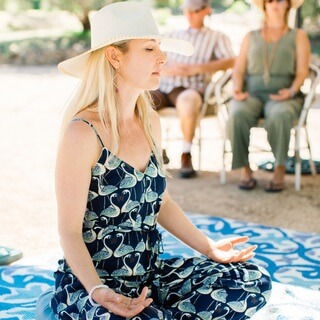
So last week,
I actually experienced from a lot of people sending in messages,
Something that came with the word ending,
Which was relief.
And relief is,
It's a tricky word.
In psychology because there's a lot of the seeking of relief,
Like our attempts to get relief,
Actually can make us more entangled in our pain.
And we can think of all the things that we do to get relief that make it worse.
I used to catch butterflies when I was a little girl.
I had a friend named Katie Sorenson,
And I'd go to her house,
And she had this beautiful field outside her house of Lantana,
Which is this little orange and red flower that grows here in Southern California.
And lantana is a butterfly magnet.
And we would run around the yard looking for butterflies.
And then we'd find one,
And we'd put a jar over it,
And we'd catch it,
And then we'd bring it in.
And I always noticed that there was something that happened when I tried to catch that butterfly and we put it in the jar,
That it lost all of the magic,
Right?
So relief has that quality.
As soon as we're trying to force it or catch it,
We end up losing the relief of just it coming.
To us.
There's three half-truths about relief.
One is that relief comes from eliminating the stressor.
I used to have a colleague that I would always ask her how she was doing,
And she'd always say,
Well,
At the end of this month,
Or when this deadline is done,
Or when we're through the holidays,
Or when the kids are back in school,
Then things are going to get better.
She always had this timeline of when it was going to end,
And then it was going to get better.
And every time when I'd see her the next time,
She'd have the next thing that was going to end and things were going to be better.
Sometimes the pain that you're experiencing may not.
End or may change or maybe you're choosing to be in a certain experience that's painful for you because it's meaningful and it matters to you and the relief isn't getting rid of that thing.
So how can you find relief even with.
.
.
The pain.
And that's a lot of what our practice is here,
Is to find the spaces where the butterfly lands.
If you think about something that has stressed you out or you're struggling with in your life,
When relief comes to you,
When you've actually experienced relief with that stressor,
And it's usually not the expected,
So we don't necessarily need to eliminate the stressor to experience relief.
Sometimes eliminating the stressor is good,
But there's always going to be stressors.
Relief,
Another myth or half-truth about relief is relief is something you get to when the work is done.
And as someone who has her,
Her PhD,
It was always that it was always like,
Well,
As soon as I,
You know,
Do this,
Then I can then I can rest.
And often what I would find myself doing is,
Getting to the place of rest and just spinning in the anxiety of it all.
And I couldn't settle down.
When I started practicing yoga with Eddie at Yoga Soup many,
Many years ago,
I was like 17 years old when I started practicing with him,
He would do a practice of Shavasana throughout the class.
Like we'd be doing sun salutations and moving our bodies and then he'd lie down mid-class.
And it always felt bizarre to me.
Like,
Aren't you supposed to do that at the end?
But I get it now.
Relief is here,
It's now.
The premise isn't that it's somewhere else or some other time where you get to the end of it.
And then the third half truth is relief is a product you can buy.
So now we have an industry that is selling us relief because we're all experiencing extreme levels of stress and busyness and too much coming in.
And so there's people that are poised to sell you relief in a box.
And it actually is not a product that you can buy.
It's actually something that's already here.
So today I'm gonna go over,
This is a biopsychosocial contextual model and this comes from psychological science and process-based therapy.
But I want us to kind of start to explore ourselves as this living,
Breathing ecosystem.
And when you're experiencing distress or pain or just the troubles of living,
How do you create conditions to support the relief that's already here.
Conditions in the biological,
Psychological,
Social,
And contextual level.
And I would add conditions that support this bigger context that holds all of it.
Which are conditions for months.
So let's break it down.
I had this client this week who said to me,
He said,
You're my Klonopin.
Subtle.
And he's very,
Like,
Super scheduled,
Very busy,
Every single minute of his day has something in it.
And this was the the 50 minutes that he didn't have something,
Right.
And it was also the 50 minutes that we would always do some kind of breathing practice together.
So at the biological level,
There's a lot of supports for you in terms of relief.
And you have to kind of figure out the ones that work best for you.
Breathing and deep breathing has so much science behind it,
Just five minutes of deep breathing.
And there's some evidence that the deep breathing practices that we do are even extra beneficial for older adults.
So they've done studies where they've compared people in their 20s versus people in their 60s and beyond,
Like 65.
These type of slow breathing exercises were especially beneficial for older adults.
There's one that I learned from Annette Knopp,
Who's one of my meditation teachers at Blue Spirit,
And she taught me this butterfly breath.
So you could do this with me as I'm talking.
You take your hands and you make a little butterfly,
Back to catching butterflies.
And then you place your hands right here on your chest.
And there's just relief in making contact with your body.
And then as you breathe in,
You can open your wings.
And then as you breathe out,
Close your wings.
You could just do this with me as I'm talking and notice how it feels.
To be a little butterfly just landing on your chest.
There's the relief of singing.
Singing,
Our traditions around singing and humming and singing together,
I think have gotten lost.
I was reading one of Rosemary Trommer's poems this past week,
And she writes a poem every single day.
And on September 13th,
She wrote the poem,
That anxiousness that's nested in my chest,
Singing it a lullaby.
So the relief in using your voice that also activates your vagus nerve,
This deep breathing that activates your vagus nerve,
The relief in movement,
Going for a walk.
What I want you to think about this week is just notice what types of biological interventions bring you the most relief and it isn't something that you need to buy.
You have a whole nervous system that is available to move into this deeper rest relief space,
Even when you're under stress.
And then there's a lot of stuff around psychological relief.
Clean pain,
Dirty pain is a term that we use in act a lot.
And I know personally about dirty pain,
Which is when we take the pain we're in and we stir it up.
And we stir it up by resisting it,
By suppressing it,
By adding all sorts of story to it.
So think about something that's causing you distress right now.
And how you move from it being clean distress,
Like this is hard,
This is painful,
I'm doing a hard thing,
I'm going through a hard stage of my life,
And it turns into the dirty pain by what you're adding to it or how you are actually suppressing it.
There's a good amount of research on that.
Like trying to not feel even physical pain,
You see rises in people's cortisol and in their heart rate.
It actually makes you more stressed to not to feel stress.
With chronic pain patients,
The predictor of chronic pain,
People doing better with chronic pain,
Is not the intensity of the pain.
It's how willing they are to accept it.
This is the practice of acceptance.
So we can begin with just taking care of our physiology.
But then as we'll do in our meditation today.
Take care of your psychology.
Or as Oliver Berkman says,
Not being your own worst enemy.
Not being your own worst enemy.
So I was watching people this week and always working on the word of the week,
The week before,
And I was paying attention in my practice,
Like what brings,
Over the course of a session,
What brings someone this little bit of relief where I notice they're moving from here to here.
Or I notice an opening in their mind.
And just yesterday in speaking with a client,
She said to me,
You know,
I just,
It just helps so much to get this,
Like a perspective on this.
That zoom out.
So instead of in the figuring it out,
You zoom out and you create a bigger space and perspective for whatever you're experiencing.
It's like putting a drop of paint in a glass.
Or putting a drop of pain in an ocean.
Pay attention to that,
How you're adding to dirty pain.
And can you be at the level of clean pain,
Acceptance of what is.
And we're doing this,
I put love in here because we're doing this all in the context of love.
The next component,
If we move out into yourself as this like biopsychosocial,
Spiritual,
Contextual being,
Is social.
And I started this series called Tell the Truth because I believe in the power of truth-telling,
Not confessional truth-telling,
But in confiding,
First confiding with ourselves,
Like what is true for me,
But also confiding our truths or even our secrets to others.
And I will share a research article on truth-telling and how just confiding in another human creates this relief that you're not carrying it alone,
Which is a lot of what therapy is about,
Right?
Or good friends.
I just can't wait to go for a walk with this friend because I have to tell her what's going on for me.
And the the aspect of even when they've had people look at,
Like they're holding a secret,
If you're holding a secret,
And you look at a mountain,
They've done studies where they've had you look at the mountain and predict how steep a trail is up that mountain and how long a trail is up that mountain.
And when you're holding a secret,
If you're keeping that secret to yourself,
It looks steeper and longer.
So much of our relief comes from being able to express the things that we feel shame around with someone that is emotionally supportive to us.
And so much of our relief also comes from the practice of generosity.
In Oliver Berkman's book,
Meditation for Mortals,
He talks about doing generous acts.
And he says in here that,
Act on a generous impulse the moment it arises.
The point isn't to try to render yourself more generous than you are,
But just to notice the moments when you naturally and effortlessly feel that way.
Anyway.
Than not to screw it up with overthinking.
So this aspect of social relief comes from both us confiding and seeking emotional support,
But then also us being generous with our support.
And in our relationships,
Little new baby relationships are like little seeds.
They need frequent watering,
Frequent acts of impulsive generosity.
And then our bigger plants,
Our deeper relationships need deep watering.
Deep acts of generosity,
Appreciation,
And that brings relief.
I was in a coffee shop yesterday and I overheard a mom and daughter,
An older woman,
This woman was like in her 80s and she had bright lipstick and big bright red earrings and the daughter was helping her out and they were talking about how she needed more grounding exercises and where could she get some relief from her anxiety.
And I had this moment,
I was working in there,
I was like,
Why don't I just tell her about this meditation that we have?
And so they were leaving and it was an impulsive act of generosity.
I like flagged them down and I was like,
I'm just noticing you're such a beautiful relationship of mother and daughter in a coffee shop spending time together and a daughter helping you.
And why don't you come to this meditation that I have tomorrow?
I'll text it to you.
Impulsive acts of generosity will bring you relief,
And then there's a possibility it will bring others relief,
Too.
Which brings to this last one before we meditate,
Which is context.
Sometimes the relief comes from,
Again,
Not changing anything,
But maybe changing and shifting where we're placing our attention and the stressors are still there,
But the context can be different.
So nature,
Being in nature,
Even just images of nature,
Like looking at the nature behind me,
Has been shown to give you a little bit of relief,
Like attentional relief.
And the key component of nature is not how long you spend in it.
Or who you spend it in with or how much time with other people,
But it's really how restorative is it to you.
So with all of these aspects of relief,
This third noble truth,
Which is Naroda,
That relief is possible in the here and now,
We're going to practice them.
And what I want for you is to see and just be a sort of observer of what brings you relief.
And you may be surprised it's not getting rid of anything.
It's not figuring anything out.
It's actually relaxing into what already is.