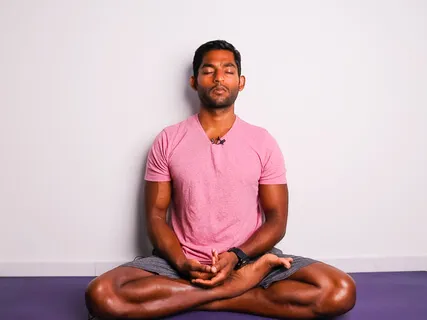
Namaste and a very warm welcome to all of you in this daily live meditation session with me,
Dhyansai.
My salutations to the knowledge of yoga,
To Patanjali who brought this knowledge to us and for us to have this opportunity to go through this knowledge and bring freedom to our life.
What is freedom?
We want so many things in life but we never even think of having freedom in life.
And even if we think of having freedom in life,
What are we meaning by freedom?
We are wanting maybe freedom of choice to have everything that we desire in the world.
Freedom for us in our imagination might mean a lot of money,
A lot of travel possibilities and freedom to execute ourselves.
But what is this freedom?
What are we really wanting when we say we want freedom?
Think about it.
Even if you become the richest man or woman in this world,
Are you free?
Is the richest man or woman in the world right now,
Is he or she free?
The same miseries,
The same sorrows,
The same unhappiness,
The same sadness,
The same inner trouble.
Why is what everything that is outside unable to give freedom?
Perhaps how we look at freedom,
How we understand freedom needs to be understood more deeply,
Needs to be redefined for us.
See that when we are looking for freedom,
We are looking for freedom of choice,
Freedom of desires,
Freedom of experiences.
This is what we are trying to mean when we say freedom.
Freedom of choice so that we have an unlimited set of options.
Freedom of experiences so that we can do whatever we want,
We can travel,
We can eat wherever we want,
Whatever we want.
Freedom of desire to push our desires onto the world as much as we want.
This is our current understanding of freedom.
This is where when we mean freedom,
We push our energy into,
We work towards it,
We make all the efforts towards freedom of things,
Freedom of choice,
Freedom of desire,
Freedom of experiences.
But there is another kind of freedom,
Because this freedom of choice,
This freedom of everything that we are right now talking about,
We have seen that again and again and again in history with evidences that those who have reached to that freedom were never free.
They only concluded when they reached to that freedom that they are not free.
They concluded only when they reached to that freedom that all that effort to reach up to that point was somewhat misleading.
They were looking for something else and then they reached somewhere else.
Where they have reached is not a bad place to be.
Definitely when you have more options,
When you have more choices,
When you have more experiences,
That too is some kind of freedom,
That too is some kind of expansion.
But does that really lead to true freedom?
That you have to contemplate yourself,
Ask yourself,
Put yourself in that situation where whatever you are chasing in life,
Whatever desire,
Experience you are chasing in life,
If you have it all,
Is that freedom?
Is that all?
Is that where the journey stops?
Is that where you have answered the question that you were trying to answer for yourself all throughout this effort,
This journey?
Ask yourself.
And if the answer is no,
If the answer is definitely not a yes,
Then consider the other possibility which is the freedom from.
Freedom from to have,
To choose these choices,
Freedom from the desires,
Freedom from the experiences.
You may misunderstand this,
So be very contemplative about what I mean by freedom from.
Freedom from choices does not mean that you don't have a choice.
Freedom from choices means that yes,
You have that expanded set of choices,
But you are also free from the compulsion to choose.
Freedom from desires does not mean that you have no desires.
It means that yes,
You have that expanded set of desires,
But you're also having not the compulsion to always have to do what your desires make you do.
Freedom from experiences similarly also mean that you are not compelled all the time to look for experiences,
To look for sensory experiences all the time or spiritual experiences all the time.
Any kind of experiences that you are looking for,
You have also that you can come out of that compulsion of that experience,
Wanting that experience,
Wanting that desire,
Wanting that choice.
So remember,
There are two types of freedom,
Freedom of,
When you make efforts in the outside world,
You expand by having freedom of all the choices,
All the desires,
All the experiences,
And when you are on the path of yoga,
When you are on the path of meditation,
You attain to freedom from all this.
Not that you have to renounce all this,
But you are free from all this.
And that is the ultimate freedom,
Because from that positioning,
From the position where you are free,
You finally actually are able to enjoy all the experiences,
Desires,
Choices of life,
Really,
Truly,
By being a master of them,
By being on top of them,
And not always under them.
This is the path of yoga,
This is the path of meditation,
And Patanjali,
In his yoga sutras is slowly taking us towards this freedom step by step,
Slow steps,
Small steps,
So that we can follow along,
So that we can move along,
So that our consciousness expands,
So that we are not facing anything so abrupt that it turns us off from the path.
Let us look into the sutras for today,
Before we sit in meditation.
Patanjali says,
Eta eva savicara nirvicara cha sukshma vishaya vikhyata,
By this process with discrimination and without discrimination,
Whose objects are finer,
Are also explained.
What that means is,
Remember that we are discussing the movement of yoga,
Which is from many objects,
From lots of things,
To bringing your mind to one,
And from moving from that one to none.
This movement of yoga I have been explaining in the last couple of sessions,
And emphasizing and repeating,
Because this movement is what is the basic foundation of what Patanjali in these sutras is bringing out.
So you have to understand this before you can appreciate what right now Patanjali is bringing out.
So here he says,
By this process,
Yesterday we looked into this process,
Which is the process of,
Firstly,
That we have all the time,
We are reasoning everything out with the mind,
So moving away from the randomness of the mind to the reasoning of the mind,
And then even dropping that reasoning,
That was the process,
That was the movement that we took yesterday.
And now Patanjali says,
By this process with discrimination and without discrimination,
Whose objects are finer are also explained.
What are these objects?
Here he is talking about Savicara,
Nirvachara Samadhi,
Savicara is with the thought,
With the contemplation,
And Nirvachara is without the thought,
Without the contemplation.
So see that we are moving not only in the direction of from many to one,
From one to none,
But we are also moving in depth.
The other dimension is of the depth,
In the beginning when we are meditating,
We have all these reasonings,
All these logics that are floating around in our mind,
And Patanjali encouraged us to move from reasoning to having no reasoning for a moment,
Dropping all the reasoning.
Then he says,
Go deeper,
One level deeper,
Below the reasoning,
What is there below the reasoning,
All the thoughts,
All the contemplations that we have,
Those contemplations which come in the form of thoughts,
Which come in the form of an inner conversation,
Which comes in the form of imagery,
All those contemplations he is saying,
Move away also from those contemplations,
From those thoughts,
To a place where there is no contemplation,
Where there is no thought.
Moving from savichara samadhi,
A concentration,
A meditation,
Where there is thought,
Where there is contemplation,
And then moving towards where there is no thought,
Where there is no contemplation.
Then he says sukshma vishyatvan chalinga pariavasanam.
What that means is,
The finer objects end with the pradhana,
With the highest,
With the highest form,
Which is the sense of I.
When we are in meditation,
And when we go deeper,
When we have let go of the reasoning,
When we have let go of the thoughts,
When we have let go of all the contemplations,
Then what is left is the sense of I,
Is that sense that I have a form,
There is a form in which our consciousness is captured,
There is a form in which our consciousness is contained,
That form we call as I.
He says even you can dilute that,
With the same flow,
With the same movement,
From the object to no object,
Once you learn this movement,
Once you get the knack of it,
Once you learn the trick of it,
Once you have the experience of it,
Then you can move from the object to no object,
And in this case,
You can even move away from the subtlest of objects in your inner awareness,
That is the sense of I,
To also a place where this becomes also it dilutes,
And there is no sense of I anymore,
Only pure consciousness remains.
Let us practice that,
Let us take this from the sutras into the experience,
Into our own lives,
By meditating upon this journey,
Upon this movement of first of all,
From many,
From the randomness that is there in our mind,
To putting our mind into stability,
Into one pointedness on one object,
And then moving into an objectlessness,
Letting go of that object.
And as we do that,
Our mind settles into a deeper layer,
Again captures an object,
We move away from that object,
We let go of that object,
Mind settles further deeper into the subtler objects,
And so on.
So that process continues in two dimensions,
From the object to the objectlessness,
And from the gross to the very subtle.
Let us close our eyes,
And move into this movement of yoga,
Of meditation,
Make sure your posture is upright and comfortable.
Start with your awareness of what you perceive from your senses,
From the very eyes,
From the very outer objects.
In this moment,
Whatever you perceive,
The sounds,
The ambient noises,
The smell,
The feeling on your skin,
The light in front of your closed eyes,
In this moment,
Whatever you perceive,
These gross objects bring your awareness to your sense perception.
At all times,
Let the breath flow naturally,
Gently,
Allowing your body to settle,
Allowing your mind to settle in the process of meditation.
As you have become aware of this moment,
All the sense perceptions,
All the senses,
All the sounds,
The ambient noises,
The smells,
And everything else that your senses are bringing to your awareness,
Slowly move away into your inner space,
Leave these outer perceptions outside and move your awareness to your inner space.
Let the breath flow naturally,
Gently,
Allowing your mind to settle in the process of meditation.
As your awareness settles,
Let the breath flow naturally,
Gently,
Allowing your mind to settle in the process of meditation.
Whatever arises in your mind,
Let that go,
The reasoning,
Thoughts,
Contemplations,
These thoughts move from the awareness on the objects to letting go of these objects in your awareness.
Let the breath flow naturally,
Gently,
Allowing your mind to settle in the process of meditation.
Let the breath flow naturally,
Gently,
Allowing your mind to settle in the process of meditation.
Whatever arises in your consciousness,
In your mind,
Let that go,
And with your awareness,
Move deeper.
Notice,
As your mind settles,
There is this sense of I,
I,
I,
I,
I,
I,
I,
I,
I,
I,
I,
I.
Become aware of the sense of I,
Sense of form,
Sense of form,
Sense of form,
Sense of form,
Sense of all.
Hold your awareness on this sense of I am.
The Emness.
And slowly let that melt.
Let that sense dissolve.
And only pure awareness,
Consciousness remains.
Let that sense dissolve.
Let that sense dissolve.
In this pure silence,
Pure awareness,
There is objectlessness.
Awareness contains no objects.
Let that sense dissolve.
Stay in this silence.
Stay in this awareness.
Let that sense dissolve.
From here on,
If you wish to meditate further,
Maintain this silent meditative state.
Stay as long as you like before opening your eyes.
Or very gently and slowly,
You may open your eyes,
Maintaining this sense of awareness and inner silence.
This inner silence and awareness is the door to freedom.
To freedom from.
Think about it.
Contemplate on it as you proceed with your day.
I will see you tomorrow at 7 am,
Central European Time.
Namaste.