Welcome to the Religion of the Month Club,
Where we discuss texts from the world scriptural traditions.
In this episode,
We will be discussing the first chapter of the book of Genesis.
In the beginning,
When God created the heavens and the earth,
The earth was a formless void and darkness covered the face of the deep,
While a wind from God swept over the face of the waters.
Then God said,
Let there be light,
And there was light.
And God saw that the light was good,
And God separated the light from the darkness.
God called the light day,
And the darkness He called night.
And there was evening,
And there was morning,
The first day.
And God said,
Let there be a dome in the midst of the waters,
And let it separate the waters from the waters.
So God made the dome and separated the waters that were under the dome from the waters that were above the dome,
And it was so.
God called the dome sky,
And there was evening,
And there was morning,
The second day.
And God said,
Let the waters under the sky be gathered together into one place,
And let the dry land appear.
And it was so.
God called the dry land earth,
And the waters that were gathered together He called seas.
And God saw that it was good.
Then God said,
Let the earth put forth vegetation,
Plants yielding seed,
And fruit trees of every kind on earth that bear fruit with the seed in it.
And it was so.
The earth brought forth vegetation,
Plants yielding seed of every kind,
And trees of every kind bearing fruit with the seed in it.
And God saw that it was good.
And there was evening,
And there was morning,
The third day.
And God said,
Let there be lights in the dome of the sky to separate the day from the night,
And let them be for signs,
And for seasons,
And for days,
And years,
And let them be lights in the dome of the sky to give light upon the earth,
And it was so.
God made the two great lights,
The greater light to rule the day,
And the lesser light to rule the night and the stars.
God set them in the dome of the sky to give light upon the earth,
To rule over the day and over the night,
And to separate the light from the darkness.
And God saw that it was good.
And there was evening and there was morning,
The fourth day.
And God said,
Let the waters bring forth swarms of living creatures,
And let birds fly above the earth,
Across the dome of the sky.
So God created the great sea monsters,
And every living creature that moves of every kind with which the waters swarm,
And every winged bird of every kind.
And God saw that it was good.
God blessed them,
Saying,
Be fruitful and multiply,
And fill the waters and the seas,
And let birds multiply on the earth.
And there was evening and there was morning,
The fifth day.
And God said,
Let the earth bring forth living creatures of every kind,
Cattle and creeping things,
And wild animals of the earth of every kind.
And it was so.
God made the wild animals of the earth of every kind,
And the cattle of every kind,
And everything that creeps upon the ground of every kind.
And God saw that it was good.
Then God said,
Let us make humankind in our image,
According to our likeness,
And let them have dominion over the fish of the sea,
And over the birds of the air,
And over the cattle,
And over all the wild animals of the earth,
And over every creeping thing that creeps upon the earth.
So God created humankind in His image.
In the image of God,
He created them.
Male and female,
He created them.
God blessed them,
And God said to them,
Be fruitful and multiply,
And fill the earth and subdue it,
And have dominion over the fish of the sea,
And over the birds of the air,
And over every living thing that moves upon the earth.
God said,
See,
I have given you every plant yielding seed that is upon the face of all the earth,
And every tree with seed in its fruit.
You shall have them for food.
And to every beast of the earth,
And to every bird of the air,
And to everything that creeps on the earth,
Everything that has the breath of life,
I have given every green plant for food.
And it was so.
God saw everything that He had made,
And indeed it was very good.
And there was evening,
And there was morning,
The sixth day.
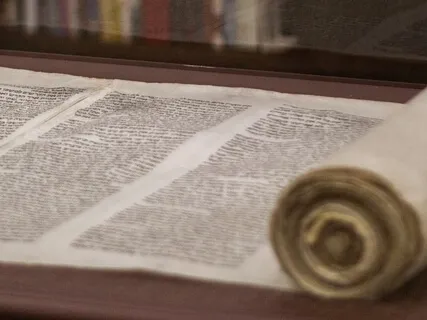
This is the first book of Genesis,
The first book of the Bible,
The first book of the Torah.
It's probably the first page in most people's experience with Scripture,
If they have one.
It is not the oldest,
Although it is one of the oldest texts.
This text in particular,
The first chapter of Genesis,
Is associated with,
Is attributed to an author who is referred to as E.
The reason for that being that the name of God used in this piece of Scripture is Elohim,
To contrast it with the author of other parts of the Torah,
Which use the tetragrammaton,
Or in Hebrew,
Yod-hey-vav-hey,
Which is,
Nobody knows definitively what the pronunciation is.
A lot of people pronounce it Yah-way.
Actually,
The name Jehovah comes from a mispronunciation of the tetragrammaton.
So the two authors of the,
The two original authors of the Torah are distinguished by which name of God they use.
The book of J is actually the older of the two.
The book of J is,
According to the New Oxford Annotated Bible,
The J,
Or Yah-wistic,
Source was written in Judah around the time of David,
The reign of David,
Or Solomon,
Which would have been around the 10th century BCE.
That's before the Common Era,
Or BCE before Christ,
As Christians would refer to it.
Whereas the book of E,
Or the Elohistic source,
Was written in the northern kingdom of Israel sometime during the 8th century BCE,
So that would have been 200 years later.
Some people think that the book of J actually had a part to it that covered the creation,
Or covered the aspects of creation that were,
That are covered in this chapter in the book of E,
That was essentially discarded when the redactors formulated the Torah the way that they did,
That they stitched together the different pieces.
So,
To recap,
Basically what happened is,
Around the 10th century BCE,
The book of J was written,
That is the Yah-wistic source,
That starts in Genesis 2,
Verse 4,
So that's actually after the passage that we just covered.
And then the book of E was written 200 years later,
In the northern kingdom.
Then comes the third portion,
Which was written probably sometime after 586 BCE,
While the Judean leaders were living in exile in Babylon.
So that is referred to as the priestly source,
Or the book of P.
And then finally,
The whole Torah was probably compiled around the time of Nehemiah and Ezra,
And this was when the Israelites had returned to Jerusalem to rebuild the temple,
So this is the time of the second temple.
So basically,
What we have is a text that was developed over many centuries,
Half a millennia really,
That was originally different stories that were brought together.
And some people think that basically the goal of the non-priestly authors,
The redactors who were creating this single text,
Were doing so for very political reasons,
Basically to unite the people who had been essentially different tribes.
And later in Genesis,
The twelve tribes of Israel are described,
And you've probably heard that term,
The twelve tribes of Israel.
So we shouldn't think of this necessarily as one single text.
The piece that I just read is one single text.
We assume that most of it,
If not all of it,
Does come from a single source.
That is just the first chapter of Genesis.
It actually extends to the next three verses of chapter two as well,
In which the seventh day is described in which God rests.
The whole story of Adam and Eve,
That's all part of the book of J,
Which starts on Genesis chapter 2,
4.
Now going back to why this book is called Bereshit in Hebrew,
The five books of the Torah,
Or the Pentateuch,
Are named in Hebrew after the first word in each of the books.
So the first word of Genesis in Hebrew is Bereshit,
Which means literally in the beginning.
You might notice that I'm using many different names to describe this text.
The Torah,
The Pentateuch,
Genesis,
Bereshit.
Bereshit and Genesis are the same.
The Pentateuch and the Torah are the same.
They're just different names for the same thing.
The Torah,
Or Torah rather,
Not the Torah.
Torah is Hebrew and Pentateuch is Greek.
Genesis is Greek.
Bereshit is Hebrew.
The Torah is the first book in both the Hebrew Bible,
Which is sometimes referred to as the Tanakh.
The Tanakh is essentially an acronym of the three books of the Tanakh,
Or the three,
Actually three sections of the Tanakh.
The first being the Torah,
So Ta in Tanakh is short for Torah.
And then the other two,
Which refer to the history and to the prophets.
The Hebrew Bible,
The Tanakh,
Is almost the same,
But not exactly the same as the Old Testament,
According to the Christians.
The order is different.
There are some books that are in one that aren't in the other,
But they're pretty much the same.
Most of it is the same.
It's also worth mentioning that Catholics and Protestants don't entirely agree on what should be kept in and what should be left out of the Bible.
So the Old Testament for Catholics is not exactly the same as the Old Testament for Protestants,
But again,
Most of it is the same.
And then later we'll go and get into the New Testament,
Which includes the Gospels and so on and so forth.
And of course that is specific to Christians,
Though Muslims do refer to both the Old Testament and the New Testament as sort of previous or prior scriptures,
Which can be helpful in elucidating the Qur'an,
Which is their sacred text,
Although they consider the Bible to be adulterated and therefore not entirely trustworthy.
And to a certain extent they're right about that,
Because the Bible has been changed over time.
It has many different authors.
They don't always agree.
So you'll find inconsistencies in the Bible.
You'll find inconsistencies in the first two chapters of Genesis.
So in the piece that we just read,
God creates man and woman in one statement.
So He says,
So God created humankind in His image.
In the image of God,
He created them.
Male and female,
He created them.
This is very different from what happens in Genesis 2,
Where He creates Adam,
And Adam is going around alone for a long time,
And God sees that Adam is lonely and then eventually creates Eve out of Adam's own body.
So it's kind of interesting that there is these dual creations of humanity.
And some have said that there's,
I think,
A midrash that says that actually the woman in these two stories is not the same,
That in Genesis 1,
The female human that is created is Lilith,
And that Lilith was actually cast out.
And so there's basically the idea that there's a missing story between Genesis 1 and Genesis 2,
Where Lilith is cast out because she refused to lie beneath Adam.
And so then Adam is lonely,
And God creates a second wife for Adam,
One who is more submissive.
Obviously there's a lot of fun that one can get into with regard to women's rights and feminism and how to interpret that piece of text.
But right now we want to focus on Genesis 1.
So there's definitely a lot to get into here as well.
So one thing that's kind of interesting is the way in which God creates everything in this text.
God does it by decree.
So this is very much as though he were a king giving his pronouncements.
He doesn't actually do any work directly.
He says,
Let the waters under the sky be gathered together into one place,
And let the dry land appear,
And it was so.
So I don't know if this is supposed to imply that there were a host of angels who were doing this,
Or other spirits,
Or how that's supposed to work,
Or if it just happens,
Or if nature simply responds to God's word directly.
One thing I'd like to point out here that I think is often missed is that there are six days of creation,
And in all but the second God says,
And it was good.
So just to recap,
In the first day God creates the light.
He says,
Let there be light,
And there was light,
And God saw that the light was good.
And he separates the light into day and night.
And in the second day,
It says,
Let there be a dome in the midst of the waters,
And let it separate the waters from the waters.
And at no point in this paragraph,
Which runs from verse 6 through verse 8,
Does God say that it was good.
It simply says,
And there was evening,
And there was morning,
The second day.
And then beginning on the third day,
And God said,
Let the waters under the sky be gathered together into one place,
And let the dry land appear.
And then that ends with,
And God saw that it was good,
And there was evening,
And there was morning,
The third day.
So every day except for the second day is said to be good.
This is easily missed because the repetition that's in the Bible,
You start to kind of mentally fill in the blanks.
But it's very significant,
I think,
That this second day is not considered to be good.
And what some scholars have said is that the reason why that is so is because in the second day,
God isn't actually creating anything.
Well,
He says,
Let there be a dome in the midst of the waters,
And let it separate the waters from the waters.
But this is the one point where He is separating creation.
He's creating space in the waters in order to continue creating things.
But He's not really creating anything at this point.
He's just making space.
He's separating.
And this separation,
There's a theme that runs through the Judeo-Christian theology,
That of separation,
And separation generally being a bad thing.
And so later on in an account of Adam and Eve being cast out from the Garden of Eden,
That is again another form of separation from the Garden of Eden,
And so on.
And in some Christian theology,
The idea of hell isn't so much this burning terrible thing that you see in Dante's Inferno,
Which actually goes back to,
I'm forgetting the name,
But eternal grounds that were a place for burning bodies.
Some Christians believe that hell is really just separation from God.
And so the idea is that when you die,
If you're a believer,
You go to God,
And if you're not,
You don't.
And that is hell.
That's it.
That's what's so terrible about hell,
Is that you're separated from God.
So,
Separation is generally considered to be a bad thing,
Although sometimes a necessary thing.
So obviously if God hadn't separated the waters,
Hadn't created a dome to stand between the waters and the waters,
There'd be no place to put land,
There'd be no place to put life.
So it's necessary.
But it's not good.
It's not considered good.
By whatever definition of good was in the mind of the author or authors of the Book of Eve.
So I think that's worth calling out.
Another interesting aspect of this text,
And this is true of really any scripture,
Is that you always have to understand that it is written in a historical context.
Much of the time,
Especially with texts this old,
The historical context may be largely lost.
So,
In this case,
The people in northern Israel who were writing this,
The Elohist author or authors,
Were amidst many other competing religions and cults around,
And what's the difference between a religion and a cult anyway,
But I guess a religion is bigger maybe,
Or more established.
But anyway,
There are many other faiths happening around them.
And each of these faiths are often defining themselves in opposition to one another.
So one example of this that's mentioned again in the New Oxford Annotated Bible,
Which I highly recommend for anyone who wants to study this more,
Get the fully revised fourth edition if you can,
Is it refers to the deep.
In verse 2,
The earth was a formless void and darkness covered the face of the deep,
While a wind from God,
Blah,
Blah,
Blah.
So the deep in Hebrew is tehom.
It says tehom has no definite article attached to it in Hebrew.
Some scholars understand tehom to be related to the Babylonian goddess Tiamat,
A deity representing primeval oceanic chaos,
Whom the head god Marduk defeated in Enuma Elish,
This is a text that we do have,
A major Babylonian myth that includes an account of creation.
So basically they're saying our god,
Elohim,
The Elohim,
Is subjugated through the power of his word,
Tiamat,
Or tehom.
We don't really know for sure,
But that's an interesting interpretation.
Finally,
I want to get into the name Elohim itself.
Elohim is a very interesting word.
It's probably one of the more interesting names of God.
So Elohim and the tetragrammaton Yod-Heh-Vav-Heh are very interesting names of God.
Yod-Heh-Vav-Heh is interesting because it has no proper pronunciation that we know of.
And there's also a lot of symbolism that goes into Yod-Heh-Vav-Heh and a lot of kabbalistic analysis that maybe we can get to in a later episode.
But for now let's focus on Elohim because that's the name of God used in this chapter.
Elohim is a plural word.
So it might be more correct in verse 27.
Instead of reading,
So God created humankind in His image.
In the image of God,
He created them.
Male and female,
He created them.
It might be more correct to say,
So the Elohim created humankind in their image.
In the image of the Elohim,
They created them.
Male and female,
They created them.
Read in this way,
I think it has a different kind of connotation,
A different feeling.
It's no longer one king stating this,
But it is a collection,
Or a collective,
If you will.
In fact,
The plural word for God is not unique to the Elohist source.
It also comes up in the Qur'an.
Though,
Over and over again,
Both the Torah and the Qur'an say that God is one.
They're very,
Obviously,
Focused on monotheism.
But what monotheism means is somewhat of a fluid concept.
And I think it deserves some looking into.
It's said that,
Actually,
In the early days before the Torah was finalized,
The Hebrews,
Or the Israelites,
Which are not the same,
But I'm not going to try to distinguish between them,
That the early Israelites were not exactly monotheist,
But henotheist.
So,
Henotheist means that you believe that other gods exist,
But you think that your god is the strongest god,
Or is the main god,
Or the better god,
Or whatever.
And so this goes back to what I was saying before about how this book of the Bible shows how their god was able to subjugate Tiamat through the word,
Through what he said,
Or what they said.
It wasn't that the authors of,
Or author of this text didn't believe in Tiamat.
Obviously,
If that hypothesis is correct,
They obviously did believe in Tiamat,
But had a different interpretation of what Tiamat meant,
Or stood for.
So,
When it comes to,
As the religion evolves and eventually becomes monotheistic,
The plurality of divinity becomes collapsed into one.
So,
In almost every version of the Bible that you'll see,
You'll see God referred to in the singular.
But it's possible that the proper interpretation,
At least in the E-texts,
Is to really see the Elohim as a collection,
Or as a collective.
In the book of J,
Jehovah,
Or Yahweh,
Is very clearly an individual.
He's very anthropomorphic,
He has a personality,
He gets angry easily.
But with the Elohim,
It's definitely a different kind of thing.
So I think it's worth it to consider it in that way.
So now that we've discussed some of the aspects of this text in terms of its historical context,
Let's read it one more time and see if anything new pops out.
And this time I will read it substituting the phrase,
The Elohim,
In place of God,
And use the plural pronoun when appropriate.
And there was morning,
The first day.
And the Elohim said,
Let there be a dome in the midst of the waters,
And let it separate the waters from the waters.
So the Elohim made the dome,
And separated the waters that were under the dome from the waters that were above the dome.
And it was so.
The Elohim called the dome sky,
And there was evening and there was morning,
The second day.
And the Elohim said,
Let the waters under the sky be gathered together into one place,
And let the dry land appear.
And it was so.
The Elohim called the dry land earth,
And the waters that were gathered together they called seas.
And the Elohim saw that it was good.
Then the Elohim said,
Let the earth put forth vegetation,
Plants yielding seed and fruit trees of every kind on earth that bear fruit with the seed in it.
And it was so.
The earth brought forth vegetation,
Plants yielding seed of every kind,
And trees of every kind bearing fruit with the seed in it.
And the Elohim saw that it was good.
And there was evening and there was morning,
The third day.
And the Elohim said,
Let there be lights in the dome of the sky to separate the day from the night.
And let them be for signs and for seasons and for days and years.
And let them be lights in the dome of the sky to give light upon the earth.
And it was so.
The Elohim made the two great lights,
The greater light to rule the day,
And the lesser light to rule the night,
And the stars.
The Elohim set them in the dome of the sky to give light upon the earth,
To rule over the day and over the night,
And to separate the light from the darkness.
And the Elohim saw that it was good.
And there was evening and there was morning,
The fourth day.
And the Elohim said,
Let the waters bring forth swarms of living creatures,
And let birds fly above the earth across the dome of the sky.
So the Elohim made the great sea monsters and every living creature that moves,
Of every kind,
With which the waters swarm,
And every winged bird of every kind.
And the Elohim saw that it was good.
The Elohim blessed them,
Saying,
Be fruitful and multiply,
And fill the waters and the seas,
And let birds multiply on the earth.
And there was evening and there was morning,
The fifth day.
And the Elohim said,
Let the earth bring forth living creatures of every kind,
Cattle and creeping things,
And wild animals of the earth of every kind.
And it was so.
The Elohim made the wild animals of the earth of every kind,
The cattle of every kind,
And every thing that creeps upon the ground,
Of every kind.
And the Elohim saw that it was good.
Then the Elohim said,
Let us make humankind in our image,
According to our likeness,
And let them have dominion over the fish of the sea,
And over the birds of the air,
And over the cattle,
And over all the wild animals of the earth,
And over every creeping thing that creeps upon the earth.
So the Elohim created humankind in their image.
In the image of the Elohim they created them.
Male and female they created them.
The Elohim blessed them.
And the Elohim said to them,
Be fruitful and multiply,
And fill the earth and subdue it,
And have dominion over the fish of the sea,
And over the birds of the air,
And over every living thing that moves upon the earth.
The Elohim said,
See,
I have given you every plant yielding seed that is upon the face of the earth,
And every tree with seed in its fruit.
You shall have them for food,
And to every beast of the earth,
And to every bird of the air,
And to everything that creeps on the earth,
Everything that has the breath of life,
I have given every green plant for food,
And it was so.
The Elohim saw everything they had made,
And indeed it was very good.
And there was evening,
And there was morning,
The sixth day.
Thank you for listening.
I hope you will join us next month when we discuss the first chapter of the Tao Te Ching.