Welcome.
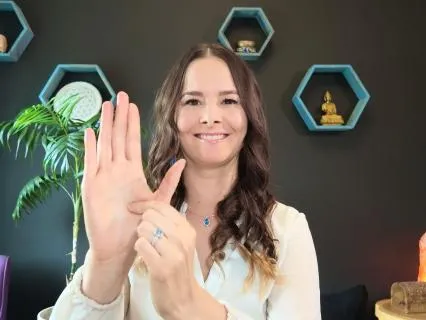
We are doing reflexology today on the hands.
To support us with stress,
Stress management,
Taking care of our nervous system,
Taking care of our brain,
Taking care of our body.
And the organs that are highly affected by stress.
And if you don't know what exactly reflexology is,
It works on the principle that specific points in your hands are reflex points that correspond through the nervous system to the organs,
To the tissues,
To the limbs of the body.
So we can really access all the points of the body through the hands,
Through these reflex points.
And very similar to The body,
We have this map.
This beautiful map.
Of the hands and generally it works like our body does where we have the head and then we're coming down through the organs.
Following the spine.
So kind of top of body to bottom of body.
It works very similar in the map of the reflex points of the hands.
And the fascinating thing is when we apply pressure on these points,
We have an immediate effect on the body.
An immediate positive healing effect,
Bringing the organ,
Bringing the affected area into a state of balance when we apply a little bit of pressure.
Everyone is different.
For some of us,
It may be a really light pressure.
And for others,
Maybe deeper feels more suitable to you.
Really follow your intuition.
So to begin,
I'm going to invite you to warm up your hands.
So just gently kind of rubbing them together.
We're going to do a gentle massage here.
And feel free to be.
Intuitive and what feels good for your hands.
We're not worrying about the points just yet.
We just want to bring in that sense of touch to the fingers.
To the palm and to the back of both of your hands.
So making your way over the surface of your hands.
And this is a lovely way to.
Calm the entire body.
Because yes we are touching all of the reflex points as we do this,
As we go over the entire surface of the hands.
Massaging the back of the hand as well as the front of the hand.
In a way that feels good to you.
Maybe circular,
Gentle motions.
Taking some deep breaths as you do this.
Trusting what feels good for you.
So not only is this touching the nerves in the hands,
But we're also affecting the energy channels as well.
In traditional Chinese medicine we have the meridians that run through the hands.
We also have the chakras that run through the hands as well.
A map of the organs is similar to a map of the chakras.
We don't have to know what everything is right now.
Just relax and be in this nice receiving mode,
Seeing what feels good for you.
Lovely.
So now that our hands are all warmed up,
I'm going to go to the back of my hand.
Biggest point for stress,
Which is the thumb,
The pad of the thumb.
So we're going to do both hands.
Doesn't matter which one you start with and this is just the entire padding of your son.
So giving it a little massage,
Just rubbing all around the tip of your thumb.
Think of it as a brain massage.
We are relaxing the mind.
We're relaxing our thoughts.
Sending lots of loving energy to our brains.
Signaling it to rest.
And switching to the other thumb.
So touching both,
They're both the same.
Points of the brain.
Both fingers as we have that left and right hemisphere.
Now you may sense tension.
As you're massaging in certain parts.
Of the hand of the thumb.
Tension is a way that the body speaks to us,
Saying there may be a little bit of imbalance here.
So give those points extra attention.
Extra love as you massage them.
Sometimes we can feel crystals forming within the tissue.
It can feel like sand.
That's also an indicator of a space where there may be imbalance in the body.
Lovely.
So we have touched on the brain.
And now we're going to be touching on.
And I have a little marker in the center of my thumb.
Not sure if you can see it there.
In the center of the part of the thumb.
We are going to massage our pituitary gland.
Just with direct pressure.
I like to pinch from both sides because it's a little bit easier.
So pushing into the center of your thumb,
Either one,
We'll do both sides.
Pushing in and just holding here.
So the pituitary gland is our master gland.
It's the most important gland.
Gland of the brain.
And when it comes to stress,
It links the brain to our hormone system.
Releasing the signals that tell our adrenal glands.
To produce or not produce stress hormones.
So very important with regulating our body,
Our nervous system,
And our stress levels.
Just taking some deep breaths as you apply that pressure.
Inviting the body to a state of balance.
And then we will do the other thumb.
Supplying that pressure onto the pituitary gland.
Simply receiving.
If you like,
You can bring your awareness into the center of your skull.
That's where your pituitary gland is.
Connecting these two points in the thumb.
And the actual gland in the brain itself.
Inviting softness to that area,
Inviting ease and wellness.
Beautiful.
And our next point is a little bit trickier to palpate.
But it is essential for navigating stress.
We're going to be locating.
.
.
The adrenal glands.
And so a lovely way to find it is to follow the lines kind of of the finger down and the thumb down as if we are creating a little triangle.
And at the apex or the tip of this triangle,
In this juicy,
Fleshy part of the thumb is where we're going to find the adrenal gland.
When we have maybe a little bit difficulty or uncertainty in locating a spot.
We can also scan with the other hand and this is really interesting.
We can feel the energy.
So if we have the other intention of I want to locate the adrenal gland,
You may feel a little heat source like a pinprick pointing out towards your finger or a sensation,
A pulse.
So following that sensation as you hover your finger or your hand over.
Until you locate.
That spot that your body is calling you towards.
Your body is wise and it knows.
So really trusting your own guidance here and finding the locations of these points.
So we are on the adrenal gland.
This is a big one.
It's located just above on the top of the kidneys in the body.
And They're small,
They're really little glands,
They're sitting on top of the kidneys.
These are the glands that receive the signals from the pituitary gland.
To release our stress hormones like cortisol and adrenaline.
And these are the hormones that boost our heart rate.
They may raise our blood sugar.
And they give us energy if there's a threat that we're facing.
So just pinching here and again I love to hold from the front and the back.
Makes it easier to grasp on to that point.
Wish me luck.
Taking some deep breaths,
If you'd like,
You can bring your awareness down to the kidneys and the body,
Kind of the low back area.
Around where the adrenal glands are.
Sending love.
Just that intention of balance,
Of regulation.
De-stressing.
Hey,
Everything is alright.
We don't need to kick the cortisol and the adrenaline into high gear.
We can just be here now.
Be in this moment.
Beautiful.
And then we're going to palpate on the other hand.
So finding that triangle between the thumb.
And between your pointer finger.
And moving in to the adrenal glands.
Pinching the tissue and relaxing.
Into this moment.
Trusting the body's connections.
Breathing into the kidneys and the adrenal glands.
Letting them know that we are safe.
All is well.
All will be okay.
Beautiful.
We're going to move into a little bit of the emotional field now with our heart so these are energetic points as well as you know touching the organs certain organs hold emotions as well and of course the heart is also corresponding to stress you know our heart rate increases it raises our blood pressure when we're under stress so the heart will still need love the physical heart and here we're just pinching at the very top the saddle here between the thumb and the pointer finger,
Grabbing a little bit of fleshy tissue,
So not just the skin on by grabbing the tissue.
Where it feels a little bit thicker and pinching again from the front and back.
So this is our emotional center and when we get stressed it may be difficult to regulate our emotions,
To be in a state of calm,
Balanced peace.
We may be stressed,
Anxious,
Irritated,
Angry.
Anything may arise,
Even sadness.
When we're stressed.
Sending love to the heart now.
Always taking some deep breaths as we do this.
And going to the other side.
So most reflexology points are on both sides of the body.
The heart is obviously a little bit more dominant on the left side over the right side of the body.
But it's still in that center line so we can pinch the left and the right side.
And when I say pinch,
I'm thinking,
You know,
Grabbing,
Massage.
Compassionate touch here,
What feels good.
So a little bit of pain and discomfort can be good.
That can be positive because it may need that.
Breathing into the heart,
Expanding that area.
Letting your emotions feel held and safe.
And open.
And now we're going to do our spleen.
And this is only found on your left hand.
So making sure you have the left hand,
Spleen is only on the left side of the body.
And this point is directly across from where the adrenal gland lies.
So directly across.
Finding that point on your left hand and again you may wish to scan over,
See if your hand speaks to you into showing you where that spleen is.
Wonderful.
Found it.
I like to just apply direct pressure onto the spleen.
In traditional Chinese medicine,
The spleen houses worry.
Worry so associated with stress right what's coming what's next So relaxing that worry,
Relaxing that spleen.
The spleen is also a reservoir for our immunity cells under periods of high stress.
So when we have chronic or long-term stress.
Our nervous system will signal the spleen.
To release the stored white blood cells.
And increase the immunity of the body.
And when it's constantly being activated through stress,
Through worry,
We can deplete that system.
Deplete.
Our immunity and become sick more easily.
So working on the spleen is a lovely spot to increase immunity.
Amazing.
So we've touched on,
I want to say,
The organs of stress,
The glands of stress,
And now I want to work on the body as it can become so affected when we are stressed out.
One of the main things that happens under periods of stress,
Anxiety,
Worry,
Is our breathing shifts,
Our breathing changes,
And we breathe at a faster pace.
So.
I would love for us to work with our lungs.
So our lungs are just this top padding here.
Almost all the way across the hand just to the fourth digit.
So massaging,
And we'll do this on both sides.
A little bit of massaging here.
Just some circles,
Bringing some love to those lungs that work really hard.
And we're stressed out.
Beautiful.
And then we're going to go under the pinky,
And this is the shoulder.
So depending if it's your left hand or right hand,
That's your left or right shoulder.
Massaging the shoulder.
Can carry the weight of our responsibilities,
Relaxing the shoulder.
And then right under the lung is almost a line across your hand.
You can kind of feel it.
There's a ridge under the tops of the metatarsals here.
This is the diaphragm,
So essential in breathing.
Moving or abdomen in and out,
In and out.
Making sure we're belly breathing.
So just massaging across that line.
Then we'll do the other hand,
So massaging the lungs,
Taking some deep breaths as we do this,
Really expanding into our lung capacity.
Getting that shoulder on the other side.
Combining your shoulders to relax as you do this.
Now I have had my hand up the whole time,
Just so you can see.
Have your hand down,
Maybe in your lap,
In a place that's relaxed.
Should be enjoyable.
This should feel good for you.
Make sure you're comfortable.
And then we're gonna get that diaphragm,
So right under the lung,
Massaging there.
Hannibal.
Now who here can get tension in the neck area?
Yes,
Also from that apical upper body breathing.
So the neck is just under the brain.
So this is the neck of the thumb.
So we're just gonna kind of twist.
Gently all around the psalm.
Relaxing that.
This is one of the neck points.
And then the second neck point is the line at the base of the fingers.
Some massaging across the very top.
Of the palms.
Before we get on to the finger joints,
The phalanges.
Massaging here.
Relaxing the neck and the trapezius muscle.
And we'll do the other side.
Twisting around the neck.
Inviting ease into your neck.
And I'm getting the top.
Of the palm here.
Tops of the shoulders.
Beautiful.
Couple more points that I'd love to touch on.
Our spine,
You know,
Our whole body can become affected.
With stress and often our posture will shift when we're stressed.
We're not necessarily upright and confident.
Maybe,
Yeah,
Feeling a lot of tension in the body.
Get the spine.
And.
We'll work our way down the side of the thumb,
So just from the top of the head.
Working our way down.
All the way until we feel a little ridge here,
Or a little sinkhole.
Into a bone.
So this is working from the the cervical spine,
Down the thoracic spine.
And the lumbar spine.
Beautiful.
Doing both sides of the spine.
And closing your eyes.
Becoming aware of your spine.
Can it relax?
Can it?
Open and create some space in between the vertebrae.
Now when we're here at the base of the spine,
If we just go inwards,
Just a small amount.
We're going to touch on the bladder.
Touching on the bladder and massaging this point here.
The bladder can have a a very close relationship to stress if any of you deal with incontinence.
Bladder leaking,
You know,
And we're stressed out and our nervous system's in fight or flight mode.
We're not really listening to the signals of the body,
So we don't know when our bladder is full.
Or maybe we're.
.
.
In our pelvic bowl because of that stress.
So this can affect the bladder and its ability to hold liquid.
Just massaging those bladder points.
Now clenching with the jaw.
Here we have the front of the thumb.
So just under our nail bed.
Our nail bed just under the cuticle area.
It's called the matrix of the nail where the nail is formed.
Gently rubbing across that line.
Right under the thumb.
This is the jaw where you can release that tension that many of us hold.
We may be grinding at night.
Or clenching throughout the day.
Relaxing that jaw.
I have one final point for stress and this one's going to be on the back of our hands.
The surface of our hands.
And this is actually the chest.
Kind of the upper portion,
Upper half,
The back of the hands.
We're just gonna massage here.
Ever experienced tightness in the chest,
Especially if we're anxious.
Tend to close in massaging that.
Relaxing opening your chest.
Energetically,
Our chest is where we hold gratitude,
And gratitude can really support us through times of stress.
Feeling into something you're grateful for right now.
As you massage the chest.
Beautiful.
And just giving your hands a little massage at the end,
A little rub.
Noticing if there's any tense points you may have missed,
Any tension coming up,
You can give it some extra love.
Beautiful.
So if any of these points really spoke to you,
Try to remember them or write them down.
You may even draw or put a little sticker on the point so you can remember it for later,
Like the spleen.
Like the pituitary gland or even just the tip of the thumb for the brain is such a powerful,
Powerful point for stress management.
And I hope that this was helpful for you.
And I'm looking forward to sharing more reflexology points with you.
Thank you so much for joining today.