It's not an intellectual proposition.
It's a way of being.
To affirm that God is one is to relate to whatever happens to us.
And by what happens,
We mean on all levels.
That's what the one means.
So not just the situation we find ourselves in,
Not just what happens to us in life,
But even what thought arises in our mind moment to moment,
What our senses are receiving.
The way that we touch life moment to moment,
To know and affirm that we are touching one reality,
That it can never be otherwise.
Hush,
Give way now.
Adonai Eloheinu Welcome to the Torah of Awakening Jewish Meditation podcast.
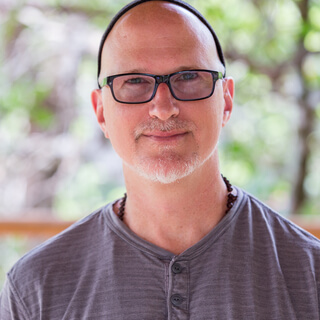
I'm Rabbi Brian Yosef Schachter-Brooks.
We tend to think of spiritual awakening as a kind of self-mastery,
Which is true,
But that master image can create a sense of disappointment and resignation when comparing ourselves to that ideal.
But this is just another way for the ego to keep us trapped.
The remedy?
Forgive yourself for not being enlightened.
In fact,
This interactive forgiveness is itself a direct path to enlightenment.
This is not just a feel-good cliche or a letting of yourself off the hook.
It's a deep surrender to the truth of what is,
And in that surrender to the truth of imperfection,
That deeper perfection that we call the divine can shine through.
How do we do that?
Learn more as we explore in Parshat Matot,
Followed by a guided meditation on the Hebrew letter Nun.
Enjoy.
So as you are probably aware,
The central premise of Judaism that gets emphasized again and again,
And was probably the most important thing to the rabbis who formulated Judaism as we know it today,
Is the affirmation of HaShem Echad,
That God is one.
And it's often been said that the greatest offense is to affirm the opposite.
Of that,
To attribute divinity to more than one,
To say that there's a plurality of ultimates.
And it's a little puzzling,
Because why is this concept,
Why is this intellectual affirmation that God is one,
That there's one God,
One divinity,
Why is it so important?
It's not an intellectual proposition.
It's a way of being.
To affirm that God is one is to relate to whatever happens to us.
And by what happens,
We mean on all levels.
That's what the one means.
So not just the situation we find ourselves in,
Not just what happens to us in life,
But even what thought arises in our mind moment to moment,
What our senses are receiving.
The way that we touch life moment to moment,
To know and affirm that we are touching one reality,
That it can never be otherwise,
Is such a profound implication,
And so simple and yet so difficult,
Maybe impossible,
To do always,
Consistently,
And yet that's the charge,
Is to regard HaShem as one,
To regard is one,
Even though the obstacles to that are seemingly insurmountable.
Because if we receive the totality of life,
The fullness of reality on all levels,
Not just as a oneness,
Because again,
You can just do that conceptually.
You can just say,
OK,
Everything's part of one reality.
That's what the word reality means,
After all.
Reality just means that which is real.
And it's one word.
So you already said it.
Just by having the word reality already affirming that it's one,
But that doesn't mean that we relate to that reality as God.
In other words,
Do we have a certain sense of reverence and reciprocal relationship with that which happens to us moment to moment that is one,
One relationship?
It's almost mind-blowing to even think about that.
And the implication of that also is that our primary task is that we become one,
That our intentions,
That we affirm our purpose,
The reason for which we are living moment to moment becomes one.
Because we know experientially that we have a plurality of motivations.
We have a plurality of forces.
I've seen so many psychologists talk about this,
You know,
How a person and we have that actually the sense of being one person is almost an illusion,
Because really we have all these different characters within us that are vying,
That are kind of competing for attention.
And yet,
The insight,
The experience,
And the promise of this spiritual practice that we call presence,
Which extended in time as we sit quietly is called meditation,
Shows us that there is a root of oneness behind all the plurality of voices and feelings and motivations and opinions and conflicting values.
There is a oneness there.
Is what we might call awareness.
And so as we call that into being,
Rather,
We call the awareness of it into being.
We're not calling awareness into being,
But we're calling awareness of awareness into being.
Then we can get a palpable sense of that oneness we are at the bottom of it all.
And it's actually not that hard.
I hope that you are feeling it,
Recognizing it right now,
And knowing that this miracle that hears these words right now that feels presence in the body,
That feels the flow of your breathing,
That that miracle that we call awareness or consciousness is what you are at the root.
It's not that hard.
That's why it's fun to go listen to a teacher of non-duality talk,
Because they're just talking about what is in your experience already right now,
But it's very easily covered over.
It's very easily ignored.
By what?
By all those different voices,
All those different feelings,
The different motives,
The different thoughts,
The different opinions,
The flow of life through time,
Which is constantly changing and shifting.
But it's not hard to awaken to that.
What we call enlightenment is actually very easy.
The hard part is then living as if that's true.
Can we bring that recognition into life in the next moment to present to the world a continuity rather than a bundle of contradictions,
Broken promises,
Thwarted intentions,
All of that stuff?
That,
I believe,
Is what this week's Parsha begins to address.
It's a double Parsha,
Parshat Matot,
Mas'eh.
We're going to look at the first one,
Matot.
Tribes,
And it's called Parshat Matot because the first sentence of the Parsha is talking about Moses addressing the tribes.
And the tribes also is significant because it's a description of a plurality of peoples that are functioning as one people,
B'nei Yisrael.
The children of Israel,
As they're standing on the Jordan,
Are a collection of disparate tribes,
And it's Moses's job to try to bring unity.
So Moses,
In a sense,
The character of Moses in the Torah is an embodiment,
A character embodiment of this basic task that is given to us moment to moment,
To live in such a way so as to present a harmony,
Present a oneness that we are.
That oneness that we are at the root,
Expressing itself through this complicated multiplicity that we are.
And so,
Accordingly,
Moses is talking about the laws of vows and oaths.
He's talking about keeping your word.
So I'm going to put some words on the screen.
And here's the first verse talking about keeping your word.
An oath to forbid something to one's soul.
So that basically just means promising to not do something.
You express an intention to do something or to not do something.
And this is the mitzvah.
This is the instruction.
Don't make what they said meaningless.
They should not make what they say meaningless.
It should be full.
There should be consistency.
Everything that comes from their mouth they shall do.
So in a sense,
This is just a very simple instruction to have integrity.
You say you're going to do something,
So you should do it.
You say you're not going to do something,
You shouldn't turn around then and do it.
There has to be one person.
You have to become one.
Don't be one person when you say you're gonna do it,
And a different person when it comes time to do it,
Right?
But also,
There's a problem here,
Because we know that,
First of all,
We are a plurality of forces,
And second of all,
The universe that we live in is not a consistent system.
Different things are happening.
What you say you're going to do might get thwarted.
What you say you're not going to do might not be possible.
And so how do we deal with this possibility—and not just possibility,
But likelihood,
Actually,
Of failure?
We want to become one,
But it's impossible sometimes to become one.
And so this next verse here,
Which is relating—it's relating a situation where there's a child,
A daughter,
Who makes an oath that's not possible to keep.
It says,
But if her father restrains her on the day that he hears,
Meaning that he hears that she made some kind of vow or oath,
So the question that I ask when I see a verse like this is,
Who is this daughter?
Who is this girl?
The girl is us.
We are the ones who impose something,
Who have an intention,
That then gets thwarted.
What does it get thwarted by?
Who's the father here?
HaKadosh Baruch Hu.
HaShem is the Father.
We have to recognize that we are not in control of what happens.
Ultimately,
Though we can make commitments and do our best to keep them,
We're also not in control,
Really,
Of what our inner experience is as well.
We go through changes which,
In order to have integrity with who we are at a later moment,
May cause us to empty our word,
To make our words empty.
But the Father restrained us,
Meaning it's HaShem that's in control.
There is a line in the Elenu prayer that comes at the end of all of the traditional services that says,
Emet malkeinu.
It's an amazing line.
It's talking about God,
But it says,
Emet malkeinu.
Truth is our king.
The truth of the moment.
The truth of what happens to us.
The truth of how things unfold.
That is God.
That is not separate from God.
We might call it the truth of what is.
Efesulato.
There is nothing else.
And so ultimately,
HaShem Yislach.
We are forgiven for our inconsistencies.
We are forgiven for our failures.
And that's the message here.
Is that.
.
.
On one hand,
It's a bit of a paradox.
On one hand,
Of course we should try to have integrity.
But on the other hand we're not fully in control of what happens and there's a deeper unity that becomes revealed when we can accept that.
It's almost like forgiving ourselves for not being enlightened is enlightened.
It's a paradox.
If we forgive ourselves for not being enlightened,
Then in that moment we are doing that.
We're being enlightened because we're actually accepting reality.
We're accepting the reality that we have been inconsistent,
That we have failed.
This is the usefulness of failure.
We normally think of failure as a terrible thing,
But the truth is that failure is the balm.
It's the medicine for the ego.
The ego that thinks,
I did it.
I made it happen.
And if we can take in our failures and recognize that we are ultimately not in control of Emmett,
We're not in control of the truth of what is,
Of the truth of what happens moment to moment,
Then we can really also take in HaShem Yisrach.
We are forgiven.
We don't have to hold on to self-judgment.
But there is a little catch here,
Because In order to forgive ourselves,
We have to be forgiving in general.
We can't just forgive ourselves and have grudges against other people.
And that's the deeper meaning of the other great stream of instruction in Judaism,
The first one being,
As I talked about before,
The affirmation of the oneness of divine,
Which means the oneness of what happens.
The other great teaching is,
You love yourself.
And you shall love your neighbor as you love yourself means,
Ultimately,
That you have to accept them as they are,
Which means forgiveness.
And we often quote this line,
You shall love your neighbor as you love yourself,
This famous Torah line,
And we forget the first part of the verse.
Here's the verse.
Prelude.
Don't take vengeance.
Don't go out and do something bad to them because of some mistake that they made.
Don't bear a grudge.
Don't sit there with hardness in your heart,
With anger,
With judgment in your heart.
Instead,
V'ahavta l'reyacha kamocha,
Love your neighbor or love your fellow as you love yourself,
Which is not merely an instruction,
But it's also a description of how to love yourself.
That if we want to forgive ourselves,
Which Of course we do.
Why do we want to hold on to the inner Mitzrayim,
The inner slavery of self-judgment?
But to really let go of that and enter that spacious inner freedom that is native to what we are at the deepest level,
That is the quality of consciousness itself,
Unencumbered by the disturbances of the mind and the heart,
Then we have to love other people too.
That's it.
Ani HaShem.
And it says,
I am God at the end.
Why does it say Ani HaShem?
I am God at the end?
Because the clue here,
The hint here,
Is that the Ani,
That is the deepest level of who we are,
The I,
The true self,
Is the divine,
Is not separate from reality.
There's not me and then what happens as two separate things.
We are the happening,
Moment to moment.
Whatever is happening,
In our experience in the moment,
Whatever conflict comes up,
Whatever way in which we feel that we may have failed or that the world is failing us.
Sometimes we feel that way.
The things that are happening make us feel that life is failing us.
How can we even go on in such a world?
But when we stand firm in the witnessing of all of that,
Letting reality be as it is,
Letting our failures and successes,
Just the truth,
The truth of what is,
Without attaching to it,
Without identifying with it,
Without saying,
I did it.
But just recognizing that it all comes from,
As it said in the verse,
The father that restrains or allows.
But it doesn't have to be a father.
That's just the metaphor in the text.
It could be a mother.
It doesn't have to have a gender.
These are all just symbols.
Symbols for the reality that we find ourselves in.
So.
.
.
Let's put it into practice.
Putting it into practice doesn't mean manufacturing something,
Doesn't mean being.
.
.
Artful in any way.
It just means bringing ourselves bringing our attention to the truth of our experience as it arises now whether in your experience right now there's a heaviness.
Whether you're holding the burden of failing at something,
Of not carrying forth with success whatever intentions you may have had.
Or perhaps not.
Perhaps the mind and heart are just kind of open right now.
And that's fine too.
The truth of whatever it is,
Is a kind of surrender.
Using whatever is available,
Meaning whatever is true,
Emet malkeinu,
Truth is king.
Or again,
If you don't like the metaphor of king.
Truth is supreme.
It's that which we revere,
What we bow before.
And in that openness is the possibility of forgiving.
Others,
Forgiving ourselves,
Not holding on to that.
Energy of grudge,
The energy of wanting people to be other than they are,
Wanting ourselves to be other than we are.
The way things are isn't that what Hashem is giving us right now.
Isn't that the gift of this moment?
The Hebrew letter that represents this recognition of our own failures.
As the means to success.
The letter that urges us to recognize our own unenlightenment.
And in doing so.
Come straight into enlightenment.
And by enlightenment,
We mean non-resistance to reality,
The letting go of all drama,
All struggle.
Coming into the truth of the moment.
There's a humility in that and acknowledging of our humanness.
That Hebrew letter is the letter Nun.
The letter Nun representing this.
Reality of transformation through the portal of whatever suffering arises.
Let's affirm.
We are returning to be with our experience as it is.
We are returning to forgiveness.
We are returning to harmony with the moment.
We are being present and in this is the power of forgiveness.
And so chanting the Kavanah,
The affirmation,
I am returning,
I am I am present.
I am forgiveness.
I am returning.
I am present.
I am forgiveness.
And our chant.
Anachnu mapilim tachanunenu.
We cast our supplications,
Our prayers,
That is,
Before the truth of this moment.
Lo altseed ko teinu,
Not because we're so great.
But because of the abundant compassion.
The infinite number of second chances that we are given as long as we're here,
Moment to moment.
Every moment is a second chance to return to presence,
To return to humility.
Nun,
Tacha nuneynu.
Anachnu mapilim tacha nuneynu.
Singing.
Nun,
Tacha nuneynu.
Anachnu mapilim tachanu neinu.
Lo atzit koteinu,
Anachnu mapilim tachanuneinu Le'hefanecha ki alrachamecha harabim Nun tachanu neinu.
Anachnu mapilim tachanu nenu.
Nun tachanu nenu,
Anachnu mapilim tachanu nenu.
Lo al tzidkotenu,
Anachnu mapilim tachanunenu.
Shabbat shalom.
Anachnum apilim tachanunenu.
Nooooooooooooooooooooooo anachnu mapilim tachanu nenu.
Lo al tzitkotenu,
Anachnu mapilim tachanunenu.
Hefanecha ki alrachamecha.
One more time,
Letting your voices vibrate in your bodies.
Nun,
Tachcha nuneynu,
Anachnu mapilim tachcha nuneynu.
Lo adzid koteinu anachnu mapilim tachanuneinu Nefan echa,
Ki alracham echa.
Harabim Nun Tachanun Einu Nachnu mapili tachanu nenu.
And preparing to drop into the stillness.
Checking your body to be in a position that's comfortable but alert,
Conducive to stillness.
And bringing forth an attitude of generous offering of your attention.
Open-hearted willingness to give your attention to whatever is present.
In your field of awareness,
In your experience.
All manifestations,
Modulations of the voice of the divine as it comes to us in the moment.
Bringing your right hand to your heart and offering your attention with L'cha,
Which means for you,
The offering word L'cha,
Deep breath in.
L'cha.
And with your right hand on your heart,
Bringing your left hand down to your belly.
Dropping your attention down into your belly,
Consciously inhabiting your belly.
Consciousness filling your abdomen.
Awareness like light permeating your organs.
Bringing gratitude and healing to this wonderful temple of the body.
Awareness flowing down through your legs,
Down to your feet,
Extending down into the earth below,
Connecting.
Into that connection with the greater planet supporting all life.
Awareness rising up from your belly.
Up into your chest,
Upper back,
Shoulders and neck,
Releasing any excess tension that might be there.
Spilling down arms and hands and fingers,
Connecting back to your heart and your belly.
Rising up face,
Facial muscles,
Brain and nervous system.
Bringing a little smile to your lips,
Being that loving,
Benevolent,
Indwelling presence in the body.
And bringing your attention a little more deeply into the sensation of the flow of your breathing.
Each inhale a kiss from the divine,
Lovingly breathing you into life,
Into being moment to moment.
Normally in the background,
This breathing is actually the most significant thing we're doing.
And so coming to this moment,
Coming to the breathing.
Affirming this basic life-giving action.
This is what we're doing right now.
This is what we're doing,
Sustaining life,
Breathing moment to moment.
And affirming this most profound and basic action with na'ase.
Na'ase is a simple action word,
Means doing.
Na'ase,
And a long out breath,
Deep breath in.
Namaste.
And bringing your right hand up from your heart to lightly touch your forehead.
As your awareness expands beyond the body into the space around you,
Touching the sounds vibrating in the air,
The feel of the room as it is now,
The light,
The space,
And recognizing that all of this sense of the space beyond the body,
As well as the inner space of thoughts and feelings are arising,
Not in different places,
But in one place.
One space of consciousness,
And you are the space of consciousness.
Not something you have,
But that which you are.
Vast,
Formless,
Boundless,
And free.
Affirming with vinishma,
Being the listening,
Being the consciousness,
Vinishma.
Deep breath in,
V'Nishma Kissing your fingers,
Relaxing your hands in your lap however is comfortable.
Ribbonu Shalom.
As it says.
In the verse,
Hashem yislach,
Hashem forgives.
May that forgiveness permeate our being,
May it be a way of being for us.
Letting go of all negativity,
Of all grudges,
Of all judgment that keeps us separate from the flow of life.
As we rest in the tefillah,
Atahu,
Atahu.
You who are not separate from anything or anyone,
Atahu.
You are not separate from this awareness that we are.
You are existence itself.
You are Hashem.
You are the divine.
You are reality.
You are truth.
Atau,
Atau,
Atiau,
Atau Ata Ho,
Ata Ho,
Ata Ho,
Ata Ho,
Ata Ho,
Ah-choo!
Ata.
Atyahou,
Atyahou,
Atyahou Satsang with Mooji Ah.
.
.
Oh.
Bye.
Taking the words on the inside,
Letting the mind vibrate with the repetition.
Things will arise moment to moment.
Sounds that may arise in our environment,
Thoughts that may arise in our inner environment,
Memories,
Feelings,
Just being present to all of it,
Accepting all of it.
But also not getting swept away by any of it simply coming back again and again.
As we come into silent meditation.
You Come on,
Man.
Bringing some movement to your body.
Taking a nice stretch to come back from the stillness.
And closing the meditation,
Help us to recognize,
Remember,
And embody this most central core truth of the perfection of recognizing our imperfection,
Of the fastest route to enlightenment being the forgiving of ourselves for not being enlightened.
May we.
Live,
Speak,
Act,
And dance in this lightness.
I hope you've enjoyed this Torah of Awakening.
I'm Rabbi Brian Yosef Shakir Brooks.
Until next time,
All blessings.