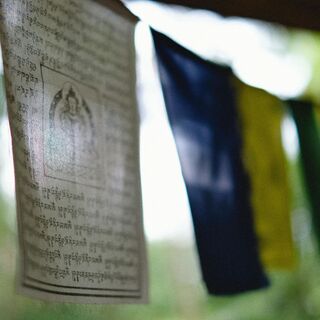
So this meditation is on the mantra of Avalokiteshvara.
Om mani padme hung.
I'll just say a very few words first of all about mantras and about this specific mantra.
So in meditation we can pay attention to lots of different things.
We can pay attention to the body,
To love or compassion.
We can be mindful of a mental image.
In mantra what we're being mindful of is a sound that we are making,
And we can either chant those sounds out loud or we can hear them in the mind.
Avalokiteshvara originally meant the regarder of the cries of the world,
Signifying that Avalokiteshvara is a compassionate figure.
Avalokiteshvara listens compassionately to the sounds of suffering.
Om is a syllable that can't literally be translated.
What it symbolizes is the indescribable nature of the awakened mind.
We're calling upon awakening by saying om.
The next part of the mantra is mani padme,
And this is an ancient name for Avalokiteshvara.
So we're calling upon Avalokiteshvara.
Mani means jewel.
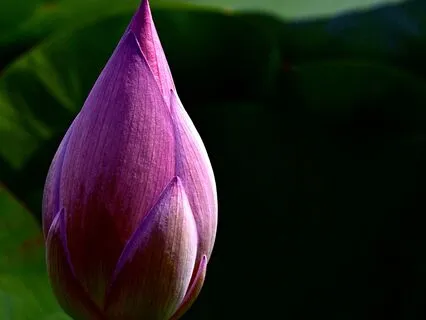
Padma means lotus.
So this is the jeweled lotus one.
One who is beautiful and gentle like a lotus,
But also beautiful and tough like a gem.
In the mantra it's mani padme rather than mani padma,
Because it's in what's called the vocative case.
That is,
We're calling upon Avalokiteshvara,
And that's signified by a change of the end of the word.
The mantra ends with hung,
And hung again does not have any literal meaning.
Although it may once have,
It may have been an ancient archaic form of the word I.
So what the mantra does is it bridges the gap between the enlightened mind,
Om,
And ourselves,
Hung,
Through Avalokiteshvara.
We're appealing to Avalokiteshvara,
Or more properly to that aspect of us that corresponds to Avalokiteshvara,
Our own potential,
Innate enlightenment.
Avalokiteshvara is the gateway.
Through which we approach enlightened compassion and wisdom.
So what I'm going to do is to chant the mantra a number of times.
You can join in with me.
If you're chanting out loud,
Be mindful of the movements that your body is making to produce the sounds.
Be mindful of your breathing.
Be mindful of the sounds themselves.
So you're hearing them as if somebody else were chanting them.
At a certain point I'll start to let the mantra fade out.
It'll become quieter and quieter.
Then it'll fade away into silence.
And then I'll ring a bell,
Just to let you know that the recording is over.
So let's just sit for a few moments,
Just connecting with the body.
OM MANI PADME HUNG OM MANI PADME HUNG OM MANI PADME HUNG OM MANI PADME HUNG OM MANI PADME HUNG OM MANI PADME HUNG OM MANI PADME HUNG OM MANI PADME HUNG OM MANI PADME HUNG OM MANI PADME HUNG OM MANI PADME HUNG OM MANI PADME HUNG OM MANI PADME HUNG OM MANI PADME HUNG OM MANI PADME HUNG OM MANI PADME HUNG OM MANI PADME HUNG OM MANI PADME HUNG OM MANI PADME HUNG OM MANI PADME HUNG OM MANI PADME HUNG OM MANI PADME HUNG OM MANI PADME HUNG OM MANI PADME HUNG OM MANI PADME HUNG OM MANI PADME HUNG OM MANI PADME HUNG OM MANI PADME HUNG OM MANI PADME HUNG OM MANI PADME HUNG OM MANI PADME HUNG OM MANI PADME HUNG OM MANI PADME HUNG OM MANI PADME HUNG