Tales of Norse mythology.
Thor.
According to some mythologists,
Thor,
Or Donar,
Is the son of Yrrd and of Odin,
But others say that his mother was Frigga,
Queen of the Gods.
This child was very remarkable for his great size and strength,
And very soon after his birth,
Amazed the assembled gods by playfully lifting and throwing about ten great bales of bare skins.
Although generally good-tempered,
Thor would occasionally fly into a terrible rage,
And as he was very dangerous at these times,
His mother,
Unable to control him,
Sent him away from home and entrusted him to the care of Vingnir,
The winged,
And of Hlora,
Heat.
These foster parents,
Who are also considered as the personification of sheet lightning,
Soon managed to control with their troublesome charge and brought him up so wisely that the gods entertained a very grateful recollection of their kind offices.
Thor himself,
Recognizing all he owned them,
Assumed the names of Vingthor and Hlorydi,
By which he is also known.
Having attained his full growth and the age of reason,
Thor was admitted to Ausgard among the other gods,
Where he occupied one of the twelve seats in the Great Judgment Hall.
He was also given the realm of Thrudvagn,
Or Thrudheim,
Where he built a wonderful palace called Bliskirnir,
Lightning,
The most spacious in all Ausgard.
It contained 540 halls for the accommodation of the Thrulls,
Who after death were welcomed to his home,
Where they received equal treatment with their masters in Valhalla.
For Thor was the patron god of the peasants and lower classes.
As he was god of thunder,
Thor alone was never allowed to pass over the wonderful bridge Bifrust,
Lest he should set it aflame by the heat of his presence.
And when he wished to join his fellow gods by the Urdar fountain under the shade of the sacred tree Yggdrasil,
He was forced to make his way thither on foot,
Wading through the rivers Qormt and Ormth,
And the two streams Ketelag to that chesting place.
Thor,
Who was honored as the highest god in Norway,
Came second in the trilogy of all the other countries and was called Old Thor,
Because he was supposed by some mythologists to have belonged to an older dynasty of gods and not an account of his actual age,
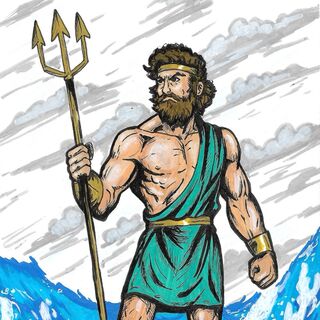
For he was represented and described as a man in his prime,
Tall and well-formed,
With muscular limbs and bristling red hair and beard,
From which in moments of anger his sparks flew in showers.
The northern people further adorned him with a crown on each point of which was either glittering star or a steadily burning flame,
So that his head was ever surrounded by a kind of halo of fire,
His own element.
Thor was the proud possessor of a magic hammer called Mjolnir,
The crusher,
Which he hurled at his enemies,
The frost giants,
With destructive power and which possessed the wonderful property of always returning to his hand,
However far away he might hurl it.
As this huge hammer,
The emblem of the Thunderbolts,
Was generally red-hot,
The god had an iron gauntlet called the Jarngraper,
Which enabled him to grasp it firmly.
He could hurl Mjolnir a great distance and his strength,
Which was always remarkable,
Was doubled when he wore his magic belt called Megingjerd.
Thor's hammer was considered so sacred by the ancient northern people that they wanted to make the sign of the hammer,
As the Christians later taught them to make the sign of the cross,
To ward off all evil influences and to secure blessings.
The same sign was also made over the newly born infant when water was poured over his head and a name given.
The hammer was used to drive in boundary stakes,
Which it was considered sacrilegious to remove,
To hollow the threshold of a new house,
To solemnize a marriage,
And lastly it played a part in the consecration of the funeral pyre upon which the bodies of heroes,
Together with their weapons and steeds,
And in some cases with their wives and dependents were burned.
In Sweden,
Thor,
Like Odin,
Was supposed to wear a broad brimmed hat and hence the storm clouds in that country are known as Thor's Hat,
A name also given to one of the principal mountains in Norway.
The rumble and roar of the thunder was said to be the roll of his chariot,
For he alone among the gods never rode on horseback but walked,
Drove in a brazen chariot drawn by two goats,
Tang Njostr,
Tooth cracker,
And Tang Grisnur,
Tooth gnash,
From whose teeth and hoofs the sparks constantly flew.
When the god thus drove from palace to palace,
He was called Akkothor,
Or Thor the charioteer,
And in southern Germany the people,
Fancying a brazen chariot alone,
Inadequate to furnish all the noise they heard,
Declared it was loaded with copper kettles,
Which rattled and clashed,
And therefore often called him,
With disrespectful familiarity,
The kettle vendor.
Thor was married twice,
First to the giantist Jarnsaksa,
Ironstone,
Who bore him two sons,
Magni,
Strength,
And Mordi,
Courage,
Both destined to survive their father and the Twilight of the gods,
And rule over the new world,
Which was to rise like a phoenix from the ashes of the first.
His second wife was Sif,
The golden-haired,
Who also bore him two children,
Lory there,
And a daughter named Thrud,
A young giantist renowned for his size and strength.
Due to the well-known affinity of contrast,
Thrud was wooed by the dwarf Alvis,
Whom she rather favored,
And one evening,
When the suitor who,
Being a dwarf,
Could not face the light of day,
Presented himself in Asgard to sue for her hand,
The assembled gods did not refuse their consent.
They had scarcely signified their approbation.
However,
When Thor,
Who had been absent,
Suddenly appeared,
And casting a glance of contempt upon the puny lover,
Declared he would have to prove that his knowledge atoned for his small statue before he could win his bride.
To test Alvis's mental powers,
Thor then questioned him in the language of the gods,
Banas,
Elves,
And dwarves,
Artfully prolonging his examination until sunrise,
When the first beam of light falling upon the unhappy dwarf petrified him.
There he stood,
An enduring example of the gods' power,
To serve as a warning to all other dwarves who might dare to test it.
Sif,
Thor's wife,
Was very vain of a magnificent head of long golden hair,
Which covered her from head to foot like a brilliant veil,
And as she too was a symbol of the earth,
Her hair was said to represent the long grass,
Or the golden grain covering the northern harvest fields.
Thor was very proud of his wife's beautiful hair.
Imagine his dismay,
Therefore,
Upon waking one morning to find her shorn,
And as bald and denuded of ornament as the earth when the grain has been garnered,
And nothing but the stubble remains.
In his anger,
Thor sprang to his feet,
Vowing he would punish the perpetrator of this outrage,
Whom he immediately and rightly conjectured to be Loki,
The arch-platter,
Ever on the lookout for some evil deed to perform.
Seizing his hammer,
Thor went in search of Loki,
Who attempted to evade the irate god by changing his form,
But it was all to no purpose.
Thor soon overtook him,
And without more ado caught him by the throat and almost strangled him ere he yielded to his imploring signs and relaxed his powerful grip.
When he could draw his breath,
Loki begged forgiveness,
But all his entreaties were vain until he promised to procure for Sif a new head of hair,
As beautiful as the first and as luxuriant in growth.
Then Thor consented to let the traitor go,
So Loki rapidly crept down into the bowels of the earth where Svartlheim was situated to beg the dwarf Dvalin to fashion not only the precious hair,
But a present for Odin and Frey,
Whose anger he wished to disarm.
His request was favorably received,
And the dwarf fashioned a spear Gungnir,
Which never failed in its aim,
And the ship Skidbladnir,
Which always wafted by favorable winds,
Could sail through the air as well as on the water,
And which had this further magic property that although it could contain the gods and other steeds,
It could be folded up into the very smallest compass and thrust into swan's pocket.
Lastly,
He spun the finest golden thread from which he fashioned the hair required for Sif,
Declaring that as soon as it touched her head it would grow fast there and become as her own.
Loki was so pleased with these proofs of the dwarf's skill that he declared the son of Yvald to be the most clever of smiths.
Words which were overheard by Brokk,
Another dwarf who exclaimed that he was sure his brother Sindri could produce three objects which would surpass those which Loki held,
Not only in intrinsic value but also in magical properties.
Loki immediately challenged the dwarf to show his skill,
Wagering his head against Brokk's on the result of the undertaking.
Sindri,
A prize of the wager,
Accepted Brokk's offer to blow the bellows,
Warning him however that he must work persistently and not for a moment relax his efforts if he wished him to succeed.
Then he threw some gold in the fire and went out to bespeak the favor of the hidden powers.
During his absence,
Brokk diligently plied the bellows while Loki,
Helping to make him pause,
Changed himself into a gadfly and cruelly stung his hand.
In spite of the pain the dwarf kept on blowing and when Sindri returned he drew out of the fire an enormous wild boar called Gullinbursti.
Because of its golden bristles,
Which had the power of radiating light as it flitted across the sky,
Before it could travel through the air with marvelous velocity.
This first piece of work successfully completed.
Sindri flung some more gold on the fire and bade his brother resume blowing while he again went out to secure magic assistance.
This time Loki,
Still disguised as a gadfly,
Stung the dwarf on his cheek.
But in spite of the pain,
Brokk worked on and when Sindri returned he triumphantly drew out of the flames the magic ring Draupnir,
The emblem of fertility,
From which eight similar rings dropped every ninth night.
Now a lump of iron was cast in the flames and with renewed caution not to forfeit their success by inattention,
Sindri passed out,
Leaving Brokk to ply the bellows as before.
Loki was now in desperation and he prepared for a final effort.
This time,
Still in the guise of the gadfly,
He stung the dwarf above the eye until the blood began to flow in such a stream that it prevented his seeing what he was doing.
Hastily raising his hand for a second,
Brokk dashed aside a stream of blood but short as was the interruption it had worked irreparable harm and when Sindri drew his work out of the fire he uttered an exclamation of disappointment for the hammer he had fashioned was short in the handle.
Notwithstanding this mishap,
Brokk was sure of his winning the wager and he did not hesitate to present himself before the guards in Ausgard where he gave Odin the ring Draupnir,
Frey the boar Gullinbursi and Thor the hammer Mjölnir,
Whose power none could resist.
Loki in turn gave the spear Gungnir to Odin,
The ship Skidbladnir to Frey and the golden heir to Thor but although the latter immediately grew upon Sif's head and was unanimously declared more beautiful than her own locks had ever been,
The guards decreed that Brokk had won the wager on the ground that the hammer Mjölnir in Thor's hands would prove invaluable against the frost giants on the last day.
In order to save his head Loki fled precipitately but was overtaken by Thor who brought him back and handed him over to Brokk telling him however that although Loki's head was rightfully his he must not touch his neck.
Hindered from obtaining full vengeance the dwarf determined to punish Loki by suing his lips together and his sword would not pierce them.
He borrowed his brothers all for the purpose.
However Loki after enduring the gods gybes in silence for a little while managed to cut the string and soon after was as locatious as ever.
In spite of his redoubtable hammer Thor was not held in dread as the injurious god of the storm who destroyed peaceful homesteads and ruined the harvest by certain hailstorms and cloud bursts,
The northmen fancied he held it only against ice giants and rocky walls reducing the latter to powder to fertilize the earth and make it yield plentiful fruit to the tillers of the soil.
In Germany where the eastern storms are always cold and blighting while the western bring warm rains and mild weather Thor was supposed to journey always from west to east to wage war against the evil spirits which would feign have enveloped the country in impenetrable veils of mist and have bounded in icy fetters.
As the giants from Jotunheim were continually sending out cold blasts of wind to nip the tender buds and hinder the growth of flowers Thor once made up his mind to go and force them to behave better.
Accompanied by Loki he set out in his chariot and after riding for a whole day the gods came at nightfall to the confines of the giant world where seeing a peasants hut they resolved to stay for rest and refreshment.
Their house was hospitable but very poor and Thor seeing that he was costly be able to supply the necessary food to satisfy his by no means small appetite slew both his goats which he cooked and made ready to eat inviting his hosts and family to partake freely of the food thus provided but cautioning them to throw all the bones without breaking them into the skins of the goats which he had spread out on the floor.
The peasant and his family ate heartily but his son Thjalfi encouraged by mischievous Loki ventured to break one of the bones and suck out the marrow thinking his disobedience would not be detected.
On the morrow however Thor ready to depart struck the goat skins with his hammer Mjolnir and immediately the goats sprang up as lively as before except the one seemed somewhat lame.
Perceiving that his commands had been disregarded Thor would have slain the whole family in his wrath.
The culprit acknowledged his fault however and the peasant offered to compensate for the loss by giving the irate God not only his son Thjalfi but also his daughter Roskva to serve him forever.
Charging the man to take good care of the goats which she left there until he should return and bidding the young peasants accompany him Thor now set out on foot with Loki and after walking all day found himself at nightfall in a bleak and barren country which was enveloped in an almost impenetrable gray mist.
After seeking some time Thor saw through the fog the uncertain outline of what looked like a strangely shaped house.
Its open portal was so wide and high that it seemed to take up all one side of the house.
Entering and fighting neither fire nor light Thor and his companions flung themselves warily down on the floor to sleep but were soon disturbed by a peculiar noise and a prolonged trembling of the ground beneath them.
Fearing lest the main roof should fall during this earthquake Thor and his companions took refuge in a wing of the building where they soon fell sound asleep.
At dawn of the garden his companions passed out but they had not gone very far ere they saw the recumbent form of a sleeping giant and perceived that the peculiar sounds which had disturbed their rest were produced by his snores.
At that moment the giant awoke,
Arose,
Stretched himself,
Looked about him for his missing property and a second later picked up the object which Thor and his companions had mistaken in the darkness for a house.
They then perceived with amazement that this was nothing more than a huge mitten and that the wing in which they had all slept was a separate place for the giant's great thumb.
Learning that Thor and his companions were on their way to Utgard as the giant's realm was also called Skrímir the giant proposed to be their guide and after walking with them all day he brought them at nightfall to a spot where he proposed to rest.
Ere he composed himself for sleep however he offered them the provisions in his wallet but in spite of strenuous efforts neither Thor nor his companions could unfasten the knots which Skrímir had tied.
Angry because of his snoring which kept them awake Thor thrice dealt him fearful blows with his hammer.
These strokes instead of annihilating the monster merely evoked sleepy comments to the effect that a leaf,
A bit of bark or twig from a bird's nest overhead had fallen upon his face.
Early on the morrow Skrímir left Thor and his companions pointing out the shortest road to Utgard Loki's castle which was built of great ice blocks with huge glittering icicles as pillars.
The guards slipping between the bars of the great gate presented themselves boldly before the king of the giants Utgard Loki who recognizing them immediately pretended to be greatly surprised at their small size and expressed a wish to see for himself what they could do as he had often heard the prowess flaunted.
Loki who had fasted longer than he wished immediately declared he was ready to eat for a wager with anyone so the king ordered a great wooden throw full of meat to be brought into the hole and placing Loki at one end and his cook Lógi at the other and bathe them see which would win.
Although Loki did wonders and soon reached the middle of the trowel he found that whereas he had picked the bones clean his opponent had devoured both of them and the trowel.
Smiling contemptuously Utgard Loki said that it was evident they could not do much in the eating line and this so nettled Thor that he declared if Loki could not eat like the voracious cook he felt confident he could drain the biggest vessel in the house.
Such was his unquenchable thirst.
Immediately a horn was brought in and Utgard Loki declaring that good drinkers emptied at one drought,
Moderately thirsty persons at two and small drinkers at three.
Thor applied his lips to the rim but although he drank so deep that he thought he would burst the liquid still came almost up to the rim when he raised his head.
A second and third attempt to empty this horn proved equally unsuccessful.
Thealfi then offered to run a race but a young fellow named Huggi who was matched against him soon off stripped him although Thealfi run remarkably fast.
Thor proposed next to show his strength by lifting weights and was challenged to pick up the Giants cat.
Seizing an opportunity to tighten his belt Megan Geert which greatly enhances strength he tugged and strained but was only able to raise one of its paws from the floor.
A last attempt on his part to wrestle with Utgard Loki's old nurse Ellie the only opponent deemed worthy of such a puny fellow and it just as disastrously and the guards acknowledging they were beaten were hospitably entertained.
On the morrow they were escorted to the confines of Utgard where the giant politely informed them that he hoped they would never call upon him again as he had been forced to employ magic against them.
He then went on to explain that he was the giant Skrímr and that he had not taken the precaution to interpose a mountain between his head and Thor's blows while he seemingly lay asleep.
He would have been slain as deep clefts in the mountainside to which he pointed testified to the guards strength.
Next he informed them that Loki's opponent was Logi,
Wildfire,
That Thjalfi had run a race with Huggi,
Thought,
Then which no swifter runner exists,
That Thor's drinking horn was connected with the ocean where his deep trots had produced a perceptible ebb,
That the cat was in reality the terrible Midgard snake encircling the world which Thor had nearly pulled out of the sea and that Eli,
His nurse,
Was old age whom none can resist.
Having finished these explanations and cautioned them never to return or he would defend himself by similar delusions,
Utgard Loki vanished and although Thor angrily brandished his hammer and would have destroyed his castle,
Such a mist enveloped it that it could not be seen and the Thunder God was obliged to return to Trudvang without having administered his purpose,
Solitary lesson to the race of giants.
Odin himself was once dashing through the air on his eight-footed steed Slipnir when he attracted the attention of the giant Hringnir who proposed a race declaring that Gul Faxi,
His steed,
Could rival Slipnir in speed.
In the heat of the race Hringnir did not notice the direction in which they were going until,
In the vain hope of overtaking Odin,
He urged his steed to the very gates of Valhalla.
Discovering then where he was,
The giant grew pale with fear for he knew he had jeopardized his life by venturing into the stronghold of the gods,
His hereditary foes.
The Aesir,
However,
Were too honorable to take even an enemy at a disadvantage and instead of doing him harm they asked him into their banqueting halls where he proceeded to indulge in liberal potations of the heavenly mead set before him.
He soon grew so excited that he had began to boast of his power,
Declaring he would come some day and take possession of Ausgard,
Which he would destroy together with the gods save only for Freya and Sif,
Upon whom he gazed with an admiring leer.
The gods,
Knowing he was not responsible,
Let him talk unmolested,
But Thor,
Coming home just then from one of his journeys and hearing his threat to carry away the beloved Sif,
Flew into a terrible rage.
He furiously brandished his hammer with intent to annihilate the boaster.
This the gods would not permit,
However,
And they quickly threw themselves between the irate thunderer and their guests,
Imploring Thor to respect the sacred rights of hospitality and not to desecrate their peace stead by shedding blood.
Thor was at last induced to bridle his wrath,
But he demanded that Hrungnir should not appoint a time and place for a Holmgang,
As a northern duel was generally called.
Thus challenged,
Hrungnir promised to meet Thor at Greutunagard,
The confines of his realm,
Three days later and departed somewhat sobered by the fright he had experienced.
When his fellow giants heard how rash he had been,
They chided him sorely,
But they took counsel together in order to make the best of a bad situation.
Hrungnir told them that he was to have the privilege of being accompanied by a squire whom Tjalfi would engage in fight,
Wherefore they proceeded to construct a creature of clay,
Nine miles long and proportionately wide,
Whom they called Mokkerkjalfi,
Or Mistweather.
As they could find no human heart big enough to put in the monster's breast,
They secured that of a mare,
Which however kept fluttering and quivering with apprehension.
The day of the duel arrived.
Hrungnir and his squire were on the ground awaiting the arrival of their respective opponents.
The giant had not only a flint heart and skull,
But also a shield and club of the same substance,
And therefore deemed himself well nigh invincible.
Tjalfi came before his master,
And soon after there was a terrible rumbling and shaking which made the giant apprehensive that his enemy would come up to the ground and attack him from underneath.
He therefore followed a hint from Tjalfi and stood upon his shield.
A moment later,
However,
He saw his mistake,
For while Tjalfi attacked Mokkerkjalfi with a spade,
Thor came with a rush upon the scene and flung his hammer-pool at his opponent's head.
Hrungnir,
Toward off the blow,
Interposed his stone club,
Which was shivered into pieces that flew all over the earth,
Supplying all the flintstones thereafter to be found,
And one fragment sank deep into Thor's forehead.
As the guard dropped fainting to the ground,
His hammer crashed against the head of Hrungnir,
Who fell dead beside him in such a position that one of his ponderous legs was thrown over the recumbent guard.
Tjalfi,
Who in the meanwhile had disposed of the great clay giant with his cowardly mare's heart,
Now rushed to his master's assistance,
But his efforts were unavailing,
Nor could the other guards whom he quickly summoned raise a penying leg.
While they were standing there helplessly wondering what they should do next,
Thor's little son Magni came up.
According to various accounts,
He was then only three days or three years old,
But he quickly seized the giant's foot and unaided set his father free,
Declaring that had he only been summoned sooner,
He would easily have disposed of both the giant and Squire.
This exhibition of strength made the guards marvel greatly and helped them recognize the truth of the various predictions,
Which one and all declared that the descendants would be mightier than they,
Would survive them,
And would rule in their turn over the new heaven and earth.
To reward his son for his timely aid,
Thor gave him the steed Gullfaxi,
Golden-maned,
To which he had fallen heir by right of conquest,
And Magni ever after rode this marvelous horse,
Which almost equally renounced Sleipnir in speed and endurance.
After vainly trying to remove the stone splinter from his forehead,
Thor sadly returned home to Thrudvang,
Where Sif's loving efforts were equally unsuccessful.
She therefore resolved to send for Groa,
Green-making,
A sorceress,
Noted for her skill in medicine and for the efficacy of her spells and incantations.
Groa immediately signified her readiness to render every service in her power to the god who had so often benefited her and solemnly began to recite powerful runes under whose influence Thor felt the stone grew looser and looser.
His delight at the prospect of a speedy deliverance made Thor wish to reward the Enchantress forthwith,
And knowing that nothing could give greater pleasure to a mother than the prospect of seeing a long-lost child,
He proceeded to tell her that he had recently crossed the Elivagar,
Or ice streams,
To rescue her little son,
Orvandil,
Jorm,
From the frost giant's cruel power and had succeeded in carrying him off in a basket.
But as the little rogue would persist in sticking one of his bare toes through a hole in the basket,
He had been frostbitten and Thor,
Accidentally breaking it off,
Had flung it up into the sky to shine as a star,
Known in the north as Orvandil's toe.
Delighted with these tidings,
The prophetess paused in her incantations to express her joy,
But having forgotten just where she left off,
She was unable to continue her spell,
And the Flintstone remained embedded in Thor's forehead,
Once it could never be dislodged.
Of course,
As Thor's hammer always did him such good service,
It was the most prized of all of his possessions,
And his dismay was very great when he awoke one morning and found it gone.
His cry of anger and disappointment soon brought Loki to his side,
And to him Thor confided the secret of his loss,
Declaring that were the ice giants to hear of it,
They would soon attempt to storm Ausgard and destroy the gods.
Loki declared he would try to discover the thief and recover the hammer if Freyja would lend him one of her falcon plums,
And he immediately hastened off to Folkvang to borrow them.
His errand was successful,
And in the form of a bird he then winged his flight across the river Æthing and over the barren stretches of Jotunheim,
Where he suspected that the thief would be found.
There he saw Thrym,
Prince of the frost giants and god of the destructive thunderstorm,
Sitting alone on a hillside.
Artfully questioning him,
He soon learned that Thrym had stolen the hammer and had buried it deep underground.
Moreover,
He found that there was little hope of its being restored unless Freyja were brought to him,
Arrayed as a bride.
Indignant at the giant's presumption,
Loki returned to Thrudpunk,
But Thor declared it would be well to visit Freyja and try to prevail upon her to sacrifice herself for the general good.
But when the Æsir told the goddess of beauty what they wished her to do,
She flew into such a passion that even her necklace burst.
She told them that she would never leave her beloved husband for any god,
Much less to marry a detested giant and dwell in Jotunheim,
Where all was dreary in the extreme and where she would soon die of longing for her green fields and flowery meadows,
In which she loved to roam.
Seeing that further persuasions would be useless,
Loki and Thor returned home and there deliberated upon another plan for recovering the hammer.
By Heimdall's advice,
Which however was only accepted with extreme reluctance,
Thor borrowed and put on Freyja's clothes together with her necklace and enveloped himself in a thick veil.
Loki,
Having attired himself as a handmaiden,
Then mounted with him in the goad-drawn chariot,
A strangely attired pair set out for Jotunheim,
Where they intended to play the respective parts of the goddess of beauty and her attendant.
Thrym welcomed his guests at the palace door,
Overjoyed at the thought that he was about to secure undisputed possession of the goddess of beauty,
For whom he had long sighed in vain.
He quickly led them to the banqueting hall where Thor,
The bride-elect,
Distinguished himself by eating an ox,
Ate huge salmon,
And all the cakes and sweets provided for the women,
Washing down these miscellaneous vines with the contents of two barrels of mead.
The giant bridegroom watched these gastronomic feats with amazement,
Whereupon Loki,
In order to reassure him,
Confidentially whispered that the bride was so deeply in love with him that she had not been able to taste a morsel of food for more than eight days.
Thrym then sought to kiss the bride but drew back appalled at the fire of her glance,
Which Loki explained as a burning glance of love.
The giant's sister,
Claiming the usual gifts,
Was not even noticed,
Wherefore Loki again whispered to the wandering Thrym that love makes people absent-minded.
Intoxicated with passion and mead,
Which he too had drunk in liberal quantities,
The bridegroom now bade his servants produce the sacred hammer to consecrate the marriage,
And as soon as it was brought he himself laid it in the pretended Freyja's lap.
The next moment a powerful hand closed over the short handle,
And soon the giant,
His sister,
And all the invited guests were slain by the terrible Thor.
Leaving a smoking heap of ruins behind them,
The guards then drove rapidly back to Asgard,
Where the borrowed garments were given back to Freyja,
Much to the relief of Thor and the Aesir rejoined at the recovery of the precious hammer.
When next Ornstein gazed upon that part of Jötunheim from his throne Hlidskjalf,
He saw the ruins covered with tender green shoots,
For Thor,
Having conquered his enemy,
Had taken possession of his land,
Which henceforth would no longer remain barren and desolate,
But would bring forth fruit in abundance.
Loki once borrowed Freyja's falcon garb and flew off in search of adventures to another part of Jötunheim,
Where he perched on top of the gables of Geirr's house.
He soon attracted the attention of this giant,
Who bade one of his servants catch the bird.
Amused at the fellow's clumsy attempts to secure him,
Loki flitted about from place to place,
Only moving just as the giant was about to lay hands upon him,
When,
Miscalculating his distance,
He suddenly found himself a captive.
Attracted by the bird's bright eyes,
Geirr looked closely at it and concluded that it was a god in disguise,
And finding that he could not force him to speak,
He locked him in a cage,
Where he kept him for three whole months without food or drink.
Conquered at last by hunger and thirst,
Loki revealed his identity and obtained his release by promising that he would induce Thor to visit Geirr without his hammer,
Belt,
Or magic gauntlet.
Loki then flew back to Asgard and told Thor that he had been royally entertained and that his host had expressed a strong desire to see the powerful thunder god of whom he had heard such wonderful tales.
Flattered by this artful speech,
Thor was induced to consent to a friendly journey to Jötunheim,
And the two gods set out,
Leaving the three marvelous weapons at home.
They had not gone far,
However,
Ere they came to the house of the giantress Gritt,
One of Odin's many wives.
Seeing Thor unarmed,
She warned him to beware of treachery and lend him her own girdle,
Staff,
And glove.
Sometime after leaving her,
Thor and Loki came to the river Veimer,
Which the thunderer accustomed to wading,
Prepared to ford,
Bidding Loki and Thjalfi cling fast to his belt.
In the middle of the stream,
However,
A sudden cloudburst and fresh heat overtook them.
The waters began to rise and roar,
And although Thor leaned heavily upon his staff,
He was almost swept away by the force of the raging current.
Thor now became aware of the presence of the stream of Geiro's daughter,
Gjalf,
And rightly suspecting that she was the cause of the storm,
He picked up a huge boulder and flung it at her,
Muttering that the best place to dam a river was at its source.
The missile had the desired effect,
For the giant has fled,
The waters abated,
And Thor,
Exhausted but safe,
Pulled himself up on the opposite bank by a little shrub,
The mountain ash or sorb.
This has since been known as Thor's salvation,
And occult powers have been attributed to it.
After resting a while,
Thor and his companions resumed their journey,
But upon arriving at Geiro's house,
The guard was so exhausted that he sank warily upon the only chair in sight.
To his surprise,
However,
He felt it rising beneath him,
And fearful lest he should be crushed against the rafters,
He pushed the borrowed staff against the ceiling and forced the chair downward with all his might.
Then followed a terrible cracking,
Sudden cries and moans of pain,
And when Thor came to investigate,
It appeared that the giant's daughters,
Gjallpen-Grape,
Had slipped under his chair with intent treacherously to slay him,
And they had reaped a righteous retribution,
And both lay crushed to death.
Geirud now appeared and challenged Thor to a test of strength and skill,
But without waiting for a preconcerted signal,
He flung a red-hot wedge at him.
Thor,
Quick of eye,
And the practice catcher,
Caught the missile with the giant's iron glove and hurled it back at his opponent.
Such was the force of the guard that the missile passed not only through the pillar behind which the giant had taken refuge,
But through him and the wall of the house,
And buried itself deep in the earth without.
Thor then strode up to the giant's corpse,
Which,
At the blow from his weapon,
Had been petrified into stone,
And set it up in a conspicuous place as a monument of his strength and of the victory he had won over his redoubtable foes,
The mountain giants.
Thor's name has been given to many of the places he was wont to frequent,
Such as the principal harbor of the Faroe Islands,
And to families which claim to be descended from him.
It is still extant in such names as Thunderhill and Surrey,
And in family names of Thorburn and Thorvaldsen,
But is most conspicuous in the name of one of the days of the week,
Thor's Day or Thursday.
Thor was considered a pre-eminently benevolent deity,
And it was for that reason that he was so widely worshipped,
And that temples to his worship arose in Mörich,
Lader,
Gödi,
Gotland,
Uppsala,
And other places where the people never failed to invoke him for a favorable year at Yuletide,
His principal festival.
It was customary on this occasion to burn a great log of oak,
His sacred tree,
As an emblem of the warmth and light of summer,
Which would drive away the darkness and cold of winter.
Brides invariably wore red,
Thor's favorite color,
Which was considered emblematical of love,
And for the same reason betrothal rings in the north were almost always set with a red stone.
Thor's temples and statues,
Like Odin's,
Were fashioned of wood,
And the greater number of them were destroyed during the reign of King Olaf the Saint.
According to ancient chronicles,
This monarch forcibly converted his subjects.
He was specially incensed against the inhabitants of a certain province because they worshipped a rude image of Thor,
Which they decked with golden ornaments,
And before which they set food every evening,
Declaring the god Aetern,
As no trace of it was left in the morning.
The people being called upon in 1030 to renounce this idol in favor of the true god promised to consent if the morrow were cloudy,
But when after a whole night spent by Olaf in Odin prayer,
There followed a cloudy day.
The obstinate people declared they were not yet convinced of the god's power and would only believe it if the sun shone on the next day.
Once more Olaf spent the night in prayer,
But at dawn to his great chagrin the sky was overcast.
Nevertheless he assembled the people near Thor's statue and after secretly bidding his principal attendant to smash the idol with his battle axe,
If the people turned their eyes away but for a moment,
He began to address them.
Suddenly,
While all were listening to him,
Olaf pointed to the horizon where the sun was slowly breaking its way through the clouds and exclaimed,
Behold our god!
The people one and all turned to see what he meant,
And the attendant seized this opportunity for attacking the idol,
Which yielded easily to his blows,
And a host of mice and other vermin scattered hastily from its hollow interior.
Seeing now that the food placed before their god had been devoured by noxious animals only,
The people seized to revere Thor and definitely accepted the faith which King Olaf had so long and vainly pressed upon them.
Thank you so much for listening and if you haven't fallen asleep already,
Listen to the sounds of the winter storm echoing the lands of the gods as you slowly fall asleep.
Good night.
Good night.
Good night.
Good night.
Good night.
Good night.
Good night.
Good night.
Good night.
Good night.
Good night.
Good night.
Good night.
Good night.
Good night.
Good night.
Good night.
Good night.
Good night.
Good night.
Good night.
Good night.
Good night.
Good night.
Good night.
Good night.
Good night.
Good night.
Good night.
Good night.
Good night.
Good night.
Good night.
Good night.
Good night.
Good night.
Good night.
Good night.
Good night.
Good night.
Good night.
Good night.