Tales of Norse Mythology Ragnarök The Twilight of the Gods One of the distinctive features of Northern mythology is that the people always believed that their gods belonged to a finite race.
The Æsir had had a beginning,
Therefore it was reasoned they must have an end,
And as they were born from a mixture of the divine and giant elements.
Being thus imperfect,
They bore within them the germ of death and were,
Like men,
Doomed to suffer physical death in order to attain spiritual immortality.
The whole scheme of Northern mythology was therefore a drama,
Every step leading gradually to the climax or tragic end when,
With true poetic justice,
Punishment and reward,
Were partially meted out.
In the foregoing chapters,
The gradual rise and decline of the gods have been carefully traced.
We have recounted how the Æsir tolerated the presence of evil personated by Loki in their midst,
How they weakly followed his advice,
Allowed him to involve them in all manner of difficulties,
From which they could be extricated only at the price of part of their virtue or peace,
And finally permitted him to gain such ascendancy over them,
That he did not scruple to rob them of their dearest possession,
Purity or innocence,
As personified by Baldr the Good.
Too late the gods realized how evil was the spirit that had found a home among them,
And too late they banished Loki to earth,
Where men,
Following the gods' example,
Listened to his teachings and were corrupted by his sinister influence.
Brothers slay brothers,
Sisters children,
Shed each other's blood,
Hard is the world.
Sensual sin grows huge,
There are sword ages,
Axe ages,
Shields are cleft in twain,
Storm ages,
Murder ages,
Till the world falls dead,
And men no longer spare or pity one another.
The Fimbulwinter Seeing that crime was rampant and all good banished from the earth,
The gods realized that the prophecies uttered of old were about to be fulfilled,
And that the shadow of Ragnarök,
The twilight or dusk of the gods,
Was already upon them.
Sol and Mauni grew pale with affright,
And drove their chariots tremblingly long their appointed paths,
Looking back with fear at the pursuing wolves,
Which would shortly overtake and devour them.
And as their smiles disappeared,
The earth grew sad and cold,
And the terrible Fimbulwinter began.
Then snow fell from the four points of the compass at once,
The biting winds swept down from the north,
And all the earth was covered with a thick layer of ice.
Grim Fimbul raged and o'ered the world,
Tempestuous winds and snowstorms hurled,
The roaring ocean icebergs ground and flung its frozen foam around.
In to the top of mountain height,
No warming air,
No radiance fair,
Of gentle summer's softening light,
Tempered this dreadful glacial night.
This severe winter lasted during three whole seasons without a break,
And was followed by three others equally severe,
During which all cheer departed from the earth,
And the crimes of men increased with fearful rapidity,
Whilst in the general struggle for life the last feelings of humanity and compassion disappeared.
THE WOLVES LET LOOSE In the dim recesses of the ironwood the giantess Jarnsaxa,
Or Angriboda,
Diligently fed the wolves Hati and Sköll and Managarn,
The progeny of Fenrir,
With the marrow of murderers and adulterers bones,
And such was the prevalence of these vile crimes that the well-nigh insatiable monsters were never stinted for food.
They daily gained strength to pursue Sol and Mauni,
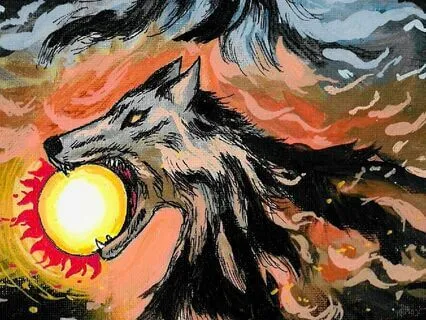
And finally overtook and devoured them.
Deluging the earth with blood from their dripping jaws.
In the east she was seated,
That aged woman,
In Jarnrid,
And there she nourished the posterity of Fenrir.
He will be the most formidable of all he,
Who under the form of a monster will swallow up the moon.
At this terrible calamity the whole earth trembled and shook.
The stars,
Affrighted,
Fell from their places,
And Loki and Fenris and Garn,
Renewing their efforts,
Rent their chains asunder and rushed forth to take their revenge.
At the same moment the dragon Nidhogg gnawed through the root of the ash Yggdrasil,
Which quivered to its topmost bow.
The red cock Fjallar,
Perched above Valhalla,
Loudly crowed an alarm,
Which was immediately echoed by Gullinkambi,
The rooster in Midgard,
And by Hel's dark red bird in Niflheim.
The gold-conned cock,
The gods in Valhalla loudly crowed to arms.
The blood-red cock,
As shrilly summons all,
On earth and down beneath it.
Heimdall,
Noting these ominous portents and hearing the cock's shill cry,
Immediately put the Gjallarhorn to his lips and blew the long-expected blast,
Which was heard throughout the world.
At the first sound of this rally,
Aesir and Einherjar sprang from their golden couches and sallied bravely out of the great hall.
Armed for the coming fray and mounting their impatient steeds,
They galloped over the quivering rainbow bridge to the spacious field of Vigrid,
Where,
As Vafthrednir had predicted long before,
The last battle was to take place.
The terrors of the sea.
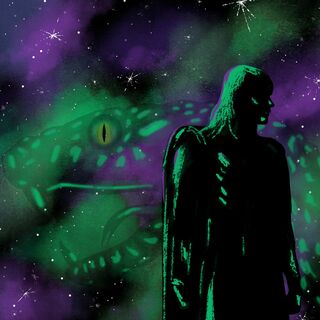
The terrible Midgardsnake Jörmungandr had been aroused by the general disturbance,
And with immense writhings and commotion whereby the seas were lashed into huge waves such as had never before disturbed the deeps of ocean,
He crawled out upon the land and hastened to join the dead fray in which he was to play a prominent role.
In giant breath the serpent tossed in ocean depths still free from chain,
He rose upon the foaming main beneath the lashings of his tail.
Seas,
Mountain high,
Swelled on the land,
Then darting mad the waves across,
Pouring forth bloody froth like hail.
Spurting with poison-venomed breath,
Foul,
Deadly mists over all the earth,
Through thundering surge he sought the strand.
One of the great waves,
Stirred up by Jörmungandr's struggles,
Set afloat Nagylfar,
The fatal ship,
Which was constructed entirely out of nails of those dead folks whose relatives had failed through the ages in their duty,
Having neglected to bear the nails of the deceased,
Ere they were laid to rest.
No sooner was this vessel afloat,
Than Loki boarded it with the fiery host from Muspelheim and steered it boldly over the stormy waters to the place of conflict.
This was not the only vessel bound for Vigrid,
However,
For out of a thick fog-bank towards the north came another ship,
Steered by Hrim,
In which were all the Frost Giants,
Armed to the teeth and eager for a conflict with the Æsir whom they had always hated.
THE TERRORS OF THE UNDERWORLD At the same time Hel,
The goddess of death,
Crept through a crevice in the earth out of her underground home,
Closely followed by the hellhound Garn,
The malefactors of her cheerless realm,
And the dragon Nitho,
Which flew over the battlefield bearing corpses upon his wings.
As soon as he landed,
Loki welcomed these reinforcements with joy,
And placing himself at their head,
He marched with them to the fight.
Suddenly the skies were rent asunder,
And through the fiery breach rode Surtr with his flaming sword,
Followed by his sons,
And as they rode over the bridge Bifrost with intent to storm Asgard,
The glorious arch sank with a crash beneath their horses' tread.
Down through the fields of air,
With glittering armor fair,
In battle order bright,
They sped while seething flame from rapid hoof-strokes came,
Leading his gleaming band rode Surtr amid the red ranks of raging fire.
The gods knew full well that the end was now near,
And that their weakness and lack of foresight placed them under great disadvantages.
For Odin had but one eye,
Tyr but one hand,
And Frey nothing but a stag's horn wherewith to defend himself instead of his invincible sword.
Nevertheless,
The Aesir did not show any signs of despair,
But,
Like true battle-gods of the North,
They donned their richest attire and gaily rode to the battlefield,
Determined to sell their lives as dearly as possible.
While they were mustering their forces,
Odin once more rode down to the Urdar fountain,
Where,
Under the toppling Yggdrasil,
The Norn sat with veiled faces and obstinately silent,
Their web lying torn at their feet.
Once more the father of the gods whispered a mysterious communication to Mimir,
After which he remounted Sleipnir and rejoined the waiting host.
THE GREAT BATTLE The combatants were now assembled on Vigrid's broad plain.
On one side were arranged the stern,
Calm faces of the Aesir,
Vanas and Einherjar,
While on the other were gathered the motley hosts of Surtr,
The grim Frost Giants,
The palely army of Hel,
And Loki and his dreaded followers,
Garm,
Fenrir and Jörmungandr.
The latter two belching forth fire and smoke,
And exhaling clouds of noxious,
Deadly vapors which filled all heaven and earth with their poisonous breath.
The years roll on,
The generations pass,
The ages grow,
And bring us nearer to the final day,
When from the south shall march the fiery band,
And cross the bridge of heaven with Loki for guide and Fenrir at his heel with broken chain,
While from the east the giant Rímer steers,
His ship and the great serpent makes the land,
And all are marshaled in one flaming square,
Against the gods upon the plains of heaven.
All the pent-up antagonism of ages was now let loose in a torrent of hate,
Each member of the opposing hosts fighting with grim determination,
As did our ancestors of old,
Hand to hand and face to face.
With a mighty shock heard above the roar of battle which filled the universe,
Odin and Fenrir came into impetuous contact,
While Thor attacked the Midgard snake,
And Tyr came to grips with the dog Garm.
Frey closed with Surtr,
Heimdall with Loki,
Whom he had defeated once before,
And the remainder of the gods and all the Einherjar engaged foes equally worthy of their courage.
But,
In spite of their daily preparation in the heavenly city,
Valhalla's host was doomed to succumb and Odin amongst the first of the Shining Ones to be slain.
Not even the high courage and mighty attributes of Allfather could withstand the tide of evil as personified the Fenrir wolf.
At each succeeding moment of the struggle,
Its colossal size assumed greater proportions,
Until finally its wide open jaws embraced all the space between heaven and earth,
And the foul monster rushed furiously upon the Father of Gods and engulfed him bodily with its horrid maw.
Fenrir shall,
With impious tooth,
Slay the sire of rolling gears,
Vithar shall avenge his fall,
And struggling with the shaggy wolf shall cleave his cold and gory jaws.
None of the gods could lend Allfather a helping hand at that critical moment,
For it was a time of sore trial to all.
Frey put forth heroic efforts,
But Surtr's flashing sword now dealt him a death stroke.
In his struggle with the arch-enemy Loki,
Heimdall fared better,
But his final conquest was dearly bought,
For he too fell dead.
The struggle between Tyr and Garn had the same tragic end,
And Thor,
After most terrible encounter,
With the Midgard snake,
And after slaying him with a stroke from Mjölnir,
Staggered back nine paces and was drowned in the flood of venom,
Which poured from the dying monster's jaws.
Odin's son goes with the monster to fight.
Midgard's Veor,
In his rage,
Will slay the worm,
Nine feet will go.
Fjörgyn's son,
Bowed by the serpent,
Who feared no foe.
Vithar now came rushing from a distant part of the plain to avenge the death of his mighty sire,
And a tomb foretold fell upon Fenrir,
Whose lower jaw now felt the impress of that shoe which had been reserved for this day.
At the same moment,
Vithar seized the monster's upper jaw with his hands,
And with one terrible wrench tore him asunder.
The devouring fire,
The other gods who took part in the fray,
And all the Einherjar having now perished,
Surtr suddenly flung his fiery brands over heaven,
Earth,
And the nine kingdoms of hell.
The raging flames enveloped the massive stem of the world-ash Yggdrasil and reached the golden palaces of the gods which were utterly consumed.
The vegetation upon earth was likewise destroyed,
And the fervent heat made all the waters seethe and boil.
Fire's breath assails the all-nourishing tree,
Towering fire plays against heaven itself.
The great conflagration raged fiercely until everything was consumed,
When the earth,
Blackened and scarred,
Slowly sank beneath the boiling waves of the sea.
Ragnarök had indeed come,
The world-tragedy was over,
The divine actors were slain,
And chaos seemed to have resumed its former sway.
But as in a play,
After the principles were slain and the curtain has fallen,
The audience looks for the favourites to appear and make their bow.
So the ancient northern races fancied that all evil,
Having perished in Surtr's flames from the general ruin goodness would rise,
To resume its sway over the earth,
And that some of the gods would return to dwell in heaven forever.
All evil dies there an endless death,
While goodness riseth,
From the great world-fire,
Purified at last,
To a life far higher,
Better,
Nobler than the past.
Our ancestors believed fully in regeneration,
And held that after a certain space of time,
The earth,
Purged by fire and purified by its immersion in the sea,
Rose again in all its pristine beauty,
And was illuminated by the sun,
Whose chariot was driven by a daughter of Saul,
Born before the wolf had devoured her mother.
The new orb of day was not imperfect,
As the first sun had been and its rays were no longer so ardent that a shield had to be placed between it and the earth.
The more beneficent rays soon caused the earth to renew its green mantle,
And to bring forth flowers and fruit in abundance.
Two human beings,
A woman,
Lif,
And a man Lifthrasir,
Now emerged from the depths of Hodmimir's forest,
Whence they had fled for refuge when Surtr set fire to the world.
They had sunk into peaceful slumber there,
Unconscious of the destruction around them,
And had remained nurtured by the morning dew until it was safe for them to wander out once more,
When they took possession of the regenerated earth,
Which their descendants were to people and over which they were to have full sway.
We shall see emerge from the bright ocean at our feet an earth more fresh,
More verdant than the last,
With roots self-springing and a seed of man preserved,
Who then shall live in peace as in war.
A new heaven.
All the gods who represented the developing forces of nature were slain on the fatal field of Ygritte,
But Vali and Vidar,
The types of the imperishable forces of nature,
Returned to the field of Idar,
Where they were met by Mordi and Magni,
Thor's sons,
The personifications of strength and energy,
Who rescued their father's sacred hammer from the general destruction and carried it thither with them.
Vidar's then and Vali's forces,
Heirs to empty realm of gods,
Mordi's Thu and Magni's Might,
Sways the massy mallet's weight,
One from Thor when Thor must fall.
Here they were joined by Hönir,
Who no longer an exile among Vanar,
Who as developing forces had also vanished forever,
And out of the dark underworld where he had languished so long so long rose the radiant Baldr,
Together with his brother Hödr,
With whom he was reconciled and with whom he was to live in perfect amity and peace.
The past had gone forever and the surviving deities could recall it without bitterness.
The memory of their former companions was,
However,
Dear to them,
And full often did they return to their old haunts to linger over the happy associations.
It was thus that walking one day in the long grass on Iðafjörðr when they found again the golden discs with which Æsir had been wont to sport,
We shall tread once more that well-known plain of Iða,
And among the grass shall find the golden dice with which we played of yore,
And that will bring to mind the former life and pastime of the gods,
The wise discourse of Orðinn,
The delights of other days.
When the small band of gods turned mournfully towards the place where their lordly dwellings once stood,
They became aware,
To their joyful surprise,
That Gimli,
The highest heavenly abode,
Had not been consumed,
For it rose glittering before them,
Its golden roof outshining the sun.
Hastening thither they discovered,
To the great increase of their joy,
That it had become the place of refuge for all the virtuous.
In Gimli,
The lofty,
There shall the hosts of the virtuous dwell,
And through all ages taste of deep gladness.
One too mighty to name,
As the Norseman who settled in Iceland,
And through whom the most complete exposition of the Odinic faith has come down to us in the Eddas and Sagas,
Were not definitely converted until the 11th century.
Although they had come in contact with Christians during their Viking raids nearly six centuries before,
It is very probable that the Northern Scalds gleaned some idea of the Christian doctrines that this knowledge influenced them to a certain extent,
And coloured their descriptions of the end of the world and the regeneration of the earth.
It was perhaps this vague knowledge also which induced them to add to the Edda a verse which is generally supposed to have been an interpellation,
Proclaiming that another god,
Too mighty to name,
Would arise to rule over Gimli.
From his heavenly seat he would judge mankind and would separate the good from the bad.
The former would be banished to the whores of Nastrand,
While the good would be transported to the blissful halls of Gimli the fair.
Then comes another,
Yet more mighty,
But him I dare not venture to name.
Few farther may look than through where Odin,
To meet the wolf,
Goes.
There were two other heavenly mansions,
However,
One reserved for the dwarves and the other for the giants.
For as these creatures had no free will and but blindly executed the decrees of fate,
They were not thought to be responsible for any harm done by them,
And were,
Therefore,
Held to be under deserving of punishment.
The dwarves,
Ruled by Sindri,
Were said to occupy a hall in the Nida mountains,
Where they drank the sparkling mead,
While giants took their pleasure in the hall of Primer,
Situated in the region of Kolnur,
Not cool.
For the power of cold was entirely annihilated and there was no more ice.
Various mythologists have,
Of course,
Attempted to explain these myths and some have been already stated.
See in the story of Ragnarok the influence of Christian teachings.
And esteem it only a barbaric version of the end of the world and the coming judgment day,
When a new heaven and earth shall arise and all the good shall enjoy eternal bliss.
Thank you so much for listening and enjoy the rest of your sleep.
Good night.