Welcome to the I Can't Sleep podcast,
Where I read random articles from across the web to bore you to sleep with my soothing voice.
I'm your host,
Benjamin Boster.
Today's episode is from a Wikipedia article titled,
Dune.
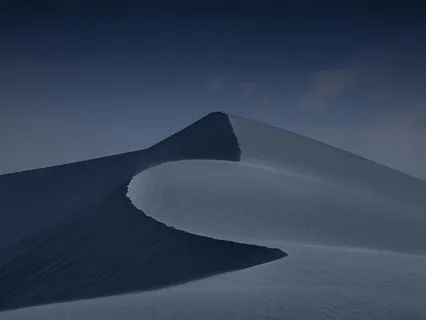
A dune is a landform composed of wind or water-driven sand.
It typically takes the form of a mound,
Ridge,
Or hill.
An area with dunes is called a dune system or a dune complex.
A large dune complex is called a dune field,
While broad,
Flat regions covered with windswept sand or dunes,
With little or no vegetation,
Are called ergs or sand seas.
Dunes occur in different shapes and sizes,
But most kinds of dunes are longer on the stoss upflow side,
Where the sand is pushed up the dune and have a shorter slip face in the lee side.
The valley or trough between dunes is called a duneslack.
Dunes are most common in desert environments,
Where the lack of moisture hinders the growth of vegetation that would otherwise interfere with the development of dunes.
However,
Sand deposits are not restricted to deserts,
And dunes are also found along seashores,
Along streams in semi-arid climates,
In areas of glacial outwash,
And in other areas where poorly cemented sandstone bedrock disintegrates to produce an ample supply of loose sand.
Subaquia dunes can form from the action of water flow on sand or gravel beds of rivers,
Estuaries,
And the seabed.
Some coastal areas have one or more sets of dunes running parallel to the shoreline,
Directly inland from the beach.
In most cases,
The dunes are important in protecting the land against potential ravages by storm waves from the sea.
Artificial dunes are sometimes constructed to protect coastal areas from the impact of storm waves from the sea.
The dynamic action of wind and water can sometimes cause dunes to drift,
Which can have serious consequences.
For example,
The town of Eucla,
Western Australia,
Had to be relocated in the 1890s because of dune drift.
The modern word dune came into English from French around 1790,
Which in turn came from Middle Dutch duina.
A universally precise distinction does not exist between ripples,
Dunes,
And draws,
Which are all deposits of the same type of materials.
Dunes are generally defined as greater than seven centimeters tall and may have ripples,
While ripples are deposits that are less than three centimeters tall.
A draw is a very large aeolian landform with a length of several kilometers and a height of tens to hundreds of meters,
And which may have superimposed dunes.
Dunes are made of sand-sized particles and may consist of quartz,
Calcium carbonate,
Snow,
Gypsum,
Or other materials.
The upwind,
Upstream,
Upcurrent side of the dune is called the stoss side.
The downflow side is called the lee side.
Sand is pushed,
Creep,
Or bounces,
Saltation,
Up the stoss side and slides down the lee side.
A side of a dune that the sand has slid down is called a slip face.
The Bagnold formula gives the speed at which particles can be transported.
Five basic dune types are recognized.
Crescentic,
Linear,
Star,
Dome,
And Parabolic.
Dune areas may occur in three forms.
Simple,
Isolated dunes of basic type.
Compound,
Larger dunes on which smaller dunes of same type form.
And complex,
Combinations of different types.
Barken dunes are crescent-shaped mounds,
Which are generally wider than they are long.
The lee-side slip faces are on the concave sides of the dunes.
These dunes form under winds that blow consistently from one direction.
They form separate crescents when the sand supply is comparatively small.
When the sand supply is greater,
They may merge into barkenoid ridges and then transverse dunes.
Some types of crescentic dunes move more quickly over desert surfaces than any other type of dune.
A group of dunes moved more than 100 meters per year between 1954 and 1959 in China's Ningxia province.
And similar speeds have been recorded in the western desert of Egypt.
The largest crescentic dunes on Earth,
With mean crest-to-crest widths of more than 3 kilometers,
Are in China's Taklamakan desert.
Abundant barken dunes may merge into barkenoid ridges,
Which then grade into linear transverse dunes,
So-called because they lie transverse or across the wind direction,
With the wind blowing perpendicular to the ridge crest.
Safe dunes are linear,
Or slightly sinuous dunes with two slip faces.
The two slip faces make them sharp-crested.
They are called safe dunes after the Arabic word for sword.
They may be more than 160 kilometers long,
And thus easily visible in satellite images.
Safe dunes are associated with bidirectional movement.
Safe dunes are associated with bidirectional winds.
The long axes and ridges of these dunes extend along the resultant direction of sand movement.
Some linear dunes merge to form Y-shaped compound dunes.
Formation is debated.
Ralph Bagnold,
In The Physics of Blown Sand and Desert Dunes,
Suggested that some safe dunes form when a barken dune moves into a bidirectional wind regime,
And one arm or wing of the crescent elongates.
Others suggest that safe winds are formed by vortices in a unidirectional wind.
In the sheltered troughs between highly developed safe dunes,
Barkens may be formed,
Because the wind is constrained to be unidirectional by the dunes.
Safe dunes are common in the Sahara.
They range up to 300 meters in height and 300 kilometers in length.
In the southern third of the Arabian Peninsula,
A vast erg called the Ruh Balkali,
Or Empty Quarter,
Contains safe dunes that stretch for almost 200 kilometers,
And reach heights of over 300 meters.
Linear loess hills known as pahas are superficially similar.
These hills appear to have been formed during the last ice age under permafrost conditions,
Dominated by sparse tundra vegetation.
Stardunes are pyramidal sand mounds with slip faces on three or more arms that radiate from the high center of the mound.
They tend to accumulate in areas with multidirectional wind regimes.
Stardunes grow upward rather than laterally.
They dominate the Grand Erg Oriental of the Sahara.
In other deserts they occur around the margins of the sand seas,
Particularly near topographic barriers.
In the southeast Badain-Djeran desert of China,
The stardunes are up to 500 meters tall,
And may be the tallest dunes on Earth.
Dome dunes are oval or circular mounds that generally lack a slip face.
Dome dunes are rare and occur at the far upward margins of sand seas.
Fixed crescentic dunes that form on the leeward margins of playas and river valleys in arid and semi-arid regions in response to the direction of prevailing winds are known as lunettes,
Source-bordering dunes,
Borrelets,
And clay dunes.
They may be composed of clay,
Silt,
Sand,
Or gypsum eroded from the basin floor or shore,
Transported up the concave side of the dune,
And deposited on the convex side.
Examples in Australia are up to 6.
5 kilometers long,
1 kilometer wide,
And up to 50 meters high.
They also occur in southern and west Africa,
And in parts of the western United States,
Especially Texas.
U-shaped mounds of sand with convex noses trailed by elongated arms are parabolic dunes.
These dunes are formed from blowout dunes,
Where the erosion of vegetated sand leads to a U-shaped depression.
The elongated arms are held in place by vegetation.
The largest arm known on earth reaches 12 kilometers.
Sometimes these dunes are called U-shaped,
Blowout,
Or hairpin dunes,
And they are well known in coastal deserts.
Unlike crescent-shaped dunes,
Their crests point upward.
The bulk of the sand in the dune migrates forward.
In plan view,
These are U-shaped or V-shaped mounds of well-sorted,
Very fine to medium sand with elongated arms that extend upward behind the central part of the dune.
There are slip faces that often occur on the outer side of the nose and on the outer slopes of the arms.
These dunes often occur in semi-arid areas where the precipitation is retained in the lower parts of the dune and underlying soils.
The stability of the dunes was once attributed to the vegetative cover,
But recent research has pointed to water as the main source of parabolic dune stability.
The vegetation that covers them—grasses,
Shrubs,
And trees— help anchor the trailing arms.
In inland deserts,
Parabolic dunes commonly originate and extend downward from blowouts and sand sheets only partly anchored by vegetation.
They can also originate from beach sands and extend inland into vegetated areas in coastal zones and on shores of large lakes.
Most parabolic dunes do not reach heights higher than a few tens of meters except at their nose,
Where vegetation stops or slows the advance of accumulating sand.
Simple parabolic dunes have only one set of arms that trail upward,
Behind the leading nose.
Compound parabolic dunes are coalesced features with several sets of trailing arms.
Complex parabolic dunes include subsidiary superposed or coalesced forms,
Usually of barchanoid or linear shapes.
Parabolic dunes,
Like crescent dunes,
Occur in areas where very strong winds are mostly unidirectional.
Although these dunes are found in areas now characterized by variable wind speeds,
The effective winds associated with the growth and migration of both the parabolic and crescent dunes probably are the most consistent in wind direction.
The grain size for these well-sorted,
Very fine-to-medium sands is about 0.
06 to 0.
5 mm.
Parabolic dunes have loose sand and steep slopes,
Only on their outer flanks.
The inner slopes are mostly well-packed and anchored by vegetation,
As are the corridors between the dunes.
Because all dune arms are oriented in the same direction,
And the inner dune corridors are generally swept clear of loose sand,
The corridors can usually be traversed in between the trailing arms of a dune.
However,
To cross straight over the dune by going over the trailing arms can be difficult.
Also,
Traversing the nose is very difficult as well,
Because the nose is usually made up of loose sand without much,
If any,
Vegetation.
A type of extensive parabolic dune that lacks discernible slip faces and has mostly coarse-grained sand is known as a parabolic dune.
A type of extensive parabolic dune that lacks discernible slip faces and has mostly coarse-grained sand is known as a zbar.
The term zbar comes from the Arabic word to describe rolling transverse ridges with a hard surface.
The dunes are small,
Have low relief,
And can be found in many places across the planet,
From Wyoming in the United States to Saudi Arabia to Australia.
Spacing between zbars ranges from 50 to 400 meters,
And they do not become more than 10 meters high.
The dunes form at about 90 degrees to the prevailing wind,
Which blows away the small,
Fine-grained sand,
Leaving behind the coarser-grained sand to form the crest.
Reversing dunes occur wherever winds periodically reverse direction.
Reversing dunes are varieties of any of the above shapes.
These dunes typically have major and minor slip faces oriented in opposite directions.
The minor slip faces are usually temporary,
As they appear after a reverse wind,
And are generally destroyed when the wind next blows in the dominant direction.
Draws are very large-scale dune bedforms.
They may be tens or a few hundreds of meters in height,
Kilometers wide,
And hundreds of kilometers in length.
After a draw has reached a certain size,
It generally develops superimposed dune forms.
They are thought to be more ancient and slower-moving than smaller dunes,
And to form by vertical growth of existing dunes.
Draws are widespread in sand areas,
And are well represented in the geological record.
All these dune shapes may occur in three forms,
Simple,
Compound,
And complex.
Simple dunes are basic forms with the minimum number of slip faces that define the geometric type.
Compound dunes are large dunes on which smaller dunes of similar type and slip face orientation are superimposed.
Complex dunes are combinations of two or more dune types.
A crescendic dune with a star dune superimposed on its crest is the most common complex dune.
Simple dunes represent a wind regime that has not changed in intensity or direction since the formation of the dune,
While compound and complex dunes suggest that the intensity and direction of the wind has changed.
The sand mass of dunes can move either windward or leeward,
Depending on if the wind is making contact with the dune from below or above its apogee.
If wind hits from above,
The sand particles move leeward.
The leeward flux of sand is greater than the windward flux.
Conversely,
If sand hits from below,
Sand particles move windward.
Further,
If the wind is carrying sand particles when it hits the dune,
The dune's sand particles will saltate more than if the wind had hit the dune without carrying sand particles.
Coastal dunes form when wet sand is deposited along the coast and dries out and is blown along the beach.
Dunes form where the beach is wide enough to allow for the accumulation of windblown sand,
And where prevailing onshore winds tend to blow sand inland.
The three key ingredients for coastal dune formation are a large sand supply,
Winds to move said sand supply,
And a place for the sand supply to accumulate.
Obstacles,
For example,
Vegetation,
Pebbles,
And so on,
Tend to slow down the wind and lead to the deposition of sand grains.
These small incipient dunes,
Or shadow dunes,
Tend to grow in the vertical direction if the obstacles slowing the wind can also grow vertically,
I.
E.
Vegetation.
Coastal dunes expand laterally as a result of lateral growth of coastal plants via seed or rhizome.
Models of coastal dunes suggest that their final equilibrium height is related to the distance between the waterline and where vegetation can grow.
Coastal dunes can be classified by where they develop or begin to take shape.
Dunes are commonly grouped into either the primary dune group or the secondary dune group.
Primary dunes gain most of their sand from the beach itself,
While secondary dunes gain their sand from the primary dune.
Along the floor at a panhandle,
Most dunes are considered to be foredunes or hummocks.
Different locations around the globe have dune formations unique to their given coastal profile.
Coastal sand dunes can provide privacy and or habitats to support local flora and fauna.
Animals such as sand snakes,
Lizards,
And rodents can live in coastal sand dunes,
Along with insects of all types.
Often the vegetation of sand dunes is discussed without acknowledging the importance that coastal dunes have for animals.
Further,
Some animals,
Such as foxes and feral pigs,
Can use coastal dunes as hunting grounds to find food.
Birds are also known to utilize coastal dunes as nesting grounds.
All these species find the coastal environment to be a great source of food.
All these species find the coastal environment of the sand dune vital to their species' survival.
Over the course of time,
Coastal dunes may be impacted by tropical cyclones or other intense storm activity,
Depending on their location.
Recent work has suggested that coastal dunes tend to evolve toward a high or low morphology,
Depending on the growth rate of dunes relative to storm frequency.
During a storm event,
Dunes play a significant role in minimizing wave energy as it moves onshore.
As a result,
Coastal dunes,
Especially those in the foredune area affected by a storm surge,
Will retreat or erode.
To counteract the damage from tropical activity on coastal dunes,
Short-term post-storm efforts can be made by individual agencies through fencing to help with sand accumulation.
How much a dune erodes during any storm surge is related to its location on the coastal shoreline and the profile of the beach during a particular season.
In those areas with harsher winter weather,
During the summer,
A beach tends to take on more of a convex appearance due to gentler waves,
While the same beach in the winter may take on more of a concave appearance.
As a result,
Coastal dunes can get eroded much more quickly in the winter than in the summer.
The converse is true in areas with harsher summer weather.
There are many threats to these coastal communities.
Some coastal dunes,
For example ones in San Francisco,
Have been completely altered by urbanization,
Reshaping the dune for human use.
This puts native species at risk.
Another danger in California,
And places in the UK specifically,
Is the introduction of invasive species.
Plant species were introduced from South Africa in an attempt to stabilize the dunes and provide horticultural benefits,
But instead spread,
Taking land away from native species.
European beach grass has a similar story,
Though it has no horticulture benefits.
It has great ground coverage and,
As intended,
Stabilized the dunes,
But as an unintended side effect,
Prevented native species from thriving in those dunes.
One such example is the dune field at Point Reyes,
California.
There are now efforts to get rid of both of these invasive species.
As the dune forms,
Plant succession occurs.
The conditions on an embryo dune are harsh,
With salt spray from the sea carried on strong winds.
The dune is well-drained and often dry,
And composed of calcium carbonate from seashells.
Rotting seaweed brought in by storm waves adds nutrients to allow pioneer species to colonize the dune.
For example,
In the United Kingdom,
These pioneer species are often marram grass,
Seaward grass,
And other seagrasses.
These plants are well-adapted to the harsh conditions of the foredune,
Typically having deep roots which reach the water table,
Root nodules that produce nitrogen compounds,
And protected stoma,
Producing transpiration.
Also,
The deep roots bind the sand together,
And the dune grows into a foredune as more sand is blown over the grasses.
The grasses add nitrogen to the soil,
Meaning other less hardy plants can then colonize the dunes.
Typically,
These are healthier heaths and gorses.
These too are adapted to the low soil water content,
And have small,
Prickly leaves which reduce transpiration.
Heather adds hummus to the soil,
And is usually replaced by coniferous trees.
Coniferous forests and heathland are common climax communities for sand dune systems.
In the United Kingdom,
This is often the case,
But in the United States,
It is often the case that the sand dune system is the primary source of water.
In the United States,
This is often the case,
But in the United States,
It is the primary source of water.
This is often the case for sand dune systems.
Young dunes are called yellow dunes,
And dunes which have high hummus content are called gray dunes.
Leaching occurs on the dunes,
Washing hummus into the slacks,
And the slacks may be much more developed than the exposed tops of the dunes.
It is usually in the slacks that more rare species are developed,
Allowing for the dune slack soil to be waterlogged,
Where only marsh plants can survive.
In Europe,
These plants include creeping willow,
Cotton grass,
Yellow iris,
Reeds,
And rushes.
As for vertebrates in European dunes,
Natterjack toads sometimes breed here.
Dune ecosystems are extremely difficult places for plants to survive.
This is due to a number of pressures related to their proximity to the ocean,
And confinement to growth on sandy substrates.
These include little available soil moisture,
Little available soil organic matter,
Nutrients,
Water,
Harsh winds,
Salt spray,
Erosion and shifting,
And sometimes burial or exposure from shifting,
Tidal influences.
Plants have evolved many adaptations to cope with these pressures.
Deep taproot to reach water table,
Shallow but extensive root systems,
Rhizomes,
Prostrate growth form to avoid wind and salt spray,
Krumholtz growth form,
Sickened cuticle,
Succulents to reduce moisture loss and reduce salt uptake,
Pale leaves to reduce insulation,
Thorny,
Spiky seeds to ensure establishment and vicinity of parent,
Reduces chances of being blown away or swept out to sea.
In deserts where large amounts of limestone mountains surround a closed basin,
Such as White Sands National Park in south-central New Mexico,
Occasional storm runoff transports dissolved limestone and gypsum into a low-lying pan within the basin,
Where the water evaporates,
Depositing the gypsum and forming crystals known as selenite.
The crystals left behind by this process are eroded by the wind and deposited as vast white dune fields that resemble snow-covered landscapes.
These types of dunes are rare and only form enclosed arid basins that retain the highly soluble gypsum that would otherwise be washed into the sea.
A nabca or coppice dune is a small dune anchored by vegetation.
They usually indicate desertification or soil erosion and serve as nesting and burrow sites for animals.