Welcome to the I Can't Sleep Podcast,
Where I read random articles from across the web to bore you to sleep with my soothing voice.
I'm your host,
Benjamin Boster.
Today's episode is from a Wikipedia article titled,
Sky.
The sky,
Or celestial dome,
Is everything that lies above the surface of the Earth,
Including the atmosphere and outer space.
In the field of astronomy,
The sky is also called the celestial sphere.
This is an abstract sphere centered on the Earth,
On which the sun,
Stars,
Planets,
And moon appear to be traveling.
A celestial sphere is conventionally divided into designated areas called constellations.
Usually,
The term sky is used informally as the point of view from the Earth's surface.
However,
The meaning and usage can vary.
An observer on the surface of the Earth can see a small part of the sky,
Which appears to be a dome,
Also known as the sky bowl,
Flatter during the day than at night.
In some cases,
Such as in discussing the weather,
The sky refers to only the lower,
More dense portions of the atmosphere.
During daylight,
The sky appears to be blue,
Because air scatters more blue sunlight than red.
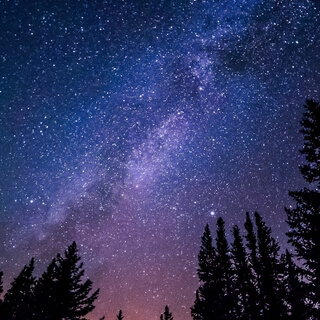
At night,
The sky appears to be a mostly dark surface or region,
Spangled with stars.
During the day,
The sun and sometimes the moon can be seen in the sky,
Unless obscured by clouds.
In the night sky,
The moon,
Planets,
And stars can be similarly visible in the sky.
Some of the natural phenomena seen in the sky are clouds,
Rainbows,
And aurorae.
Lightning and precipitation can also be seen in the sky.
Birds,
Insects,
Aircrafts,
And kites fly in the sky.
Due to human activities,
Smog during the day and light pollution during the night are often seen above large cities.
During the day,
Except for light that comes directly from the sun,
Most of the light in the day sky is caused by scattering,
Which is dominated by a small particle limit called Rayleigh scattering.
The scattering,
Due to the molecule-sized particles as in air,
Is greater in the direction toward and away from the source of light than it is in directions perpendicular to the arrival path.
Scattering is significant for light at all visible wavelengths,
But is stronger at the shorter,
Bluer end of the visible spectrum,
Meaning that the scattered light is bluer than its source,
The sun.
The remaining sunlight,
Having lost some of its short wavelength components,
Appears slightly less blue.
Scattering also occurs even more strongly in clouds.
Individual water droplets exposed to white light will create a set of colored rings.
If a cloud is thick enough,
Scattering from multiple water droplets will wash out the set of colored rings and create a washed-out white color.
Sky can turn a multitude of colors,
Such as red,
Orange,
Purple,
And yellow,
Especially near sunset or sunrise,
When the light must pass through a much longer path or optical depth through the atmosphere.
Scattering effects also partially polarize light from the sky and are most pronounced at an angle 90 degrees from the sun.
Scattered light from the horizon travels through as much as 38 times the atmosphere,
As does light from the zenith,
Causing a blue gradient,
Vivid at the zenith and pale near the horizon.
Because red light also scatters if there is enough air between the source and the observer,
Causing parts of the sky to change color during a sunset,
As the amount of atmosphere nears infinity,
The scattered light appears whiter and whiter.
The sun is not the only object that may appear less blue in the atmosphere.
Far away clouds or snowy mountain tops may appear yellowish.
The effect is not very obvious on clear days,
But is very pronounced when clouds cover the line of sight,
Reducing the blue hue from scattered sunlight.
At higher altitudes,
The sky tends toward darker colors since scattering is reduced due to lower air density.
An extreme example is the moon,
Where there is no atmosphere and no scattering,
Making the sky on the moon black even when the sun is visible.
Sky luminance distribution models have been recommended by the International Commission on Illumination,
CIE,
For the design of daylighting schemes.
Recent developments relate to all sky models for modeling sky luminance under weather conditions ranging from clear to overcast.
Dusk and Dawn The intensity of the sky varies greatly over the day,
And the primary causes of that intensity differs as well.
When the sun is well above the horizon,
Direct scattering of sunlight,
Rayleigh scattering,
Is the overwhelmingly dominant source of light.
However,
In twilight,
The period of time between sunset and night and between night and sunrise,
The situation is more complicated.
Green flashes and green rays are optical phenomena that occur shortly after sunset or before sunrise when a green spot is visible above the sun,
Usually for no more than a second or two,
Or it may resemble a green ray shooting up from the sunset point.
Green flashes are a group of phenomena that stem from different causes,
Most of which occur when there is a temperature inversion,
When the temperature increases with altitude rather than the normal decrease in temperature with altitude.
Green flashes may be observed from any altitude,
Even from an aircraft.
They are usually seen at an unobstructed horizon such as over the ocean,
But are also seen over cloud tops and mountain tops.
Green flashes may also be observed at the horizon in association with the moon and bright planets including Venus and Jupiter.
The Earth's shadow is the shadow that the Earth casts on its atmosphere.
This atmospheric phenomenon is sometimes seen twice a day,
Around the times of sunset and sunrise.
When the weather conditions in the observer's viewing point permit a clear sight of the horizon,
The shadow can be seen as a dark blue or grayish blue band.
Assuming the sky is clear,
The Earth's shadow is visible in the half of the sky opposite to the sunset or sunrise,
And is seen as a dark blue band right above the horizon.
A related phenomenon is the Belt of Venus,
Or anti-twilight arch,
A pink band that is visible above the dark blue band of the Earth's shadow in the same part of the sky.
There is no clear dividing line between the Earth's shadow and the Belt of Venus.
One colored band shades into the other in the sky.
Twilight is divided into three segments according to how far the sun is below the horizon,
Measured in segments of 6 degrees.
After sunset,
The civil twilight sets in.
It ends when the sun drops more than 6 degrees below the horizon.
This is followed by the nautical twilight,
When the sun is 6 degrees and 12 degrees below the horizon,
Heights of between negative 6 degrees and negative 12 degrees,
After which comes the astronomical twilight,
Defined as the period from negative 12 degrees to negative 18 degrees.
When the sun drops more than 18 degrees below the horizon,
The sky generally attains its minimum brightness.
Several sources can be identified as the source of the intrinsic brightness of the sky,
Namely airglow,
Indirect scattering of sunlight,
Scattering of starlight,
And artificial light pollution.
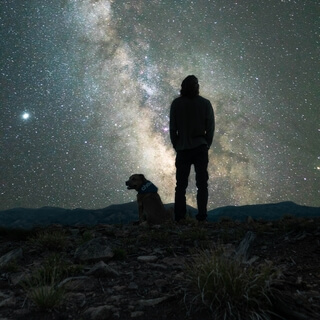
During the night,
The term night sky refers to the sky as seen at night.
The term is usually associated with skygazing and astronomy,
With reference to views of celestial bodies such as stars,
The moon,
And planets that become visible on a clear night after the sun has set.
Other light sources in a night sky include moonlight,
Starlight,
And airglow,
Depending on location and timing.
The fact that the sky is not completely dark at night can be easily observed.
Were the sky in the absence of moon and city lights absolutely dark,
One would not be able to see the silhouette of an object against the sky.
The night sky and studies of it have a historical place in both ancient and modern cultures.
In the past,
For instance,
Farmers have used the state of the night sky as a calendar to determine when to plant crops.
The ancient belief in astrology is generally based on the belief that relationships between heavenly bodies influence or convey information about events on earth.
The scientific study of the night sky and bodies observed within it,
Meanwhile,
Takes place in the science of astronomy.
Within visible light astronomy,
The visibility of celestial objects in the night sky is affected by light pollution.
The presence of the moon in the night sky has historically hindered astronomical observation by increasing the amount of ambient light.
With the advent of artificial light sources,
However,
Light pollution has been a growing problem for viewing the night sky.
Special filters and modifications to light fixtures can help to alleviate this problem,
But for the best views,
Both professional and amateur optical astronomers seek viewing sites located far from major urban areas.
Use in weather forecasting Along with pressure tendency,
The condition of the sky is one of the more important parameters used to forecast weather in mountainous areas.
Thickening of cloud cover or the invasion of a higher cloud deck is indicative of rain in the near future.
At night,
High thin serostratus clouds can lead to halos around the moon,
Which indicate the approach of a warm front and its associated rain.
Rain fog pretends fair conditions and can be associated with a marine layer,
An indication of a stable atmosphere.
Rainy conditions are preceded by wind or clouds which prevent fog formation.
The approach of a line of thunderstorms could indicate the approach of a cold front.
Cloud-free skies are indicative of fair weather for the near future.
The use of sky cover and weather predictions has led to various weather lore over the centuries.
Tropical cyclones Within 36 hours of the passage of a tropical cyclone center,
The pressure begins to fall and a veil of white serous clouds approaches from the cyclone's direction.
Within 24 hours of the closest approach to the center,
Low clouds begin to move in,
Also known as the bar of a tropical cyclone,
As the barometric pressure begins to fall more rapidly and the winds begin to increase.
Within 18 hours of the center's approach,
Squally weather is common,
With sudden increases in wind accompanied by rain showers or thunderstorms.
Within six hours of the center's arrival,
Rain becomes continuous.
Within an hour of the center,
The rain becomes very heavy and the highest winds within the tropical cyclone are experienced.
When the center arrives with a strong tropical cyclone,
Weather conditions improve and the sun becomes visible as the eye moves overhead.
As the system departs,
Winds reverse and,
Along with the rain,
Suddenly increase.
One day after the center's passage,
The low overcast is replaced with a higher overcast and the rain becomes intermittent.
By 36 hours after the center's passage,
The high overcast breaks and the pressure begins to level off.
Use in transportation It is the process by which an object moves through or beyond the sky,
As in the case of spacecraft,
Whether by generating aerodynamic lift,
Propulsive thrust,
Aerostatically using buoyancy,
Or by ballistic movement,
Without any direct mechanical support from the ground.
The engineering aspects of flight are studied in aerospace engineering,
Which is subdivided into aeronautics,
Which is the study of vehicles from travel through the air,
And astronautics,
The study of vehicles that travel through space,
And in ballistics,
The study of the flight of projectiles.
While human beings have been capable of flight via hot air balloons since 1783,
Other species have used flight for significantly longer.
Animals such as birds,
Bats,
And insects are capable of flight.
Spores and seeds from plants use flight via use of the wind as a method of propagating their species.
Significance in mythology Many mythologies have deities,
Especially associated with the sky.
In Egyptian religion,
The sky was deified as the goddess Nut and as the god Horus.
Dius is reconstructed as the god of the sky or the sky personified.
In Proto-Indo-European religion,
Went Zeus,
The god of the sky and thunder,
In Greek mythology,
And the Roman god of sky and thunder,
Jupiter.
In Australian Aboriginal mythology,
Algira or Arante is the main sky god and also the creator god.
In Iroquois mythology,
Atahensic was a sky goddess who fell down to the ground during the creation of the earth.
Many cultures have drawn constellations between stars and the sky,
Using them in association with legends and mythology about their deities.
Airglow Airglow,
Also called nightglow,
Is a faint emission of light by a planetary atmosphere.
In the case of Earth's atmosphere,
This optical phenomenon causes the night sky to never be completely dark,
Even after the effects of starlight and effused sunlight from the far side are removed.
The airglow phenomenon was first identified in 1868 by Swedish physicist Anders Unngström.
Since then,
It has been studied in the laboratory and various chemical reactions have been observed to emit electromagnetic energy as part of the process.
Scientists have identified some of those processes that would be present in Earth's atmosphere,
And astronomers have verified that such emissions are present.
Airglow is caused by various processes in the upper atmosphere of the earth,
Such as the recombination of atoms,
Which were photoionized by the sun during the day,
Luminescence caused by cosmic rays striking the upper atmosphere,
And chemiluminescence caused mainly by oxygen and nitrogen reacting with hydroxyl-free radicals at heights of a few hundred kilometers.
It is not noticeable during the daytime due to the glare and scattering of sunlight.
Even at the best ground-based observatories,
Airglow limits the photosensitivity of optical telescopes.
Partly for this reason,
Space telescopes like Hubble can observe much fainter objects than current ground-based telescopes at visible wavelengths.
Airglow at night may be bright enough for a ground observer to notice and appears generally bluish.
Although airglow emission is fairly uniform across the atmosphere,
It appears brightest at about 10 degrees above the observer's horizon since the lower one looks,
The greater the depth of atmosphere one is looking through.
Very low down,
However,
Atmospheric extinction reduces the apparent brightness of the airglow.
One airglow mechanism is when an atom of nitrogen combines with an atom of oxygen to form a molecule of nitric oxide.
In the process,
A photon is emitted.
This photon may have any of several different wavelengths characteristic of nitric oxide molecules.
The free atoms are available for this process because molecules of nitrogen and oxygen are disassociated by solar energy in the upper reaches of the atmosphere and may encounter each other to form NO.
Other species that can create airglow in the atmosphere are hydroxyl OH,
Atomic oxygen OH,
Sodium NA,
And lithium Li.
Induced Airglow Scientific experiments have been conducted to induce airglow by directing high-power radio emissions at the Earth's ionosphere.
These radio waves interact with the ionosphere to induce faint but visible optical light at specific wavelengths under certain conditions.