Welcome to the I Can't Sleep podcast,
Where I read random articles from across the web to bore you to sleep with my soothing voice.
I'm your host,
Benjamin Bostor.
Today's episode is from a Wikipedia article titled Black Hole.
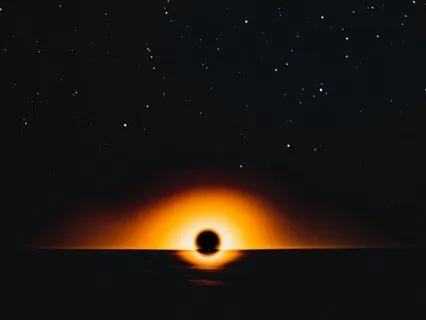
A black hole is a region of space-time where gravity is so strong that nothing,
No particles or even electromagnetic radiation such as light,
Can escape from it.
The theory of general relativity predicts that a sufficiently compact mass can deform space-time to form a black hole.
The boundary of the region from which no escape is possible is called the event horizon.
Although the event horizon has an enormous effect on the fate and circumstances of an object crossing it,
According to general relativity it has no locally detectable features.
In many ways a black hole acts like an ideal black body as it reflects no light.
Moreover,
Quantum field theory in curved space-time predicts that event horizons emit Hawking radiation with the same spectrum as a black body of a temperature inversely proportional to its mass.
This temperature is on the order of billionths of a Kelvin for black holes of stellar mass,
Making it essentially impossible to observe directly.
Objects whose gravitational fields are too strong for light to escape were first considered in the 18th century by Jean Michel and Pierre-Simon Laplace.
The first modern solution of general relativity that would characterize a black hole was found by Karl Schwarzschild in 1916,
Although its interpretation as a region of space from which nothing can escape was first published by David Finkelstein in 1958.
Black holes were long considered a mathematical curiosity.
It was not until the 1960s that theoretical work showed they were a generic prediction of general relativity.
The discovery of neutron stars by Jocelyn Bell Burnell in 1967 sparked interest in gravitationally collapsed compact objects as a possible astrophysical reality.
Black holes of stellar mass are expected to form when very massive stars collapse at the end of their life cycle.
After a black hole has formed,
It can continue to grow by absorbing mass from its surroundings.
By absorbing other stars and merging with other black holes,
Supermassive black holes of millions of solar masses may form.
There is consensus that supermassive black holes exist in the centers of most galaxies.
The presence of a black hole can be inferred through its interaction with other matter and with electromagnetic radiation such as visible light.
Matter that falls onto a black hole can form an external accretion disk heated by friction forming quasars,
Some of the brightest objects in the universe.
Stars passing too close to a supermassive black hole can be shred into streamers that shine very brightly before being swallowed.
If there are other stars orbiting a black hole,
Their orbits can be used to determine the black hole's mass and location.
Such observations can be used to exclude possible alternatives such as neutron stars.
In this way,
Astronomers have identified numerous stellar black hole candidates in binary systems and established that the radio source known as Sagittarius A at the core of the Milky Way galaxy contains a supermassive black hole of about 4.
3 million solar masses.
On the 11th of February 2016,
The LIGO Scientific Collaboration and the Virgo Collaboration announced the first direct detection of gravitational waves,
Which also represented the first observation of a black hole merger.
As of December 2018,
11 gravitational wave events have been observed that originated from 10 merging black holes,
Along with one binary neutron star merger.
On the 10th of April 2019,
The first direct image of a black hole and its vicinity was published following observations made by the Event Horizon Telescope in 2017 of the supermassive black hole in MISER 87's Galactic Center.
The idea of a body so massive that even light could not escape was briefly proposed by astronomical pioneer and English clergyman John Michel in a letter published in November 1784.
Michel's simplistic calculations assumed such a body might have the same density as the sun,
And concluded that such a body would form when a star's diameter exceeds the sun's by a factor of 500,
And the surface escape velocity exceeds the usual speed of light.
Michel correctly noted that such supermassive but non-radiating bodies might be detectable through their gravitational effects on nearby visible bodies.
Others of the time were initially excited by the proposal that giant but invisible stars might be hiding in plain view,
But enthusiasm dampened when the wave-like nature of light became apparent in the early 19th century.
If light were a wave rather than a corpuscle,
It is unclear what,
If any,
Influence gravity would have on escaping light waves.
Modern physics discredits Michel's notion of a light ray shooting directly from the surface of a supermassive star,
Being slowed down by the star's gravity,
Stopping,
And then free-falling back to the star's surface.
General Relativity In 1915,
Albert Einstein developed his theory of general relativity,
Having earlier shown that gravity does influence light's motion.
Only a few months later,
Karl Schwarzschild found a solution of the Einstein field equations,
Which describes the gravitational field of a point mass and a spherical mass.
A few months after Schwarzschild,
Johannes Droste,
A student of Hendrik Lorentz,
Independently gave the same solution for the point mass and wrote more extensively about its properties.
This solution had a peculiar behavior at what is now called the Schwarzschild's radius,
Where it became singular,
Meaning that some of the terms in the Einstein equations became infinite.
The nature of this surface was not quite understood at the time.
In 1924,
Arthur Eddington showed that the singularity disappeared after a change of coordinates,
Although it took until 1933 for Georges Lemaître to realize that this meant the singularity at the Schwarzschild radius was a non-physical coordinate singularity.
Arthur Eddington did,
However,
Comment on the possibility of a star with mass compressed to the Schwarzschild's radius in a 1926 book,
Noting that Einstein's theory allows us to rule out overly large densities for visible stars like Betelgeuse,
Because a star of 250 million kilometers radius could not possibly have so high a density as the sun.
Firstly,
The force of gravitation would be so great that light would be unable to escape from it,
The rays falling back to the star like a stone to the earth.
Secondly,
The red shift of the spectral lines would be so great that the spectrum would be shifted out of existence.
Thirdly,
The mass would produce so much curvature of the space-time metric that space would close up around the star,
Leaving us outside,
I.
E.
Nowhere.
In 1931,
Subramanyan Chandraskar calculated,
Using special relativity,
That a non-rotating body of electron-degenerate matter above a certain limiting mass has no stable solutions.
His arguments were opposed by many of his contemporaries like Eddington and Lev Lando,
Who argued that some yet unknown mechanism would stop the collapse.
They were partly correct.
A white dwarf slightly more massive than the Chandraskar limit would collapse into a neutron star,
Which is itself stable.
But in 1939,
Robert Oppenheimer and others predicted that neutron stars above another limit would collapse further for the reasons presented by Chandraskar,
And concluded that no law of physics was likely to intervene and stop at least some stars from collapsing to black holes.
Oppenheimer and his co-authors interpreted the singularity at the boundary of the Schwarzschild radius as indicating that this was the boundary of a bubble in which time stopped.
This is a valid point of view for external observers,
But not for infalling observers.
Because of this property,
The collapsed stars were called frozen stars,
Because an outside observer would see the surface of the star frozen in time at the instant where its collapse takes it to the Schwarzschild radius.
Golden Age In 1958,
David Finkelstein identified the Schwarzschild surface as an event horizon,
A perfect unidirectional membrane.
Causal influences can cross it in only one direction.
This did not strictly contradict Oppenheimer's results,
But extended them to include the point of view of infalling observers.
Finkelstein's solution extended the Schwarzschild solution for the future of observers falling into a black hole.
A complete extension had already been found by Martin Kruskal,
Who was urged to publish it.
These results came at the beginning of the Golden Age of General Relativity,
Which was marked by general relativity and black holes becoming mainstream subjects of research.
This process was helped by the discovery of pulsars by Jocelyn Bell Burnell in 1967,
Which by 1969 were shown to be rapidly rotating neutron stars.
Until that time,
Neutron stars,
Like black holes,
Were regarded as just theoretical curiosities.
But the discovery of pulsars showed their physical relevance and spurred a further interest in all types of compact objects that might be formed by gravitational collapse.
In this period,
More general black hole solutions were found.
In 1963,
Roy Kerr found the exact solution for a rotating black hole.
Two years later,
Ezra Newman found the axi-semitic solution for a black hole that is both rotating and electrically charged.
Through the work of Werner Israel,
Brandon Carter,
And David Robinson,
The no-hair theorem emerged,
Stating that a stationary black hole solution is completely described by the three parameters of the Kerr-Newman metric,
Mass,
Angular momentum,
And electric charge.
At first,
It was suspected that the strange features of the black hole solutions were pathological artifacts from the symmetry conditions imposed,
And that the singularities would not appear in generic situations.
This view was held in particular by Vladimir Belinsky,
Isaac Kalatnikov,
And Evgeny Lifshitz,
Who tried to prove that no singularities appear in generic solutions.
However,
In the late 1960s,
Roger Penrose and Stephen Hawking used global techniques to prove that singularities appear generically.
For this work,
Penrose received half of the 2020 Nobel Prize in Physics,
Hawking having died in 2018.
Work by James Bardeen,
Jacob Bekenstein,
Carter,
And Hawking in the early 1970s led to the formulation of black hole thermodynamics.
These laws describe the behavior of a black hole in close analogy to the laws of thermodynamics,
By relating mass to energy,
Area to entropy,
And surface gravity to temperature.
The analogy was completed when Hawking,
In 1974,
Showed that quantum field theory implies that black holes should radiate like a black body,
With a temperature proportional to the surface gravity of the black hole,
Predicting the effect now known as Hawking radiation.
Etymology John Michel used the term dark star,
And in the early 20th century,
Physicists used the term gravitationally collapsed object.
Science writer Marsha Bartusiak traces the term black hole to physicist Robert H.
Dick,
Who in the early 1960s reportedly compared the phenomenon to the black hole of Kolkata,
Notorious as a prison where people entered but never left alive.
The term black hole was used in print by Life and Science News magazines in 1963,
And by science journalist Anne Ewing in her article,
Black Holes in Space,
Dated 18th January 1964,
Which was a report on a meeting of the American Association for the Advancement of Science held in Cleveland,
Ohio.
In December 1967,
A student reportedly suggested the phrase black hole at a lecture by John Wheeler.
Wheeler adopted the term for its brevity and advertising value,
And it quickly caught on,
Leading some to credit Wheeler with coining the phrase.
Properties and Structure The No-Hair Conjecture postulates that once it achieves a stable condition after formation,
A black hole has only three independent physical properties,
Mass,
Charge,
And angular momentum.
The black hole is otherwise featureless.
If the conjecture is true,
Any two black holes that share the same values for these properties or parameters are indistinguishable from one another.
The degree to which the conjecture is true for real black holes under the laws of modern physics is currently an unsolved problem.
These properties are special because they are visible from outside a black hole.
For example,
A charged black hole repels other like charges,
Just like any other charged object.
Similarly,
The total mass inside a sphere containing a black hole can be found by using the gravitational analog of Gauss's law far from the black hole.
Likewise,
The angular momentum,
Or spin,
Can be measured from far away,
Using frame-dragging by the gravitomagnetic field through the example the lens-thirring effect.
When an object falls into a black hole,
Any information about the shape of the object or distribution of charge on it is evenly distributed along the horizon of the black hole,
And is lost to outside observers.
The behavior of the horizon in this situation is a dissipative system that is closely analogous to that of a conductive stretchy membrane with friction and electrical resistance,
The membrane paradigm.
This is different from other field theories such as electromagnetism,
Which do not have any friction or resistivity at the microscopic level,
Because they are time-reversible.
Because a black hole eventually achieves a stable state with only three parameters,
There is no way to avoid losing information about the initial conditions.
The gravitational and electric fields of a black hole give very little information about what went in.
The information that is lost includes every quantity that cannot be measured far away from the black hole horizon,
Including approximately conserved quantum numbers such as the total baryon number and lepton number.
This behavior is so puzzling that it has been called the black hole information loss paradox.
Physical Properties The simplest static black holes have mass,
But neither electric charge nor angular momentum.
These black holes are often referred to as Schwarzschild black holes after Karl Schwarzschild,
Who discovered this solution in 1916.
According to Birkhoff's theorem,
It is the only vacuum solution that is spherically symmetric.
This means there is no observable difference at a distance between the gravitational field of such a black hole and that of any other spherical object of the same mass.
The popular notion of a black hole sucking in everything in its surroundings is therefore correct only near a black hole's horizon.
Far away,
The external gravitational field is identical to that of any other body of the same mass.
Solutions describing more general black holes also exist.
Non-rotating charged black holes are described by the Reznor Nordstrom metric,
While the Kerr metric describes a non-charged rotating black hole.
The first general stationary black hole solution known is the Kerr-Newman metric,
Which describes a black hole with both charge and angular momentum.
While the mass of a black hole can take any positive value,
The charge and angular momentum are constrained by the mass.
In Planck units,
The total electric charge Q and the total angular momentum J are expected to satisfy for a black hole of mass M.
Black holes with the minimum possible mass satisfying this inequality are called extremal.
Solutions of Einstein's equations that violate this inequality exist,
But they do not possess an event horizon.
These solutions have so-called naked singularities that can be observed from the outside,
And hence are deemed unphysical.
The cosmic censorship hypothesis rules out the formation of such singularities when they are created through the gravitational collapse of realistic matter.
This is supported by numerical simulations.
Due to the relatively large strength of the electromagnetic force,
Black holes forming from the collapse of stars are expected to retain the nearly neutral charge of the star.
Rotation,
However,
Is expected to be a universal feature of compact astrophysical objects.
The black hole candidate binary X-ray source GRS 1915 plus 105 appears to have an angular momentum near the maximum allowed value.
Event Horizon The defining feature of a black hole is the appearance of an event horizon,
A boundary in space-time through which matter and light can pass only inward toward the mass of the black hole.
Nothing,
Not even light,
Can escape from inside the event horizon.
The event horizon is referred to as such because,
If an event occurs within the boundary,
Information from that event cannot reach an outside observer,
Making it impossible to determine whether such an event occurred.
As predicted by general relativity,
The presence of a mass deforms space-time in such a way that the paths taken by particles bend towards the mass.
At the event horizon of a black hole,
This deformation becomes so strong that there are no paths that lead away from the black hole.
To a distant observer,
Clocks near a black hole would appear to tick more slowly than those further away from the black hole.
Due to this effect,
Known as gravitational time dilation,
An object falling into a black hole appears to slow as it approaches the event horizon,
Taking an infinite time to reach it.
At the same time,
All processes on this object slow down from the viewpoint of a fixed outside observer,
Causing any light emitted by the object to appear redder and dimmer,
An effect known as gravitational redshift.
Eventually the falling object fades away until it can no longer be seen.
Typically,
This process happens very rapidly with an object disappearing from view within less than a second.
On the other hand,
Indestructible observers falling into a black hole do not notice any of these effects as they cross the event horizon.
According to their own clocks,
Which appear to them to tick normally,
They cross the event horizon at a finite time without noting any singular behavior.
In classical general relativity,
It is impossible to determine the location of the event horizon from local observations,
Due to Einstein's equivalence principle.
The topology of the event horizon of a black hole at equilibrium is always spherical.
For non-rotating static black holes,
The geometry of the event horizon is precisely spherical,
While for rotating black holes the event horizon is oblique.
Singularity At the center of a black hole,
As described by general relativity,
May lie a gravitational singularity,
A region where the space-time curvature becomes infinite.
For a non-rotating black hole,
This region takes the shape of a single point,
And for a rotating black hole it is smeared out to form a ring singularity that lies in the plane of rotation.
In both cases,
The singular region has zero volume.
It can also be shown that the singular region contains all the mass of the black hole solution.
The singular region can thus be thought of as having infinite density.
Members falling into a Schwarzschild black hole,
I.
E.
Non-rotating and not charged,
Cannot avoid being carried into the singularity once they cross the event horizon.
They can prolong the experience by accelerating away to slow their descent,
But only up to a limit.
When they reach the singularity,
They are crushed to infinite density,
And their mass is added to the total of the black hole.
Before that happens,
They will have been torn apart by the growing tidal forces in a process sometimes referred to as spaghettification,
Or the Noodle Effect.
In this case of a charged,
Resoner Nordstrom,
Or rotating Kerr black hole,
It is possible to avoid the singularity.
Extending these solutions as far as possible reveals the hypothetical possibility of exiting the black hole into a different space-time,
With the black hole acting as a wormhole.
The possibility of traveling to another universe is,
However,
Only theoretical since any perturbation would destroy this possibility.
It also appears to be possible to follow close time-link curves,
Returning to one's own past,
Around the Kerr singularity,
Which leads to problems with causality like the Grandfather Paradox.
It is expected that none of these peculiar effects would survive in a proper quantum treatment of rotating and charged black holes.
The appearance of singularities in general relativity is commonly perceived as signaling the breakdown of the theory.
This breakdown,
However,
Is expected.
It occurs in a situation where quantum effects should describe these actions due to the extremely high density and therefore particle interactions.
To date,
It has not been possible to combine quantum and gravitational effects into a single theory.
Although there exist attempts to formulate such a theory of quantum gravity,
It is generally expected that such a theory will not feature any singularities.