My name is Andrew McElroy and I am your guide today.
Let's be accurate about what's happening.
You're not thinking.
Thinking arrives somewhere.
This is the other thing.
The same four thoughts circling.
Wearing a groove in your brain.
And you've probably already tried to stop it.
Which,
As you discovered,
Is a bit like trying to be less annoyed.
So we won't try to stop it.
We're going to give the mind a job it can actually do instead.
Atha,
Let us commune and practice together.
In the Yoga Sutras of Patanjali.
Patanjali defines yoga in the second line of the text.
Yogas chittas vritti nirodha.
Yoga is the settling of the turnings of the mind.
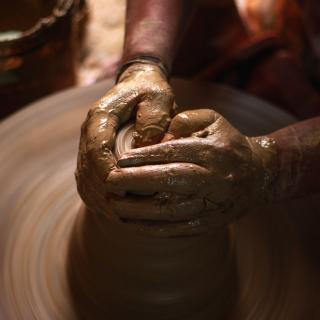
The word viriti is a whirlpool or a turning.
Not a thought,
But a rotation.
Patanjali isn't describing bad thoughts.
He's describing thoughts that have stopped going anywhere,
That have stopped serving you.
And in two lines later,
In sutra.
Book 1 verse 4,
He says something quite kind.
When this settling isn't happening.
We take the shape of the whirlpool.
We become the loop.
Which is why it doesn't feel like you're having a thought.
It feels like you're in the weather.
Our tool today.
Comes from later in the sutras,
Or by way of controlled expulsion and the retention of breath.
The exhale,
That's the lever.
The extended exhale,
Then a brief natural pause at the bottom.
Extending your exhale relative to your inhale shifts the anatomic balance toward the parasympathetic branch.
This is straightforward physiology.
Heart rate rises slightly on the inhale and falls on the exhale.
So a longer exhale means more time spent in the slowing phase.
The mental peace matters too.
Rumination,
The technical word for the loop.
Has been studied extensively as a maintaining factor in low mood and anxiety.
What consistently helps isn't the argument with content.
It's what researchers call de-centering.
The shift from being inside the thought to observing the thought.
And Accounting Tasks gives you decentering for free.
You can't fully occupy the loop and hold the count at the same time.
The count isn't a distraction,
It's a place to stand.
Away from the thought in order to observe it.
If you would like,
You can sit in a comfortable posture.
Or lie down if it's in the evening.
We'll be using a 4-6-2 pattern.
Inhale for 4,
Exhale for 6,
And pause for 2.
If the breath retention creates any anxiety,
And for some people it does,
Drop the pause entirely and let 4 inhales and 6 exhales become the complete practice.
The pause is always optional and always has been.
Close your eyes or soften your gaze toward the floor.
Before we count one honest inventory.
Name the loop.
Just the headline,
Four or five words.
The money thing.
The email.
The scan results.
Name it and set it down beside you.
It doesn't have to go away.
It just doesn't get to dry.
Now,
Inhale through the nose,
2,
3,
4.
Exhale,
2,
3,
4,
5,
6.
Pause to breathe.
Inhale,
2,
3,
4.
Exhale,
2,
3,
4,
5,
6.
Pause,
2.
Once more with me.
In 2,
3,
4.
Out 2,
3,
4,
5,
6.
Pause 2.
Now,
Continue your on your own.
I'll be quiet.
If you lose the count,
Just keep returning to it.
That's the practice working.
Again,
It's okay if you've lost the count.
That's the practice working,
Not failing.
Losing is how you notice you lack.
And so the whole practice is returning.
So come back to four.
Exhale for six.
And pause for two.
I'll let you count on your own for a little bit.
Now let the count go.
And breathe however you like.
And notice the quality of your mind right now.
Not whether it's quiet.
Just the texture of it.
The loot and they still be there.
And that's allowed.
The question was never whether the thought stops.
The question is whether you're inside it.
Or as you're beside it.
I'm fully observing.
What the loop is.
And the reality of it.
Now let the attention drop into your body.
We're going to start with our forehead.
Space between our eyebrows.
Let it be wide and relaxed.
The jaw.
The time.
Let it rest heavy on the floor of your mouth.
Now down into your chest.
And your belly.
Just allowing that tension to relax.
The loop will probably come back.
Some of them come back for years.
But what changes is the distance.
You practice putting a count between you and the whirlpool.
And it worked for a few minutes.
Do it again tomorrow.
And it'll work for a few minutes tomorrow.
And that's how it compounds.
Not dramatically,
Just steadily.
With practice.
Over time,
That loop will lose its shape.
And another one will replace it.
One where you can come into the observing state.
And see it for what it is.
Iti,
Until we practice together again.