What is the difference between uposada sila and the eight precepts?
Uposada sila is keeping the eight precepts.
As for the eight precepts,
We can keep this regularly.
But if it is the lunar observance day,
Which are the eighth day of the waxing or waning moons,
Or the 14th day of the waning moon,
Or the 15th day of the waxing moon,
Then keeping sila on that day is called uposada sila.
We keep the eight precepts for one day and one night.
From the first thing in the morning,
We take up the eight precepts,
The uposada sila,
At home all the way until the next morning.
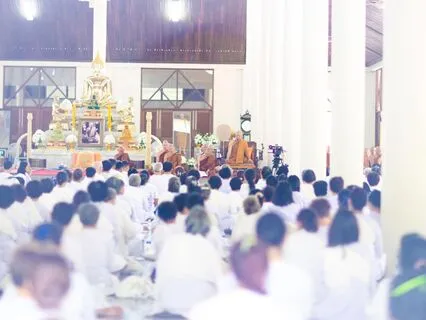
In going to the monastery,
We take up the precepts one more time,
And we learn and practice dhamma until the next day.
We call this keeping uposada sila completely.
So uposada sila,
The keeping of the eight precepts,
Is for laypeople who are householders,
For whom keeping the eight precepts every day isn't convenient.
You do work and duties,
Are exhausted and tired,
And need to eat in the evening as well.
But you take up the opportunity when it comes to the lunar observance day,
That you will go to the monastery and keep the sila of the uposada,
Called uposada sila,
Which are the eight precepts as well.
If you break any of the precepts,
Then the uposada sila is not complete.
The uposada sila is broken.
So you need to keep all of the eight precepts.
You are determined to have restraint by way of body and speech,
And restraint by way of mind in a special way.
And when our Barami spiritual accumulations are stronger,
Then we may make larger determinations.
The taking up of the eight precepts for one day and one night is a normal uposada,
For the day that we determine it,
On the fifteenth waxing,
Fourteenth waning,
Or eighth waxing or waning moons.
For those who may have more strength of mind,
They can keep the eight precepts for three days.
That is,
The day before the observance day for one day,
And the observance day is another day,
And the day after the observance day is another day,
So together it is for three days and three nights.
Those who have more strength than that may keep it for one month.
Or there are those who keep it for the whole vasa,
The three-month rains retreat,
Or it can be for fifteen days.
It is up to one's determination that one takes up.
And the eight precepts begin from the refraining of taking the life of a living being,
From taking things from others that aren't ours,
Refraining from any sexual conduct which is the enemy of the practice of the brahmacharya,
The celibate life.
And together with the precept on the various types of false speech,
Not drinking alcohol and all intoxicants,
Not taking food at the wrong time,
Afternoon,
Not beautifying with adornments,
Perfumes,
Cosmetics,
Colourings,
Not watching all forms of entertainment,
Refraining from sitting and lying down on a high and luxurious bed.
So we are determined to keep these precepts.
So coming to the uposatha is mostly about entering and staying at the monastery.
It's based on coming to a place of practice.
But in the case that we don't go to take the precepts up at the monastery,
Then we take it at home.
So we are determined to take up uposatha sila all the same.
In the Buddha's time,
The wealthy man Anattapindika and his following,
On the lunar observance day,
The uposatha,
Everyone would take up the uposatha sila.
Even for the children who drank their mother's milk,
They would not let them drink milk,
But would give them sweet water or honey instead.
So the whole household,
They all kept it.
But there was one time when there was a new worker of Anattapindika's,
Who had been working cutting firewood in the forest,
And he came back and thought,
Why is the house of Anattapindika so quiet?
All the people were quiet and restrained,
Talking little.
They were in their own dwellings,
Chanting and meditating.
The head of the kitchen told him that there was no food to eat,
Because everyone was taking the uposatha sila.
So the man was determined to keep uposatha sila for half a day.
For uposatha sila,
One can drink sugary water and sugar cane,
But I'm not sure if this man had made a special determination,
Or he didn't know about it properly,
Or it was due to some other factor,
But the man didn't take any water.
Ultimately he was too exhausted and died,
And he became a ruka deva,
A tree deity.
So this was the benefit of having kept sila,
Which is a lot.
We may have seen that we have relatives,
Parents,
Grandparents,
Who keep the uposatha sila.
They keep the sila,
But because they are scared that their sila would be broken,
So they go to sleep early and do various things.
They may listen to just a bit of dhamma,
And then go to sleep and rest.
They go chatting about various subjects.
It makes the quality of their keeping sila lowered.
One has to not talk of subjects of the household,
The city,
Not talking about trade and livelihood,
Not talking of all work-related subjects.
One refrains from it and stops at all.
Because it's a day that one should stop and not speak of worldly things.
We will maintain our mind to have a lot of peace.
So we will develop our kamatthana,
Meditation object.
We walk meditation and sit meditation and so on.
This is to make the mind peaceful.
So to keep sila on a higher level than this,
One will be maintaining one's mind as well.
It is true that one does not kill living beings,
But one may think about it continuously that one wants to kill.
And to not speak this out,
It is sila as well.
But the mind is lowered.
So we will maintain our mind as well.
We need to have metta,
Goodwill to supervise the mind.
Have compassion,
Sympathetic joy and equanimity as well.
Train to develop the mind to be peaceful.
Have effort.
We become careful with the mind that is thinking of harming and violence,
Or that goes to thoughts of all the moods and objects of sensual desire and liking.
We are careful of all sensuality,
Being careful of the mind.
This is samadhiti,
Right view,
And it is within the Noble Eightfold Path.
When speaking,
We have caution.
In actions and speech,
We are careful.
And especially the mind.
Have it controlled through a meditation object with sati,
Mindfulness.
Make your samadhi,
Concentration be firm.
It is normal for the mind that is currently in training,
That though we won't kill living beings,
Steal,
Commit any sexual misconduct or drink intoxicants,
But sometimes we have old memories,
Thoughts and proliferation about it.
But we have to abandon it,
By having effort.
If unskillful states of mind arise,
We need to abandon it.
That which hasn't arisen yet,
We don't let it arise.
We repeat mentally the meditation repetition of buttho,
Tammo,
Sankho.
We use contemplation,
So that the mind is peaceful constantly,
And we are not heedless.
This is keeping sila,
That has greater virtues.
It is not just maintaining only actions and speech,
But maintaining the mind as well,
To have the eight precepts,
Having uposada sila,
Completely and fully,
Not thinking of sleeping on a high or luxurious bed.
We may think,
Today I'm sleeping so badly,
So I'll go home and sleep comfortably.
Don't think and be agitated like that.
We are supervising over the mind.
We are joyous to have been able to determine to keep uposada sila.
When we are keeping the uposada sila,
We have some hunger come up.
We think,
Okay,
Tomorrow I will eat more,
More of the delicious food that I like.
We proliferate about it.
Like this,
We do get the results,
But they are of the coarse type.
But the mind is still lowered and thinking and proliferating.
We need to control over it through the practice,
By the mental object that will train the mind,
Which is the meditation object.
So we need to learn it,
So our mind can be peaceful through the meditation object.
For example,
Using butto,
Domo,
Sanko,
And so on.
We have to try to do it.
So someone who isn't careless,
They will keep sila,
And this has great benefits.
We keep uposada sila and have great wealth,
More wealth than a universal monarch.
And the universal monarch has more wealth than all the wealth in the world gathered up.
It doesn't compare to the wealth of a universal monarch,
But the benefit of uposada sila is even more than that.
Those who can keep uposada sila for one day and one night will have even greater benefits and results.
They will get a mass of wealth,
Because of not being heedless.
They will have a wealth of fame from keeping this sila,
Which will spread wide and far.
Those with sila can enter any gathering group,
And they will have bravery and courage,
Not being timid.
Those with sila won't be lost when passing away from this life.
That is,
They won't lack mindfulness when they die.
And,
On dying,
They will go to sukhati,
A heaven realm.
They are friends to all the deities.
And the higher benefit of sila is that it is the start of samadhi concentration.
The benefit of sila is the arising of samadhi.
It has great benefits.
Samadhi that has been well developed will bring up wisdom.
The wisdom that has been well developed will bring up vimuti,
Liberation from suffering.
This comes from our keeping of sila.
The goal of keeping sila is so that the mind is peaceful,
Not wavering.
And the higher benefit of sila is the arising of inner happiness and peace in its fullness,
The highest of which is nibbana.
So,
Being laity,
We can take up the practice of the celibate life as well.
We take it up on the lunar observance day,
On the uposada day,
For one day and one night,
Or it can be for three days.
We make a determination to do it.
If we have no chance to go to the monastery,
Then we make the determination at our house,
And then this will have great benefits.
We give dana on a regular basis and it has benefits.
The benefit of dana is that we have completeness and abundance.
We have the four requisites in abundance.
We have wealth which can be on the level of a millionaire,
Or the higher wealth is on the level of a universal monarch.
This is from the benefit of giving dana.
But the benefit of sila is higher than this.
In the time of the Buddha,
The Savaka,
The enlightened disciples of the Sammasambuddha,
The perfectly self-awakened one,
They were examples.
The wealthy Anattapindika,
He kept uposada sila regularly.
Lady Visaka was the same.
She kept uposada sila.
From the morning of the lunar observance day,
Then she would go into the monastery that she had built,
And keep the uposada sila together with her following.
So can we see those who had noble inner wealth,
Who had closed off the lower realms already,
They will have an even greater faith in keeping sila.
They are not heedless.
They go to the monastery,
Keep sila,
Walk meditation and sit meditation.
They practice cultivating themselves,
Because they know that the great benefit of sila is greater than the dana that they have done.
And even having known and seen the Dhamma,
Being laity,
With families,
They took up the opportunity to practice,
And were not heedless.
So we who have faith in the Buddha sasana,
The dispensation,
We have learnt about sila,
The uposada sila,
And the eight precepts,
And so we promote our faith.
And the sila we maintain is for magga phala nibbana,
The paths and fruits of nibbana.
The benefits of sila that I have said is silena sugatinyanti,
Silena bhogasampada,
And silena nibbutinyanti.
This sila can make us go to nibbana.
So may we be determined constantly,
When it comes to the lunar observance day,
The day of sila,
To be determined to practice and cultivate ourselves.
Come to take up the sila,
The uposada sila,
The eight precepts.
What for?
So that our minds can put down the moods and sense objects,
Putting down pleasure.
This is praiseworthy.
We have slept on a high luxurious bed,
Slept comfortably,
But we come to sleep on a thin mattress unlike what we used to.
We have beautified our bodies with adornments,
Perfumes,
Cosmetics,
Colorings.
We have watched various entertainments,
But then we don't do it.
We have eaten in the evening,
Then we don't eat like that.
We practice the celibate life.
We see that the mind is brightened and ready to receive the Dhamma.
And it's a good opportunity to listen to Dhamma,
Which is important.
We listen to the Dhamma.
When we go to the monastery,
The mind is not scattered,
And we have lay friends who we meet as well.
If we are young and we go to the monastery to practice like that,
We may be a bit taken back to go be with many who tend to be a lot older.
We are young,
But we enter and listen to the Dhamma.
And this is up to your spiritual development.
Maybe you can know the Dhamma,
To see everything as being empty,
That rupa and nama,
Material and mental phenomena,
Are empty.
All material objects arise,
Stay and cease.
They are conventions.
The mind is joyous at seeing the arising and ceasing of sankhara,
Conditioned phenomena.
Just this much,
And the mind changes over.
Seeing through conventional reality,
Then vimutti,
Ultimate reality and liberation arises.
It's the virtue of a sotapanna,
Stream-enterer,
And it can arise suddenly.
It's just the benefit of sila,
From keeping the uposatha in the monastery and being determined to practice for one day and one night,
Learning Dhamma until one sees the Dhamma.
So keeping sila has great benefits,
As I have explained.
May you be determined to be established in dhana,
In sila,
In uposatha sila,
Keeping the eight precepts.
This will be the causes and conditions for you to know and see the Dhamma,
And to bring you inner happiness in this life and the next life.
May you grow in blessings.