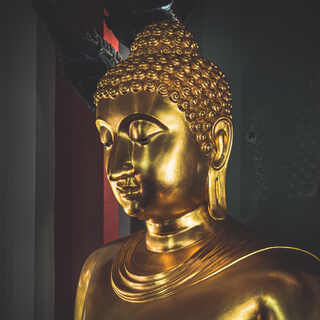
Seeking Budo,
Awakened awareness.
Every year on January 16th,
The ordained and lay disciples of Venerable Ajahn Chah assemble at Wat Nongpapong to commemorate his passing away and to practice the legacy of Dhamma he left behind.
Venerable Ajahn Anand gave the following Dhamma talk on this occasion in 2005.
We must all be determined from this point onwards to make our minds peaceful.
We focus our awareness upon knowing the in-breath and the out-breath together with the mantra putto.
Developing these basic meditation themes of Buddha nisati,
The recollection of the qualities of the Buddha,
And anapanasati,
Mindfulness of breathing,
Are a way of cultivating sati,
That is,
Mindful recollection.
We practice Dhamma in order to train ourselves to further the development of our hearts and minds.
We practice meditation for the purpose of elevating our hearts to loftier,
Nobler heights,
Making it more excellent and sublime.
All of us here possess confidence,
Faith,
And trust in the Great Teacher,
The supremely enlightened Buddha.
He is known as sata-deva-manusanam,
The teacher of gods and humans.
The arising of a supremely enlightened Buddha,
One who realizes ultimate truth for the welfare and happiness of the multitude,
Both earthly and celestial,
Is not a common occurrence.
However,
We have all gained the opportunity to encounter the Buddha-sasana.
The Lord Buddha set the wheel of Dhamma turning over 2,
500 years ago,
And with this first teaching,
Venerable Anya Kondhanya attained the vision of Dhamma.
This same teaching is still in motion,
Being realized and transmitted right into the present by the Lord Buddha's Savakasanga,
His enlightened disciples,
Such as the most venerable Lungpor Chah,
Who practiced in accordance with the instructions of the fully enlightened teacher until he understood and realized the Dhamma for himself.
He then established a base for training here at Wat Nongpapong,
Producing a large following,
Many of whom are now senior monks and great teachers themselves.
Therefore,
As long as we still have faith and are alive,
We have this opportunity to discover the teaching of the Buddha,
Its practice,
And its realization.
Every year we gather here at Wat Nongpapong to recollect the kindness of Lungpor Chah and to practice sitting and walking meditation as an offering to his memory.
We make an effort towards the higher cultivation of the mind,
Because the mind that has never been trained or developed will inevitably follow its worldly moods.
When mindfulness and samadhi are weak and unreliable,
The heart will naturally race along with these habitual moods and mind states,
Desire and aversion,
Sloth and torpor,
Agitation and restlessness,
Ill will and doubt.
These five hindrances are what separate the heart from the good and the wholesome and obstruct the realization of Dhamma.
At this time,
However,
We can make an effort to train our hearts,
Trying to cultivate mindfulness whether standing,
Walking,
Sitting,
Or lying down.
Whatever our activity,
Be it drinking,
Thinking,
Or talking,
We have mindfulness,
That is,
Clear recollection.
Alternatively,
We can establish the recitation of a mantra,
Bhutto,
Dhammo,
Or Sangho,
To govern and guide our mind.
Whether standing,
Walking,
Seated,
Or reclining,
We establish this internal recitation of Bhutto to govern the mind's tendency towards distraction and diversity as it wanders about in the past and future,
Continually proliferating.
If we don't have a basic meditation object to govern and guide our mind,
Then it will be very difficult to make it calm and still.
The heart will inevitably just follow its usual variety of moods and preoccupations.
However,
When we put forth effort to train mindfulness and focus it on looking after the heart through the recitation of a mantra,
Then it will gradually become more peaceful.
The mind that used to be lost in proliferation,
Unable to settle in meditation for even five minutes,
Will become more peaceful,
Patient,
And resolute.
We will then see that not training the heart results only in suffering because our outlook will always be wrong.
When we are really determined to practice meditation and develop our hearts to know and see the Dhamma,
Then through the strength of this chanda,
Our genuine wholesome aspiration,
We must endeavor to struggle and strive in accordance with the Lord Buddha's instructions.
The way of practice to knowing,
Seeing,
And understanding Dhamma is the excellent path of sila,
Samadhi,
Panya,
That is,
The Noble Eightfold Path.
Today we recited the Dhamma-cakka pavatana-sutta,
Recounting the four noble truths of dukkha,
Samudaya,
Niroda,
And magha.
The reason we come here is to study these very truths,
The way dukkha,
Or suffering,
Is,
The way suffering is caused,
Samudaya,
The way suffering ceases,
Niroda,
And how to practice in order to bring the heart to niroda,
The cessation of suffering.
Chanting and reciting in this way is a skillful means by which to study the Dhamma as practical theory.
After we have memorized and recited the teachings like this,
We are able to remember and understand them so that when we begin the practice to realize the truth,
Then everything we contemplate becomes Dhamma.
Practicing Dhamma means striving to abandon the unwholesome states that arise within our hearts,
Making merit and maintaining the wholesome,
And preventing unarisen,
Unwholesome states from arising.
This is equivalent to the path factor of right effort.
If we have no mindfulness or don't control ourselves with mindfulness,
Then it is like a river without a dam.
Without an embankment to contain the water,
It will naturally overflow.
In the same way,
If we don't have any mindfulness,
Or our mindfulness is insufficient,
Then our habitual moods will inevitably flood in and overwhelm our mind.
Therefore,
We need to establish a strong and stable mindfulness by focusing upon the meditation mantra,
Bhutto.
We sit in meditation clearly knowing the in-breath and the out-breath,
Along with the mantra Bhutto,
Watching over our heart until eventually this internal recitation fades away and tranquility arises.
Sometimes there is a feeling that mindfulness is gathered at one point within the body,
Such as the tip of the nose,
For example.
At this point,
The heart is peaceful and firm in samadhi.
Samadhi means concentration or concentrated awareness.
The method of practice that results in right concentration is called samatha kamatana.
This refers to those skillful techniques by which the heart is brought to total tranquility.
The recitation of a mantra such as Bhutto,
Dhammo,
Or Sankho,
Practicing mindfulness of breathing,
Or the contemplation of death,
And so forth,
Are all forms of samatha meditation.
When the mind has been trained in samatha meditation,
Then whether standing,
Walking,
Seated,
Or reclining,
There will be the excellent peace of samadhi.
Vipassana kamatana refers to those meditation practices that bring us to correct knowledge and vision of the truth.
In what way,
However,
Does this insight arise?
When the mind is properly calm and peaceful,
It is this very peace that we then use to train ourselves in basic contemplation.
This means investigating the physical body to which the heart clings as ours or ourself.
This clinging attachment,
Or upadana,
Is the cause of renewed existence,
The cause of birth and the cause of aging,
Death,
Sorrow,
Lamentation,
Pain,
Grief,
And despair.
When the heart is upadana towards the body,
Then this physical form is perceived as ourself or as something we possess.
With the resulting experience of us and them,
There is also the appearance of desire and aversion,
And the process of origination begins with the renewal of being and birth,
And is always accompanied by the arising of dukkha.
It is this very dukkha that brings renewal of being and birth,
And which creates upadana,
Tanha,
Kilesa,
And finally,
Aujja,
Fundamental ignorance.
This is paticca samupada,
The process of dependent origination,
Evolving according to the conditions of defilement.
However,
When we develop sila,
Samadhi,
And panya,
As we have come here to do by determining to keep precepts,
Training diligently in mindfulness and samadhi,
And striving to cultivate wisdom,
Then this is called walking the noble path.
While we listen to dhamma,
We can also focus upon the in-breath and the out-breath,
Establishing our mindfulness on the sensation of the breathing together with the mantra putto.
This is also practicing sila and samadhi together with panya,
Or wisdom,
In as far as training the mind in tranquility is concerned.
When the mind is peaceful,
Then we can contemplate what this physical body that we habitually attach to as me and mine is actually like.
What was its minuscule form at conception like?
What did it look like in the womb?
What was the body like when it was newly born?
How did it develop,
And upon what does its life depend?
If our body goes without food,
Water,
Oxygen,
Or warmth,
Then its elemental properties cannot sustain themselves.
This body that we cling to as our self must eventually disintegrate according to causes and conditions.
If we contemplate in this way,
The wisdom will arise that if this body we habitually cling to is really ours or our self,
Then why can we not control it?
Why is it that although we don't desire it,
The body grows old,
Sickens,
And dies?
We don't want old age,
Sickness,
And death,
So why do these things happen?
The wisdom will arise that these things are normal.
They are the way of nature.
The heart will then disentangle itself from this upadana,
That is,
From the sense of me and mine.
If this body was really our self,
We would have command over it and be able to direct it away from that which we do not desire,
Old age,
Sickness,
And death.
But it isn't like this.
This lump of a body follows the natural law of cause and condition.
The manifestation of sila is the arising and sustaining of mindfulness and wisdom through the restraint of body and speech.
The heart is firmly focused in samadhi without the hindrances of restlessness,
Anger,
Ill-will,
Sloth,
Torpor,
Agitation,
And doubt.
At that moment,
The heart is free from all the hindrances and possessed of internal peace and serenity.
This is the manifestation of samadhi.
We then use the power of this samadhi for contemplation of the body,
Analyzing it in terms of elements or khandhas.
Investigate this body for yourselves.
Contemplate the external body,
That is,
The bodies of others,
And the internal body,
Or the body within the body,
That is,
Ourselves sitting right here.
What is there inside this body,
Wrapped in skin and hair with its nails and teeth?
We must investigate to see what there is,
Analyzing its components into elements and khandhas,
So that the heart will acknowledge the truth and give rise to insight.
This is how we train our hearts in wisdom.
Through frequent training and wisdom like this,
The power of samadhi will grow faint and fade away.
We must then focus on bringing back and strengthening our mindfulness and concentration by training our hearts with the samatha meditation object without letting up,
Whatever our posture may be.
Whatever our thoughts or feelings might be,
We must observe and look after our heart continuously.
Those things that wander into awareness are namely forms,
Sounds,
Odors,
Flavors,
Bodily sensations,
And mind states.
If the heart lacks concentration,
Then it will chase after the sensory contact,
Giving rise to becoming and birth together with happiness and suffering.
The number of these becoming and births are countless.
Life at present takes many forms,
Always cycling from birth to death and from death to birth,
Sometimes human,
Sometimes subhuman,
Sometimes with the growth of wisdom as devas,
And when the heart grows in peace,
Even as Brahma gods.
Consequently,
We must put forth effort to train ourselves by patiently enduring sensory contact and the moods that arise in conjunction with this.
If we allow this sensory contact to possess the heart,
Then samadhi will be weak and wisdom won't arise.
Sila,
That is,
Virtuous,
Disciplined behavior,
Is an essential aspect of the training that requires our careful attention.
Sila includes well-mannered composure of conduct and speech together with patient endurance.
This virtue of patience and forbearance is a trait and a treasure of the sages and saints.
When possessed by moods such as anger and ill will,
We can initially practice patience and forbearance by determining not to follow these mind states.
When we can patiently endure and curb our feelings,
Then this is called practicing the dhamma of restraint.
Patiently containing our moods and mind states means knowing how to contemplate in order to renounce and relinquish the heart from these feelings of lust and hate or anger and ill will.
We generate feelings of renunciation and self-sacrifice by sharing what we have for the benefit of others.
We must also be sincere in our aspiration to develop goodness and virtue.
Being born as a human and encountering the Buddha Satsana is not easily accomplished.
The Lord Buddha gave a simile expressing the immeasurable difficulty of gaining a human birth.
It is more difficult to gain human existence than it is for a blind turtle living in the great ocean,
In which surfaces only once every hundred years,
To come across a floating bamboo ring that is being ever blown by the wind in all four directions.
Nowadays the greater number of those born as human beings can be called human only in outward form.
On the level of the heart,
However,
They are not yet complete or perfect human beings.
It is extremely difficult for the heart to become fully human because of the ever-blowing wind of sensory contact.
Our hearts and minds are blown back and forth by the wind of forms,
Sounds,
Smells,
Tastes,
Touches,
Moods,
And mind states.
Lacking peace,
Our sila is shaky and concentration doesn't come.
Therefore we can look within our hearts and ask ourselves,
Will it be difficult to realize our humanity?
Through contemplation we come to see the danger in lacking sila and also the benefits that these qualities of virtue and discipline bring.
Practicing sila brings us internal happiness,
Peace,
And security.
In Pali these qualities are referred to as boga sapaya,
The most excellent of treasures,
That is internal spiritual wealth.
This is called to mind in the phrase silena sugatim yanti.
Sila is the vehicle to happiness.
Silena,
Boga,
Sampara.
Sila is the way to spiritual wealth.
When well restrained in body and speech,
We can see that sila is something of immense value,
A vital wealth and the most perfect of possessions that can free our hearts from the cycle of birth and death.
Whatever worldly wealth we may possess,
It cannot free us from the suffering of samsara.
The greater the heart's greed,
Then the greater the delusion and clinging and attachment,
And the greater the growth of desire.
This desire is what gives rise to the binding snare of upadana,
Which,
Even if not very strong,
Is difficult to abandon.
However,
When we are determined to practice sila,
We can see the many advantages to be gained,
That is,
We realize how restraint,
Modesty,
And graceful behavior of body,
Speech,
And mind bring happiness now and in the future.
Sila is an essential inner wealth that will enable our minds to know and see the dhamma and realize nibbana,
That is,
Peace and coolness within the heart.
Therefore,
We must be determined to be well trained in our behavior of body and speech.
We must train our hearts in proper concentration,
But this requires the use of a meditation object.
As has already been explained,
Whatever this may be,
We can practice mara na nusati,
The recollection of death,
Contemplating the uncertainty of our lives and the certainty of death.
We continuously reflect that having been born,
We must also die.
Wherever we hear news of death and dying,
We can likewise reflect upon our own mortality.
We cannot escape from death.
Suppose that the global human population amounted to five thousand million people,
Of whom fifty million died every year,
Five hundred million every decade.
If there were no new supplementary births,
Then within a century the entire population of the world would have passed away,
All five thousand million people.
However,
Because there are additional births replacing those who have died,
We fail to see the presence of death,
Excepting those terrible events that stem from natural disasters involving water,
Wind,
Or fire.
When great numbers of human beings die through events such as these,
Then we can feel our own mortality and are able to reflect back upon ourselves that we too must also die.
We cannot escape from death.
When the heart is peaceful,
Falling on from whatever the method of training employed,
Whether the contemplation of death or a subha meditation,
Then the insight can arise that really there is nobody who dies.
What we take for a person is only the four elements shifting and changing according to causes and conditions.
At that moment the clear insight arises that there is no self or soul,
No person or being,
No me or you.
This insight manifests as a non-verbal,
Non-discursive awareness.
This is the arising of the wisdom that is known as vipassana and is dependent upon a mind that has previously been concentrated with samatha meditation.
When the mind has been so concentrated,
Then whenever possessed by attachment to conventions such as the self,
Simultaneous insight into not self will arise at that moment.
This is what is called vipassana.
We realize that referring to the body,
Whether our own or that of others,
As our self or their self,
As this being or that person,
Is only a convention of speech.
Really there is no person or being,
There is no self or soul,
And there is no us in them.
It is this realization right here that was spoken of as a non-verbal awareness arising in the heart,
Clearly knowing and seeing the dhamma,
Leaving no room for doubt.
Training ourselves further,
We put forth effort practicing walking and sitting meditation until our hearts become calm and serene.
Peace and pity,
Spiritual rapture,
Arise within our heart whatever our posture.
Previously we had to be vigilant in our practice and strive hard to arouse energy and effort.
However,
When the mind becomes peaceful,
The practice takes on a discipline and a momentum of its own that pulls us onto the walking path and the meditation cushion.
With mindfulness watching over the heart,
Knowledge and understanding arise.
The one who guards and cares for their heart will be freed from Mara's snare,
Delivered from all dukkha.
With mindfulness carefully watching over our heart,
The objects of attachment will be seen and with reflection let go of.
When all sense objects are seen as nica,
Dukkha,
Anatta,
Then the heart becomes peaceful.
However,
We still cannot afford to be negligent.
When the heart is stilled with the common peace of samadhi,
Then we must return again to the investigation of the body,
Contemplating this sankara that is a real source of clinging attachment.
We must strive to uproot this upadana right here.
If we continuously practice in this way,
Then wisdom will arise,
Enabling samadhi to develop.
This samadhi will,
In turn,
Aid in the arising of sila,
That is,
In the cultivation of discipline and restraint.
We call this practice the three-fold training of sila,
Samadhi,
And paññā,
Which can be expanded to include the eight factors of the noble path,
As explained by the supremely enlightened Buddha,
The teacher of devas and humans.
Putto means one who is awakened to the truth.
After the Buddha's enlightenment,
Then due to the power of his great compassion,
Rather than dwelling alone in the bliss of liberation,
He went forth with loving-kindness to teach the multitude,
Beginning with Venerable Anya Kondhanya,
The first of the Sāwaka Sangha.
This realization and transmission of the dharma continues through our teacher and guide in the practice,
Lumpu Chah,
Right into the present.
I believe that if we diligently apply ourselves to his teachings,
Then peace and happiness will arise in our lives.
Laypeople should firmly establish their lives in virtue and goodness and try to cultivate mindfulness,
Samadhi,
Wisdom,
And sama-adjīva,
Right livelihood.
Whatever our work or duties,
We should endeavor to perform them with mindfulness using a mantra,
Putto,
Dhammo,
Sangho,
To hold our attention.
We have come together to practice dharma and so whatever bodily movement or wholesome activity we engage in,
We can meditate on it.
At the same time,
By focusing upon the mantra,
Putto,
Continuously.
In this way,
We can say that we are performing both our external duties and the internal task of making the heart peaceful.
When we strive to train our hearts continuously like this,
Then our humanity will be complete in both body and mind.
We become a Kalyāna-jana,
One whose heart is possessed of goodness and grace,
Like all of us gathered together here practicing the dharma.
The heart of such a person aspires only to the arising of the wholesome merit that comes through the practice of dharma.
For what purpose have we traveled here today from the towns and the cities both near and far?
We have come seeking putto,
The knower,
Or in other words,
To realize this enlightened awareness and awaken our hearts like the Lord Buddha before us.
In bringing forth this putto,
Or awakened awareness,
Then there is putto on the level of sila and putto on the level of generosity or dana.
We already know that there is abundant wealth in the world and that stinginess is blameworthy.
However,
If we don't use our wealth beneficially,
Then when we are gone,
It's worthless.
Everyone is born and dies and nobody can take with them the assets that they have amassed,
Whether vast wealth or even this physical body.
Entirely everything must be left behind.
If our assets are not used in wholesome and meritorious activities directed towards our spiritual welfare or the benefit of society as a whole,
Then they have scarcely any value.
However,
If we are heedful and possessed of putto,
This awakened awareness,
Then according to our strength or ability,
We can be generous,
Self-sacrificing,
And of service to others,
Whether to our country,
Our fellows in society,
Or those experiencing accidents and misfortune.
In this way,
We are giving and sharing our happiness with others.
This is how we perfect the virtues of dana and caga,
Generosity and self-sacrifice.
When these virtues of goodness and generosity become natural inclinations of the heart,
We then train in making peace and tranquility our heart's natural abiding.
Sometimes,
However,
While training the heart in peace,
There will be restlessness,
Agitation,
And doubt.
This is also natural.
On occasions we may become frustrated.
I'm a meditator.
Why are greed,
Anger,
And delusion still present in the heart?
It is natural,
Though,
That because our heart is not yet putto,
Enlightened,
It will still be deluded by the power of ignorance,
Craving,
And attachment.
Therefore,
When we come to the practice of dhamma,
We have to abandon ignorance,
Craving,
And attachment.
We must let go of delusion and cultivate wisdom,
Establishing the heart in putto,
Awakened awareness.
When possessed of putto,
The heart is not deluded.
The undiluted heart is one possessed of wisdom,
And the heart possessed of wisdom is free from suffering.
The awareness that is putto begins with a heart that is happy,
Peaceful,
And free from stinginess.
The Lord Buddha's heart was completely established in putto.
He further taught that if we aspire to a peaceful,
Radiant heart,
Or in other words,
If we are determined to realize the genuine,
Original mind,
The mind naturally possessed of purity and peace,
Then we must ardently meditate.
Today we have such an opportunity to strive in meditation.
We can use this occasion to listen to the teachings of the Krupa Ajahn and senior monks from the various branch monasteries of Wat Nongpapong,
Who have traveled here today to recollect the kindness of Lumpur Chah,
The teacher who enabled us to gain understanding in these very teachings,
And who guided us in the same practice that we now undertake as an offering to his memory.
As we practice in dedication to Lumpur Chah,
We are cultivating that which is of benefit to us,
Higher wisdom and understanding.
We have to put forth effort to train ourselves,
Developing patient endurance in both sitting and walking meditation.
Why is it that we train ourselves?
We train to realize the Dhamma.
Our Krupa Ajahn,
Lumpur Chah,
Told us how this realization of Dhamma did not come easily.
Before his heart awakened to Bhutto and he was able to teach and instruct his lay and ordained disciples,
He experienced all kinds of obstacles,
Barely escaping with his life.
We must focus on the mantra Bhutto,
Establishing continuous awareness,
Whether standing,
Walking,
Sitting,
Reclining,
Working,
Talking,
Drinking,
Or thinking.
Right now,
While listening to the Dhamma,
We can direct our minds to peace and not allow our attention to wander to other things.
When the heart is peaceful,
We can say that sila,
Samadhi,
And panya have arisen.
We are able to understand the Dhamma as taught by the Lord Buddha,
That this body is aniccaṅ duḥkhaṅ anattaḥ.
Aniccaṅ means impermanent,
Duḥkhaṅ means suffering,
And anattaḥ means without a genuine self or soul.
These physical forms that we call our substance or ourselves arise through a compounding of impersonal elements.
The mind possessed by delusion,
However,
Discriminates between these bodies believing,
This is me,
This is you.
All of us sitting here are identical in that we breathe,
Eat,
And drink.
Therefore,
We are all composed of the same fundamental elements,
Earth,
Air,
Fire,
And water.
Why then do we cling to these elements,
Identifying with them as me and you?
This attachment is because of delusion.
The heart lacks wisdom,
And so delusion arises.
In order to establish our heart and wisdom,
We must have mindfulness and put forth effort to carefully restrain our actions of body,
Speech,
And mind in a way that gives rise to samadhi.
In practicing this way,
We are cultivating satipaṭṭhāna,
Because this way of practice is within the framework of these four foundations of mindfulness.
When developing satipaṭṭhāna,
Do we begin by contemplating the body or feelings,
The mind or mind objects?
Lumpu Chah would answer that we begin by developing the first foundation,
The section called kāyāgata,
Mindfulness focused on the body.
It is essential that we mindfully consider our physical body.
Why is this so?
For the reason that this coarse physical form,
A source of our clinging attachment,
Can easily be investigated.
As for the other foundations of mindfulness,
Beginning with feelings,
Their investigation proceeds from the contemplation of the body.
Bodily feelings and mental feelings,
For example,
Are related to each other.
Sometimes we might investigate the body with mindfulness and wisdom,
Distinguishing between the various physical elements and immaterial aggregates,
Such as feelings,
And contemplating their arising and ceasing,
Until we realize that these feelings are merely mental processes that are neither a self nor a soul,
Neither a person nor a being,
And to be regarded as neither ours nor theirs.
On those occasions when the heart has been empowered through the practice to a greater degree,
We can gain insight into the state of the mind itself,
Mind possessed by attraction or aversion,
Possessed by rāga,
Dosa,
Or moha.
Sometimes we are able to recognize the mind that is without these defilements of greed,
Hatred,
And hatred,
And we are able to understand the hatred and delusion.
When with mindfulness and wisdom the heart recognizes these defilements together with attraction and aversion,
Then they pass away.
This is an indication that,
On those occasions,
The investigation is focused on the third foundation of mindfulness.
However,
This does not mean that we are able to contemplate at this level all the time,
Because the strength of our heart,
The powers of samādhi and wisdom,
Eventually weaken,
And we are unable to maintain the contemplation anymore.
The investigation then falls back to the second foundation,
Focused on feelings,
Which in turn further weakens and drops down to a lower level.
Therefore,
We must contemplate this body as the basic foundation of practice.
In the initial stage of the training,
We must try our absolute hardest in caring for the mind,
Keeping it wholesome,
Firm,
And focused.
We can look internally.
What's our state of mind like?
Is it wholesome or unwholesome?
In what ways does the mind think and proliferate?
Are these thoughts and mental formations just memories and fantasies?
Whatever mental phenomena arise,
We must observe and investigate them.
If our inner strength is sufficient,
When we contemplate these phenomena,
Wisdom will arise.
When our inner strength weakens,
Then it is enough to investigate the body.
This is the work we have to do.
Striving in this way weakens clinging and attachment,
Brings forth wisdom,
And strengthens our practice of the path.
This way of practice can be called the path of power,
Or the fearless path through which the kalesas shrink away.
However,
We cannot cease in our efforts.
Whenever we pause along the path,
The kalesas take over from there.
We must put forth effort to be carefully composed and consistent in our practice of the path.
When our practice is steady all the time,
Then our heart will develop to a higher degree.
If the heart is peaceful to a certain level while walking in meditation,
Then when coming to sit in samadhi,
This calm and serenity will further deepen.
When we maintain an even and continuous calm while sitting in meditation,
Then this tranquil abiding will develop and extend into all our normal,
Everyday movements and activities,
And the heart will experience even greater peace.
The practice will progress to the level where,
Through investigation,
The body is seen with insight as just four elements and as something loathsome and repulsive.
The more the body is seen with insight as unattractive,
The more the heart becomes beautiful and bright.
The deeper the insight into the repulsiveness of the body,
Then the deeper the happiness that arises,
And as this internal happiness increases,
The more profound becomes the insight into not-self.
The heart uproots clinging and attachment.
It is as if it has entered another world.
This experience can be called the comprehension or realization of the Dhamma.
We persist and persevere,
Training our hearts continuously this way,
Until clear comprehension arises.
We will come to know the meaning of the phrases,
Apamano buddho,
Boundless are the virtues and the goodness of the Lord Buddha,
Apamano dhammo,
Boundless is the excellence of the Dhamma,
Apamano sankho,
Boundless are the virtues and the goodness of the Lord Buddha's enlightened disciples,
Including our teacher,
Lungpu Chah.
Through the most venerable Lungpu Chah,
As our refuge and focus of recollection,
We are also recollecting the virtues and goodness of the Sangha and the enlightened teachers.
That we have gathered here and are practicing together today is because of the goodness and kindness of Lungpu Chah.
The wholesome,
Meritorious,
And sublime spiritual virtues he accumulated through diligent practice are the very qualities that we bring to mind today.
These virtues of our Kuba Ajaan that we recall today are absolutely boundless.
Whatever training we have received or whatever knowledge or understanding of the Dhamma we have gained,
It is because of the kindness of our Kuba Ajaan who taught and instructed us with so much loving kindness.
This itself was only made possible by virtue of the Lord Buddha's boundless and all-encompassing great compassion,
Which motivated both his quest for enlightenment and,
Following this realization,
His mission to teach the Dhamma to the multitude.
In India at present,
Those who count themselves as faithful Buddhists amount to less than 1% of a total population that numbers more than 1 billion people,
Lest the number of Buddhists in India can be reckoned as insignificant.
However,
Owing to the loving kindness of the Lord Buddha's enlightened disciples,
The Dhamma has spread to Thailand,
Where it provides the founding and guiding principles of this country,
Which enable us to practice in their wake.
The Lord Buddha has already passed away into Parinibbana,
But his teaching still remains.
It is taught that the one who sees the Dhamma sees the Tathagata.
If we travel to India,
We can see the various holy sites.
Here the Buddha was born.
Right here is where the Lord Buddha realized enlightenment.
Here at the Deer Park in Isipatana is where he delivered the first teaching,
The Dhamma-chakka-pavatana-sutta.
Here is where he passed away into Parinibbana.
Visiting all these places can give rise to pity and samvega,
Elevating our hearts,
Bringing forth that which is wholesome and meritorious.
However,
If we understand and realize the Dhamma,
Then we will see the Buddha in our heart.
How do we see the Buddha?
How do we see the Dhamma?
How do we see Anicca,
Dukkha,
Anatta?
In order for this wisdom to arise,
The heart must be at peace.
How do we make the heart peaceful?
Stilling the heart requires a basic meditation object.
Wherever we live in this world,
Thailand or elsewhere,
We must develop our minds,
Cultivating a basic theme of meditation.
We must develop mindfulness in the type of samadhi that is endowed with huitaka,
Hichara,
Pitti,
Sukha,
And ekagata.
We meditate knowing the in-breath and the out-breath,
Focused on the mantra,
Bhutto.
Eventually the breathing becomes more refined and the mantra vanishes.
The mind then converges firmly in samadhi.
There is no internal recitation of a mantra.
The mind is serene,
Happy,
Blissful and one-pointed.
The mind has converged to the basic level of samadhi.
The mind that is converged in samadhi to this point is peaceful and free from all the hindrances.
We can then use the power of this samadhi for contemplation in our quest for wisdom until we see clearly,
That is,
We see the Dhamma.
When we see the Dhamma,
We see the Buddha.
We see Buddha,
Dhamma,
Sangha,
Indivisibly,
Together at the same moment.
We no longer have any doubts about the meaning of the phrase,
The one who sees the Dhamma sees the Tathagata.
Therefore,
Let us all get on with the practice,
Restraining our speech and actions,
Being disciplined and mindful,
And well concentrated in samadhi.
Let us strive and battle with the hindrances of sloth and torpor,
Anger,
Ill will,
And doubt.
We must persevere even though it sometimes appears difficult and that we can no longer endure.
When possessed of energy and effort,
Then if we don't get discouraged,
We are bound to succeed.
If our effort is consistent,
Then peace is bound to arise.
We have to consider how many years of our life remain.
Suppose that we live to 75 years of age.
How much longer do we have?
If we are 50 years old already,
Then we only have 25 years left.
25 years is not long at all.
The hours and days are ticking by.
Our life too will soon be extinguished and we will have to depart from this world.
Whereas the length of this life is uncertain,
Death is a definite certainty.
Therefore,
We must persist and persevere in training the mind and admonishing ourselves continuously without lapse.
We can remind ourselves that due to the goodness and kindness of Umpucha,
This assembly of the faithful,
Both lay and ordained,
Increases in numbers every year.
Furthermore,
Many Kruvajans,
Disciples of Umpucha,
Have traveled here from near and far to venerate the goodness of our venerable teacher.
Many lay people have also come here from both near and far away to practice meditation and train the mind.
Therefore,
We remind ourselves as to the purpose of coming together here,
That is,
To study the Dhamma and to train the mind.
We can ask ourselves,
How do we study the Dhamma?
Where is the Dhamma?
The Dhamma is right here,
This body and mind of ours.
However much one expounds upon the teaching,
The truth lies here within this body and mind.
Therefore,
We train our hearts to realize peace and then we contemplate the body to gain the insight that it is clinging and attached to the mind.
That it is clinging and attachment to this body alone that is the cause of greed,
Hatred,
Delusion,
And attachment itself.
When clinging attachment has already arisen,
Then craving and defilement will arise as the conditioning cause for further attachment,
Bringing forth renewal of being and birth continuously.
All the various ways and routes through this world upon which we have traveled here from near or far away,
Whether by air,
Land,
Or water,
Are still rooted only in this world.
They are ways that merely wheel and wander in samsara,
The cycle of birth and death,
Death and birth.
The best of paths,
However,
Is the way that leads to magha-samangi,
That is,
The unification of the eight factors of the path,
Or in short,
The merging into unity of sila-samadhi-panya.
The way of the Noble Eightfold Path is the way out of samsara.
It is not every day that a being comes into the world to proclaim this best of paths.
It was our teacher,
The supremely enlightened Buddha,
Who awakened to and made known this noble path,
And it was one who had practiced in his wake one of the Arya-sanga,
Who explained this way of practice to us all,
That is,
Lungpu-ca.
Therefore,
We must follow his example and practice accordingly.
Lungpu-ca explained the way of practice completely.
It is just a question of whether we will walk this path or not.
If we don't follow this path,
Then the heart will remain diluted and a cause of our mental and physical suffering.
It is not every day that a being comes into the world to proclaim this best of paths.
It was our teacher,
The supremely enlightened Buddha,
Who awakened to and made known this noble path,
And it was one who had practiced in his wake one of the Arya-sanga,
Who explained this way of practice to us all,
That is,
Lungpu-ca.
Therefore,
We must follow his example and practice accordingly.
Lungpu-ca explained the way of practice completely.
It is just a question of whether we will walk this path or not.
If we don't follow this path,
Then the heart will remain diluted and a cause of our mental and physical suffering.
The Buddha taught that if our bones did not decay as we wander through samsara,
Being born and dying endlessly,
Then there would not be enough room in this world to contain all these bones.
We should consider this carefully,
That if this world is not broad enough to contain the bones of even one person as they are born and die countless times,
Then wherever we walk or step on this earth,
We are treading mountains of our own bones from all these previous lives.
We should further contemplate that whatever the duration of this samsara may be,
We have already experienced countless births,
And so if we remain in a state of delusion,
Then we still won't know how many more years or future lives will have to come before we gain insight and samsara reaches its end.
In this life,
However,
We have gained a human birth and have discovered the Buddha sasana.
We can put forth effort to practice meditation so that we do not lose the advantage of this meritorious and auspicious human birth where we have encountered the teachings of the Buddha.
In Thailand,
The Buddha sasana is complete and perfect in every way,
And so we should put forth effort to realize these teachings.
Don't dally in the practice.
If we don't practice sincerely and resolutely,
Then we won't see or realize the truth.
Therefore,
We should possess ourselves of chanda,
Virya,
Citta,
And vimaksa in order to develop the bodhi pakiya dhammas,
That is,
The enlightenment factors.
The bodhi pakiya dhammas include these four roads to success,
As well as the four foundations of mindfulness,
The Noble Eightfold Path,
The five spiritual faculties,
The five powers,
And so on.
Collectively,
They are called the enlightenment factors,
But these can be further divided into many categories that can seem quite complicated.
However,
When they come together in the mind,
Their function is simply to know,
Am I mindful?
Where is my mind right now?
What's my mind thinking about in this present moment?
Is it wandering or lost in fantasies?
What is the state of the mind like?
We can observe our own mind,
Asking ourselves the question as to who we should take as the teacher and trainer of this mind.
The answer is that we should take the one who knows,
This awakened awareness,
As the teacher and trainer of our deluded heart.
If we don't have this awakened awareness guiding the heart,
Then it will just race about,
Endlessly generating a continuous succession of becomeings and births and suffering.
It is said that with mindfulness closely keeping watch over and caring for our heart,
It will not be destitute and orphaned like a child without a guardian,
Unable to look after itself.
The mind is similar to this helpless child.
Without a guardian,
The mind will just race along,
Thinking,
Fantasizing,
Doubting,
Lost in views of self and others,
Which always arise with the feeling that these things,
Our self and others,
Are real.
This is ignorance.
These things are anatta.
Their reality is only the four elements.
These skeletons sitting right here,
That is all of us sitting right here,
Are they the same or different from each other?
We can ask ourselves,
As one pile of bones to another,
Are these skeletons men and women?
They are neither of these.
They are natural elements existing just the way they are.
Head hair,
Body hair,
Nails,
Teeth and skin.
These are the wrappings of this body.
What is this body like on the inside?
We can go internally and contemplate this body within the body to see what is wrapped up inside.
When our eyes contact forms,
Delusion and attachment arise,
We perceive beauty and attractiveness,
Which brings forth desire and aversion.
What is the cause of this?
The cause is ignorance smothering our hearts so that it doesn't see the truth.
The Buddha declared that the Dhamma is beautiful in the beginning,
Beautiful in the middle,
And beautiful in the end.
The beauty in the beginning is sila.
The beauty in the middle is that of samadhi,
And if we are to arouse knowledge and vision of the truth,
Then we must practice this centered concentration.
The beauty in the end is wisdom,
Bringing it forth and perfecting it.
We are already possessed of good fortune and merit,
And therefore we should strive to realize the Dhamma in this lifetime,
Bringing it forth to reside in our heart.
As a monk and a member of the Sangha,
The Buddha called us a renunciate,
One who is resolute,
Frugal,
And content,
One who comes to train the heart with no desire but that of knowledge and the realization of the truth,
Which is there to be realized in this world.
Whether an enlightened Buddha appears or not,
The true nature of all things is aniccaṃ tukkaṃ anatta.
Although these truths have already been revealed,
If the heart lacks wisdom,
Then delusion and attachment arise so that we do not see them.
However,
When the heart is possessed of wisdom,
It will see the truth.
It has already been revealed that the body,
For example,
Is aniccaṃ tukkaṃ anatta.
This body has no self or soul.
It is not a person or a being or me or you.
Has this body ever declared that it's ourself?
Have the hairs of the head and body or the nails,
Teeth,
Or skin ever declared this?
Have the bones or any other part of the body ever announced that they are our essence or self?
We can take this body apart and see for ourselves.
The skeleton,
For example,
Is made up of many parts located throughout the body,
Such as the bones of the skull,
Arms,
Legs,
Hands,
Feet,
And rib cage.
We can sort out the bones of the body a piece at a time,
A section at a time.
Have any of these parts ever declared that they are ourself?
None of them have ever announced this.
When we analyze the body and see that there is no self,
Then the heart becomes peaceful and the clear realization arises that this body is merely elements that exist just as they are,
Following the way of nature.
There is no person or being or self or soul or me or you to be found.
Seeing in this way,
The mind will disengage from the body and the simultaneous insight will arise that the body is one thing and the mind another.
With this realization,
The body is one thing and the mind another.
With this realization,
Knowledge and vision arise,
But we no longer cling to this wisdom and insight,
That is,
We no longer identify with it as ours or ourself.
As we gain insight,
We let go of it at the same time,
Repeating this process over and over again.
If we proceed this way over and over again,
Then the heart will become resplendent with the knowledge and vision of the truth and realize this very dharma that has long been revealed.
The Lord Buddha announced that the Tāgata is simply one who declares.
What is it he declares?
He declares that this is impermanent,
This is suffering,
This is not self.
When we don't have a sense of discipline or restraint of body and speech,
Then the heart is troubled and confused.
We must have internal discipline because the heart that is troubled and confused is never satisfied.
It is always on the lookout for sensory stimulation and chasing after the objects of sensual desire.
The undisciplined heart is never content,
It never has its fill of sensuality.
What is the reason for this?
The reason is that the heart lacks a meditation practice to guide and train it.
It is said that to see the value in Bhutto,
The knower,
The awakened one,
The enlightened one,
We have to take up the internal recitation of the mantra Bhutto and make the heart peaceful.
When the heart is tranquil and at peace,
Then it is awakened within.
In what way is it awakened within?
The heart is awakened in that it is peaceful and greed,
Hatred,
And delusion cannot enter.
In this peaceful state,
The heart is completely satisfied and is no longer interested in external sense objects.
We can recite Bhutto continuously,
Whatever our posture or activity,
Be it eating,
Coming or going,
Chanting or meditating.
If we can keep this up,
Then our mindfulness will be firm and focused.
Bhutto and peace will become firmly and inseparably rooted in the heart.
If we do not practice in this way,
Then our samadhi may weaken and deteriorate.
Internally,
We will lose our cool and composure and become troubled and confused,
Unable to find any peace.
Why does our strength of mind weaken?
It weakens because the heart lacks the supervision of a basic meditation object.
We must strive to train our heart to realize peace and maintain the state of mind,
Freed from all the hindrances,
Without becoming discouraged.
When the peace that is freedom from the hindrances arises,
We will know the value of the awakened heart.
We will see the value in the peace of meditation and in the heart that is radiant and free from the hindrances that distract and disturb it.
The value of all these things will become apparent to us.
Faith in meditation will arise,
As well as the confidence that we can maintain continuous mindfulness.
Effort and perseverance will also become continuous.
What have been described here are the principles and methods of practice as taught to us by our great teacher,
Lungpu Chah.
Therefore,
Let us continuously strive to put these teachings into practice.
This is the way of paying homage to them and bringing forth wisdom.
With this wisdom,
We can analyze this body and mind,
Distinguishing between the elements,
The khandhas,
The sense bases,
And so on.
As we advance along the path,
Wisdom will develop,
Mindfulness will improve,
And we'll be free from ill will.
We will come to know and see the body and mind in increasing levels of refinement,
And this insight will steadily deepen.
This is the way to go to abandon greed,
Hatred,
And delusion until we clearly know all these internal and external hindrances of heart and mind.
Whenever the heart converges and the factors of the eightfold path unify,
It is liberated from greed,
Hatred,
And delusion.
Initially,
This freedom from greed,
Hatred,
And delusion is the experience of Tandanga Huamuti,
That is using insight to temporarily overcome these defilements.
Eventually,
However,
There is the experience of total liberation through the destruction of the fetters that bind the heart to samsara.
The defilements of Sakaya-dhiti,
Personality view,
Which Ikecha,
Doubt,
And Sila-pata-paramasa,
Attachment to precepts and practices,
Are destroyed by this unified path.
Therefore,
Let's get down to basics,
Then proceed higher and higher until greed,
Hatred,
And delusion fade away and are finished.
At this stage,
Knowledge and vision arise,
And the heart is completely filled with the awakened awareness that is bhutto,
Together with the genuine peace that comes from the cessation of greed,
Hatred,
And delusion.
Coming to practice dhamma as an offering or an expression of devotion and gratitude means that we recollect the boundless virtues and goodness of the Lord Buddha,
The unsurpassed teacher of devas and humans.
He is the Buddha,
The knower,
The enlightened one,
The awakened one,
And He is Bhagavah,
The one who thoroughly explained and expanded the dhamma until it was realized by others,
Bringing into being the Savakasanga.
This dhamma revealed by the Buddha has value beyond limits.
With the phrase,
Apamano sanko,
Boundless are the virtues and the goodness of the sangha,
We can especially recollect the most venerable Bodhinyana Tara,
Who is dearly respected,
Revered,
And venerated by us all.
Finally,
As a consequence of our respect and reverence for the Buddha,
Dhamma,
And sangha,
May we be firmly established in virtue and in that which is wholesome.
May we prosper and progress,
Free from obstacles,
Both in work and in the practice of dhamma.
May we live within the bounds of Buddha-dhamma until our hearts realize peace,
Together with the wisdom that witnesses the truth.