All the sensory objects that come to us by the eye,
Ear,
Nose,
Tongue,
Body and mind,
They enter into the heart.
So we have to have sati,
Mindfulness,
To maintain the heart well.
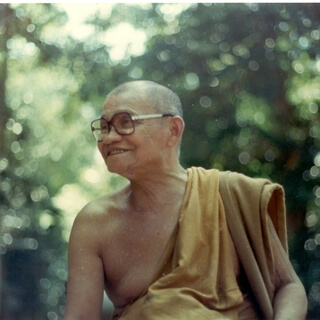
Venerable Ajahn Chah compared it like we are in our house,
And there is the one chair that we are sitting on.
If we don't get off that chair,
Then whoever comes into the house doesn't have a place to sit.
But if we get off that chair,
And they enter,
Then they can sit on that chair.
So this is compared to us having mindfulness to know at the heart.
If we don't have mindfulness,
Then our heart will attach to all the sensory objects,
Taking it as a self,
A me,
A being,
A person,
An us or them.
Here the way to overcome it is for us to have mindfulness,
To know that there is no self,
Me or being,
Person,
Us or them.
So for this the Buddha taught about contemplation of the four Satipatthana.
Satipatthana is the foundations of mindfulness of the four aspects of the body,
Feeling,
Mind and mind objects.
Like now we are watching the in and out breath.
We are developing the foundation of mindfulness on the aspect of the body.
When we have finished our sitting meditation,
We get up and walk.
We walk and we have mindfulness carefully restraining ourselves.
If our mindfulness is broken,
That's dangerous.
We can see someone driving who breaks their mindfulness and bends down to get something,
And in a moment can get into an accident.
This is from lapsing in mindfulness.
One can get into an accident,
And many lose their life this way.
So mindfulness is something we need to try to train in and instruct ourselves a lot in.
We need to do it a lot,
Develop it a lot.
And mindfulness or recollection and Sampajjhāna,
Clear self-awareness,
Has a lot of resulting benefits.
When we have lots of mindfulness,
Then Samadhi concentration becomes firmly established.
So it follows on like this.
Like we know the in and out breath,
We have mindfulness,
And the mind becomes peaceful.
When the mind is peaceful,
It is Samadhi concentration.
We are aware of ourselves.
The Samadhi,
When it is still and very deep,
The mind is stilled.
It is Apana Samadhi,
Full concentration.
The mind is calm,
And we can hear a sound,
But we are not interested in the external sound.
The mind is still.
It's like the pendulum of a grandfather clock that does not swing about.
It is still.
It doesn't swing from left to right.
We feel,
Why is it peaceful?
We doubt this.
We try to think,
And here it doesn't think.
Before we wanted the thoughts to be still and to stop,
But it wouldn't stop.
The mind didn't stop.
But when we have trained,
And the mind is still,
Then we want to use thinking,
But we can't think as well.
So here we just know that this is a mind that is still and peaceful.
So what benefit does a mind that is stilled and peaceful have?
When our mind follows its natural state,
It leaves that stillness.
The stillness arises,
Stays,
And ceases.
It is a sankara,
A mental formation,
On the side of kusala,
Skillfulness.
But in the beginning,
We think that we are the one that is still.
But later,
When we have wisdom,
We know that the stillness is not us as well.
It is something that we must use to support ourselves.
We walk this way to see the Dhamma,
To awaken to the Dhamma.
When the mind has left the state of stillness,
We learn about what the Buddha taught.
Learn about what the Krupa Ajhons,
The enlightened teachers,
Had themselves trained and instructed in already.
They taught and told us that we are to learn about the body that we understand wrongly as being us.
The body that we have strong attachment and clinging to.
And which is the cause for greed,
Anger,
Delusion to keep coming up continually.
And so suffering arises all the time.
So we use wisdom.
For the breath,
There is the in-breath arising,
Staying for a moment,
And then the out-breath ceasing.
This is Vipassana,
Insight meditation.
In the beginning,
We know the in and out-breath,
Until it is peaceful and stilled.
And later we know and see the arising and ceasing of the breath.
We see that this life is simply just within this in and out-breath.
Whatever people have in this world,
It's not a sure thing at all.
Whenever the breath ceases,
Then that all ends.
There is knowing arising bit by bit that this body is not long-lasting and enduring.
It is a compounded heap that is impermanent.
It isn't stable.
It has to decay and deteriorate.
And we can see people who die,
Who are sick and in pain.
The decaying and ending of the bodily formation is like that.
But we see it as a me and them.
But when the wisdom arises,
We see it's not like that.
It's not us.
It's not a self.
It's not a being,
A person,
A me or them.
We see the truth like this.
Wisdom arises.
The heart is brightened bit by bit,
Coming out from its deluded state.
This is building our hearts,
Building our mind,
Building the inner monastery.
We are taking a measure of our mind and heart.
So building a monastery is from the intention to train the heart.
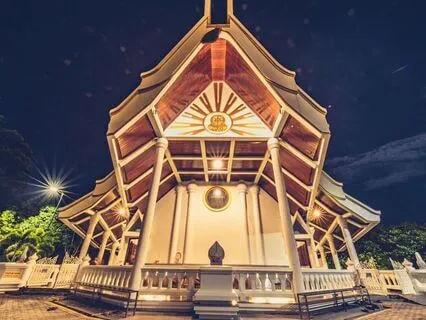
On the 28th November this year is the 40th anniversary of Wat Marp Jan,
Of the building of this monastery as a place that is for the training of the mind,
For the training of mindfulness,
For the practice of dana,
Generosity,
Sila,
Moral conduct and bhavana,
Mental cultivation.
The monastery is peaceful and quiet,
Which is for bodily seclusion by being in the forest.
But here we have to be careful as well.
One can be in the forest,
But that is the forest on the outside.
But the heart may not be in the forest.
It is still in the city.
It is in the house and town.
It knows about everything.
When it's like this,
It's not peaceful.
We are in the forest because we want our minds to be with nature,
To be in the forest as well.
So coming to the monastery,
We have to be careful that we don't talk about things of the household,
The city,
Of business and trade.
Not talking about war and not talking about that which is chaotic in our minds,
Because we have talked about all this a lot already.
When we come to the external monastery,
We make our body and speech be at peace,
Which is having sila,
Moral conduct.
If we talk a lot,
The mind is scattered.
The speech is used in bad and unskillful ways and it gives no benefit.
It is gossip.
It becomes idle speech.
So we are careful with this.
And this is about sila.
So we train like this.
And this is building the external monastery for the purpose of building the inner monastery.
So we train the mind.
The laity build a hall or build an uposada hall.
It is so that we have a place to meditate and practice and to listen to Dhamma.
In the past it was an open grass thatched roofed hall,
Which was 6 meters wide and 12 meters long.
When it rained,
The wind would blow the rain in and then it would all be wet.
In the evening,
While sitting meditation there,
There were the deadly mosquitoes.
There were many that were carrying malaria.
The monks would get sick with malaria.
The hall couldn't keep out all the creatures.
So we had to progress to build the old eating hall,
Which had insect screens,
So we could meditate and practice there.
When there were more and more monks staying here,
There were also more laity coming as well.
And when sitting inside the hall,
It would be full.
So we expanded the hall to be the present hall that we are listening to Dhamma in.
And it is a place for laity to stay and practice as well.
Because there are those coming from outside the monastery who want to stay and practice for 3,
5 or 7 days.
And more so these days,
There are people from overseas who can come as well,
Giving a chance to those from many countries to practice here.
So this is constructing the monastery buildings and facilities,
Which have expanded.
From the first year,
We had 8 monks and 1 novice.
Recently,
We have had sometimes 60 monks,
Sometimes 65 monks,
About this much.
And also expanding to have branch monasteries in various places,
So the monks can practice and meditate there in smaller communities of just several monks.
This is so that they can train and practice in order to build the monastery in the heart.
And we have built an uposatha hall so that we can ordain novices and monks on a conventional level.
And they train and practice to give rise to the true monk.
This is called a true venerable monk,
The monk in the heart.
A monk who has practiced well or attained.
And it can be a well-practiced layperson as well.
In the Buddha's time,
There were laypeople who practiced and became anagamis,
Non-returners,
And had special abilities,
Like the layman citta,
Who was an anagami.
There were many very developed and skilled laypeople.
So for all the laity,
You can practice sincerely,
Develop a lot of mindfulness,
Have your samadhi firmly established,
And contemplate the arising and ceasing of the body.
When the body dies,
The heap of earth,
Air,
Fire,
Water decay and break apart.
Or sometimes our body has pain and sickness.
A part of it dies.
If it doesn't heal,
It will go rotten.
Because it has died already.
A part of the body is dead.
The pus discharges and oozes out.
If they really die,
Then the pus will flow out through the whole body.
It's worth contemplating this.
The body is the place of disease.
The seat of sickness.
So may we contemplate and practice to have wisdom arise.
See the body as being simply a body.
It is not a being,
A person,
A self,
A me or them.
These are words we say.
But if we see it truly,
Then it's like that.
It's simply as such.
There are no words for it.
It just isn't.
A me,
It isn't.
Someone,
It's not.
It's just not anything.
It's a convention.
It's elements going according to nature.
And we may understand it following what we have studied and learnt.
From what we have heard of before.
Have thought about and gained knowledge on.
But the wisdom that will know it truly.
That knows clearly.
Knows insightfully.
Knows with the heart.
Then for this we need to practice and cultivate our minds.
In this way,
Then the building of the monastery creates benefit for those who are coming to practice and develop themselves.
Both for those that ordain as monks and novices.
And for all the laity that learn and practice here.
So this is important.
So this year is the 40th year of Wat Marp Jan.
May you all,
The monks and laity,
Be determined to practice Dhamma.
Be able to get to true seeing and knowing in this life.
Because after we die,
We don't know when we will meet with the teachings again.
At least in this life,
We have to be able to know clearly and understand.
Understand about rupa,
Material phenomena.
And nama,
Mental phenomena.
And be able to change our wrong views to right view.
For those that are building Barami,
Spiritual perfections.
To build it fully.
Before the bodily form breaks apart.
Whatever goal and aspiration we have.
We do it fully.
May you all succeed according to all your aspirations of the heart.
May you have good health and strength.
Even if you have external sickness and pain.
May you have the heart to learn about it.
And to have mindfulness and wisdom come up with it.
May you all grow in blessings.